
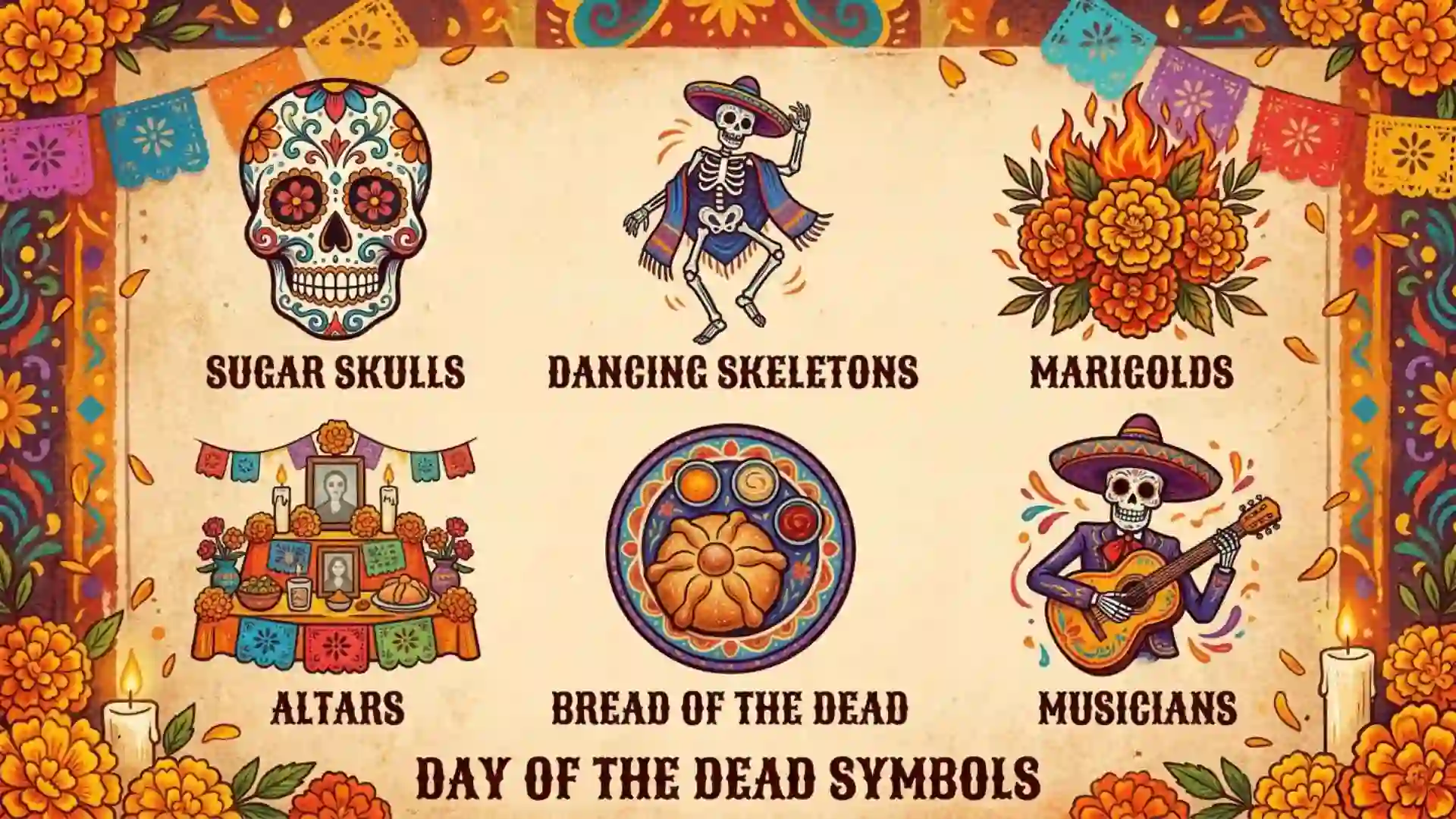
Day of the Dead symbols represent love, remembrance, family, and the spiritual connection between the living and those who have passed away. Known in Spanish as Día de los Muertos, this cherished Mexican celebration honors deceased loved ones through colorful altars, marigold flowers, decorated skulls, candles, photographs, and traditional foods. Although some of its imagery may look like Halloween decorations, the celebration has its own cultural roots and focuses on remembering the dead with joy, respect, and gratitude.
Every symbol used during the Day of the Dead carries a special meaning. Marigolds, often called cempasúchil, are believed to help guide the spirits of loved ones with their bright colors and distinctive scent. Sugar skulls celebrate the lives of the deceased, while candles represent hope and guidance. Meanwhile, ofrendas (offerings), photographs, papel picado, and favorite foods help families welcome and remember the people who remain an important part of their lives.
In this complete guide to Day of the Dead symbols and their meanings, you will discover the history, cultural significance, and traditions behind the celebration’s most recognizable objects. From the meaning of La Catrina and the monarch butterfly to the importance of altars, crosses, and pan de muerto, each symbol offers insight into how Mexican families honor their ancestors. Whether you are researching Mexican culture, exploring spiritual symbolism, or learning about Día de los Muertos for the first time, this guide will help you understand the deeper meaning behind this beautiful celebration of life and memory.
Quick Answer
Day of the Dead symbols are meaningful objects and images used during Día de los Muertos to honor deceased loved ones and welcome their spirits. Common symbols include ofrendas, marigolds, candles, sugar skulls, skeletons, photographs, incense, food, water, papel picado, and monarch butterflies.
Quick Facts About Day of the Dead Symbols
| Aspect | Information |
| Origin | Indigenous Mexican traditions blended with Spanish Catholic customs |
| Historical significance | Used to remember the dead and maintain family connections across generations |
| Main meaning | Remembrance, love, hospitality, and the continuing relationship between life and death |
| Spiritual meaning | Guiding and welcoming the souls of deceased loved ones |
| Cultural importance | Strengthens family identity, community memory, and Mexican heritage |
| Modern usage | Altars, festivals, public art, tattoos, films, fashion, education, and social media |
What Are Day of the Dead Symbols?
Day of the Dead symbols are the objects, foods, flowers, colors, images, and ritual elements connected with Día de los Muertos. Families place many of them on an ofrenda, or offering altar, made for relatives and friends who have died.
The celebration is observed mainly from the end of October through November 2. November 1 is often associated with deceased children, while November 2 commonly honors deceased adults. Customs differ by family, Indigenous community, town, and region.
UNESCO describes the celebration as a time when deceased relatives temporarily return to the world of the living. Offerings help welcome them and support their spiritual journey. The dates also connect with the traditional end of the maize-growing cycle in many Mexican communities.
The tradition developed through centuries of cultural blending. Indigenous Mexican beliefs about ancestors, death, agriculture, and the sacred calendar met Catholic observances such as All Saints’ Day and All Souls’ Day after Spanish colonization. It is therefore inaccurate to describe Día de los Muertos as purely Aztec or purely Catholic. It is a living tradition shaped by many peoples and historical experiences.
Deep Symbolic Meaning of Day of the Dead Symbols
Spiritual Meaning
Spiritually, Day of the Dead symbols create a path between the living and the dead.
Candles provide light. Marigold petals form bright trails. Incense cleanses the space. Food and water offer comfort after the soul’s journey. Photographs identify the person being welcomed.
The ofrenda is not usually treated as an object of worship. It is an act of hospitality and remembrance. Families prepare a place for the dead much as they would prepare a table for a beloved guest.
At the heart of the celebration is the idea that physical death does not completely end a relationship. Love, memory, family stories, and ritual allow the deceased to remain part of the community.
Psychological Meaning
From a psychological viewpoint, these symbols give people a safe way to approach grief.
Death can feel abstract and frightening. A photograph, favorite meal, or familiar piece of music makes loss more personal and manageable. Instead of focusing only on the moment of death, families remember the full personality of the person who lived.
Carl Jung’s idea of archetypes can help explain the emotional power of skulls, candles, journeys, and thresholds. These images appear across human cultures because they express shared experiences such as mortality, separation, transformation, and return.
The smiling skeleton is especially powerful. It turns the feared image of death into a familiar companion. Humor does not remove sorrow. Instead, it can reduce fear and help people hold sadness and joy at the same time.
Cultural Meaning
Culturally, Day of the Dead symbols protect family memory.
An altar may teach a child the name of a great-grandparent they never met. A recipe may preserve the taste of a grandmother’s kitchen. A song may bring back a father’s voice or a friend’s laughter.
Public celebrations also strengthen community identity. However, there is no single correct altar design followed by every Mexican family. Regional traditions in Oaxaca, Michoacán, Puebla, Mexico City, and other areas may differ greatly.
Types and Variations of Day of the Dead Symbols
Ofrenda
An ofrenda is an altar or arranged offering dedicated to the dead. It may contain photographs, flowers, candles, food, drinks, religious images, personal belongings, and handmade decorations.
Its levels are sometimes interpreted as representing heaven and earth, stages of a spiritual journey, or different parts of existence. These meanings vary by tradition.
The ofrenda symbolizes reunion, hospitality, family loyalty, and remembrance. UNESCO has also described it as a cultural expression of reconciliation, solidarity, and renewed connection.
Marigolds
Bright orange and yellow marigolds are called cempasúchil, a name connected with the Nahuatl language.
Their strong color and scent are traditionally believed to guide spirits toward the altar. Families may create arches, bouquets, crosses, or trails of petals.
Because marigolds bloom for a limited season, they also represent the beauty and briefness of life.
Sugar Skulls and Calaveras
Sugar skulls, known as calaveras de azúcar, are decorated with icing, foil, beads, and bright colors. Some carry the name of a deceased or living person across the forehead.
They represent death, but not only sorrow. Their sweetness, humor, and beauty express the idea that mortality is part of life.
The word calavera can also refer to playful poems that imagine living people as dead. These satirical verses often make gentle fun of human pride, politics, habits, or social status.
La Catrina
La Catrina is an elegant female skeleton wearing a fashionable hat or fine clothing.
Her visual ancestor was created by Mexican printmaker José Guadalupe Posada, whose skeletal figure mocked people who rejected their Indigenous roots while copying European fashion. Artist Diego Rivera later portrayed the figure in his mural Dream of a Sunday Afternoon in Alameda Central.
Today, La Catrina is strongly associated with Día de los Muertos. She reminds viewers that wealth, beauty, and social rank cannot protect anyone from death.
Candles
Candles represent light, hope, prayer, and guidance.
A family may light one candle for each deceased person being remembered. In some traditions, four candles mark the cardinal directions, helping the spirit find its way.
Their small flames also reflect the fragile but persistent nature of human life.
Papel Picado
Papel picado is delicate tissue paper cut into detailed patterns. Designs may include flowers, birds, skeletons, saints, and geometric forms.
Its movement in the air is often linked with wind, breath, and the invisible presence of spirits. Its fragile material also suggests that life can be beautiful yet temporary.
The art developed in Puebla and has connections with earlier traditions of cutting designs into bark paper called amate.
Pan de Muerto
Pan de muerto, or bread of the dead, is a sweet ceremonial bread placed on altars and shared with family.
Many loaves have strips of dough shaped like bones. A round shape may represent the cycle of life and death, while a raised center may suggest a skull or heart.
Its meaning comes from nourishment, generosity, shared identity, and the bond created by eating together.
Food, Water, and Salt
Families often prepare the deceased person’s favorite dishes, sweets, fruits, coffee, mole, tamales, or other regional foods.
Water refreshes the returning spirit. Salt may symbolize purification and preservation. Food communicates affection because it remembers the individual as a real person with tastes, habits, and pleasures.
Traditional Mexican foods made from maize, including tortillas and tamales, remain important in many Day of the Dead offerings.
Copal Incense
Copal is an aromatic tree resin burned as incense.
Its smoke is used to cleanse the altar, create a sacred atmosphere, and guide spirits. The rising smoke visually connects earth and sky.
Copal also reflects the continuing influence of Indigenous ceremonial practices.
Photographs and Personal Objects
A photograph tells visitors whose life is being honored.
Personal objects may include clothing, tools, toys, books, musical instruments, religious items, or favorite possessions. Children’s altars may contain sweets and toys.
These objects turn a general ritual into a deeply personal story.
Monarch Butterflies
Monarch butterflies arrive in central Mexico around the Day of the Dead season.
In some communities, especially in Michoacán, they are associated with returning souls. Their long migration and dramatic transformation make them natural symbols of spiritual travel, change, and renewal.
Day of the Dead Symbols Across Different Cultures
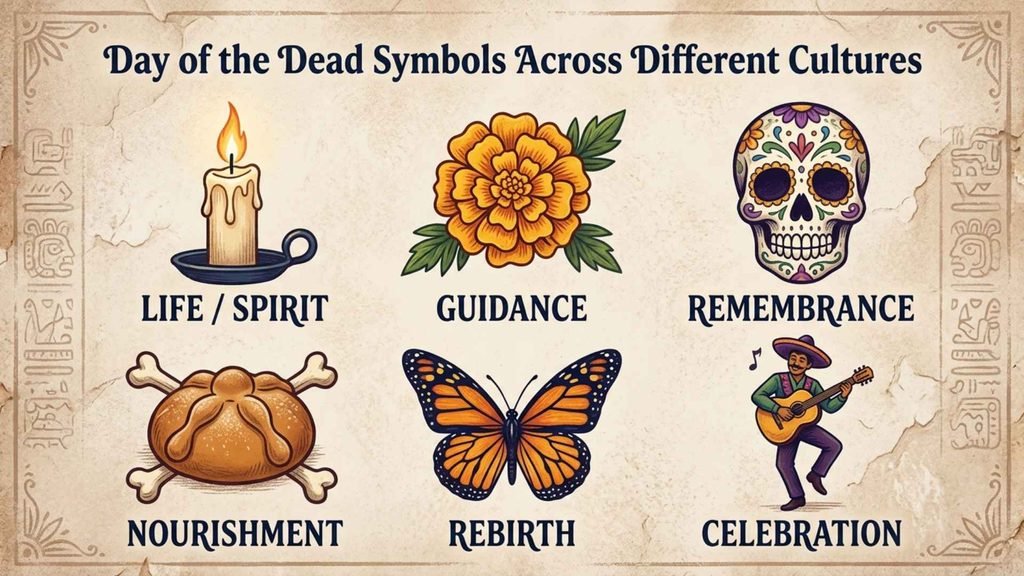
Día de los Muertos belongs specifically to Mexican and related cultural traditions. Other civilizations did not use modern Day of the Dead symbols in the same way. However, many created comparable symbols for honoring ancestors.
Ancient Egypt
Ancient Egyptians placed food, possessions, protective amulets, and images in tombs. Like an ofrenda, these objects supported the dead and maintained a connection between worlds.
The Egyptian approach focused heavily on preservation and preparation for the afterlife, while Día de los Muertos emphasizes a temporary reunion with family.
Ancient Greece
Greeks offered food, wine, flowers, and prayers to the dead. Myths about crossing rivers into the underworld expressed death as a journey.
This resembles the symbolic use of candles, petals, water, and incense to guide returning spirits.
Roman Culture
Romans remembered ancestors through family images, tomb offerings, meals, and festivals such as Parentalia.
Both Roman remembrance and Día de los Muertos treated deceased family members as continuing members of the household and community.
Eastern Traditions
China’s Qingming Festival includes grave cleaning, food offerings, incense, and respect for ancestors. Japan’s Obon traditions use lanterns, dances, and offerings to welcome ancestral spirits.
The customs are culturally different, but they share the human desire to guide, feed, honor, and remember the dead.
Indigenous Traditions
Many Indigenous peoples of Mexico developed complex beliefs about ancestors, sacred landscapes, agricultural cycles, and multiple destinations after death.
Present-day observances vary among Nahua, Maya, Purépecha, Totonac, Huastec, and other communities. UNESCO recognizes the Indigenous festivity dedicated to the dead as intangible cultural heritage.
Modern Interpretations
Today, Day of the Dead imagery appears worldwide. Mexican and Mexican American communities use it to celebrate heritage, teach younger generations, and remember victims of violence, disasters, or injustice.
Outside its cultural setting, the imagery should be approached respectfully. A decorative skull is not a complete representation of the tradition.
Similar Symbols and Their Meanings
| Symbol | Shared Meaning | Important Difference |
| Halloween skull | Mortality and the supernatural | Halloween often uses fear, while Día de los Muertos emphasizes remembrance |
| Memento mori | Awareness of death | Usually encourages reflection rather than welcoming specific ancestors |
| Buddhist lotus | Transformation and spiritual growth | Connected with enlightenment, not Mexican ancestral rituals |
| Obon lantern | Guidance for ancestral spirits | Belongs to Japanese Buddhist tradition |
| Memorial candle | Prayer and remembrance | Used across many religions and cultures |
| Butterfly | Change, soul, and rebirth | Its meaning depends on the culture and species |
The most common misconception is that Día de los Muertos is “Mexican Halloween.” The celebrations can occur close together and may both include skeleton imagery, but their histories, emotional tones, and purposes are different.
Day of the Dead Symbols in Mythology and Folklore
Stories about the Aztec underworld and deities such as Mictlantecuhtli and Mictecacihuatl are often connected with modern discussions of Día de los Muertos.
However, the relationship is not a simple unbroken line from one ancient festival to today. Modern customs developed through regional Indigenous traditions, Catholic ritual, colonial history, family practice, and artistic change.
Folklore often describes spirits following flower petals, candlelight, incense, bells, or familiar scents home. These stories shape the emotional logic of the altar. Every object becomes part of a welcoming path.
Day of the Dead Symbols in Art, Literature, Movies, and Pop Culture
Mexican printmakers and muralists helped turn the skeleton into a tool of social criticism. Posada’s calaveras mocked vanity and inequality, while Rivera placed La Catrina inside a larger story of Mexican history.
Poetry and calavera verses use humor to challenge powerful people and remind readers that death treats everyone equally.
Movies such as Coco and The Book of Life introduced global audiences to ofrendas, marigold bridges, family memory, and skeletal characters. These films use artistic fantasy, so they should not be treated as complete guides to every real tradition.
In tattoos, fashion, and modern design, sugar skulls may represent ancestry, survival, remembrance, or comfort with mortality. Their meaning becomes strongest when the wearer understands and respects the culture behind the image.
Spiritual and Dream Meaning of Day of the Dead Symbols
Dreaming of an altar may reflect a need to remember someone, heal a family wound, or reconnect with personal roots.
A marigold path may symbolize guidance. A candle can suggest hope or spiritual presence. A skull may represent acceptance of change rather than literal death.
Dream meanings are personal, not fixed predictions. Grief, recent memories, films, family traditions, and emotions can all influence dream images.
A comforting dream may support healing. A disturbing dream may reveal fear, unresolved guilt, or difficulty accepting loss.
Positive and Negative Meanings of Day of the Dead Symbols
| Positive meanings | Negative or cautionary meanings |
| Love that continues after death | Unresolved grief |
| Family unity | Fear of loss |
| Respect for ancestors | Commercialization |
| Acceptance of mortality | Cultural misunderstanding |
| Spiritual guidance | Forgetting or excluding the dead |
| Joyful remembrance | Using sacred imagery without context |
| Transformation | Anxiety about change |
The same skull can feel frightening in one setting and comforting in another. Context determines whether the image communicates fear, satire, memory, equality, or celebration.
Why Humans Are Attracted to Day of the Dead Symbols
People are drawn to these symbols because they make an invisible experience visible.
Grief has no clear shape, but an altar gives it structure. Memory cannot be touched, but a photograph can be held. Death cannot be controlled, but a candle can be lit.
Bright colors also challenge the belief that mourning must always be dark and silent. They show that grief may include laughter, food, beauty, and gratitude.
Most importantly, the symbols answer a universal fear: that a person disappears when others stop remembering them. Día de los Muertos responds by speaking names, sharing stories, and making memory a community act.
Modern Uses of Day of the Dead Symbols
Today, these symbols appear in:
- Tattoos: To honor relatives, express Mexican identity, or acknowledge mortality.
- Jewelry: Skulls, marigolds, crosses, and butterflies symbolize remembrance and transformation.
- Fashion: Catrina makeup and embroidered clothing appear during cultural events and parades.
- Public art: Murals and installations honor community members and social causes.
- Social media: Families share altar photographs, recipes, memories, and educational content.
- Home decor: Temporary altars create personal spaces for reflection.
- Museums and schools: Exhibitions teach history, art, and cultural respect.
- Branding: Commercial use is common but can become insensitive when sacred meanings are ignored.
Interesting Facts About Day of the Dead Symbols
- Sugar skulls may display the names of living people as playful reminders that everyone is mortal.
- Papel picado is used for weddings, birthdays, religious festivals, and other Mexican celebrations, not only Día de los Muertos.
- Altars may honor pets as well as human family members.
- Favorite foods are chosen for personal meaning, not simply because they are considered traditional.
- Some communities decorate graves and spend the night in cemeteries with music, candles, and meals.
- Calavera poems often make fun of politicians, celebrities, friends, and social habits.
- Monarch butterflies reach central Mexico near the celebration season, strengthening their connection with returning souls.
- Ofrendas can be private family altars or large public installations dedicated to historical figures and community tragedies.
- Smithsonian resources identify sugar skulls, marigolds, monarch butterflies, and papel picado among the best-known symbols of the celebration.
Frequently Asked Questions
What is the most important Day of the Dead symbol?
The ofrenda is often considered the central symbol because it brings photographs, candles, flowers, food, water, and personal objects together in one place.
What do skulls symbolize on the Day of the Dead?
Skulls represent mortality, equality, remembrance, and the acceptance of death as part of life. Their colorful designs often make death feel less frightening.
Why are marigolds used for Día de los Muertos?
Their vivid color and strong scent are traditionally believed to guide spirits toward the altar. They also symbolize life’s beauty and brief duration.
Is the Day of the Dead the same as Halloween?
No. Halloween and Día de los Muertos occur near each other and both may feature skeletons, but Día de los Muertos centers on honoring deceased loved ones.
What do the four elements represent on an ofrenda?
Interpretations vary, but earth may appear through food, water through a drink, fire through candles, and wind through moving papel picado.
Can someone who is not Mexican create an ofrenda?
Yes, when it is done respectfully. Learn about the tradition, focus on genuine remembrance, avoid stereotypes, and acknowledge its Mexican and Indigenous cultural roots.
Conclusion
Day of the Dead symbols show that remembrance can be joyful without denying the pain of loss.
Every flower, flame, photograph, and offering says that a loved person still belongs to the family story.
Together, these symbols transform death from a silent ending into an ongoing relationship built through memory.
They remind us that people remain present whenever their names are spoken and their lives are celebrated.
 John Mercer
 Michael Rivera