
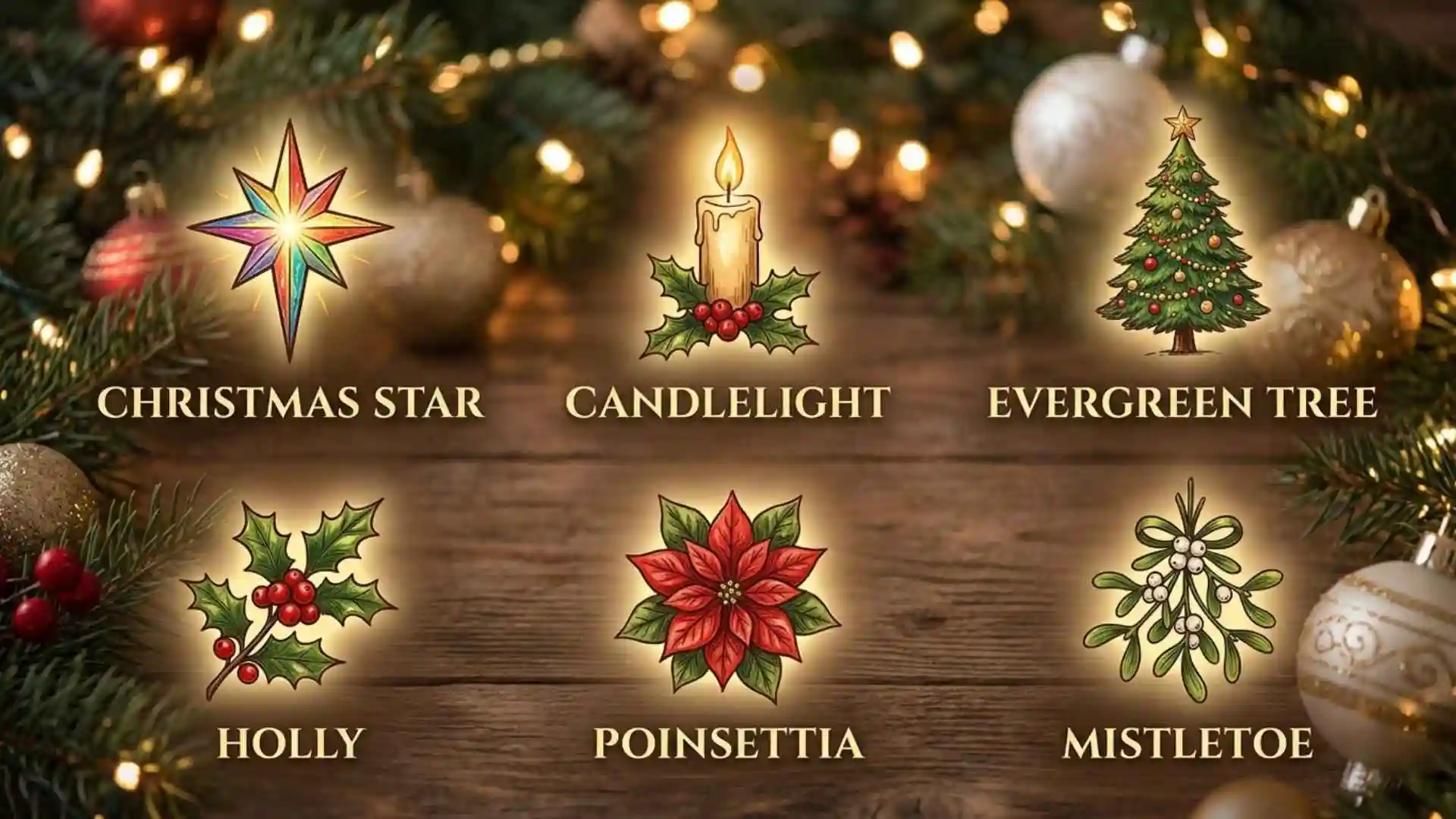
Christmas is a season filled with beautiful decorations, joyful traditions, and meaningful symbols that bring people together. From sparkling Christmas trees and glowing candles to wreaths, stars, and festive bells, each symbol adds something special to the celebration. While many people enjoy these familiar decorations, their deeper meanings often reveal stories of faith, hope, love, peace, and the joy of giving.
The symbols of Christmas come from a variety of religious beliefs, historical customs, and cultural traditions. The Christmas star is commonly associated with the Star of Bethlehem, which guided the Wise Men toward Jesus in the biblical story. Evergreen trees represent enduring life in many Christmas traditions, while candles and Christmas lights symbolize hope and warmth during the darkest days of winter. Other beloved symbols, including angels, holly, mistletoe, stockings, and Santa Claus, carry their own fascinating histories and meanings.
Understanding the meanings behind Christmas symbols can make the holiday more memorable and meaningful. Whether you celebrate Christmas as a Christian religious holiday, enjoy its cultural traditions, or simply love the festive atmosphere, exploring these symbols helps you appreciate the stories behind the season. In this guide, you will discover the history, symbolism, and significance of popular Christmas decorations, religious symbols, and holiday traditions, along with the ways they continue to inspire people around the world.
Quick Answer
The symbols of Christmas are objects, colors, plants, characters, and traditions that represent the spiritual and cultural meaning of the holiday. Common examples include the Christmas tree, star, wreath, candles, bells, angels, gifts, holly, candy canes, and the Nativity scene. Together, they express hope, love, faith, generosity, peace, and renewal.
Quick Facts About Symbols of Christmas
| Aspect | Information |
| Origin | A blend of Christian traditions, European winter customs, Roman festivals, and local folklore |
| Historical Significance | Many symbols developed over centuries as Christmas spread across Europe and the wider world |
| Main Meaning | Hope, joy, family, generosity, peace, and celebration |
| Spiritual Meaning | Divine light, salvation, renewal, faith, and the birth of Jesus Christ |
| Cultural Importance | Christmas symbols unite religious beliefs with family traditions and seasonal customs |
| Modern Usage | Decorations, worship, advertising, music, movies, social media, gifts, and community events |
What Are Symbols of Christmas?
Symbols of Christmas are visual signs and traditional objects associated with the Christmas season. Some come directly from the biblical story of the birth of Jesus. Others developed from ancient winter celebrations, medieval customs, European folklore, and modern popular culture.
The Nativity scene, angels, shepherds, and the Star of Bethlehem are rooted in the Christian story. Evergreen trees, holly, candles, and winter feasts have connections to older seasonal traditions. Santa Claus developed from stories about Saint Nicholas, a fourth-century Christian bishop known for generosity.
Over time, these symbols changed as Christmas moved between cultures. German tree customs influenced Britain and North America. Dutch traditions helped shape the modern image of Santa Claus. Victorian families made Christmas cards, decorated trees, and gift-giving more popular.
Christmas symbols became important because they gave visible form to invisible ideas. A candle could represent hope. A wreath could suggest eternal life. A gift could express love. Even people who celebrate Christmas mainly as a cultural holiday often respond to these meanings.
Deep Symbolic Meaning of Symbols of Christmas
Spiritual Level
On a spiritual level, many Christmas symbols focus on light entering darkness. This idea appears in candles, stars, glowing trees, and illuminated homes.
For Christians, the light often represents Jesus Christ, divine guidance, and salvation. The Nativity scene symbolizes humility because the birth takes place in a simple setting rather than a palace. Angels represent divine messages, while shepherds reflect ordinary people receiving sacred news.
Evergreen plants also carry spiritual meaning. Because they remain green through winter, they can represent eternal life, endurance, and faith that survives difficult seasons.
Psychological Level
Christmas symbols are powerful because they awaken memory and emotion. The smell of pine, the sound of bells, or the sight of colored lights may bring back childhood experiences within seconds.
Psychologist Carl Jung wrote about archetypes, which are recurring images and themes found across human cultures. Christmas contains several archetypal patterns, including the sacred child, the wise elder, the guiding star, the generous giver, and the return of light.
These symbols give people emotional structure during winter. They offer comfort, predictability, and connection. Repeating familiar traditions can make life feel stable when the world feels uncertain.
Cultural Level
Culturally, Christmas symbols build shared identity. Families may hang the same ornaments each year, communities may light public trees, and churches may display the same Nativity figures for generations.
These traditions create a sense of belonging. They help people say, “This is how our family celebrates,” or “This is what this season means to us.”
Even when the symbols are similar, their meaning may differ. One family may see the Christmas tree as a religious symbol. Another may value it mainly as a sign of togetherness and seasonal joy.
Types and Variations of Symbols of Christmas
The Christmas Tree
The Christmas tree is usually an evergreen decorated with lights, ornaments, ribbons, and a star or angel.
Its evergreen branches symbolize endurance, life, and hope during winter. The decorated tree became especially popular through German-speaking regions before spreading across Europe and North America.
Today, it appears in homes, churches, public squares, movies, shopping centers, and holiday art.
The Star of Bethlehem
The Christmas star is often shown as a bright star with long rays.
In the Gospel of Matthew, a star guides the Magi to Jesus. Because of this story, the star represents guidance, divine purpose, truth, and hope.
It commonly appears on top of Christmas trees, greeting cards, church decorations, and Nativity scenes.
The Wreath
A Christmas wreath is a circular arrangement made from evergreen branches, berries, ribbons, or ornaments.
Its circular shape has no clear beginning or end, so it often symbolizes eternity, unity, and everlasting life. Evergreen leaves add the idea of survival through winter.
Wreaths are placed on doors, walls, tables, and church altars.
Candles and Christmas Lights
Candles produce warmth and light during the darkest part of the year.
They symbolize hope, spiritual guidance, welcome, and the victory of light over darkness. In Christian traditions, candles may represent Christ as the light of the world.
Modern electric lights continue this symbolism on trees, buildings, streets, and windows.
Bells
Christmas bells are linked with celebration, worship, and announcement.
Church bells historically called communities to religious services. In Christmas music and folklore, bells signal joy, arrival, and festive movement.
They appear in songs, ornaments, sleigh imagery, door decorations, and holiday performances.
Angels
Christmas angels are usually shown with wings, white robes, glowing halos, or musical instruments.
They symbolize divine protection, purity, peace, and sacred messages. In the Nativity story, angels announce the birth of Jesus to shepherds.
Angels often appear on tree tops, cards, church displays, ornaments, and paintings.
Gifts
Wrapped gifts represent generosity, gratitude, love, and sacrifice.
In Christian interpretation, they may recall the gifts of gold, frankincense, and myrrh brought by the Magi. They can also represent God’s gift of Christ to humanity.
In modern culture, gift-giving remains one of the strongest expressions of Christmas affection.
Holly and Mistletoe
Holly has dark green leaves and bright red berries. It has long been associated with protection and winter life.
Christian symbolism later connected its sharp leaves with the crown of thorns and its red berries with sacrifice. Mistletoe became linked with peace, affection, and reconciliation.
Both plants appear in garlands, wreaths, illustrations, and seasonal decor.
The Candy Cane
The candy cane is a curved red-and-white sweet.
Its exact symbolic history is debated, but modern interpretations often connect the white color with purity and the red stripes with sacrifice. Its curved shape is sometimes compared to a shepherd’s staff.
It appears in stockings, table settings, trees, advertisements, and children’s holiday traditions.
The Nativity Scene
A Nativity scene shows Mary, Joseph, Jesus, shepherds, angels, and often the Magi.
It represents humility, divine love, family, faith, and the sacred meaning of Christmas. Saint Francis of Assisi is often credited with helping popularize living Nativity displays in the thirteenth century.
Nativity scenes appear in homes, churches, schools, public spaces, art, and theater.
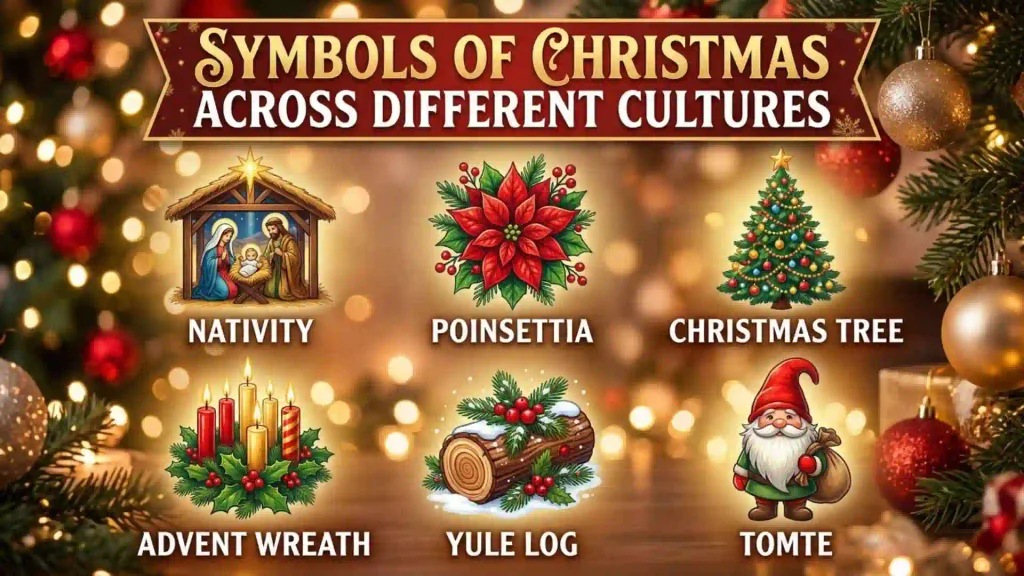
Symbols of Christmas Across Different Cultures
Ancient Egypt
Ancient Egyptian culture did not celebrate Christmas, but evergreen plants and sun symbolism played important roles in seasonal thought. Plants that stayed alive through difficult conditions represented endurance and rebirth.
Later Christmas symbolism used similar themes, especially the return of light and the promise of life.
Ancient Greece
Greek traditions connected winter, fire, feasting, and sacred hospitality. Myths about seasonal change reflected death and renewal in nature.
Modern Greek Christmas customs include decorated boats in some regions, along with stars, lights, and religious icons.
Roman Culture
Roman winter festivals, especially Saturnalia, included feasting, candles, social gatherings, and gift-giving. Christmas did not simply copy Saturnalia, but both traditions developed in the same seasonal world.
Roman customs helped create a cultural setting in which winter celebration, light, and generosity were already meaningful.
Eastern Traditions
In Eastern Orthodox Christianity, icons, candles, incense, stars, and Nativity imagery hold strong spiritual importance.
Christmas dates and customs may vary by church calendar and region. In places such as Greece, Serbia, Ethiopia, Russia, and parts of the Middle East, religious services may carry greater importance than commercial decoration.
Indigenous Traditions
Indigenous communities have adopted and adapted Christmas in many different ways. Some combine Christian symbols with local art, natural materials, storytelling, music, and community feasts.
In these settings, stars, trees, animals, woven patterns, and handmade gifts may reflect both Christmas beliefs and cultural identity.
Modern Interpretations
Modern Christmas symbolism is global. Santa may appear beside local winter characters. Trees may be decorated with regional crafts. Holiday colors may reflect national styles.
Today, Christmas symbols can express religious devotion, family tradition, nostalgia, seasonal joy, or commercial celebration.
Similar Symbols and Their Meanings
| Symbol | Main Meaning | Similarity | Key Difference |
| Christmas tree | Life, hope, endurance | Shares evergreen symbolism with wreaths | Usually serves as the central indoor decoration |
| Wreath | Eternity, unity, welcome | Made from evergreen branches | Circular shape gives it a stronger meaning of completeness |
| Star | Guidance, faith, divine direction | Like candles, it represents light | Linked specifically with the journey of the Magi |
| Candle | Hope, prayer, spiritual light | Similar to Christmas lights | More personal and closely connected with worship |
| Angel | Protection, peace, divine message | Like the star, guides people toward sacred truth | Represents a heavenly being rather than a natural sign |
| Gift | Love, generosity, gratitude | Similar to Santa imagery | Focuses on giving rather than the giver |
A common misconception is that every Christmas symbol has one fixed meaning. In reality, symbols change across families, faiths, countries, and historical periods.
Symbols of Christmas in Mythology and Folklore
Christmas folklore is filled with generous saints, winter spirits, magical animals, and household visitors.
Saint Nicholas became one of the strongest influences on Santa Claus. In Dutch tradition, his name developed into Sinterklaas. Over time, European and American stories shaped the familiar figure in a red suit.
Reindeer gained popularity through nineteenth-century poetry and later through the story of Rudolph. Elves drew from older European folklore about small supernatural beings, but modern Christmas elves became cheerful toy makers.
Not all winter folklore is gentle. In Alpine traditions, Krampus appears as a frightening companion to Saint Nicholas. Icelandic folklore includes the Yule Lads, a group of mischievous visitors with distinct personalities.
These figures reveal that Christmas folklore often teaches behavior through reward, warning, humor, and imagination.
Symbols of Christmas in Art, Literature, Movies, and Pop Culture
Religious paintings often focus on the Madonna and Child, angels, shepherds, and the Magi. Artists use light around the infant Jesus to show holiness and divine presence.
In literature, Charles Dickens helped shape modern ideas of Christmas compassion through A Christmas Carol. The story uses cold, fire, food, bells, ghosts, and family gatherings as symbols of emotional transformation.
Poetry and songs use snow, stars, firesides, bells, and homecoming to create feelings of comfort and longing.
Movies often use Christmas trees and lights to represent family reunion or emotional healing. A dark tree becoming illuminated may signal renewed hope. An unopened gift may represent distance, while a shared meal may symbolize forgiveness.
Christmas symbols also appear in tattoos, fashion, jewelry, packaging, social media graphics, and home design. Their meaning may range from sacred faith to playful seasonal identity.
Spiritual and Dream Meaning of Symbols of Christmas
Dreaming of Christmas symbols often reflects hope, memory, belonging, or a desire for emotional renewal.
A Christmas tree in a dream may suggest growth, family roots, or the wish to bring warmth into life. A bright star may symbolize guidance or a new direction. Gifts may represent hidden talents, emotional needs, or opportunities.
A broken ornament can suggest disappointment or fear of losing a cherished tradition. Tangled lights may reflect stress, confusion, or pressure to create a perfect celebration.
Dream meanings are personal. The strongest clue is usually the emotion felt during the dream. Joy may point toward connection, while sadness may reveal grief, loneliness, or nostalgia.
Positive and Negative Meanings of Symbols of Christmas
| Positive Meaning | Negative Meaning |
| Hope | Unrealistic expectations |
| Generosity | Consumer pressure |
| Family connection | Family conflict |
| Faith | Exclusion or misunderstanding |
| Tradition | Resistance to change |
| Childhood wonder | Painful nostalgia |
| Community | Social comparison |
| Celebration | Stress and exhaustion |
The same symbol can hold both light and shadow. A family ornament may bring comfort to one person and grief to another. A gift may express love, but it can also create financial pressure.
Context gives symbols their emotional power.
Why Humans Are Attracted to Symbols of Christmas
Humans naturally search for patterns and meaning. Seasonal symbols make large ideas easier to feel and remember.
A star turns guidance into an image. A candle makes hope visible. A wreath gives eternity a shape. A gift turns affection into an action.
Christmas symbols also carry cultural memory. People may repeat traditions without knowing their full history because the actions feel familiar and safe. Hanging ornaments, lighting candles, and sharing food connect the present with childhood, ancestors, and community.
These rituals also help people face winter. In cold and darkness, humans create light, color, music, sweetness, and warmth. The symbols remind us that hardship is temporary and that life can return.
Modern Uses of Symbols of Christmas
Christmas symbols appear in nearly every form of modern expression.
People wear star, angel, snowflake, and tree jewelry. Fashion brands use red, green, gold, plaid, and winter imagery. Companies use bells, gifts, reindeer, and Santa in seasonal branding.
Social media fills with decorated trees, family photos, festive filters, and countdown calendars. Home decor includes wreaths, candles, miniature villages, stockings, and personalized ornaments.
Some people use Christmas symbols in prayer and worship. Others use them for nostalgia, creativity, family bonding, or personal style.
The meaning depends on intention. A simple ornament may be decoration, a family heirloom, or a reminder of someone deeply loved.
Interesting Facts About Symbols of Christmas
- The Christmas tree tradition became widely fashionable in Britain during the Victorian era.
- Saint Francis of Assisi is linked with an early live Nativity scene in 1223.
- The poinsettia is named after Joel Roberts Poinsett, who helped introduce the plant to the United States.
- Red and green became dominant Christmas colors partly because of evergreen plants and holly berries.
- Advent wreaths usually contain four candles, with one lit on each Sunday before Christmas.
- The star placed on a tree usually represents the Star of Bethlehem.
- Stockings are connected with legends of Saint Nicholas secretly giving gold to a poor family.
- Mistletoe was associated with peace and fertility before it became a Christmas kissing tradition.
- Many modern Santa features developed through nineteenth-century poems, illustrations, and advertising.
- Electric Christmas tree lights began replacing candles because they were safer.
Frequently Asked Questions
What are the main symbols of Christmas?
The main symbols include the Christmas tree, star, wreath, candles, bells, angels, gifts, holly, mistletoe, candy canes, Santa Claus, and the Nativity scene.
What is the most important Christmas symbol?
For Christians, the Nativity scene and the Star of Bethlehem hold central spiritual importance. In popular culture, the Christmas tree is often the most widely recognized symbol.
What do Christmas lights symbolize?
Christmas lights symbolize hope, divine guidance, joy, and the victory of light over darkness.
Why is the Christmas tree a symbol of Christmas?
The evergreen tree represents life and endurance during winter. It became part of Christmas tradition through European customs and later spread around the world.
What do Christmas colors mean?
Red often represents love, warmth, and sacrifice. Green symbolizes life and renewal. Gold suggests light, royalty, and celebration, while white represents peace, purity, and snow.
Are all Christmas symbols Christian?
No. Some are directly Christian, while others developed from European winter customs, folklore, commercial culture, or regional traditions.
Conclusion
The symbols of Christmas are more than seasonal decorations. They carry stories of faith, survival, generosity, family, and the return of light during darkness. Each star, candle, wreath, and gift allows people to express emotions that words cannot always hold. Their deepest message is simple and lasting: even in the coldest season, hope can still shine.
 John Mercer
 Michael Rivera