
Physics symbols are the universal language scientists use to describe how the world works. From the force that moves an object to the energy that powers the stars, these symbols help explain complex ideas through simple letters, signs, and mathematical expressions. Whether you are a student learning physics for the first time, preparing for an exam, or exploring the mysteries of the universe, understanding physics symbols makes scientific concepts easier to read, remember, and apply.
Each physics symbol has a specific meaning that depends on the formula, topic, and scientific context in which it appears. For example, F commonly represents force, v represents velocity, m stands for mass, and E often represents energy. Greek letters such as λ (lambda), θ (theta), and μ (mu) are also widely used in mechanics, waves, electricity, and modern physics. Learning these symbols helps you understand equations, interpret scientific measurements, and solve problems more confidently.
In this complete guide to physics symbols, you will discover the meanings of common symbols used in mechanics, motion, energy, electricity, magnetism, thermodynamics, waves, optics, and quantum physics. You will also explore their historical development, mathematical formulas, SI units, and practical applications. From basic notation to advanced scientific expressions, this guide will help you understand how physics symbols connect mathematical ideas with the fundamental laws of the universe.
Quick Answer
Physics symbols are letters, Greek characters, mathematical signs, and unit abbreviations used to represent physical quantities, constants, operations, and relationships. Examples include v for velocity, F for force, λ for wavelength, and Ω for electrical resistance. Their exact meaning depends on the equation and branch of physics.
Quick Facts About Physics Symbols
| Aspect | Information |
| Origin | Ancient mathematics, Greek scholarship, European science, and modern international standards |
| Historical Significance | Allowed scientists to express natural laws clearly and share discoveries across languages |
| Main Meaning | Represent quantities, units, constants, particles, directions, and mathematical operations |
| Spiritual Meaning | Often used metaphorically to express balance, transformation, unity, energy, and cosmic order |
| Cultural Importance | Form a shared scientific language used around the world |
| Modern Usage | Education, engineering, medicine, astronomy, electronics, computing, and space research |
What Are Physics Symbols?
Physics symbols are compact signs used to represent measurable properties and scientific ideas. Instead of writing “velocity” repeatedly, physicists may write v. Instead of spelling out “change in temperature,” they often use ΔT.
A symbol may represent:
- A physical quantity, such as mass or time
- A unit, such as kilogram or second
- A universal constant
- A particle or field
- A mathematical operation
- A direction or vector
- A change in a measured value
This system developed slowly. Ancient Greek thinkers used geometry and letters to describe nature. Later scholars in Europe created more specialized notation. During the Scientific Revolution, equations became central to the work of Galileo, Johannes Kepler, Isaac Newton, and others.
Today, international organizations help standardize measurement symbols. The International System of Units, known as SI, contains seven base units and many derived units used throughout science and technology. Unit symbols are designed to remain consistent across languages, helping researchers communicate clearly worldwide.
Why Physics Symbols Became Important
Without shared notation, every scientist might describe the same idea differently. That would make experiments difficult to compare and equations harder to understand.
Symbols solve this problem by compressing large ideas into simple forms. Consider Newton’s second law:
F = ma
This short equation states that force equals mass multiplied by acceleration. Three letters describe a relationship that applies to falling objects, moving cars, rockets, machines, and countless other systems.
Physics symbols also reduce language barriers. A student in Pakistan, Japan, Brazil, or France can recognize many of the same equations even when their spoken languages differ.
Common Physics Symbols and Their Meanings
| Symbol | Common Meaning | SI Unit |
| m | Mass | kilogram, kg |
| t | Time | second, s |
| d or x | Distance or position | meter, m |
| v | Velocity | meter per second, m/s |
| a | Acceleration | meter per second squared, m/s² |
| F | Force | newton, N |
| E | Energy | joule, J |
| P | Power or pressure | watt, W, or pascal, Pa |
| p | Momentum | kilogram meter per second |
| T | Temperature or period | kelvin, K, or second, s |
| Q | Heat or electric charge | joule, J, or coulomb, C |
| V | Voltage, volume, or potential | volt, V, or cubic meter, m³ |
| I | Electric current | ampere, A |
| R | Resistance | ohm, Ω |
| f | Frequency | hertz, Hz |
| λ | Wavelength | meter, m |
| ρ | Density | kilogram per cubic meter |
| θ | Angle | radian, rad |
| ω | Angular velocity | radian per second |
| Δ | Change or difference | Depends on the quantity |
A symbol does not always have one fixed definition. P, for example, can mean power, pressure, probability, or momentum in different contexts. The equation and unit reveal the intended meaning.
Types and Variations of Physics Symbols
Latin Letter Symbols
Latin letters are widely used for familiar quantities.
Examples include:
- F for force
- m for mass
- v for velocity
- a for acceleration
- E for energy
- c for the speed of light
Uppercase and lowercase forms can represent different ideas. For example, v often means velocity, while V may mean voltage or volume.
Greek Letter Symbols
Greek letters provide extra symbols when Latin letters are not enough. They also help distinguish special quantities.
Common examples include:
- α for angular acceleration or fine-structure constant
- β for velocity as a fraction of light speed
- γ for the Lorentz factor or gamma radiation
- λ for wavelength
- μ for coefficient of friction or micro
- ρ for density
- σ for stress, conductivity, or cross section
- φ for phase or electric potential
- ω for angular frequency
- Ω for electrical resistance
Greek notation became deeply connected with science because Greek scholarship shaped early mathematics, astronomy, philosophy, and natural inquiry.
Mathematical Operation Symbols
Physics uses mathematical signs to show relationships and processes.
| Symbol | Meaning |
| + | Addition or positive direction |
| − | Subtraction or negative direction |
| × | Multiplication or vector cross product |
| ÷ or / | Division |
| = | Equality |
| ≈ | Approximately equal |
| ∝ | Proportional to |
| √ | Square root |
| Σ | Sum of several terms |
| ∫ | Integration |
| ∂ | Partial derivative |
| ∇ | Gradient, divergence, or curl |
| ∞ | Infinity |
| ± | Plus or minus |
These signs allow physicists to describe change, accumulation, direction, and uncertainty.
Vector Symbols
Some quantities have both magnitude and direction. These are called vectors.
Velocity, force, acceleration, momentum, and electric fields are common examples. A vector may appear as:
- A bold letter, such as F
- A letter with an arrow, such as F⃗
- Components such as Fx, Fy, and Fz
A car traveling at 60 kilometers per hour has speed. A car traveling at 60 kilometers per hour north has velocity because direction is included.
Unit Symbols
Unit symbols identify how a quantity is measured.
The seven SI base units are:
| Quantity | Unit | Symbol |
| Time | second | s |
| Length | meter | m |
| Mass | kilogram | kg |
| Electric current | ampere | A |
| Temperature | kelvin | K |
| Amount of substance | mole | mol |
| Luminous intensity | candela | cd |
Derived units include the newton, joule, watt, pascal, volt, ohm, and hertz. NIST explains that the SI contains seven base units and 22 derived units with special names and symbols.
Famous Constants and Their Symbols
Physical constants describe stable relationships found in nature.
Speed of Light, c
The symbol c represents the speed of light in a vacuum. It appears in Einstein’s famous equation:
E = mc²
This equation connects mass and energy.
Gravitational Constant, G
The symbol G appears in Newton’s law of universal gravitation. It helps calculate the attraction between masses.
Planck Constant, h
The symbol h is central to quantum physics. It connects the energy of a photon with its frequency:
E = hf
Elementary Charge, e
The symbol e represents the magnitude of the electric charge carried by a proton, while an electron carries the negative of this charge.
Boltzmann Constant, k
The symbol k or kB connects temperature with the microscopic energy of particles.
Avogadro Constant, NA
The Avogadro constant links microscopic particles with measurable amounts of matter. Its exact value is 6.02214076 × 10²³ per mole.
Modern SI definitions are based on fixed values of seven constants. This approach makes the measurement system stable and closely tied to the natural world.
Deep Symbolic Meaning of Physics Symbols
Spiritual Level
Physics symbols are scientific tools, not evidence of supernatural forces. However, people often use them metaphorically.
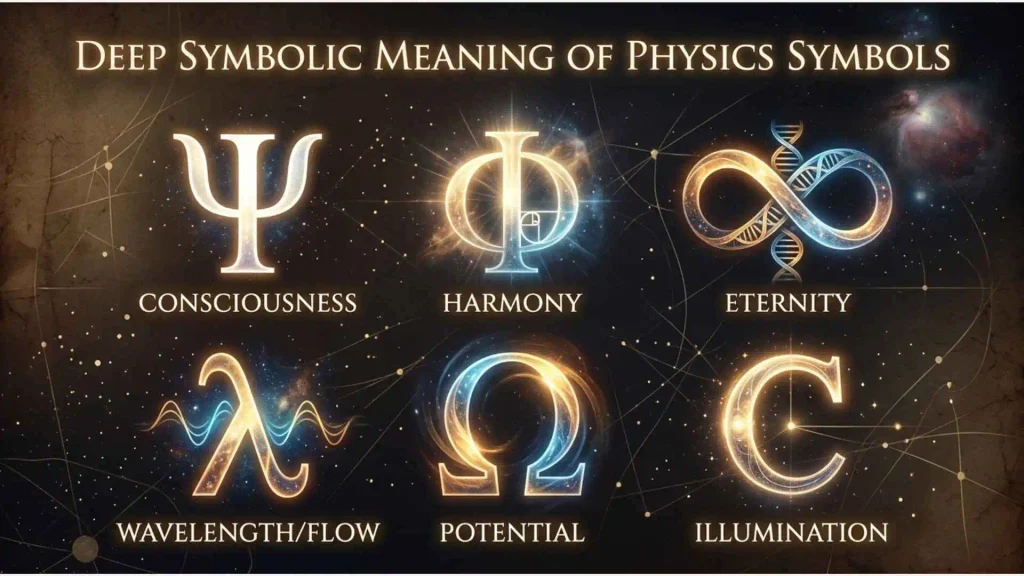
The infinity sign may suggest eternity. A wave may represent cycles, emotion, or change. The atom is sometimes used as a symbol of hidden power and the unseen structure of reality.
Light is especially rich in spiritual symbolism. In physics, light is electromagnetic radiation. In religion and philosophy, it may represent truth, wisdom, hope, or awakening.
These meanings belong to culture and personal interpretation rather than experimental physics.
Psychological Level
Humans naturally search for patterns. Equations appeal to the mind because they turn complexity into order.
A difficult symbol may first create anxiety. Once understood, it can create satisfaction and confidence. This emotional shift is one reason students often remember the moment when a challenging formula finally makes sense.
From a Jungian perspective, circles, waves, light, darkness, and transformation can resemble archetypal patterns. Still, physics notation itself is designed for calculation, not psychological diagnosis.
Cultural Level
Physics symbols often represent progress, intelligence, technology, and discovery.
The atom became a powerful cultural image during the twentieth century. It represented scientific promise, nuclear energy, medicine, danger, and the fear of atomic warfare.
Einstein’s E = mc² moved beyond textbooks and became a symbol of genius. It now appears on clothing, posters, advertisements, and popular media, even when people do not fully understand the equation.
Physics Symbols Across Different Cultures
Ancient Egypt
Egyptian mathematics and astronomy used written signs, diagrams, and measurement systems for architecture, calendars, and land surveying. Their notation differed from modern physics, but their careful observation helped build early scientific traditions.
Ancient Greece
Greek thinkers explored motion, matter, geometry, optics, and astronomy. Figures such as Aristotle, Archimedes, Euclid, and Ptolemy shaped later scientific language. Greek letters remain essential in modern equations.
Roman Culture
Romans were practical engineers. They applied measurement to roads, aqueducts, military machines, buildings, and surveying. Roman numerals were useful for records, though less suitable for advanced algebra.
Eastern Traditions
Indian scholars made major advances in numbers, astronomy, and mathematical methods. Chinese scholars studied mechanics, magnetism, calendars, sound, and engineering. Islamic Golden Age scientists later preserved, tested, translated, and expanded Greek, Persian, and Indian knowledge.
Indigenous Traditions
Indigenous cultures developed detailed knowledge of seasons, navigation, plants, weather, sound, materials, and the night sky. These systems were often expressed through oral traditions, patterns, landmarks, and stories rather than modern equations.
Modern Interpretations
Modern physics uses internationally shared notation. However, teaching styles and pronunciation may still vary by language and region. The symbols remain largely consistent, allowing global scientific cooperation.
Similar Symbols and Their Meanings
| Symbols | Similarity | Key Difference |
| m and M | Both may refer to mass-related ideas | Capitalization changes meaning by context |
| v and ν | Both may appear similar in some fonts | Latin v often means velocity, Greek nu often means frequency |
| p and ρ | Both can relate to matter | p often means momentum or pressure, rho often means density |
| ω and w | Similar visual form | Omega usually means angular frequency |
| Δ and δ | Both express change | Delta often means a finite change, lowercase delta may mean a small variation |
| Ω and ω | Both are omega | Capital omega is the ohm symbol, lowercase omega often means angular frequency |
Confusing similar characters is a common source of errors. Good fonts, clear handwriting, and attention to units can prevent mistakes.
Physics Symbols in Mythology and Folklore
Modern physics notation does not come directly from mythology, but some scientific names do.
Greek and Roman mythology influenced the names of planets, moons, elements, and astronomical objects. Mars was named after the Roman god of war. Jupiter carried the name of the king of the Roman gods. Saturn was associated with agriculture and time.
The word “electricity” comes from the Greek word for amber. Ancient observers noticed that rubbed amber could attract light objects. Over time, this curious effect became part of electrical science.
Mythological names give scientific vocabulary a human memory. They connect new discoveries with old stories about power, mystery, creation, and the heavens.
Physics Symbols in Art, Literature, Movies, and Pop Culture
Artists and filmmakers often use scientific signs to suggest intelligence, mystery, danger, or futuristic power.
Atomic symbols appear in stories about nuclear energy and radiation. Equations fill laboratory walls in science fiction films. Quantum symbols are sometimes used to suggest alternate realities, although fictional explanations may not match real quantum theory.
In fashion, formulas can express curiosity or academic identity. Tattoos may feature atoms, waves, equations, constellations, or infinity symbols.
In literature, scientific notation can represent humanity’s desire to understand reality. It may also show the limits of knowledge when emotions, morality, or consciousness cannot be reduced to a simple formula.
Spiritual and Dream Meaning of Physics Symbols
Dreaming about formulas may reflect problem-solving, pressure, curiosity, or a desire for order. A confusing equation might symbolize a situation that feels difficult to understand. Solving it may reflect growing confidence.
Common symbolic interpretations include:
- Light: clarity, hope, or discovery
- Gravity: responsibility or emotional weight
- Waves: changing emotions or repeating cycles
- Atoms: hidden potential or inner complexity
- Energy: motivation, vitality, or tension
- Infinity: continuity, eternity, or endless possibility
Dream meanings are subjective. They should not be treated as scientific predictions.
Positive and Negative Meanings of Physics Symbols
| Positive Meaning | Negative Meaning |
| Knowledge | Confusion |
| Discovery | Intellectual pressure |
| Order | Rigidity |
| Progress | Dangerous technology |
| Universal communication | Emotional distance |
| Curiosity | Fear of the unknown |
| Creative problem-solving | Misuse of scientific power |
The same symbol can represent light or shadow. An atom may suggest medical progress and clean energy, but it may also evoke nuclear weapons. Context shapes the emotional meaning.
Why Humans Are Attracted to Physics Symbols
Physics symbols make the universe feel understandable.
A falling apple, a rainbow, a thunderstorm, and a distant galaxy may seem unrelated. Physics reveals that each follows patterns. Symbols allow the mind to hold those patterns in a compact form.
They also create a sense of mystery. A page of equations may look like a secret code. Learning the code brings the reward of seeing connections that were previously hidden.
This combination of mystery and order has emotional power. It reminds us that nature is vast, yet parts of it can be described with remarkable precision.
Modern Uses of Physics Symbols
Physics notation appears in:
- School and university textbooks
- Engineering plans
- Medical imaging
- Electronics
- Weather forecasting
- Space exploration
- Computer simulations
- Architecture
- Renewable energy systems
- Tattoos and jewelry
- Clothing and graphic design
- Educational social media content
Correct formatting matters. For example, a space is normally placed between a numerical value and its unit symbol, as in 7 m, 25 kg, or 30 °C. Prefixes attach directly to unit symbols, as in km and mV.
Interesting Facts About Physics Symbols
- The same symbol can have different meanings in mechanics, electricity, optics, and quantum physics.
- Capitalization matters. m means meter as a unit symbol, while M may represent mega as a prefix or another quantity in an equation.
- Unit symbols are not ordinary abbreviations. They normally do not take plural forms or periods.
- Greek letters provide 24 additional characters for scientific notation.
- The symbol Ω honors Georg Ohm and represents the unit of electrical resistance.
- The newton, joule, watt, volt, and pascal are named after influential scientists.
- The symbol Δ usually means a measurable change, such as Δv for change in velocity.
- The nabla symbol ∇ is used in vector calculus for gradients, divergence, and curl.
- Modern constants are regularly evaluated through CODATA using experimental and theoretical evidence.
- Symbols make equations shorter, but units often provide the clue needed to interpret them correctly.
Frequently Asked Questions
What are the most common physics symbols?
Common symbols include m for mass, t for time, v for velocity, a for acceleration, F for force, E for energy, and λ for wavelength.
Why does physics use Greek letters?
Greek letters expand the available set of symbols and help distinguish quantities such as angles, wavelength, density, angular frequency, and coefficients.
Can one physics symbol have several meanings?
Yes. A symbol’s meaning depends on the equation, field of physics, and unit. For example, T may mean temperature, period, or tesla.
What does the triangle symbol mean in physics?
The uppercase triangle Δ, called delta, usually means change. For example, ΔT means change in temperature.
What is the difference between a quantity symbol and a unit symbol?
A quantity symbol represents what is being measured, such as m for mass. A unit symbol shows the measurement standard, such as kg for kilogram.
Are physics symbols universal?
Many are internationally recognized, especially SI unit symbols. However, certain variable choices can differ between textbooks, teachers, and branches of physics.
Conclusion
Physics symbols are more than marks on a classroom page. They form a shared language that turns motion, matter, light, energy, and time into ideas we can study. Their scientific meanings are precise, while their cultural meanings often reflect curiosity, power, progress, and mystery. Learning this language allows us to read nature’s patterns and feel a little closer to the hidden order of the universe.
 Sarah Thompson
 Michael Rivera