
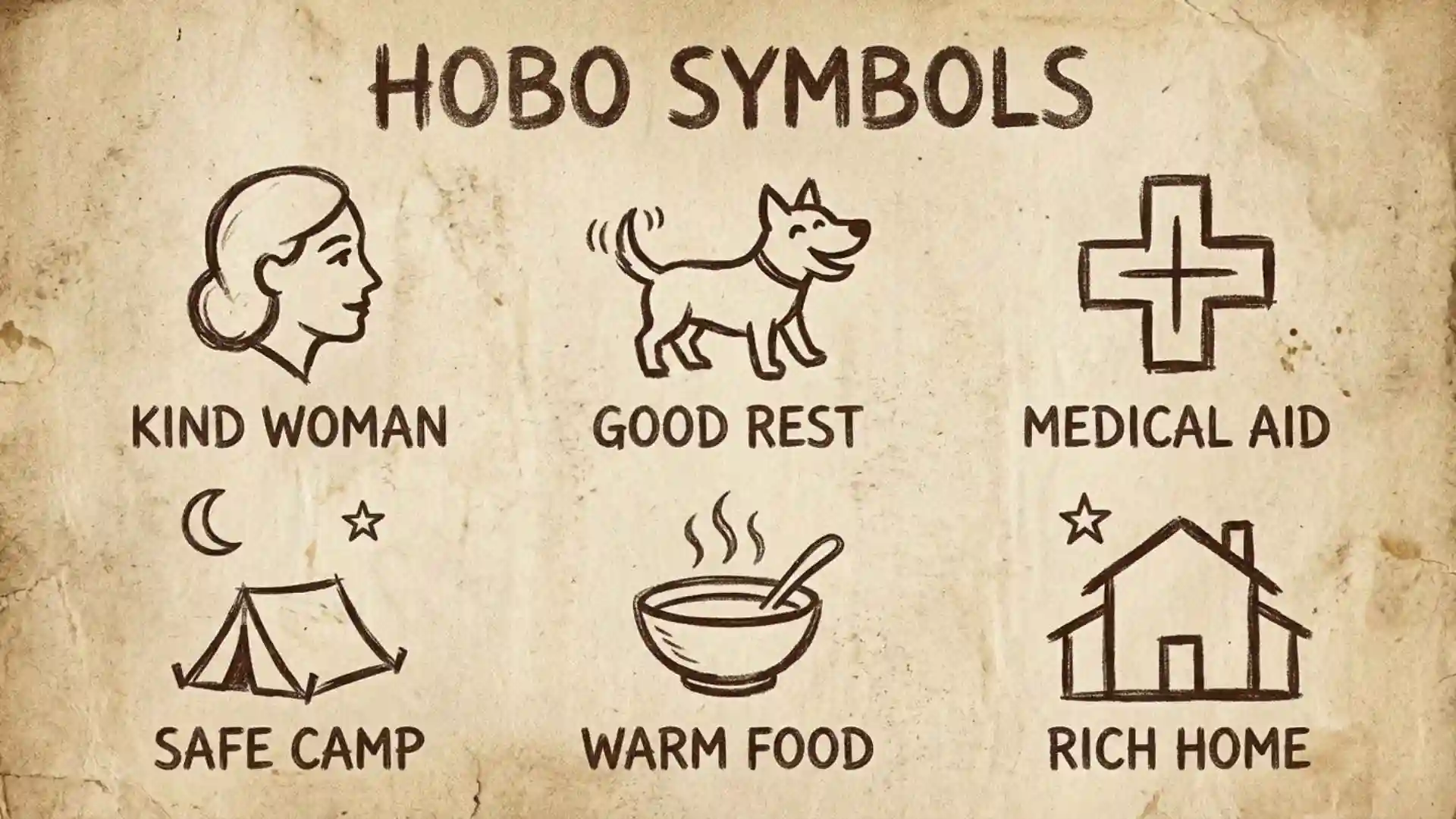
Hobo symbols are often described as simple signs that travelers, especially hobos and other people riding freight trains in the late 19th and early 20th centuries, used to communicate with one another. These marks were sometimes drawn or scratched on fences, walls, sidewalks, and other visible places to share information about nearby towns, helpful people, safe places to rest, or possible dangers. Although these symbols have become part of American folklore, their actual use and meaning varied across places and periods.
Many popular guides associate individual hobo symbols with messages such as “safe place to stay,” “danger ahead,” “kind people live here,” or “work available.” However, not every symbol has a verified historical meaning, and some modern charts repeat interpretations that are difficult to trace to reliable historical sources. Understanding the difference between documented history, oral tradition, and modern interpretations helps you explore hobo symbols without treating every claimed meaning as proven fact.
In this guide, you will discover the history of hobo symbols, their commonly reported meanings, and the role they played in the lives of traveling workers. You will also learn how these signs became part of American culture, what historians say about the so-called hobo code, and which popular claims deserve a closer look. Whether you are researching American history, exploring traditional signs, or simply curious about the hidden messages behind these markings, this guide will help you understand their stories and historical context.
Quick Answer
Hobo symbols, also called hobo signs or the hobo code, were simple marks reportedly drawn with chalk, coal, or carved into surfaces to guide migrant workers. They could identify safe camps, generous households, dangerous dogs, available work, hostile authorities, or places to find food and water.
Quick Facts About Hobo Symbols
| Aspect | Information |
| Origin | Commonly associated with American migrant workers of the late 1800s and early 1900s |
| Historical significance | Represented practical communication among people traveling for seasonal or temporary work |
| Main meaning | Guidance, warning, safety, food, shelter, work, and local conditions |
| Spiritual meaning | Survival, freedom, trust, compassion, and the search for belonging |
| Cultural importance | Became part of American railroad, labor, Depression-era, and folk history |
| Modern usage | Museums, art, tattoos, television, historical displays, graphic design, and online culture |
What Are Hobo Symbols?
Hobo symbols were supposedly small visual messages left by traveling laborers, homeless wanderers, and railroad riders. A person might draw one near a gate, fence, sidewalk, bridge, railway structure, or water tank where another traveler could find it.
The term hobo became widely known in American English near the end of the nineteenth century. Traditionally, a hobo was understood as a migrant worker who traveled in search of employment. This differed from the old stereotypes of a tramp, who traveled but supposedly avoided work, and a “bum,” who neither traveled nor worked regularly.
Hobo life expanded during periods of rapid railroad growth, industrialization, agricultural migration, and economic hardship. Chicago became an important center of this culture because its railway lines connected workers with factories, farms, construction projects, and distant cities. Smithsonian reporting describes late nineteenth-century Chicago as a major center of “Hobohemia,” where itinerant workers could find temporary jobs before moving onward.
The popular explanation says travelers developed a visual code because they often entered unfamiliar towns without knowing where they would be welcomed. The National Security Agency’s National Cryptologic Museum explains that signs could communicate where to get a meal, whether work was expected in return, whether police were alert, and where a traveler might catch a train.
However, historians debate how organized or universal this code really was. Some symbols may have been used locally, while later newspapers, books, museums, and popular culture may have turned scattered customs into a standardized “secret alphabet.”
Were Hobo Symbols Real?
The most accurate answer is partly, but probably not in the perfectly organized form shown on modern posters.
There is strong evidence that travelers left graffiti, names, dates, directions, and personal marks. These were often called monikers or monicas. A railway rider might carve a road name into a water tank or bridge to show that they had passed through.
Writer Jack London, who traveled as a hobo during the 1890s, described water tanks as informal directories where travelers carved their names, dates, and routes. Such marks helped people trace friends and recognize who had recently traveled through an area.
Evidence for a large, universal dictionary of detailed symbols is weaker. Sociologist Nels Anderson, who had firsthand experience of hobo life and studied it academically, rejected the idea that American tramps shared a formal sign language. Some historians believe newspaper photographs and symbol charts may have been staged or exaggerated to make stories more colorful.
Therefore, hobo signs should be approached as a mixture of:
- Genuine traveler graffiti
- Local warning marks
- Personal monikers
- Informal oral knowledge
- Newspaper storytelling
- American folklore
- Later museum interpretation
Common Types and Variations of Hobo Symbols
Meanings differed between charts, locations, and time periods. The following examples are widely repeated, but they should not be treated as a universal historical dictionary.
The Cat
Visual description: A simple outline of a cat or cat-like face.
Meaning: A kind or generous woman lives here.
Symbolism: Hospitality, care, food, and temporary safety.
Cultural connection: Cats were associated with the home and domestic space. In hobo folklore, the image marked a household where a traveler might receive sympathy.
The Circle With an X
Visual description: A circle crossed by two diagonal lines.
Meaning: Often interpreted as a good place for food or a generous handout.
Symbolism: Opportunity, relief, and human kindness.
Where it appeared: Supposedly near houses, fences, gates, or roads leading toward a helpful property.
The Zigzag Line
Visual description: A sharp horizontal line resembling lightning or teeth.
Meaning: A barking or dangerous dog.
Symbolism: Threat, territorial defense, and caution.
Psychological effect: Its pointed shape naturally suggests agitation and danger, making the mark easy to understand even without words.
Two Parallel Arrows or Lines
Visual description: Directional lines, sometimes enclosed within a circle.
Meaning: Leave quickly, keep moving, or avoid the area.
Symbolism: Urgency and escape.
Cultural connection: Railroad travelers depended on quick decisions. A warning about police, guards, or hostile residents could prevent arrest or injury.
A Cross or Religious Mark
Visual description: A cross, church-like form, or combination of lines.
Meaning: Religious conversation may help someone receive food.
Symbolism: Faith, charity, persuasion, and the social expectations surrounding Christian hospitality.
This sign is frequently shown in popular hobo-code charts, although its exact design varies.
The Table-Shaped Sign
Visual description: A rectangle supported by angled or straight lines.
Meaning: Food may be available.
Symbolism: Nourishment, rest, and shared meals.
An Iowa PBS feature on the National Hobo Museum describes a table-like symbol used to indicate food and notes that signs could also point toward water, healthcare, or danger.
Three Curved or Straight Lines
Visual description: Three lines grouped together.
Meaning: Frequently interpreted as a safe or suitable place to camp.
Symbolism: Shelter, temporary community, and protection from exposure.
A Gun or Armed-Household Sign
Visual description: Some charts show a triangle with hand-like marks or another angular design.
Meaning: The homeowner is armed.
Symbolism: Serious danger and the need to stay away.
Because symbol charts disagree, this is one of many signs that should be understood as folklore rather than a guaranteed historical translation.
Deep Symbolic Meaning of Hobo Symbols
Spiritual Level
At a spiritual level, hobo symbols represent the search for guidance in an uncertain world.
A small mark beside a road could offer hope to someone who had no map, money, shelter, or trusted local contact. In that sense, the symbol became a quiet act of service. The person leaving it might never meet the stranger who benefited from it.
These marks can therefore symbolize:
- Faith in unseen companions
- Compassion without reward
- Freedom from material attachment
- The difficult search for home
- Trust between strangers
- Transformation through hardship
The road itself is an ancient spiritual image. In religious stories, myths, and literature, travelers often leave familiar surroundings, face danger, and return changed. Hobo folklore gives this timeless journey a distinctly American setting of railway tracks, camps, industrial towns, and open country.
Psychological Level
Psychologically, hobo signs reflect the human need to reduce uncertainty.
When people enter an unfamiliar place, they search for patterns that indicate safety or risk. A simple mark can calm fear because it turns an unknown environment into something readable.
From a Jungian perspective, the hobo resembles the wanderer archetype. This figure lives outside ordinary social boundaries and searches for work, freedom, identity, or meaning. The wanderer can appear wise and independent, but also isolated and vulnerable.
Hobo symbols also reveal the power of an in-group code. Knowing the meaning of a mark creates a sense of belonging. It tells the reader, “Someone like you was here before.”
Cultural Level
Culturally, the signs represent both solidarity and exclusion.
They suggest that marginalized travelers created their own information network when official institutions offered little protection. At the same time, their secrecy reflects a society in which unemployed and unhoused people could face suspicion, arrest, anti-vagrancy laws, or violence.
The signs preserve a cultural memory of people who were often ignored in formal historical records.
Hobo Symbols Across Different Cultures
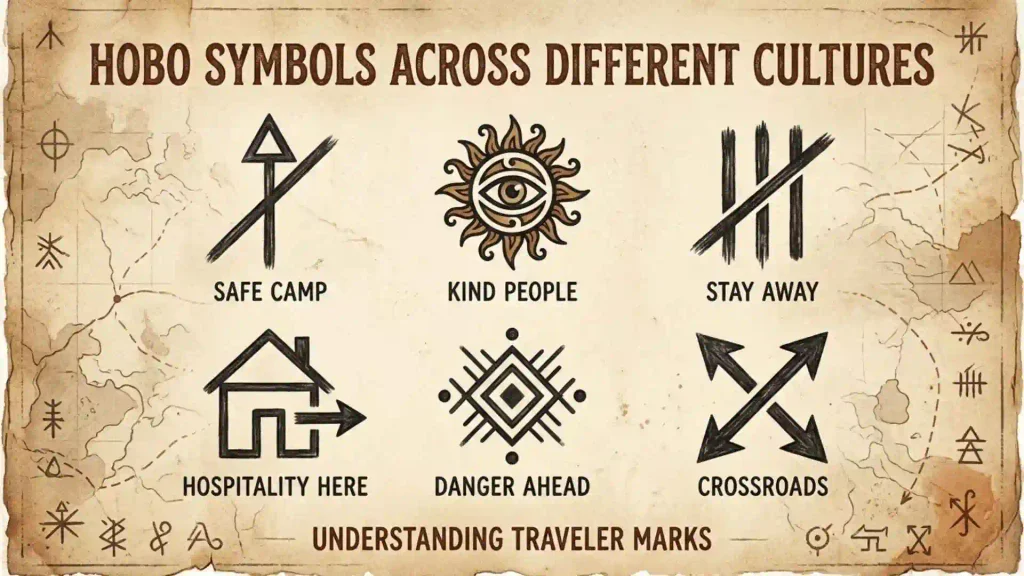
Hobo symbols were mainly associated with North American railroad culture. They did not originate in Ancient Egypt, Greece, Rome, or Asian religious traditions. However, useful comparisons can be made with other systems of signs.
Ancient Egypt
Egyptian hieroglyphs combined pictures, sounds, and concepts in a formal writing system. Unlike hobo marks, they were used for religion, government, monuments, and recordkeeping.
The similarity lies only in visual communication. Both show that a simple image can carry meaning, but hieroglyphs were far more structured.
Ancient Greece
Greek travelers relied on spoken reports, boundary stones, road markers, and symbols linked to gods such as Hermes, the protector of travelers.
Hobo folklore shares the theme of seeking protection on the road, but there is no historical line connecting hobo signs to Greek sacred symbols.
Roman Culture
Romans used milestones, military marks, inscriptions, and commercial signs throughout their road network.
Roman signs usually represented official authority. Hobo markings, by contrast, belonged to people with little authority who communicated outside formal systems.
Eastern Traditions
Chinese and Japanese travelers historically used written characters, road markers, temple signs, and religious images. Pilgrimage routes also developed recognizable signs that directed travelers toward shelter and sacred sites.
The shared idea is practical guidance, not common origin.
Indigenous Traditions
Indigenous cultures across North America used highly varied forms of visual communication, including pictographs, trail markers, woven designs, carvings, and symbolic landscapes.
It would be inaccurate to label these “hobo codes.” They belong to distinct nations, languages, histories, and spiritual traditions. Any comparison must respect those differences.
Modern Interpretations
Today, people compare hobo signs with trail blazes, homeless-community information networks, street art, geocaching marks, digital maps, online reviews, and location-based social media.
The technology has changed, but the need remains familiar: people still warn one another about danger and share places where help can be found.
Similar Symbols and Their Meanings
| Symbol system | Main purpose | Similarity to hobo signs | Key difference |
| Trail blazes | Guide hikers along routes | Simple visual direction | Usually standardized and officially maintained |
| Railway monikers | Record a traveler’s name and movement | Connected with railroad culture | Usually identify a person rather than describe a place |
| Graffiti tags | Express identity or presence | Marks left in public spaces | Often personal or artistic rather than practical |
| Pilgrimage markers | Guide spiritual travelers | Help strangers navigate | Connected with recognized religious routes |
| Military field signs | Communicate tactical information | Fast, compact communication | Controlled by formal organizations |
| Digital map reviews | Share local warnings and recommendations | Report safety and resources | Stored online rather than drawn physically |
A common misconception is that every old geometric mark near a railroad is hobo code. Many marks may instead be survey symbols, utility markings, workers’ notes, construction signs, railway maintenance codes, or modern graffiti.
Hobo Symbols in Mythology and Folklore
Hobo symbols do not belong to ancient mythology, but they have become part of modern American folklore.
The hobo is often portrayed as a wandering outsider who survives through intelligence, humor, courage, and luck. This character resembles older folklore figures such as the wandering trickster, the disguised stranger, and the poor traveler who tests a household’s generosity.
Many folktales teach that kindness toward a stranger brings a blessing, while cruelty brings misfortune. Hobo-code stories give this moral lesson a practical form. A kind household receives a favorable mark. A hostile place receives a warning.
Whether every sign was historically used matters less to folklore than the message behind it: reputation travels, and one act of kindness may help people you will never meet.
Hobo Symbols in Art, Literature, Movies, and Pop Culture
Hobo imagery appears in photography, folk songs, novels, documentaries, television, museum exhibits, tattoos, and graphic design.
Jack London’s writing helped preserve firsthand descriptions of migrant travel and railway monikers. Later stories often romanticized the open road while paying less attention to hunger, injury, unemployment, and social exclusion.
Television introduced the code to new audiences. The Mad Men episode “The Hobo Code” used the idea of a household mark as a symbol of identity, judgment, and hidden social knowledge. Other programs, cartoons, and crime dramas have also drawn on hobo folklore.
Museums now display reconstructed code charts as examples of cryptic communication. The Franklin D. Roosevelt Presidential Library presents the signs in the context of travelers warning one another about dangers and opportunities.
In modern design, the symbols appeal because they are simple, mysterious, and visually strong. However, decorative use can erase the poverty and danger connected with the people they supposedly represented.
Spiritual and Dream Meaning of Hobo Symbols
Dreaming of hobo signs may suggest that you are searching for guidance during a period of change.
A warning sign may reflect anxiety about a risky decision. A food or shelter symbol may show a need for emotional support. A directional mark could represent a choice between staying in a familiar situation and moving toward something new.
Common interpretations include:
- Finding a sign: You are noticing guidance that was previously hidden.
- Drawing a sign: You want to help someone or leave a meaningful legacy.
- Misreading a sign: You fear making the wrong decision.
- Seeing a danger symbol: Your instincts may be warning you about a person or place.
- Seeing a kindness symbol: Support may come from an unexpected source.
Dream meanings are personal, not predictive facts. The strongest interpretation usually comes from your emotions and current life circumstances.
Positive and Negative Meanings of Hobo Symbols
| Positive meanings | Negative meanings |
| Mutual aid | Poverty |
| Resourcefulness | Social exclusion |
| Freedom | Instability |
| Secret knowledge | Mistrust |
| Community | Loneliness |
| Guidance | Danger |
| Compassion | Exploitation |
| Survival | Fear of authority |
The same symbol system can represent both light and shadow. It celebrates cooperation, yet it also reminds us why vulnerable travelers needed hidden warnings in the first place.
Why Humans Are Attracted to Hobo Symbols
People are drawn to hobo symbols because they turn ordinary marks into hidden stories.
The idea that a tiny chalk line could save someone from hunger or danger feels powerful. It suggests that the landscape contains secret messages visible only to those who know how to read them.
Humans naturally enjoy pattern recognition, codes, maps, and mysteries. We also respond emotionally to stories about outsiders creating community under pressure.
Finally, hobo signs touch a universal fear: arriving somewhere unknown and having no one to trust. The possibility that a stranger left guidance behind makes the world feel less lonely.
Modern Uses of Hobo Symbols
Today, these symbols appear in:
- Tattoos representing freedom, travel, survival, or independence
- Jewelry inspired by railway and folk history
- Clothing and fashion prints
- Museum exhibits
- Historical reenactments
- Posters and educational charts
- Television and film production design
- Street-art projects
- Branding for travel-themed businesses
- Digital art and social media posts
- Home decor with rustic or railroad themes
People using these designs should remember that they are connected to real histories of labor migration, homelessness, economic hardship, and criminalized poverty.
Interesting Facts About Hobo Symbols
- The most reliable hobo markings may have been personal monikers rather than a universal pictorial code.
- Travelers often wrote names, dates, and directions on railway structures to show where they had been.
- Many popular code charts disagree about the meanings and shapes of individual signs.
- Chalk and coal were practical materials because they were cheap, portable, and easy to use.
- Signs were supposedly placed where travelers would notice them but property owners might overlook them.
- The code is strongly associated with the Great Depression, although stories about traveler marks appeared earlier.
- Museums have preserved the code as part of American communication and labor history.
- Some modern “hobo symbols” found online were invented for humor, art, fiction, or entertainment.
- The term “hobo code” can also refer to an ethical code of behavior, not only a set of visual signs.
- Modern phones, messaging platforms, GPS maps, and online communities now perform many of the functions once attributed to road signs.
Frequently Asked Questions
What do hobo symbols mean?
They reportedly communicated useful information about food, shelter, jobs, water, police, dangerous animals, friendly residents, and safe camps.
Did hobos really use a secret code?
Travelers definitely used graffiti, monikers, dates, and directional information. However, historians dispute whether there was one universal and widely understood pictorial code.
What does the cat hobo symbol mean?
Popular charts say a cat indicated that a kind or generous woman lived nearby. The meaning is widely repeated but may not have been universal.
Where were hobo signs placed?
They were supposedly marked near fences, gates, sidewalks, buildings, railway bridges, water tanks, camps, and routes used by migrant workers.
Are hobo symbols still used today?
The traditional signs are not commonly used as a practical communication system. They survive mainly in folklore, museums, art, tattoos, design, and popular culture.
Are hobo symbols the same as railway monikers?
No. A hobo symbol usually describes local conditions, while a railway moniker identifies a particular traveler through a name, nickname, image, date, or personal mark.
Conclusion
Hobo symbols represent far more than a collection of mysterious scratches beside a railway line.
They preserve stories of movement, hardship, mutual aid, fear, freedom, and the human desire to guide strangers through danger.
Although the standardized code may be partly folklore, real travelers did leave marks that recorded their presence and connections.
Their enduring message is simple: even on the loneliest road, someone may have passed before you and left a sign of hope.
 Sarah Thompson
 John Mercer