
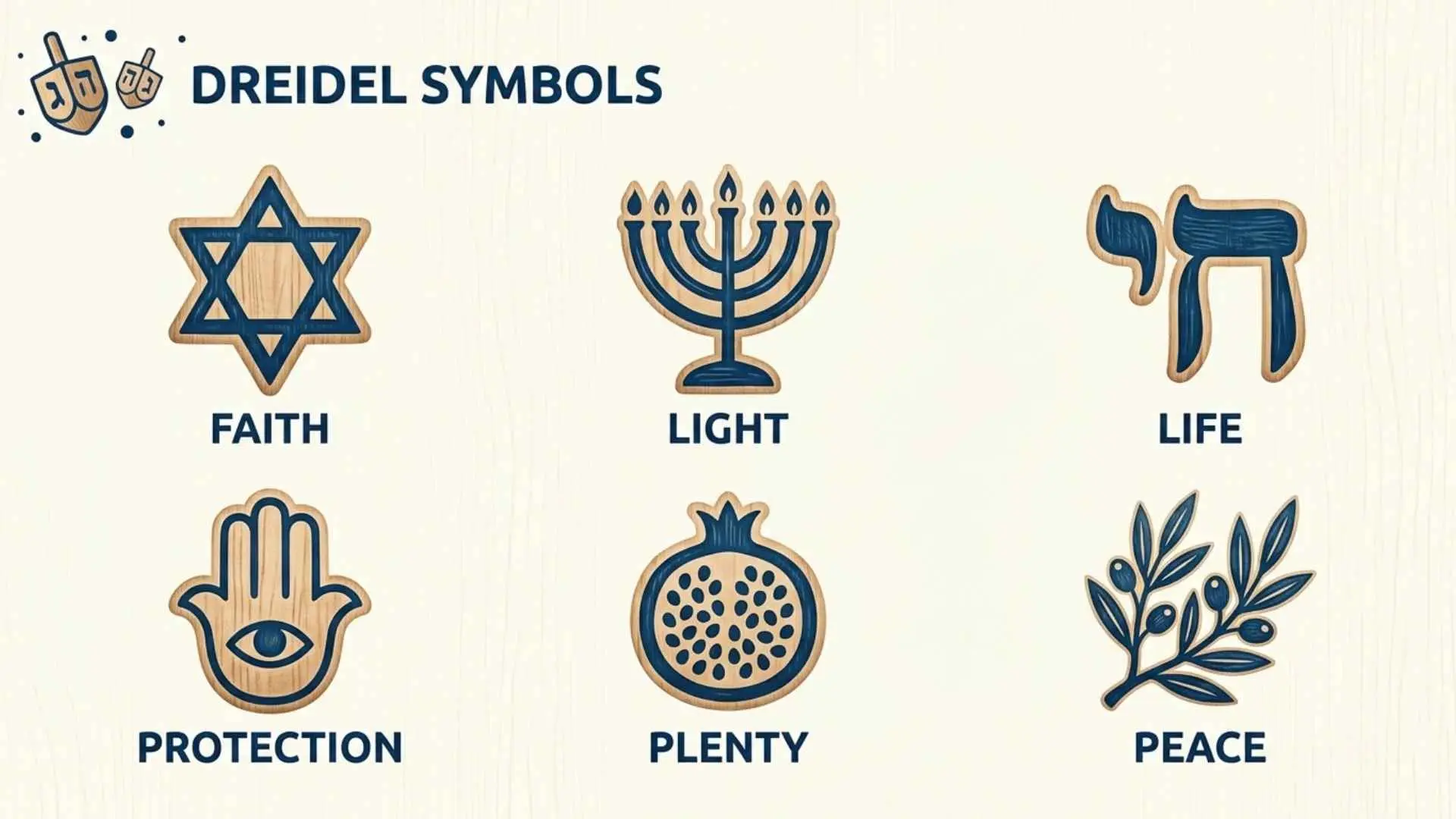
Dreidel symbols are an important part of the Jewish celebration of Hanukkah, representing tradition, faith, and the history of Jewish communities. A dreidel is a four-sided spinning top that children and families play with during the Festival of Lights. Each side features a Hebrew letter: Nun (נ), Gimel (ג), Hey (ה), and Shin (ש). These letters are more than simple markings on a toy; they connect the game to Jewish culture, religious heritage, and the story of Hanukkah.
Each of the four dreidel symbols has a specific meaning and determines what a player does during the game. Together, the letters represent the Hebrew phrase Nes Gadol Haya Sham, meaning “A great miracle happened there.” In Israel, the Shin is replaced with Peh (פ), making the phrase Nes Gadol Haya Po, meaning “A great miracle happened here.” These words recall the miracle associated with Hanukkah and explain why the dreidel remains a meaningful symbol of the holiday.
In this guide, you will discover the meanings of all four dreidel symbols, their Hebrew pronunciations, and the rules associated with each letter. You will also learn about the dreidel’s historical origins, its connection to Hanukkah, and the differences between dreidels used in Israel and other parts of the world. Whether you are learning about Jewish traditions, preparing for Hanukkah, or simply curious about the symbolism behind this spinning top, this guide will help you understand its cultural and spiritual significance.
Quick Answer
Dreidel symbols are Hebrew letters written on the four sides of a traditional Hanukkah spinning top. Outside Israel, the letters are Nun, Gimel, Hey, and Shin. Together, they represent Nes Gadol Haya Sham, meaning “A great miracle happened there.” In Israel, Pe replaces Shin, changing “there” to “here.”
Quick Facts About Dreidel Symbols
| Aspect | Information |
| Origin | Jewish adaptation of a European spinning-top game |
| Historical Significance | Became associated with Hanukkah in European Jewish communities |
| Main Meaning | A reminder of the Hanukkah miracle |
| Spiritual Meaning | Faith, divine help, perseverance, and hope |
| Cultural Importance | Connects Jewish families with shared memory and tradition |
| Modern Usage | Hanukkah games, decorations, jewelry, art, education, and gifts |
What Are Dreidel Symbols?
A dreidel is a four-sided spinning top traditionally used during Hanukkah. Its Yiddish name is dreydl, while the common modern Hebrew word is sevivon, meaning “spinning top.”
Each side displays one Hebrew letter:
- Nun: נ
- Gimel: ג
- Hey: ה
- Shin: ש
Together, these letters form the initials of the Hebrew phrase:
Nes Gadol Haya Sham
This means:
“A great miracle happened there.”
The phrase points toward the events remembered during Hanukkah, especially the rededication of the Temple in Jerusalem after the Maccabean revolt and the traditional account of a small amount of oil lasting for eight days.
On most dreidels used in Israel, the letter Pe: פ replaces Shin. The letters then form Nes Gadol Haya Po, meaning “A great miracle happened here.”
This small change reflects geography. Jewish communities outside Israel look toward the place where the Hanukkah events occurred, while players in Israel describe the miracle as happening “here.”
The Historical Origin of the Dreidel
A popular story says Jewish children played dreidel to hide Torah study from Seleucid soldiers. According to the tale, they quickly brought out spinning tops whenever authorities approached.
This story expresses Jewish courage under religious oppression, but historians generally do not treat it as the literal origin of the dreidel. The recognizable Hanukkah dreidel developed much later in Europe.
European communities had played games with lettered spinning tops for centuries. One version was known as a teetotum or “put and take” game. Its sides instructed players to take everything, take half, do nothing, or contribute to the pot.
Jewish communities in German-speaking Europe adapted this game, likely around the 18th century. Because Yiddish was written with Hebrew letters, familiar European game instructions could be represented through Nun, Gimel, Hey, and Shin. The letters later gained their deeply meaningful connection to the Hanukkah phrase about a great miracle.
The dreidel therefore reflects two kinds of history. It preserves a European game tradition while also expressing Jewish memory, faith, and cultural creativity.
Meaning of Each Dreidel Symbol
Nun: נ
Game instruction: Do nothing.
Nun is traditionally connected with the Yiddish word nisht, meaning “nothing.” When the dreidel lands on Nun, the player neither gains nor loses anything.
Symbolically, Nun can represent stillness, patience, and uncertainty. Not every moment produces an immediate reward. Sometimes a person must wait, observe, and remain steady.
On a spiritual level, Nun may remind players that silence and apparent emptiness are not always meaningless. A quiet moment can prepare the way for change.
Gimel: ג
Game instruction: Take the entire pot.
Gimel is associated with the Yiddish word gants, meaning “all” or “the whole thing.” It is usually the most exciting result because the player receives everything in the center.
Symbolically, Gimel represents abundance, completion, and unexpected blessing. It captures the emotional joy of receiving more than expected.
Within the Hanukkah story, this sense of abundance echoes the traditional miracle of limited oil lasting far longer than its ordinary supply should have allowed.
Hey: ה
Game instruction: Take half the pot.
Hey is linked with the Yiddish word halb, meaning “half.” The player receives half of what is available, usually rounding up when necessary.
Its symbolic meaning can involve balance, moderation, and shared benefit. Hey is neither complete loss nor total victory.
Psychologically, it reflects an important truth about life: progress often comes in portions. A partial success still matters. Receiving half can teach gratitude without encouraging excess.
Shin: ש
Game instruction: Put one token into the pot.
Shin is connected with the Yiddish expression shtel ayn, meaning “put in.” When it appears, the player contributes a coin, nut, candy, or other game piece.
Shin symbolizes responsibility, contribution, and sacrifice. Community life cannot survive through taking alone. Everyone must sometimes give.
Outside Israel, Shin also stands for Sham, meaning “there,” in the phrase “A great miracle happened there.”
Pe: פ
Game instruction: Put one token into the pot.
On Israeli dreidels, Pe replaces Shin. It represents Po, meaning “here.”
This version creates a strong connection between place and memory. The Hanukkah story is not described as something that happened in a distant land. It happened “here,” within the historical landscape of Israel.
Deep Symbolic Meaning of Dreidel Symbols
Spiritual Meaning
The dreidel’s movement offers a simple image of faith. Once released, it spins through uncertainty. No player can fully control which side will appear.
This does not mean the dreidel predicts destiny. Rather, its movement can remind people that human life contains both choice and uncertainty. People prepare, act, hope, and respond, even when outcomes remain unknown.
The letters also transform chance into memory. Instead of displaying meaningless marks, the top carries a statement about miracle, endurance, and sacred history.
Psychological Meaning
Humans are naturally drawn to spinning objects, repeated patterns, and uncertain outcomes. The dreidel creates suspense because every spin may bring a different result.
From a psychological viewpoint, its four outcomes resemble common human experiences:
- Waiting
- Receiving
- Sharing
- Losing or contributing
The game allows children and adults to experience these emotions in a safe setting. Players practise patience when they land on Nun, excitement with Gimel, acceptance with Hey, and generosity with Shin or Pe.
In Jungian terms, the spinning top can resemble a symbol of the centered self. It moves rapidly around a stable inner axis. This interpretation is modern rather than a traditional Jewish teaching, but it offers a useful image of remaining grounded while life moves around us.
Cultural Meaning
Dreidel symbols help preserve Jewish identity through play. A child does not need to attend a formal history lesson to encounter Hebrew letters, the language of miracle, or the memory of Hanukkah.
The tradition works because it is enjoyable. Families laugh, compete, share chocolate coins, and repeat the same basic actions practised by earlier generations.
In this way, culture survives not only in books and ceremonies, but also around kitchen tables.
Types and Variations of Dreidel Symbols
Diaspora Dreidel
Letters: Nun, Gimel, Hey, Shin
Phrase: Nes Gadol Haya Sham
Meaning: “A great miracle happened there”
Where it appears: Jewish communities outside Israel
This is the form most familiar in North America and many European communities.
Israeli Dreidel
Letters: Nun, Gimel, Hey, Pe
Phrase: Nes Gadol Haya Po
Meaning: “A great miracle happened here”
Where it appears: Israel and Israeli-themed collections
The Pe creates a direct geographical connection to the land where the Hanukkah events took place.
Decorative Dreidels
Decorative versions may be made from silver, glass, ceramic, wood, stone, or precious metals. Some are created as Judaica rather than for regular play.
Their letters remain culturally meaningful even when the object is displayed instead of spun.
Educational Dreidels
Teachers and families may use large, colorful dreidels to introduce Hebrew letters, Hanukkah vocabulary, counting, probability, or storytelling.
These versions show how one traditional object can support religious, cultural, linguistic, and mathematical learning.
Dreidel Symbols and Related Traditions Across Cultures
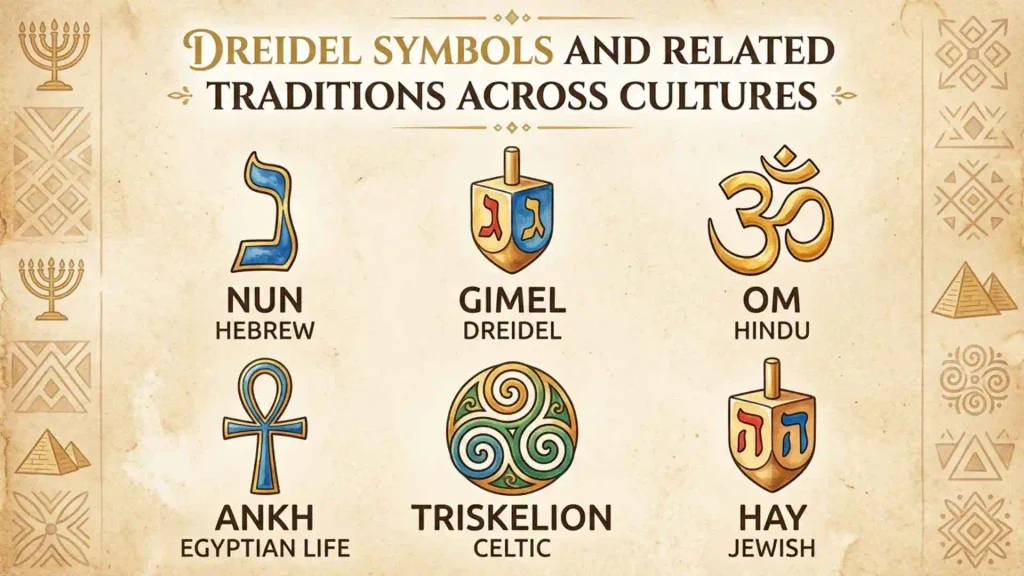
Dreidel symbols belong specifically to Jewish Hanukkah tradition. They should not be presented as ancient Egyptian, Greek, Roman, Eastern, or Indigenous religious symbols.
However, spinning tops and chance games have appeared in many cultures.
Ancient Egypt
Archaeologists have found ancient Egyptian spinning toys and tops. These objects show that rotational play is extremely old, but they did not carry Hebrew dreidel letters or Hanukkah meanings.
Ancient Greece
Greek children and adults played with spinning tops. Some tops were used for entertainment, physical skill, or games of chance.
Roman Culture
Roman communities also knew spinning toys and gambling devices. Lettered or marked tops eventually contributed to later European “put and take” games.
European Traditions
The European teetotum is the closest historical relative of the dreidel. Its marked sides gave instructions such as taking all, taking half, doing nothing, or paying into the pot.
Eastern Traditions
Many Asian societies developed distinctive spinning tops, including Japanese koma. These often represented skill, craftsmanship, celebration, or competition rather than Hanukkah memory.
Indigenous Traditions
Various Indigenous communities created spinning toys from local materials. Their meanings depended on each nation and should not be merged into a single universal tradition.
Modern Interpretation
Today, spinning tops are found worldwide, but the Hebrew letters make the dreidel culturally distinct. Its identity comes not simply from its shape, but from its connection to Jewish language and Hanukkah.
Similar Symbols and Their Meanings
| Symbol or Object | Similarity | Main Difference |
| Menorah or Hanukkiah | Connected with Hanukkah and miracle | Focuses on sacred light and the eight nights |
| Gelt | Commonly used in dreidel games | Represents money, reward, charity, or chocolate coins |
| Teetotum | Four-sided game of chance | European predecessor without Hanukkah symbolism |
| Spinning top | Shares the same basic motion | Usually lacks Hebrew letters and Jewish meaning |
| Magen David | Widely recognized Jewish symbol | Represents Jewish identity more broadly, not specifically Hanukkah |
| Oil jug | Refers to the traditional miracle of oil | Directly represents the oil rather than the game |
A common misconception is that every four-sided spinning top is a dreidel. A true dreidel is identified by its Hebrew letters and connection to Hanukkah.
Dreidel Symbols in Myth, Legend, and Folklore
The most famous dreidel legend describes Jewish children secretly studying Torah during Seleucid persecution. When soldiers appeared, the children supposedly hid their books and pretended to play with tops.
Although historians trace the modern dreidel to a later European game, the legend remains culturally meaningful. It expresses the determination to protect learning, faith, and identity.
Folklore often communicates emotional truth even when it is not a precise historical record. In this story, the dreidel becomes a symbol of quiet resistance. A harmless toy hides an act of spiritual courage.
Dreidel Symbols in Art, Literature, and Pop Culture
Dreidels frequently appear in Hanukkah cards, children’s books, television episodes, classroom art, holiday films, and seasonal decorations.
The song “I Have a Little Dreidel” helped make the spinning top especially recognizable in English-speaking Jewish communities. Its playful image of a clay dreidel presents tradition through music and childhood joy.
Artists often place dreidels beside Hanukkiahs, candles, oil jugs, and gelt. In such scenes, the object represents family gathering, cultural continuity, and celebration.
Modern jewelry may feature miniature dreidels or individual Hebrew letters. Fashion and home decor also use the four symbols as expressions of Jewish identity.
Spiritual and Dream Meaning of Dreidel Symbols
There is no single traditional Jewish rule for interpreting dreams about dreidels. Dream meanings depend heavily on personal experience.
A spinning dreidel may suggest:
- Uncertainty about an approaching outcome
- A need to remain centered
- Memories of childhood or family
- A desire to reconnect with Jewish heritage
- Changing fortune or emotional instability
- Hope that a difficult situation will improve
A dreidel that spins steadily may symbolize balance and confidence. One that repeatedly falls may reflect exhaustion, frustration, or fear of losing control.
These are psychological possibilities, not predictions or religious laws.
Positive and Negative Meanings of Dreidel Symbols
| Positive Meaning | Cautionary or Negative Meaning |
| Hope during difficulty | Dependence on chance |
| Cultural memory | Fear of losing |
| Faith and perseverance | Impatience |
| Family connection | Excessive competition |
| Generosity | Reluctance to contribute |
| Abundance | Greed |
| Joyful learning | Treating sacred tradition as empty decoration |
The same symbol can hold light and shadow. Gimel may suggest blessing, but it can also awaken greed. Shin may feel like loss, yet it teaches contribution. Meaning depends on attitude and context.
Why Humans Are Attracted to Dreidel Symbols
The dreidel combines several things the human mind naturally enjoys: movement, sound, suspense, pattern, and storytelling.
Its spinning body catches the eye. Its uncertain landing creates anticipation. Its letters invite questions. Its connection to Hanukkah gives the game emotional depth.
Most importantly, the dreidel turns history into participation. Players do not merely hear that Jewish tradition survived. They touch it, spin it, read its letters, and pass it to someone else.
Modern Uses of Dreidel Symbols
Today, dreidel symbols appear in:
- Family Hanukkah games
- Synagogue and school activities
- Hebrew-language lessons
- Probability and mathematics exercises
- Jewelry and Judaica
- Greeting cards
- Clothing and accessories
- Social media graphics
- Holiday branding
- Table decorations
- Children’s books
- Personal collections
They may also appear in tattoos, although religious attitudes toward tattooing vary within Jewish communities. For some people, a dreidel tattoo represents family history, resilience, or love for Hanukkah.
Interesting Facts About Dreidel Symbols
- The dreidel’s Hebrew letters also match Yiddish game instructions.
- Shin is usually replaced by Pe on Israeli dreidels.
- The dreidel developed from a wider European family of spinning games.
- The Torah-hiding origin story is beloved folklore, but it is not strongly supported as literal history.
- Players often use chocolate gelt, coins, nuts, raisins, or candy as tokens.
- Game rules can vary between families and communities.
- Some researchers have studied whether physical dreidels land fairly.
- A mathematically perfect four-sided dreidel would give each side an equal chance, but real objects may be uneven.
- Dreidels range from simple plastic toys to valuable handcrafted Judaica.
- The letters preserve both a game system and a statement of Jewish memory.
Frequently Asked Questions
What do the four dreidel symbols mean?
Nun, Gimel, Hey, and Shin represent Nes Gadol Haya Sham, meaning “A great miracle happened there.” They also control what happens during the game.
What does each dreidel letter do?
Nun means nothing happens. Gimel means take the whole pot. Hey means take half. Shin or Pe means put one token into the pot.
Why does an Israeli dreidel have a Pe?
Pe stands for Po, meaning “here.” Israeli dreidels say, “A great miracle happened here,” instead of “there.”
Is the dreidel an ancient Jewish object?
The modern dreidel is not considered an ancient Maccabean object. Historians connect it to European spinning-top games later adapted by Jewish communities.
What miracle do dreidel symbols refer to?
They refer to the Hanukkah story, including the Jewish victory and rededication of the Temple. Tradition also remembers the oil that lasted for eight days.
Is a dreidel a religious symbol or a toy?
It is primarily a Hanukkah game and cultural symbol. It is not a sacred ritual object like a Torah scroll, but its letters carry religious and historical meaning.
Conclusion
Dreidel symbols hold far more meaning than their small size suggests. They combine Hebrew language, European game history, Hanukkah memory, family joy, and lessons about patience, abundance, balance, and giving. Every spin moves between uncertainty and hope. In the hands of each new generation, the dreidel continues to turn history into living tradition.
 Sarah Thompson
 Michael Rivera