
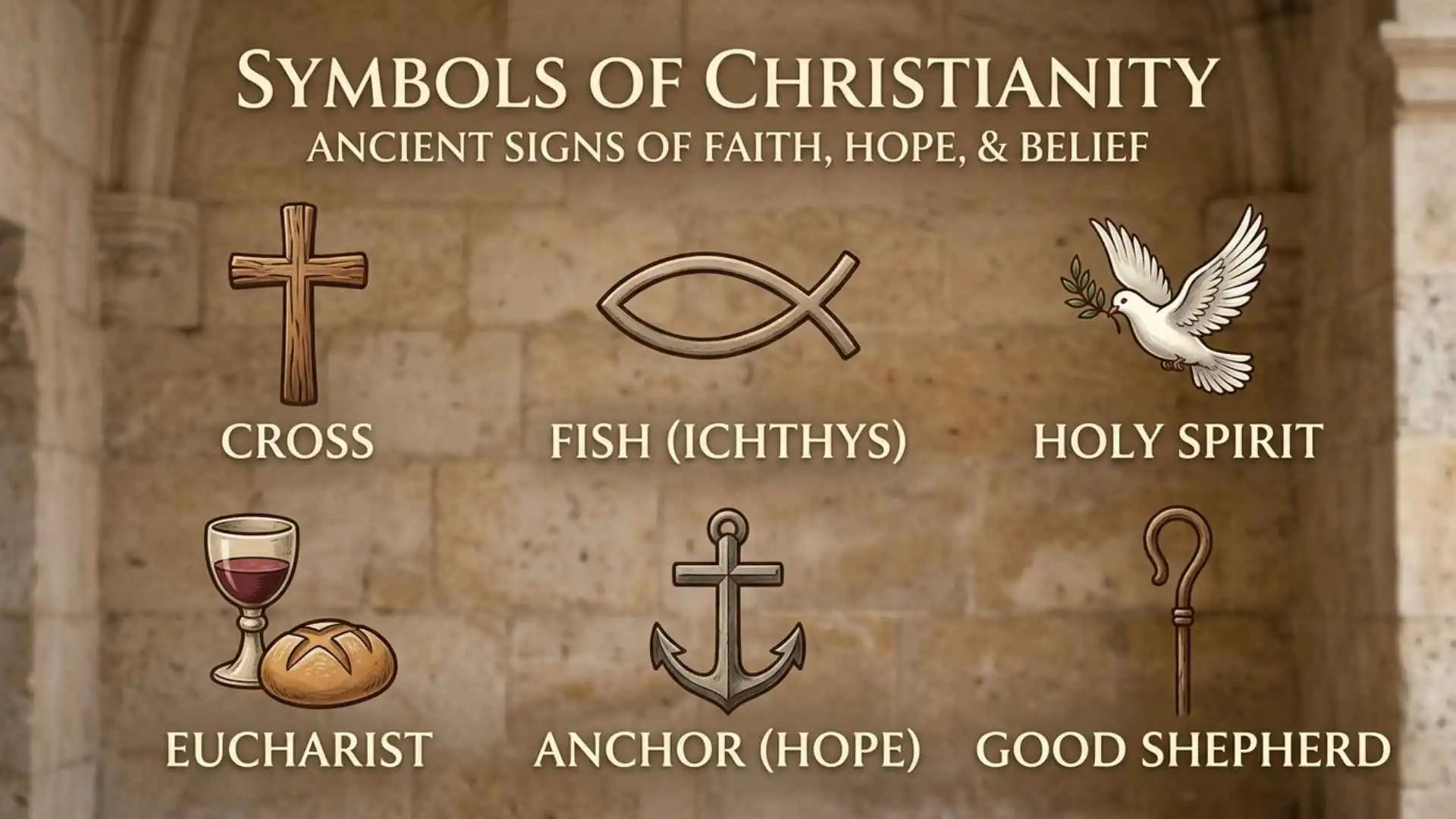
Christian symbols have been used for centuries to express faith, hope, sacrifice, salvation, and devotion. From the familiar cross to the dove, fish, lamb, and crown, these symbols often communicate ideas that are deeply connected to the life and teachings of Jesus Christ. Many of them also appear in churches, artwork, jewelry, religious celebrations, and Christian traditions around the world.
Some Christian symbols have meanings that are easy to recognize, while others have deeper historical and spiritual messages. The cross, for example, represents Christ’s crucifixion and is closely connected with salvation and resurrection. Other symbols, such as the Chi-Rho, anchor, ichthys, olive branch, and Alpha and Omega, developed through Scripture, early Christian traditions, and religious art.
Understanding the symbols of Christianity can provide a richer view of Christian history and belief. Whether you are studying religion, exploring biblical symbolism, researching the meaning behind a Christian symbol, or simply curious about the signs found in churches and Christian artwork, each symbol offers a unique connection to faith and spiritual meaning.
Quick Answer
Symbols of Christianity are visual signs, objects, animals, letters, and images that express Christian beliefs and biblical teachings. Common examples include the cross, fish, dove, lamb, anchor, and Alpha and Omega. They represent ideas such as salvation, Jesus Christ, the Holy Spirit, sacrifice, resurrection, hope, and eternal life.
Quick Facts About Symbols of Christianity
| Aspect | Information |
| Origin | Biblical imagery, Jewish tradition, Roman culture, and early Christian communities |
| Historical Significance | Helped early believers communicate faith, especially during periods of persecution |
| Main Meaning | Faith in Jesus Christ, salvation, divine love, sacrifice, and resurrection |
| Spiritual Meaning | Transformation, forgiveness, hope, protection, and union with God |
| Cultural Importance | Shaped Christian worship, art, architecture, literature, and public identity |
| Modern Usage | Churches, jewelry, tattoos, clothing, memorials, digital media, and home decor |
What Are Symbols of Christianity?
Symbols of Christianity are visible representations of Christian beliefs, people, events, and spiritual truths. Some come directly from the Bible. Others developed through early Christian worship, church history, Roman society, and religious art.
Christianity began in the first century within a Jewish cultural setting. Early followers of Jesus used familiar images such as bread, wine, shepherds, lambs, water, light, and vines. These images already carried meaning in Hebrew Scripture and became connected with the life and teachings of Jesus.
During certain periods of Roman rule, Christians faced social pressure and persecution. Believers sometimes used less obvious signs to recognize one another. The fish symbol, for example, became an early mark of Christian identity. It could be drawn quickly and understood by people familiar with its meaning.
As Christianity spread, its symbols became more public. Crosses appeared in churches, mosaics, manuscripts, clothing, and monuments. Christian artists also developed halos, sacred monograms, biblical animals, and symbolic colors.
These signs became important because they made complex theology easier to remember. A single image could teach a child, comfort a grieving family, or remind a worshipper of an entire biblical story.
Deep Symbolic Meaning of Symbols of Christianity
Spiritual Level
On a spiritual level, Christian symbols point beyond the physical world. They invite believers to remember God, reflect on Scripture, and examine their inner lives.
The cross represents Christ’s suffering, but it also points to forgiveness and resurrection. Water suggests cleansing and new life. Fire represents the presence and transforming power of the Holy Spirit. Bread and wine recall the Last Supper and the spiritual nourishment found in Christ.
These images often express inner transformation. A person may wear a cross not only as a statement of belief but also as a reminder to practice humility, mercy, courage, and love.
Psychological Level
Symbols affect the mind because the brain responds strongly to recognizable patterns and emotional images. They can hold memories, fears, hopes, and values in a compact form.
Psychologist Carl Jung described powerful shared images as archetypal symbols. While Christian theology differs from Jungian psychology, many Christian images carry archetypal qualities. The shepherd suggests guidance. The lamb represents innocence. Light symbolizes truth. The serpent can suggest temptation, danger, or healing, depending on context.
Christian symbols can also provide emotional stability. A cross in a hospital room may remind a patient that suffering is not meaningless. A dove at a funeral may communicate peace when spoken comfort feels inadequate.
Cultural Level
At the cultural level, sacred symbols unite communities. They appear in rituals, festivals, buildings, paintings, songs, and family traditions.
A church steeple topped with a cross identifies a place of Christian worship. Baptismal water marks entry into the faith community. Wedding rings used in Christian ceremonies symbolize covenant and faithfulness.
However, interpretations may vary among Catholic, Orthodox, Protestant, Anglican, and other Christian traditions. Some churches use detailed icons and sacred images, while others prefer simpler visual forms.
Types and Variations of Symbols of Christianity
The Cross
Visual description: Two intersecting lines, usually with a longer vertical beam.
Meaning: The crucifixion and resurrection of Jesus Christ.
Symbolism: Sacrifice, salvation, forgiveness, victory over death, and divine love.
Cultural connection: The cross became Christianity’s most recognized symbol, especially after the religion gained legal acceptance in the Roman Empire.
Where it appears: Churches, graves, paintings, jewelry, flags, tattoos, and religious clothing.
A crucifix includes the figure of Jesus on the cross, while an empty cross often emphasizes the resurrection.
The Ichthys Fish
Visual description: Two curved lines forming the outline of a fish.
Meaning: Identity with Jesus Christ.
The Greek word ichthys means fish. Early Christians understood its letters as an abbreviation connected with the confession, “Jesus Christ, Son of God, Savior.”
Symbolism: Faith, discipleship, evangelism, and Christian fellowship.
Where it appears: Ancient catacombs, church art, jewelry, car emblems, and modern Christian design.
The Dove
Visual description: A white bird, often shown flying downward or holding an olive branch.
Meaning: The Holy Spirit, peace, purity, and divine presence.
In the Gospel accounts of Jesus’ baptism, the Holy Spirit descends like a dove. The olive branch also recalls the story of Noah, when a dove signaled that the floodwaters were retreating.
Where it appears: Baptismal art, stained glass, confirmation materials, memorials, and peace imagery.
The Lamb of God
Visual description: A lamb, sometimes carrying a cross or banner.
Meaning: Jesus Christ as the innocent sacrifice for humanity.
The image connects with Passover, temple sacrifice, the words of John the Baptist, and the Book of Revelation.
Symbolism: Innocence, obedience, redemption, gentleness, and victory through sacrifice.
Where it appears: Church mosaics, altars, paintings, hymns, and liturgical objects.
Alpha and Omega
Visual description: The first and last letters of the Greek alphabet.
Meaning: God is the beginning and the end of all things.
Symbolism: Eternity, completeness, divine authority, and Christ’s timeless nature.
Where it appears: Church architecture, sacred manuscripts, vestments, graves, and Christian artwork.
The Anchor
Visual description: A traditional ship’s anchor, sometimes combined with a cross.
Meaning: Hope and spiritual security.
The Letter to the Hebrews describes hope as an anchor for the soul. Early Christian anchors also offered a discreet cross-like shape.
Where it appears: Catacombs, maritime churches, memorial art, jewelry, and tattoos.
The Chi-Rho
Visual description: The Greek letters Chi and Rho placed together.
Meaning: A monogram for Christ, based on the opening letters of the Greek word Christos.
Symbolism: Christ’s authority, divine protection, and Christian victory.
Cultural connection: The emblem became closely associated with Emperor Constantine and the growing public influence of Christianity in the Roman world.
Bread and Wine
Visual description: A loaf, wheat, grapes, or a chalice.
Meaning: The Last Supper and Christian Communion.
Symbolism: Christ’s body and blood, covenant, spiritual nourishment, remembrance, and community.
Where it appears: Church altars, Eucharistic art, stained glass, and worship services.
The Good Shepherd
Visual description: Jesus carrying a lamb or standing among sheep.
Meaning: Christ’s loving guidance and care.
Symbolism: Protection, rescue, leadership, mercy, and belonging.
The Good Shepherd was one of the most common images in early Christian art because it expressed care without immediately revealing an openly Christian identity.
The Flame
Visual description: A single flame or several tongues of fire.
Meaning: The Holy Spirit and the event of Pentecost.
Symbolism: Divine power, purification, inspiration, courage, and spiritual awakening.
Where it appears: Pentecost art, church logos, candles, confirmation materials, and worship settings.
Symbols of Christianity Across Different Cultures
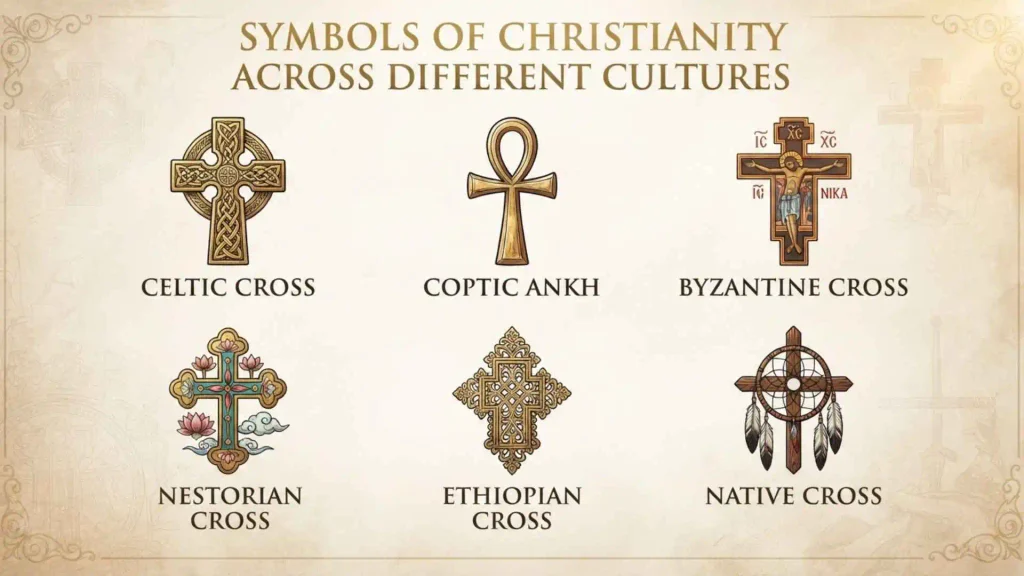
Ancient Egypt
Egyptian culture influenced the visual world in which early Christianity developed. Egyptian Christians, later known as Copts, adapted local artistic forms to express Christian belief.
The ankh, an ancient Egyptian sign of life, visually resembled a cross with a loop. The Coptic cross developed its own distinctive forms, symbolizing eternal life through Christ.
Ancient Greece
Greek language and philosophy played major roles in early Christian theology. The New Testament was written in Koine Greek, and symbols such as Alpha and Omega, Ichthys, and Chi-Rho came directly from Greek letters and words.
Greek Christian art later became central to the Eastern Orthodox tradition, especially through icons and mosaics.
Roman Culture
The Roman Empire provided roads, cities, and shared institutions that helped Christianity spread. At first, crucifixion was a shameful Roman punishment. Christians transformed the cross from an image of disgrace into a sign of spiritual victory.
After Constantine’s rise in the fourth century, Christian symbols appeared more openly in imperial banners, basilicas, coins, and public monuments.
Eastern Traditions
Eastern Christianity developed rich symbolic traditions in Byzantine, Syriac, Armenian, Ethiopian, and Slavic cultures.
Orthodox icons are not treated merely as decoration. They are understood as sacred images that direct attention toward Christ, Mary, angels, and the saints. Gold backgrounds often symbolize heavenly reality, while light represents divine glory.
Indigenous Traditions
In many Indigenous Christian communities, biblical themes have been expressed through local materials and artistic styles. Crosses may include regional patterns, plants, animals, or traditional carving techniques.
These blended forms can represent both Christian faith and cultural identity. However, they must also be understood within the painful history of colonization and missionary activity.
Modern Interpretations
Today, Christian symbols appear in minimalist logos, digital illustrations, social media profiles, tattoos, music videos, and fashion.
Some people use them as expressions of active faith. Others wear them for family tradition, cultural identity, remembrance, or personal strength. Context helps determine the intended meaning.
Similar Symbols and Their Meanings
| Symbol | Main Meaning | Similarity | Key Difference |
| Cross | Sacrifice and salvation | Represents Christian faith | Directly connected with Jesus’ crucifixion |
| Crucifix | Christ’s suffering | A form of the cross | Includes the body of Jesus |
| Fish | Christian identity | Represents Jesus and discipleship | Was often more discreet in early Christianity |
| Dove | Holy Spirit and peace | Expresses divine presence | Focuses on purity, peace, and spiritual movement |
| Anchor | Hope and stability | Suggests trust in God | Emphasizes endurance during hardship |
| Lamb | Christ and sacrifice | Represents salvation | Highlights innocence and willing sacrifice |
| Flame | Holy Spirit and transformation | Points to divine power | Emphasizes energy, purification, and inspiration |
A common misconception is that every cross design has the same meaning. In reality, Latin, Greek, Coptic, Celtic, Orthodox, and Jerusalem crosses reflect different histories and traditions.
Symbols of Christianity in Mythology and Folklore
Christian symbolism often developed through biblical narratives, saints’ legends, and regional folklore.
The legend of Saint George and the dragon became a symbolic story of faith defeating evil. The pelican was once believed to feed its young with its own blood, so medieval Christians used it as an image of Christ’s self-sacrifice.
The phoenix, a bird said to rise from its ashes, became associated with resurrection. Although it came from ancient mythology rather than the Bible, Christian writers adopted it as a picture of life overcoming death.
Such stories helped people understand theology through memorable images, especially when books were rare and literacy was limited.
Symbols of Christianity in Art, Literature, Movies, and Pop Culture
Christian symbols fill major works of Western and global art. Medieval paintings used halos, lilies, keys, crowns, and specific colors to identify sacred figures and spiritual qualities.
In literature, writers such as Dante, John Milton, Fyodor Dostoevsky, and C. S. Lewis used Christian imagery to explore sin, grace, temptation, sacrifice, and redemption.
Movies often use cross-shaped lighting, baptism-like water scenes, resurrection themes, or self-sacrificing heroes. These images can appear even in stories that are not openly religious.
In tattoos and fashion, crosses, praying hands, sacred hearts, wings, and biblical verses may express faith, grief, protection, family memory, or personal recovery.
Spiritual and Dream Meaning of Symbols of Christianity
Dreaming about Christian symbols may reflect faith, guilt, forgiveness, hope, fear, or a desire for guidance. Dream meanings are personal, so no symbol has one guaranteed interpretation.
A bright cross may suggest hope, commitment, or the need to make a moral choice. A broken cross may reflect spiritual conflict, disappointment, or changing beliefs. A dove may represent peace, healing, or emotional release.
From a Christian perspective, dreams should be approached carefully. They can reflect ordinary thoughts and emotions. Believers may choose to compare a dream’s message with Scripture, prayer, wisdom, and sound judgment rather than treating every dream as a divine prediction.
Positive and Negative Meanings of Symbols of Christianity
| Positive Meaning | Negative or Cautionary Meaning |
| Faith and hope | Empty display without sincere belief |
| Sacrifice and love | Suffering, persecution, or grief |
| Forgiveness | Feelings of guilt or judgment |
| Spiritual protection | Fear-based superstition |
| Community and belonging | Exclusion or misuse of religious authority |
| Eternal life | Anxiety about death or the afterlife |
| Moral courage | Conflict when symbols are used politically or aggressively |
A symbol can carry both light and shadow. The cross comforts millions, yet it also recalls execution and suffering. Its deeper power comes from holding pain and hope together.
Why Humans Are Attracted to Symbols of Christianity
People are drawn to Christian symbols because they make invisible beliefs visible.
Humans naturally search for patterns and attach meaning to familiar shapes. A symbol can become connected with childhood, family, worship, grief, safety, or a life-changing moment.
Christian symbols also carry collective memory. Generations have seen the cross at births, weddings, hospitals, funerals, and public ceremonies. This repeated presence gives it emotional weight.
Most importantly, sacred symbols help people tell personal stories. A small pendant may represent recovery from illness. An anchor tattoo may honor hope during depression. A candle may preserve the memory of someone loved and lost.
Modern Uses of Symbols of Christianity
Christian symbols continue to appear in many parts of daily life:
- Tattoos: Crosses, doves, fish, sacred hearts, and Scripture references express belief or remembrance.
- Jewelry: Necklaces, rings, bracelets, and pins offer visible reminders of faith.
- Fashion: Christian images appear on shirts, hats, and accessories.
- Branding: Churches, charities, schools, and ministries use crosses, flames, doves, and open Bibles in logos.
- Social media: Symbols appear in profile images, posts, digital art, and faith-based messages.
- Contemporary spirituality: Candles, prayer corners, icons, and devotional art support reflection.
- Home decor: Wall crosses, biblical prints, and nativity scenes create a faith-centered environment.
- Personal expression: People use symbols to communicate identity, values, grief, gratitude, or hope.
Interesting Facts About Symbols of Christianity
- The cross was not the only important early Christian symbol. Fish, anchors, shepherds, and monograms were also widely used.
- Early images of Jesus often showed him as a young shepherd rather than suffering on a cross.
- The Chi-Rho monogram combines the first two Greek letters of Christos, meaning Christ.
- The peacock became a Christian symbol of immortality because ancient people believed its flesh did not decay.
- The halo existed in ancient art before Christianity and was later used to show holiness and divine glory.
- The Jerusalem cross contains one large cross and four smaller crosses. It is often linked with Christ and the four Gospels spreading across the world.
- The Celtic cross combines a cross with a circle, which may symbolize eternity, divine unity, or the glory of God.
- Purple became associated with royalty, repentance, and Christ’s suffering.
- White commonly represents purity, resurrection, and celebration in Christian worship.
- Many church buildings are designed in the shape of a cross when viewed from above.
Frequently Asked Questions
What is the main symbol of Christianity?
The cross is the main symbol of Christianity. It represents the crucifixion of Jesus, his sacrifice for humanity, and the Christian belief in resurrection and salvation.
What are the oldest symbols of Christianity?
Some of the oldest Christian symbols include the fish, anchor, Good Shepherd, Chi-Rho, dove, and praying figure. Several appear in early Christian tombs and catacombs.
Why is the fish a Christian symbol?
The fish represented Jesus Christ and helped early believers identify their faith. Its Greek name, ichthys, was connected with a confession describing Jesus as Christ, God’s Son, and Savior.
What symbol represents the Holy Spirit?
The dove is the best-known symbol of the Holy Spirit. Fire, wind, water, and oil can also represent the Spirit’s presence and activity.
What Christian symbol represents hope?
The anchor is a traditional Christian symbol of hope. It expresses spiritual stability, trust in God, and strength during suffering or uncertainty.
Are Christian symbols worshipped?
Most Christian traditions teach that worship belongs to God alone. Symbols may support prayer, teaching, memory, and devotion, but views about sacred images differ among Christian denominations.
Conclusion
Symbols of Christianity turn faith, memory, suffering, and hope into images people can carry through life.
From the cross and fish to the dove, lamb, anchor, and flame, each sign opens a doorway into biblical history and spiritual meaning.
Their power does not rest only in their shape, but in the stories, beliefs, and emotions connected with them.
A sacred symbol becomes most meaningful when it inspires love, courage, forgiveness, and a deeper awareness of God.
 Sarah Thompson
 John Mercer