
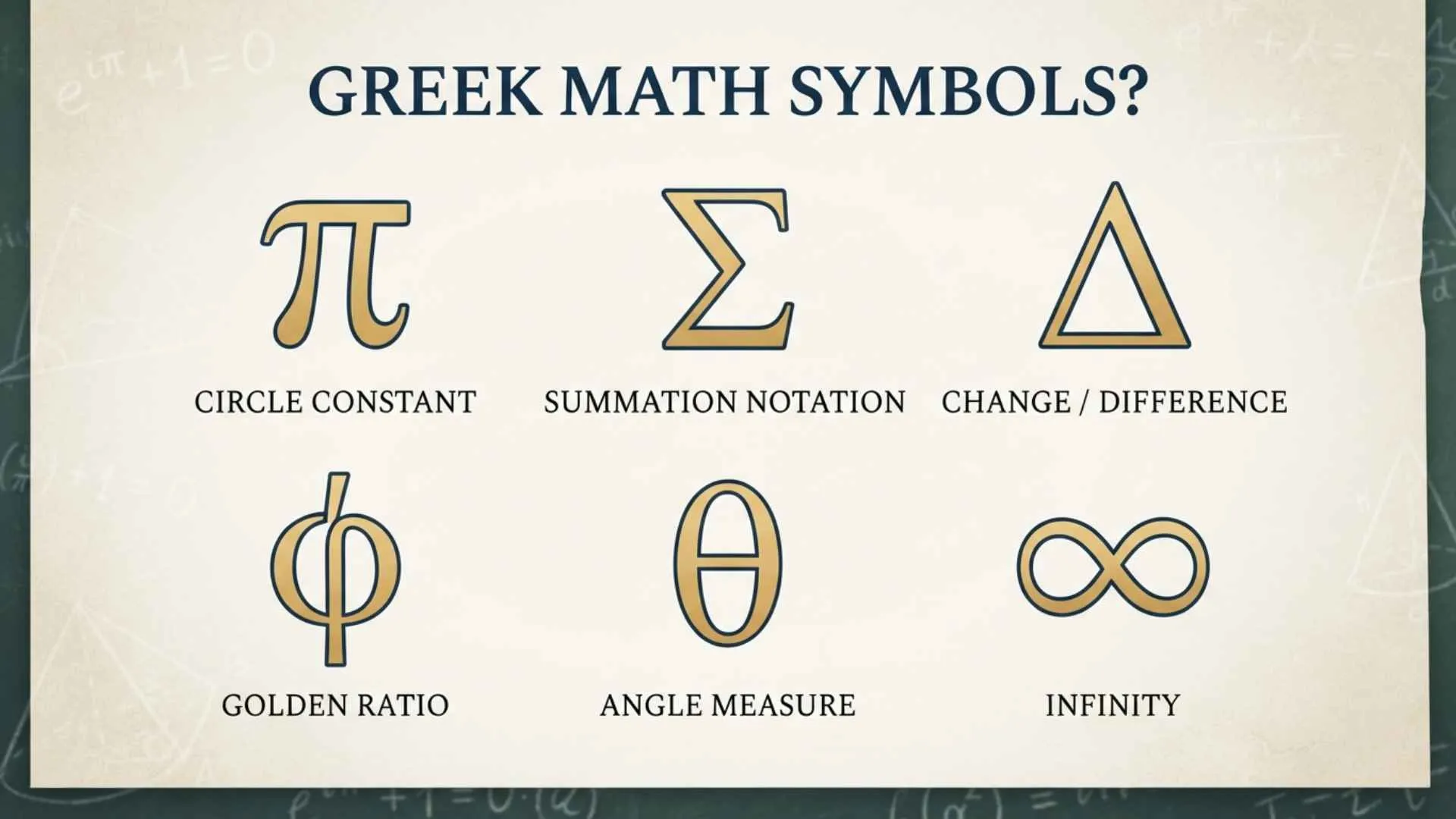
Greek math symbols are an essential part of mathematics, science, engineering, statistics, and advanced academic studies. Letters such as alpha (α), beta (β), pi (π), theta (θ), sigma (Σ), and delta (Δ) appear in equations, formulas, graphs, and mathematical expressions. Although these symbols may look unfamiliar at first, each serves a specific purpose. They help mathematicians represent numbers, variables, angles, constants, functions, and complex relationships using simple notation.
Different Greek letters have different meanings depending on the mathematical subject and context. For example, pi (π) represents the ratio of a circle’s circumference to its diameter, while sigma (Σ) indicates summation. Alpha (α) and beta (β) often represent variables or angles, theta (θ) commonly represents an unknown angle, and delta (Δ) can indicate a change or difference. You will also find Greek symbols in calculus, algebra, geometry, probability, physics, and statistical formulas. Understanding these symbols makes mathematical expressions easier to read and interpret.
In this complete guide to Greek math symbols, you will explore their names, meanings, pronunciations, mathematical uses, and historical origins. You will discover the differences between uppercase and lowercase Greek letters, learn how symbols appear in important formulas, and understand why mathematicians continue to use this ancient alphabet. Whether you are a student, teacher, researcher, or simply curious about mathematical notation, this guide will help you recognize and understand the Greek symbols used in everyday and advanced mathematics.
Quick Answer
Greek math symbols are letters from the Greek alphabet used to represent mathematical variables, constants, functions, operations, angles, sets, and statistical values. Common examples include π for the circle constant, Σ for summation, Δ for change, θ for an angle, and μ for a population mean.
Quick Facts About Greek Math Symbols
| Aspect | Information |
| Origin | The symbols come from the Greek alphabet, which developed in ancient Greece from an earlier Phoenician writing system. |
| Historical Significance | Greek letters gave scholars an expanded set of characters for naming geometric objects, quantities, constants, and functions. |
| Main Meaning | Their meanings depend on context. A single letter may represent an angle, variable, operator, constant, or physical quantity. |
| Spiritual Meaning | Greek math symbols have no universal spiritual meaning, although people may interpret shapes such as circles, triangles, and infinity through philosophical or spiritual ideas. |
| Cultural Importance | They connect ancient Greek language and scholarship with the international language of mathematics and science. |
| Modern Usage | They appear in algebra, geometry, calculus, statistics, physics, engineering, economics, computing, medicine, and finance. |
What Are Greek Math Symbols?
Greek math symbols are uppercase and lowercase letters from the Greek alphabet that have been assigned conventional roles in mathematical notation.
The Greek alphabet contains 24 letters. Many of them appear in mathematics, although some are used more often than others. Lowercase and uppercase forms can have completely different meanings. For example, lowercase sigma, σ, commonly represents standard deviation, while uppercase sigma, Σ, is used as a summation operator.
Greek symbols do not have one fixed meaning in every equation. Their meaning is determined by the subject, formula, and definition given by the writer. The symbol λ may describe an eigenvalue in linear algebra, a wavelength in physics, a rate in probability, or a parameter in another mathematical model.
NIST explains that symbols for quantities are often single letters from the Latin or Greek alphabets, sometimes combined with subscripts, superscripts, or other marks.
The Origin of the Greek Alphabet
The Greek alphabet emerged during the early first millennium BCE. It developed from the Phoenician script, but Greek writers made an important change by creating clear letters for vowel sounds.
The word “alphabet” itself comes from the names of the first two Greek letters, alpha and beta.
Ancient Greek mathematicians such as Euclid, Archimedes, Apollonius, and Ptolemy wrote about geometry, number theory, astronomy, and measurement. However, their notation was not identical to modern mathematical symbolism. Many Greek letters gained their present technical roles much later, especially during the growth of European mathematics from the Renaissance onward.
Why Did Mathematicians Begin Using Greek Letters?
As mathematics expanded, scholars needed more symbols.
Latin letters such as x, y, a, and b were already being used for unknowns, coordinates, coefficients, and ordinary variables. Greek letters gave mathematicians another organized set of characters that could represent special quantities without requiring long written descriptions.
This made formulas shorter and easier to share across languages.
For example:
- π is easier to write than “the ratio of a circle’s circumference to its diameter.”
- Σ is more efficient than repeatedly writing a long sequence of additions.
- Δ quickly tells the reader that a change or difference is being measured.
- θ clearly identifies an angle without confusing it with a common algebraic variable.
How Greek Math Symbols Evolved
Modern notation developed slowly.
Ancient mathematical texts often described ideas through words and geometric diagrams. During the Renaissance and early modern period, printed books encouraged scholars to adopt shorter and more standardized notation.
Leonhard Euler was especially influential in shaping mathematical language during the eighteenth century. His work helped establish or popularize several conventions used in analysis, geometry, trigonometry, and number theory.
Today, Greek letters are encoded digitally through Unicode and can be written in word processors, websites, programming languages, and scientific typesetting systems. The Unicode Greek and Coptic block includes the characters needed for standard Greek letters and several variant forms used in technical contexts.
Common Greek Math Symbols and Their Meanings
The following table shows the most common Greek letters used in mathematics. Their exact meanings may change according to context.
| Symbol | Name | Common Mathematical Uses |
| α | Alpha | Angles, coefficients, significance level, parameters |
| β | Beta | Coefficients, angles, beta functions, regression parameters |
| γ | Gamma | Angles, Euler’s constant, gamma function, curves |
| Γ | Capital Gamma | Gamma function, groups, distributions |
| δ | Delta | Small change, variation, Dirac delta, Kronecker delta |
| Δ | Capital Delta | Change, difference, discriminant, Laplacian, triangle |
| ε or ϵ | Epsilon | Small positive quantity, error, limit tolerance |
| ζ | Zeta | Riemann zeta function, complex variables |
| η | Eta | Parameters, efficiency, transformations |
| θ or ϑ | Theta | Angles, parameters, asymptotic notation |
| Θ | Capital Theta | Set or parameter space, tight asymptotic bound |
| κ | Kappa | Curvature, condition number, constants |
| λ | Lambda | Eigenvalues, parameters, rates, wavelength |
| Λ | Capital Lambda | Diagonal matrix, lattice, logical expressions |
| μ | Mu | Population mean, measure, small parameter |
| ν | Nu | Degrees of freedom, frequency, parameter |
| ξ | Xi | Random variables, coordinates, special functions |
| π | Pi | Circle constant, permutations, products |
| Π | Capital Pi | Product notation, projection, product set |
| ρ | Rho | Correlation, density, radius, distance |
| σ | Sigma | Standard deviation, permutation, function |
| Σ | Capital Sigma | Summation, alphabet or set in formal language |
| τ | Tau | Circle constant alternative, topology, divisor function |
| φ or ϕ | Phi | Golden ratio, angle, function, Euler totient |
| Φ | Capital Phi | Distribution function, golden ratio in some contexts |
| χ | Chi | Chi-square distribution, characteristic functions |
| ψ | Psi | Wave functions, functions, mappings |
| ω | Omega | Angular frequency, smallest infinite ordinal, event outcome |
| Ω | Capital Omega | Sample space, domain, asymptotic lower bound |
Deep Symbolic Meaning of Greek Math Symbols
Greek math symbols are practical tools rather than sacred signs. Still, their visual forms and mathematical roles can inspire philosophical, psychological, and cultural interpretations.
It is important to separate established mathematical definitions from personal symbolism. In an equation, π does not officially mean eternity, and Δ does not spiritually guarantee transformation. Those ideas come from human interpretation rather than mathematical convention.
Spiritual Level
Mathematics has often been connected with ideas of cosmic order, proportion, harmony, and truth.
The Pythagorean tradition treated number and ratio as central to the structure of reality. Later thinkers continued to see geometry and mathematics as ways of understanding an ordered universe.
Because of these associations, some Greek symbols are given modern spiritual interpretations:
- π may represent cycles, wholeness, and the endless nature of numerical discovery.
- Δ may represent transformation because it means change in many formulas.
- Σ may suggest unity because it gathers separate terms into a total.
- φ may represent harmony because it is often connected with the golden ratio.
- Ω may symbolize completion because omega is the final letter of the Greek alphabet.
These are metaphorical meanings. They are not formal mathematical definitions.
Inner Transformation
Delta is one of the strongest examples of a mathematical symbol becoming a personal metaphor.
In mathematics, Δ often represents the difference between two values:
Δx = x₂ − x₁
In personal reflection, this can become a symbol of the distance between where someone began and where they are now. The mathematical idea is measurable change. The emotional interpretation is growth.
Sigma offers another useful metaphor. A summation joins many individual terms into one result. In human life, identity can also be seen as the sum of experiences, relationships, choices, and memories.
Soul and Consciousness Connections
There is no scientific evidence that Greek letters directly reveal the soul or control consciousness.
However, people naturally use symbols to think about experiences that are difficult to express in ordinary words. A simple character can become a mental container for a larger idea.
Omega may remind someone of endings. Alpha may suggest beginnings. Theta may evoke cycles or meditation because of its circular form. These associations reveal more about human meaning-making than about the mathematical symbols themselves.
Psychological Meaning of Greek Math Symbols
Pattern Recognition
The human brain is highly responsive to patterns.
When students first encounter Greek notation, the unfamiliar forms may create anxiety. Once the symbols are connected with clear concepts, they become mental shortcuts. Seeing Σ can instantly activate the idea of adding a sequence. Seeing θ may bring angles and trigonometry to mind.
This process is called symbolic association. The brain learns to connect a visual mark with a concept, action, or relationship.
Cognitive Efficiency
Mathematical notation reduces mental and visual clutter.
Consider the sentence:
“Add every value of x beginning at the first value and ending at the hundredth value.”
The same idea can be expressed as:
Σxᵢ, from i = 1 to 100
The symbolic version is shorter and easier to manipulate. It allows the mind to focus on the structure of the problem instead of repeatedly reading a long verbal instruction.
Archetypes and Jungian Interpretation
Swiss psychologist Carl Jung argued that certain symbolic patterns appear repeatedly in myths, dreams, art, and human imagination.
Greek mathematical letters are not standard Jungian archetypes. Yet shapes within mathematics can overlap with archetypal images.
The circle may represent wholeness. A triangle may suggest balance, conflict, or transformation. The first and last letters, alpha and omega, may evoke the archetypal journey from beginning to completion.
Such interpretations belong to psychology, religion, and cultural symbolism rather than formal mathematics.
Emotional Attraction
Many people find mathematical symbols beautiful because they compress a large idea into a small form.
The symbol π can carry geometry, history, infinite decimals, and childhood memories of school. Sigma may remind a student of statistics, while lambda may feel linked to advanced science or computer programming.
A symbol becomes emotionally powerful when knowledge and personal experience meet.
Cultural Meaning of Greek Math Symbols
Greek notation reflects the international character of knowledge.
A mathematician in Pakistan, Greece, Brazil, Japan, or the United States can often understand the same formula even when their spoken languages differ. Mathematical symbols create a shared system that crosses national borders.
Greek letters also preserve a visible link with the intellectual history of the Mediterranean world. Modern science did not come from one civilization alone, but Greek notation honors one important branch of that larger history.
Arabic, Indian, Persian, Chinese, Egyptian, Babylonian, European, and many other traditions made major contributions to mathematics. The use of Greek letters should therefore be understood as part of a multicultural development of knowledge, not as proof that mathematics belonged to only one culture.
Types and Variations of Greek Math Symbols
Alpha: α and Α
Visual description: Lowercase alpha often appears as a rounded loop with a curved stroke. Uppercase alpha looks like the Latin letter A.
Meaning: Alpha commonly represents angles, coefficients, parameters, or a statistical significance level.
Symbolism: Because alpha is the first Greek letter, it may suggest beginnings, leadership, or a starting point.
Cultural connection: Alpha appears in Greek language, Christian expressions, academic organizations, science, and branding.
Where it appears: Trigonometry, algebra, statistics, physics, astronomy, and finance.
Beta: β and Β
Visual description: Lowercase beta has a long vertical stroke and two rounded curves.
Meaning: Beta often represents coefficients, angles, probability parameters, or regression values.
Symbolism: It may suggest a second stage, testing phase, or developing form because beta follows alpha.
Cultural connection: “Beta testing” in software refers to a product stage before final release.
Where it appears: Statistics, calculus, finance, computing, and physics.
Gamma: γ and Γ
Visual description: Lowercase gamma has a descending curved stroke. Capital gamma resembles a right angle.
Meaning: Gamma may represent the gamma function, Euler’s constant, angles, or parameters in probability distributions.
Symbolism: Its formal meaning varies widely, so it has no single universal symbolic interpretation.
Cultural connection: Gamma appears in mathematics, gamma radiation, astronomy, and scientific naming systems.
Where it appears: Calculus, number theory, statistics, geometry, and physics.
Delta: δ and Δ
Visual description: Capital delta is a triangle. Lowercase delta is a looped character with a rising stroke.
Meaning: Delta represents change, difference, variation, a discriminant, or specialized functions.
Symbolism: Transformation, movement, contrast, and transition.
Cultural connection: River deltas were named because their triangular shapes resemble capital delta.
Where it appears: Algebra, calculus, geometry, physics, engineering, and geography.
Epsilon: ε and ϵ
Visual description: Epsilon has two common lowercase forms. One resembles a rounded backward 3, while the other looks like a curved lunate form.
Meaning: Epsilon often represents a very small positive number, an error limit, or a tolerance.
Symbolism: Smallness, precision, closeness, and the narrow space between approximation and certainty.
Cultural connection: Epsilon is central to rigorous definitions of limits and continuity.
Where it appears: Calculus, real analysis, numerical methods, optimization, and computer science.
Theta: θ and ϑ
Visual description: Theta often looks like a circle or oval with a horizontal line through it.
Meaning: Theta commonly represents an unknown angle or parameter.
Symbolism: Cycles, direction, rotation, and measurement.
Cultural connection: It is one of the most recognizable letters in trigonometry.
Where it appears: Geometry, trigonometry, statistics, algorithms, and physics.
Lambda: λ and Λ
Visual description: Lowercase lambda looks like a bent rising stroke. Capital lambda resembles an inverted V.
Meaning: Lambda may represent an eigenvalue, rate, wavelength, parameter, or anonymous function.
Symbolism: Frequency, transformation, relationship, and abstract structure.
Cultural connection: Lambda has been used in logic, computing, physics, and social identity movements.
Where it appears: Linear algebra, probability, physics, programming, and calculus.
Pi: π and Π
Visual description: Lowercase pi has two vertical strokes joined by a curved or flat top. Capital pi resembles a squared arch.
Meaning: Lowercase π usually represents the circle constant, approximately 3.14159. Capital Π often represents multiplication across a sequence.
Symbolism: Circles, continuity, endless exploration, and mathematical beauty.
Cultural connection: Pi Day is celebrated on March 14 because the date 3/14 resembles the first digits of π.
Where it appears: Geometry, trigonometry, calculus, probability, physics, and popular culture.
Sigma: σ and Σ
Visual description: Lowercase sigma is rounded, while capital sigma has an angular form similar to a sideways zigzag.
Meaning: Lowercase sigma often represents standard deviation. Capital sigma indicates summation.
Symbolism: Accumulation, totality, variation, and collective structure.
Cultural connection: Sigma is common in statistics, quality control, Greek organizations, and internet culture.
Where it appears: Statistics, algebra, calculus, probability, computer science, and engineering.
Phi: φ, ϕ, and Φ
Visual description: Phi may appear as a circle crossed by a vertical line or as a looped form with a descending stroke.
Meaning: Phi can represent the golden ratio, an angle, Euler’s totient function, or a general function.
Symbolism: Proportion, harmony, balance, and growth.
Cultural connection: Phi is often associated with discussions of art, architecture, nature, and design.
Where it appears: Number theory, geometry, algebra, art theory, and physics.
Omega: ω and Ω
Visual description: Lowercase omega resembles a curved w. Capital omega has a broad arch with outward feet.
Meaning: Omega may represent angular frequency, the first infinite ordinal, a sample space, or asymptotic bounds.
Symbolism: Completion, limits, endings, and vastness.
Cultural connection: Omega is the last letter of the Greek alphabet and appears in religion, branding, physics, and computing.
Where it appears: Set theory, probability, algorithms, electrical engineering, and mechanics.
Greek Math Symbols Across Different Cultures
Greek mathematical notation is now global, but each culture encountered mathematics through its own history.
Ancient Egypt

Ancient Egyptian mathematics developed long before modern Greek notation.
Egyptian scribes used hieroglyphic and hieratic numerals to solve practical problems involving land, construction, grain, taxation, and measurement. Documents such as the Rhind Mathematical Papyrus show arithmetic, fractions, geometry, and problem-solving methods.
Greek letters were not part of the original Egyptian system. However, later Greek-speaking scholars worked in Egypt, especially in Alexandria. This created an important meeting point for Egyptian, Greek, Jewish, Roman, and other intellectual traditions.
Ancient Greece
Greek culture provided the alphabet from which the symbols come.
Mathematicians such as Euclid organized geometry through definitions, propositions, and proofs. Archimedes studied areas, volumes, mechanics, and approximations related to circles. Greek astronomy and geometry shaped later scientific study.
Still, ancient Greek mathematicians did not use every modern symbol exactly as students do today. Modern Greek mathematical notation developed through centuries of reinterpretation and standardization.
Roman Culture
Roman scholars inherited and translated much Greek learning.
Latin became the main scholarly language in Western Europe for many centuries. As a result, Greek and Latin letters eventually appeared together in scientific writing.
Roman numerals were useful for recording values, dates, and accounts, but they were less convenient for advanced symbolic calculation. Later European mathematics combined Hindu-Arabic numerals, Latin letters, Greek letters, and newly invented operational signs.
Islamic Golden Age
From roughly the eighth to the fourteenth centuries, scholars working in Arabic made major advances in algebra, astronomy, geometry, optics, and calculation.
They translated, preserved, criticized, and expanded Greek mathematical works. They also drew on Indian and Persian knowledge.
The word “algebra” comes from the Arabic title of a work associated with al-Khwarizmi. Modern mathematics therefore combines Greek symbolic heritage with foundational contributions from the Islamic world and many other civilizations.
Indian Traditions
Indian mathematicians developed the decimal place-value system and powerful methods involving zero, algebra, trigonometry, and infinite series.
Modern formulas may use Greek letters to express ideas, but the underlying concepts often have multicultural histories. For example, trigonometric knowledge developed through interaction among Greek, Indian, Islamic, and European scholars.
Chinese Traditions
Ancient Chinese mathematics used counting rods, written characters, diagrams, and practical algorithms.
Texts such as The Nine Chapters on the Mathematical Art addressed equations, measurement, fractions, and geometry. Greek letters were not part of that original tradition.
Today, Chinese students and researchers use Greek notation as part of international mathematics while also studying their own mathematical heritage.
Eastern Traditions
Across Japan, Korea, South Asia, and other regions, Greek mathematical symbols are now standard in schools, universities, laboratories, and engineering work.
They function less as “Greek cultural signs” and more as internationally shared technical notation.
Indigenous Traditions
Indigenous cultures around the world developed sophisticated systems of counting, navigation, measurement, pattern, architecture, astronomy, and environmental knowledge.
Greek letters were generally not part of these original systems. Applying Greek notation to Indigenous knowledge can be useful in modern scientific description, but it should not erase the culture’s own language, symbols, and methods.
Modern Interpretations
Today, Greek math symbols belong to global education and research.
They appear in textbooks, computer code, scientific papers, engineering diagrams, financial models, and online communication. Their modern cultural significance comes from international agreement rather than a single religious or national tradition.
Similar Symbols and Their Meanings
| Greek Symbol | Similar Symbol | Similarity | Important Difference |
| Δ | Triangle △ | Both are triangular | Δ often means change, while △ may simply represent a geometric triangle |
| Σ | E | Their shapes can appear similar in some fonts | Σ is Greek sigma and often means summation |
| π | Product symbol Π | Both are forms of pi | π is usually the circle constant, while Π often means repeated multiplication |
| μ | Latin u | They may look alike in handwriting | μ is Greek mu and often represents a mean or micro-related quantity |
| ν | Latin v | Both may appear as a pointed curve | ν is nu, while v is a Latin variable |
| ρ | Latin p | Both can look similar | ρ is rho and often represents correlation or density |
| χ | Latin x | Both use crossing strokes | χ is chi and appears in chi-square notation |
| ω | Latin w | Both have a double-curve form | ω is omega and has specialized mathematical meanings |
| φ | Empty-set symbol ∅ | Both may contain a circle and line | φ is phi, while ∅ means the empty set |
| ε | Membership symbol ∈ | Both may look like curved E forms | ε is epsilon, while ∈ means “is an element of” |
Common Misconceptions
One frequent mistake is assuming every symbol has a single permanent meaning.
In reality, mathematical notation depends on context. The same letter may represent different ideas in geometry, statistics, physics, and computing.
Another misconception is that all mathematical symbols are Greek. Signs such as +, −, =, ∞, ∫, and √ come from different historical sources.
Greek letters are only one part of the larger system of mathematical notation.
Greek Math Symbols in Mythology and Folklore
Greek math symbols themselves are alphabetic characters, not mythological objects.
However, their names belong to the Greek language, which also carried the myths of Zeus, Athena, Apollo, Hermes, and other figures. This shared cultural origin sometimes causes people to assume that every Greek letter has a mythological meaning.
Most do not.
A letter such as theta or sigma was originally part of ordinary written language. Its mathematical meaning came from scholarly convention, not a legend about a god.
Alpha and Omega in Religious Tradition
Alpha and omega gained strong symbolic importance in Christianity because they are the first and last letters of the Greek alphabet.
They came to represent beginning and end, completeness, and divine eternity. In mathematics, however, α and Ω have technical meanings determined by the equation or discipline.
The religious and mathematical uses can coexist, but they should not be confused.
Pi and the Myth of Perfect Circles
Pi is sometimes surrounded by almost mythical language because its decimal expansion continues without repeating.
This does not make π supernatural. It is an irrational and transcendental number with well-defined mathematical properties.
Its emotional power comes from a simple fact: every perfect circle, regardless of size, shares the same circumference-to-diameter ratio.
Phi and the Golden Ratio Legend
Phi is often linked with claims about perfect beauty, ancient temples, the human body, and universal design.
Some relationships involving the golden ratio are real. Others are exaggerated, selected after the fact, or based on loose measurement.
Phi is mathematically important, but it should not be treated as a secret code that controls all beauty in nature and art.
Greek Math Symbols in Art, Literature, Movies, and Pop Culture
Paintings and Visual Art
Artists often use π, φ, geometric diagrams, and equations to suggest intelligence, balance, mystery, or hidden order.
Phi is especially popular in discussions of proportion. Some artists deliberately use golden rectangles or spirals, although not every visually pleasing composition follows the golden ratio.
Literature
Greek symbols can represent abstraction, destiny, science, or intellectual struggle in fiction.
A writer may use omega to suggest an ending, delta to suggest change, or infinity-related mathematics to explore the limits of human knowledge.
In academic literature, the symbols usually retain precise technical meanings.
Poetry
Poets sometimes borrow mathematical language to describe emotions.
A relationship may be called an equation. Memory may become a sum. Love may be compared with an irrational number. Change may be represented by delta.
These metaphors work because mathematics offers a language of order, distance, probability, and uncertainty.
Movies and Television
Greek equations often appear on classroom boards, laboratory screens, and futuristic displays.
Sometimes the notation is accurate. In other cases, it is visual shorthand designed to communicate “advanced science” quickly.
Pi, omega, lambda, and sigma are especially recognizable to general audiences.
Tattoos
Popular Greek math symbol tattoos include:
- π for a love of mathematics or endless discovery
- Δ for personal change
- Σ for the sum of life experiences
- φ for balance or the golden ratio
- Ω for completion
- λ for science, identity, or transformation
The meaning of a tattoo is personal. A symbol should be checked carefully before it is permanently used because uppercase, lowercase, and variant forms may represent different ideas.
Fashion
Greek letters appear on shirts, jewelry, watches, university clothing, and accessories.
Some designs celebrate mathematics or science. Others reference Greek-letter organizations, brands, or internet trends. Context is essential because the same letter can belong to several unrelated communities.
Modern Design and Branding
Brands use Greek letters because they look concise, technical, classical, and memorable.
Alpha may imply leadership. Omega may imply completion. Delta may imply change. Sigma may imply quality, measurement, or advanced performance.
These branding meanings are cultural associations, not mathematical laws.
Spiritual and Dream Meaning of Greek Math Symbols
Dream interpretation is subjective. No scientific dictionary can prove that seeing sigma, pi, or delta in a dream has one universal meaning.
Still, symbols may reflect what a person is learning, fearing, remembering, or trying to understand.
Dreaming About Pi
Pi may appear in a dream when you are thinking about repetition, cycles, complexity, or a problem that seems endless.
For a student, it may simply reflect recent study or exam stress.
Dreaming About Delta
Delta may suggest that your mind is focused on change.
You may be comparing your past and present, considering a decision, or noticing that an important part of life is shifting.
Dreaming About Sigma
Sigma may symbolize accumulation.
Your mind may be trying to add up responsibilities, experiences, costs, or consequences. It may also reflect a desire to understand the larger result of many small actions.
Dreaming About Theta
Theta can be associated with angles, direction, or turning points.
Its circular shape may also remind the dreamer of cycles, boundaries, or inward attention.
Meditation Experiences
Some people choose a Greek symbol as a meditation focus.
Delta may support reflection on change. Alpha may represent a beginning. Omega may represent acceptance or closure.
These practices can be personally meaningful, but they do not change the symbols’ formal mathematical definitions.
Positive Messages
A Greek math symbol may encourage:
- Curiosity
- Focus
- Intellectual growth
- Acceptance of change
- Respect for complexity
- Trust in careful reasoning
Cautionary Messages
The same symbols may also reflect:
- Fear of failure
- Perfectionism
- Mental overload
- Confusion
- A need to simplify
- Overdependence on logic while ignoring emotion
Positive and Negative Meanings of Greek Math Symbols
| Positive Meaning | Negative or Cautionary Meaning |
| Precision | Obsession with perfection |
| Knowledge | Intellectual pride |
| Change and growth | Instability or fear of change |
| Logical structure | Emotional detachment |
| Unity and totality | Loss of individuality |
| Infinite curiosity | Feeling trapped in an endless problem |
| Balance and proportion | Unrealistic search for perfect harmony |
| Shared scientific language | Exclusion of people unfamiliar with notation |
| Efficient communication | Confusion when symbols are undefined |
| Discovery | Anxiety about difficult subjects |
A symbol can represent both light and shadow because people connect it with personal experience.
For one student, sigma may represent the excitement of understanding statistics. For another, it may bring back memories of a stressful exam. The mathematical meaning stays the same, but the emotional meaning changes.
Why Humans Are Attracted to Greek Math Symbols
They Make Complex Ideas Feel Contained
A symbol gives a visible boundary to an abstract thought.
Infinity, probability, variation, curvature, and uncertainty can be difficult to imagine. A letter allows the mind to name and manipulate the concept.
They Create a Sense of Discovery
Greek letters often appear when mathematics becomes more advanced.
Students may first encounter them in geometry, trigonometry, algebra, statistics, or physics. Because of this, they become associated with deeper knowledge and intellectual progress.
They Connect Beauty With Logic
Many people admire a well-written equation in the same way they admire a balanced painting or elegant sentence.
The beauty comes from economy. A small number of symbols can reveal a large relationship.
They Activate Cultural Memory
Greek letters remind people of ancient philosophy, temples, geometry, astronomy, and classical education.
Even when those associations are historically simplified, they give mathematical notation a sense of age and authority.
They Invite Personal Meaning
A symbol is precise inside a formula but open to interpretation outside it.
Delta can be a change in temperature and a symbol of personal transformation. Sigma can be a summation operator and a reminder that small actions create a larger life.
This balance between precision and imagination makes Greek symbols emotionally appealing.
Modern Uses of Greek Math Symbols
Education
Greek symbols appear in school and university courses including:
- Geometry
- Trigonometry
- Algebra
- Calculus
- Statistics
- Probability
- Number theory
- Linear algebra
- Differential equations
Learning the names and common roles of these symbols helps students read formulas with greater confidence.
Statistics
Statistics uses Greek letters frequently because many symbols represent population values.
Common examples include:
- μ for population mean
- σ for population standard deviation
- ρ for population correlation
- α for significance level
- β for a regression coefficient or Type II error probability
- χ² for the chi-square statistic or distribution
Latin letters often represent sample values, while Greek letters often represent population parameters, although this convention is not universal.
Calculus
Calculus uses Greek notation to describe limits, small changes, sequences, functions, and transformations.
Epsilon, ε, is central to rigorous limit definitions. Delta, δ, often represents a chosen input distance. Together, epsilon-delta arguments express how closely one value can control another.
Geometry and Trigonometry
Angles are commonly labeled with Greek letters such as θ, α, β, and γ.
Pi appears in formulas involving circles:
Circumference: C = 2πr
Area: A = πr²
Greek letters allow several angles to be labeled without confusing them with side lengths or coordinates.
Linear Algebra
Lambda often represents an eigenvalue:
Av = λv
Here, multiplying the vector v by the matrix A changes its magnitude by λ without changing its basic direction.
Capital lambda, Λ, may represent a diagonal matrix containing eigenvalues.
Probability
Greek letters can describe parameters, outcomes, rates, and distributions.
Examples include:
- λ as the rate parameter of a Poisson distribution
- μ as an expected value
- σ² as variance
- Ω as a sample space
- θ as an unknown model parameter
Physics and Engineering
Greek letters are essential in technical formulas.
Examples include:
- λ for wavelength
- ω for angular frequency
- ρ for density
- μ for coefficient of friction or permeability
- τ for torque or time constant
- φ for electric potential or phase angle
- Δ for a measurable change
- θ for angular position
The exact meaning must always be defined because usage differs across fields.
Computer Science
Greek symbols appear in:
- Algorithm analysis
- Formal language theory
- Type theory
- Lambda calculus
- Machine learning
- Cryptography
- Logic
- Computational complexity
Capital theta, Θ, describes a tight asymptotic bound. Capital omega, Ω, may represent a lower bound, while capital sigma, Σ, can represent an alphabet in formal language theory.
Finance
In mathematical finance, “the Greeks” describe how the value of an option responds to changing market conditions.
Examples include delta, gamma, theta, vega, and rho. Not all names in this group are actual Greek letters, but the collective term remains common.
Tattoos and Jewelry
People wear Greek symbols to express:
- Love of mathematics
- Academic identity
- Personal change
- Intellectual curiosity
- A meaningful formula
- Connection with science or engineering
Social Media
Symbols such as π, Δ, Σ, α, and Ω appear in usernames, bios, memes, educational posts, and aesthetic designs.
Online usage may differ sharply from formal mathematical meaning. Sigma, for example, has become part of internet slang that is unrelated to summation or standard deviation.
Home Decor
Equations, geometric diagrams, pi digits, and Greek letters appear on posters, clocks, mugs, wall art, and office decorations.
These designs often celebrate learning, curiosity, or a scientific identity.
Personal Expression
A scientist may choose lambda because of wavelength. A statistician may prefer sigma. A mathematics teacher may use pi. A person experiencing major change may identify with delta.
The strongest personal symbol is often the one connected with a real story.
How to Read Greek Math Symbols Correctly
Identify the Letter
First, learn the name of the character.
For example:
- α is read “alpha”
- Δ is read “capital delta”
- θ is read “theta”
- λ is read “lambda”
- μ is read “mu”
- π is read “pi”
- Σ is read “capital sigma”
- φ is read “phi”
- Ω is read “capital omega”
Check the Context
Do not assume the meaning from the symbol alone.
Sigma in a statistics problem may represent standard deviation. Sigma in a calculus expression may indicate a sum. Sigma in computer science may represent a formal alphabet.
Notice Uppercase and Lowercase Forms
Case matters.
- σ and Σ are not interchangeable.
- π and Π usually have different roles.
- ω and Ω may represent different ideas.
- δ and Δ often describe different forms of change or difference.
Read Subscripts and Superscripts
Additional marks provide important information.
For example:
σₓ
may represent the standard deviation of x or a stress component in a specific direction.
λ₁, λ₂, λ₃
may identify several eigenvalues.
Look for Definitions
Good mathematical writing defines unusual notation before using it.
When reading a textbook or paper, search nearby for phrases such as:
- “Let θ represent…”
- “Where λ is…”
- “For every ε > 0…”
- “Define Ω as…”
How to Type Greek Math Symbols
In Microsoft Word
Type the Unicode code and press Alt + X in supported versions.
Examples:
- Type 03C0, then press Alt + X for π
- Type 03A3, then press Alt + X for Σ
- Type 0394, then press Alt + X for Δ
- Type 03BB, then press Alt + X for λ
You can also use Insert > Symbol or the equation editor.
In Google Docs
Select:
Insert > Special characters
Then search for the symbol by name, such as “Greek small letter pi” or “Greek capital letter sigma.”
In LaTeX
LaTeX is widely used for scientific and mathematical writing.
Examples:
| Symbol | LaTeX Command |
| α | \alpha |
| β | \beta |
| γ | \gamma |
| Δ | \Delta |
| ε | \epsilon |
| θ | \theta |
| λ | \lambda |
| μ | \mu |
| π | \pi |
| ρ | \rho |
| σ | \sigma |
| Σ | \Sigma |
| φ | \phi |
| ω | \omega |
| Ω | \Omega |
Overleaf documents the standard LaTeX commands for Greek letters, including alternative forms such as \epsilon, \varepsilon, \phi, and \varphi.
In HTML
Greek symbols can be entered as Unicode characters, numeric character references, or named entities.
For example:
- π displays π
- Σ displays Σ
- Δ displays Δ
- λ displays λ
In Programming
Most modern programming languages support Unicode characters, but many programmers still use written variable names such as theta, lambda, or sigma for readability and compatibility.
In some languages, Unicode variable names are permitted, but team conventions should determine whether they are appropriate.
Interesting Facts About Greek Math Symbols
- Not every Greek letter is equally useful in mathematics.
Letters that closely resemble Latin characters are often avoided because they can cause confusion. - Uppercase and lowercase forms may represent unrelated concepts.
For example, π is the circle constant, while Π commonly means repeated multiplication. - Several Greek letters have alternative printed forms.
Epsilon, theta, phi, pi, rho, and kappa may appear in stylistic variants. - The symbol π was not invented by the ancient Greeks in its modern role.
Its widespread mathematical use developed much later. - Delta is connected with river geography.
A river delta received its name because its triangular shape resembles capital Δ. - Sigma performs two famous mathematical jobs.
Lowercase σ often means standard deviation, while uppercase Σ means summation. - Greek letters help prevent variable confusion.
Mathematicians can assign Latin letters to one class of objects and Greek letters to another. - The golden ratio is often written as φ.
However, not every spiral or attractive design is based on the golden ratio. - Omega can represent infinity without meaning the infinity symbol.
In set theory, ω often represents the first infinite ordinal, while ∞ is a separate symbol. - Greek notation is supported by international digital standards.
Unicode allows Greek letters to be displayed consistently across modern devices and software.
Frequently Asked Questions
What are the most common Greek math symbols?
The most common Greek math symbols include π for the circle constant, Σ for summation, Δ for change, θ for angles, μ for population mean, σ for standard deviation, λ for eigenvalues or rates, and φ for the golden ratio or functions.
Why does mathematics use Greek letters?
Mathematics uses Greek letters because scholars needed more symbols for constants, variables, angles, functions, parameters, and operations. Greek letters expanded the available notation and helped create an internationally recognizable mathematical language.
What does the Greek symbol Δ mean in math?
Capital delta, Δ, usually represents change, difference, a discriminant, a triangle, or the Laplacian operator. Its exact meaning depends on the formula and branch of mathematics.
What does Σ mean in mathematics?
Capital sigma, Σ, is the summation symbol. It instructs the reader to add a sequence of terms according to the starting value, ending value, and expression shown beside it.
What is the difference between π and Π?
Lowercase pi, π, usually represents the circle constant, approximately 3.14159. Capital pi, Π, commonly represents the product of several terms, meaning they should be multiplied together.
Do Greek math symbols have spiritual meanings?
Greek math symbols do not have official spiritual meanings in mathematics. However, people may give them personal or philosophical interpretations, such as delta for transformation, sigma for unity, pi for cycles, and omega for completion.
Conclusion
Greek math symbols are more than unfamiliar letters placed inside difficult equations. They form a precise visual language for expressing angles, change, probability, proportion, functions, and patterns.
Their history connects the Greek alphabet with centuries of multicultural mathematical discovery.
Although their formal meanings depend on context, symbols such as π, Δ, Σ, and Ω can also inspire personal ideas about curiosity, transformation, unity, and completion.
Once you learn to read them, formulas begin to feel less like secret codes and more like clear maps of human thought.
 Michael Rivera