
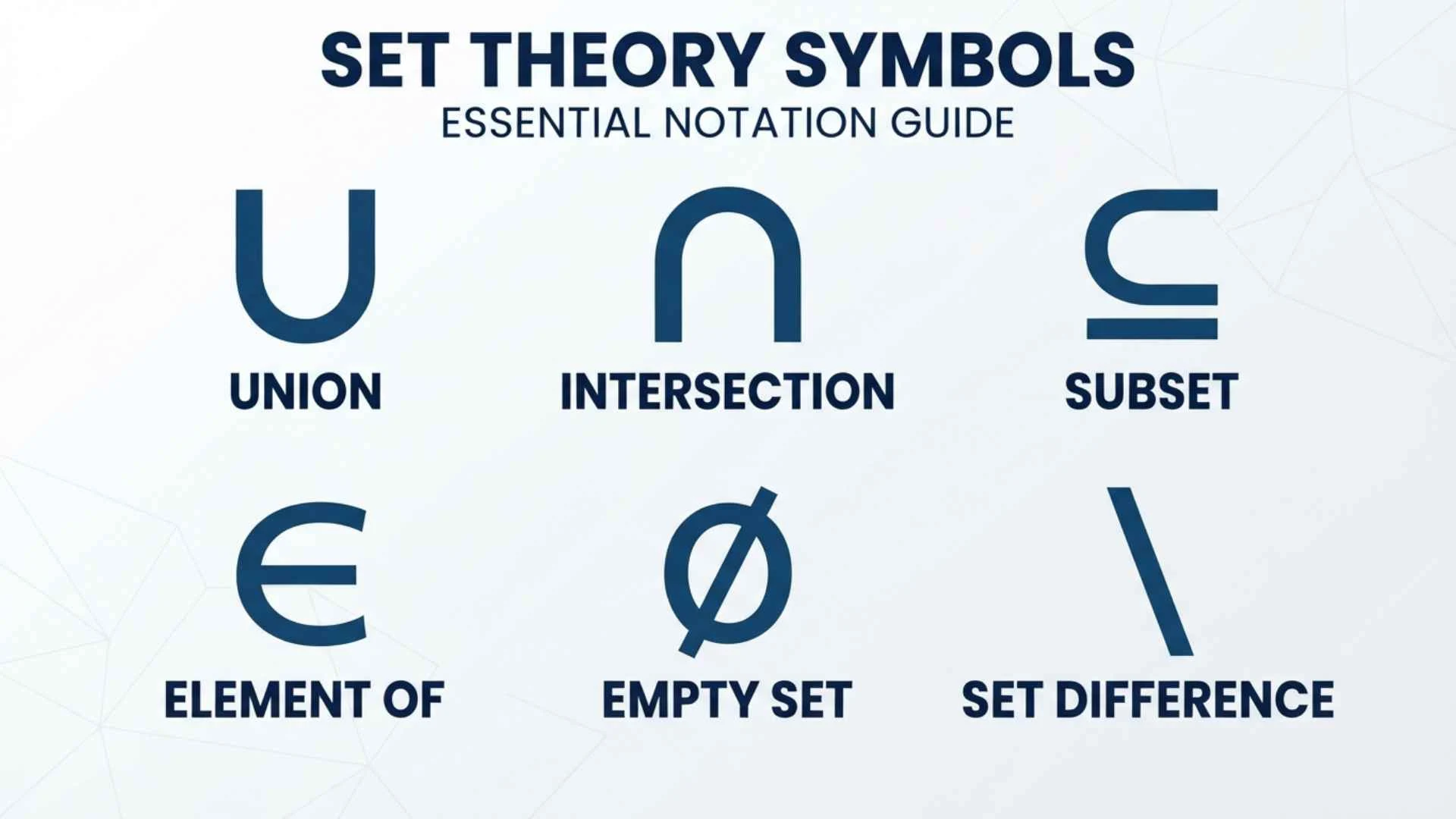
Set theory symbols are essential tools in mathematics that help explain relationships between numbers, objects, groups, and collections. Whether you’re studying basic algebra, discrete mathematics, logic, or advanced mathematical concepts, these symbols make complex ideas easier to understand. From the familiar union (∪) and intersection (∩) signs to subset (⊆), element of (∈), and empty set (∅), each symbol represents a specific mathematical relationship or operation.
Different set theory symbols and their meanings help mathematicians describe how sets interact, compare collections, and organize information. For example, the union symbol combines elements from two or more sets, while the intersection symbol identifies elements they share. Other symbols, such as difference (∖), complement (ᶜ), and Cartesian product (×), describe additional relationships and operations. Understanding these signs also makes Venn diagrams, mathematical proofs, probability, computer science, and logical reasoning much easier to follow.
In this complete guide to set theory symbols, you’ll explore their meanings, mathematical notation, history, practical applications, and common examples. You’ll also learn how to distinguish similar symbols, read set expressions, and understand the logic behind important mathematical operations. Whether you’re a student, teacher, or mathematics enthusiast, this guide will help you recognize set theory notation and use it with greater confidence.
Quick Answer
Set theory symbols are mathematical signs used to describe sets, their elements, and relationships between collections. Common examples include ∈ for “belongs to,” ⊆ for “is a subset of,” ∪ for union, ∩ for intersection, ∅ for the empty set, and ℘ for the power set.
Quick Facts About Set Theory Symbols
| Aspect | Information |
| Origin | Developed from mathematical logic and early work on collections, especially during the 19th century |
| Historical Significance | Helped create a formal foundation for modern mathematics |
| Main Meaning | Represent membership, relationships, operations, size, and logical conditions involving sets |
| Spiritual Meaning | No formal spiritual meaning, though some people interpret ideas such as unity, emptiness, and infinity philosophically |
| Cultural Importance | Used internationally as part of the shared symbolic language of mathematics |
| Modern Usage | Mathematics, computer science, databases, probability, statistics, artificial intelligence, and formal logic |
What Are Set Theory Symbols?
Set theory symbols are signs used to represent collections of objects and the relationships between them. A collection is called a set, while the objects inside it are called elements or members.
For example:
A = {1, 2, 3}
Here, the letter A names the set, while the numbers 1, 2, and 3 are its elements.
Instead of writing, “The number 2 belongs to set A,” mathematicians write:
2 ∈ A
The symbol ∈ means “is an element of” or “belongs to.”
This symbolic language saves time and removes uncertainty. A mathematical statement should mean the same thing whether it is read in Pakistan, the United States, Japan, Brazil, or France.
The Origin of Set Theory
Modern set theory is closely connected with the German mathematician Georg Cantor, who developed major ideas about sets and infinity during the late 19th century.
Cantor studied collections of numbers and discovered that infinite sets could have different sizes. This idea was revolutionary. It also caused serious debate because many mathematicians had previously treated infinity as a vague concept rather than something that could be compared mathematically.
Cantor introduced a systematic way to discuss:
- Membership
- Infinite collections
- One-to-one correspondence
- Cardinality
- Ordered sets
- Different levels of infinity
Other mathematicians and logicians, including Richard Dedekind, Gottlob Frege, Bertrand Russell, Ernst Zermelo, and Abraham Fraenkel, helped shape the field.
Why Set Theory Became Important
Set theory became important because mathematical objects can often be described as sets.
Numbers can be grouped into sets. Functions can be represented using ordered pairs. Geometric structures can be built from sets of points. Probability can be described through sets of possible outcomes.
Because of this flexibility, set theory became one of the main foundations of modern mathematics.
However, early unrestricted set theory created logical contradictions. The most famous example is Russell’s paradox, which considers the set of all sets that do not contain themselves.
To avoid such contradictions, mathematicians developed formal systems of axioms. The best-known modern framework is Zermelo-Fraenkel set theory, often combined with the Axiom of Choice and written as ZFC.
Complete List of Common Set Theory Symbols
The following chart explains the most widely used set notation.
| Symbol | Name | Meaning | Example |
| { } | Braces | Show the elements of a set | A = {1, 2, 3} |
| ∈ | Element of | Belongs to a set | 2 ∈ A |
| ∉ | Not an element of | Does not belong to a set | 5 ∉ A |
| = | Equal sets | Two sets contain exactly the same elements | {1, 2} = {2, 1} |
| ≠ | Not equal | Sets do not contain exactly the same elements | {1, 2} ≠ {1, 3} |
| ⊂ | Proper subset | Every element belongs to another set, but the sets are not equal | {1, 2} ⊂ {1, 2, 3} |
| ⊆ | Subset | Every element belongs to another set, possibly with equality | {1, 2} ⊆ {1, 2, 3} |
| ⊄ | Not a proper subset | One set is not a proper subset of another | {1, 4} ⊄ {1, 2, 3} |
| ⊈ | Not a subset | At least one element does not belong to the other set | {1, 4} ⊈ {1, 2, 3} |
| ⊃ | Proper superset | Contains every element of another set and has additional elements | {1, 2, 3} ⊃ {1, 2} |
| ⊇ | Superset | Contains every element of another set, possibly with equality | {1, 2, 3} ⊇ {1, 2} |
| ∪ | Union | Elements found in either set or both | A ∪ B |
| ∩ | Intersection | Elements shared by both sets | A ∩ B |
| ∅ | Empty set | A set containing no elements | A = ∅ |
| U | Universal set | All objects under discussion | A ⊆ U |
| Aᶜ | Complement | Elements in the universal set but not in A | Aᶜ |
| A′ | Complement | Another notation for the complement of A | A′ |
| A \ B | Set difference | Elements in A that are not in B | A \ B |
| A △ B | Symmetric difference | Elements in either set but not both | A △ B |
| A × B | Cartesian product | All ordered pairs formed from A and B | A × B |
| |A| | Cardinality | Number of elements in A | |{1, 2, 3}| = 3 |
| n(A) | Cardinality | Another way to show the size of A | n(A) = 3 |
| ℘(A) | Power set | Set of all subsets of A | ℘({1, 2}) |
| : or | | Such that | Introduces a condition in set-builder notation | {x : x > 0} |
| ∀ | For all | A statement applies to every relevant object | ∀x ∈ A |
| ∃ | There exists | At least one object satisfies a condition | ∃x ∈ A |
| ∄ | There does not exist | No object satisfies a condition | ∄x ∈ A |
| ℕ | Natural numbers | Usually 0, 1, 2, 3, and so on, though some systems begin at 1 | x ∈ ℕ |
| ℤ | Integers | Negative whole numbers, zero, and positive whole numbers | x ∈ ℤ |
| ℚ | Rational numbers | Numbers expressible as a fraction of integers | x ∈ ℚ |
| ℝ | Real numbers | Rational and irrational numbers | x ∈ ℝ |
| ℂ | Complex numbers | Numbers involving real and imaginary parts | x ∈ ℂ |
Deep Symbolic Meaning of Set Theory Symbols
Set theory notation has precise mathematical meanings. It is not normally treated as religious, mystical, or spiritual symbolism.
Still, the ideas behind sets can encourage philosophical reflection. Concepts such as belonging, separation, unity, emptiness, and infinity have appeared in human thought for centuries.
Spiritual Level
In mathematics, a symbol means only what its formal definition allows. The empty set does not officially represent spiritual emptiness, and the union symbol does not formally represent cosmic unity.
However, people sometimes use mathematical ideas as metaphors.
The empty set, ∅, may remind someone of silence, openness, or the absence from which new possibilities emerge. Union, ∪, can suggest connection. Intersection, ∩, can resemble shared experience. Infinity can inspire reflection on existence, time, and the limits of human understanding.
These interpretations may be meaningful in philosophy, poetry, or meditation, but they should not be confused with mathematical definitions.
Psychological Level
Set theory reflects several natural habits of the human mind.
People constantly create mental categories. We group objects as safe or dangerous, familiar or unfamiliar, useful or useless. We also place ourselves into social groups such as families, professions, communities, and nations.
The membership symbol, ∈, can therefore resemble a basic psychological question:
“Where do I belong?”
The subset symbol, ⊆, reflects how smaller categories fit inside larger ones. A robin belongs to the set of birds, while birds belong to the broader set of animals.
From a psychological perspective, this form of classification helps reduce mental complexity. It allows the brain to organize large amounts of information efficiently.
Jungian and Archetypal Interpretation
The psychologist Carl Jung explored recurring patterns he called archetypes. He did not create a standard interpretation of set theory symbols, but his ideas can help explain why humans respond strongly to shapes and categories.
A circle may suggest wholeness. An empty space may suggest absence or potential. Overlapping regions may represent relationships between different parts of life.
A Venn diagram, for instance, can become a visual metaphor for identity. One circle may represent family, another work, and another personal values. Their intersections reveal where different parts of the self meet.
This is a modern psychological interpretation, not a formal part of mathematics.
Cultural Level
Set theory symbols form part of an international mathematical culture.
They allow researchers, teachers, engineers, and students from different language backgrounds to communicate with less dependence on ordinary words.
The notation also reflects a wider human desire to classify the world. Libraries classify books. Governments classify laws and regions. Scientists classify species. Digital systems classify users, files, and information.
Set notation makes this ancient cultural habit precise.
Types and Variations of Set Theory Symbols
Membership Symbols: ∈ and ∉
The symbol ∈ means “belongs to” or “is an element of.”
If:
A = {2, 4, 6}
then:
4 ∈ A
The symbol ∉ means “does not belong to.”
Therefore:
5 ∉ A
The modern membership symbol developed from a stylized Greek letter epsilon. It is closely associated with the phrase “is an element of.”
These symbols appear in algebra, logic, probability, computer science, and formal proofs.
Subset Symbols: ⊆ and ⊂
A set A is a subset of B when every element of A also belongs to B.
For example:
A = {1, 2}
B = {1, 2, 3}
Therefore:
A ⊆ B
The symbol ⊂ is often used for a proper subset, meaning A is contained in B but A is not equal to B.
A ⊂ B
Notation conventions can vary between textbooks. Some authors use ⊂ to mean any subset, while others reserve it for proper subsets. For complete clarity, many mathematicians use ⊆ for “subset or equal to” and ⊊ for “proper subset.”
Union Symbol: ∪
The union of two sets contains every element found in either set.
If:
A = {1, 2, 3}
B = {3, 4, 5}
then:
A ∪ B = {1, 2, 3, 4, 5}
The repeated 3 is written only once because sets do not count duplicate entries as separate elements.
The union symbol appears in probability, database searches, geometry, logic, and programming.
Intersection Symbol: ∩
The intersection of two sets contains only the elements they share.
Using the same sets:
A ∩ B = {3}
Intersection is useful whenever we need to identify overlap.
For example, one set may contain students who study mathematics, while another contains students who study computer science. Their intersection contains students who study both subjects.
Empty Set Symbol: ∅
The empty set contains no elements.
It may be written as:
∅
or:
{ }
These two expressions represent the same set.
However, {∅} is not empty. It is a set containing one element, and that element is the empty set.
Therefore:
|∅| = 0
but:
|{∅}| = 1
This distinction is one of the most common sources of confusion for beginners.
Universal Set Symbol: U
The universal set contains all objects being considered in a particular discussion.
Suppose the topic is whole numbers from 1 to 10. Then the universal set may be:
U = {1, 2, 3, 4, 5, 6, 7, 8, 9, 10}
The universal set changes with context. There is no single universal set used in every problem.
Complement Symbols: Aᶜ and A′
The complement of A contains all elements in the universal set that do not belong to A.
Suppose:
U = {1, 2, 3, 4, 5}
A = {1, 2}
Then:
Aᶜ = {3, 4, 5}
The complement may also be written as A′ or, in some contexts, U \ A.
Set Difference Symbol: A \ B
The difference A \ B contains elements that belong to A but not to B.
If:
A = {1, 2, 3, 4}
B = {3, 4, 5}
then:
A \ B = {1, 2}
Notice that set difference is directional:
B \ A = {5}
Therefore, A \ B and B \ A are usually not equal.
Symmetric Difference Symbol: △
The symmetric difference contains elements found in one set or the other, but not in both.
Using:
A = {1, 2, 3}
B = {3, 4, 5}
we get:
A △ B = {1, 2, 4, 5}
It can also be expressed as:
(A \ B) ∪ (B \ A)
Cartesian Product Symbol: ×
The Cartesian product A × B is the set of all ordered pairs whose first element comes from A and whose second comes from B.
If:
A = {1, 2}
B = {a, b}
then:
A × B = {(1, a), (1, b), (2, a), (2, b)}
Cartesian products are essential in coordinate geometry, relations, functions, databases, and computer science.
Power Set Symbol: ℘
The power set of A is the set containing every possible subset of A.
If:
A = {1, 2}
then:
℘(A) = {∅, {1}, {2}, {1, 2}}
A set with n elements has 2ⁿ subsets.
Since A has two elements:
|℘(A)| = 2² = 4
Cardinality Symbols: |A| and n(A)
Cardinality means the number of distinct elements in a set.
If:
A = {red, blue, green}
then:
|A| = 3
For finite sets, cardinality is simple counting. For infinite sets, it becomes more surprising.
Cantor showed that the natural numbers and rational numbers have the same cardinality, even though the rational numbers may seem more numerous. He also proved that the real numbers form a larger kind of infinity.
Set-Builder Notation
Set-builder notation describes a set by stating a rule its elements must satisfy.
For example:
A = {x ∈ ℕ : x < 5}
This means:
“A is the set of all natural numbers x such that x is less than 5.”
Depending on whether natural numbers begin at 0 or 1, the set may be:
A = {0, 1, 2, 3, 4}
or:
A = {1, 2, 3, 4}
The colon may be replaced by a vertical bar:
A = {x ∈ ℕ | x < 5}
Both forms usually mean “such that.”
Set Theory Symbols Across Different Cultures
Mathematical set notation is a modern international system. Ancient civilizations did not use symbols such as ∈ or ⊆ in their present form.
However, many cultures developed methods of grouping, counting, classifying, and comparing objects. These traditions helped prepare the intellectual ground for formal mathematics.
Ancient Egypt
Ancient Egyptian mathematics focused on practical needs such as taxation, land measurement, construction, and food distribution.
Egyptian scribes organized numbers, fractions, goods, and geometric measurements. They did not have modern set theory, but their work depended on grouping and categorization.
For example, records could separate different types of grain, livestock, workers, and property. This shows the early importance of thinking in collections.
Ancient Greece
Greek philosophers explored categories, logic, number, and the nature of mathematical objects.
Aristotle developed systems of classification and formal reasoning. Euclid organized geometry through definitions, axioms, and propositions.
Although neither created modern set notation, Greek thought strongly influenced the logical structure later used in mathematics.
The Greek alphabet also contributed many symbols to modern mathematical language.
Roman Culture
Roman mathematics was strongly connected with administration, trade, engineering, military organization, and architecture.
Romans grouped citizens, territories, legal classes, and military units. These were social and administrative categories rather than mathematical sets.
Roman numerals were important historically, but they were not well suited for the symbolic algebra and formal logic that later supported set theory.
Indian Mathematical Traditions
Indian mathematicians made major contributions to number systems, algebra, zero, and infinity.
The development and spread of place-value notation made advanced calculation more efficient. Indian philosophical traditions also explored concepts of emptiness and infinity, though these ideas should not be treated as direct equivalents of the mathematical empty set or Cantorian infinity.
Modern set theory symbols are now widely used in Indian schools, universities, engineering, and computer science.
Chinese Mathematical Traditions
Ancient Chinese mathematics often solved practical problems involving measurement, trade, agriculture, and administration.
Texts such as The Nine Chapters on the Mathematical Art organized problems into categories and systematic methods.
This tradition did not include modern set symbols, but it demonstrated a powerful culture of structured classification and mathematical problem-solving.
Islamic Golden Age
Scholars working in Arabic, Persian, and other intellectual traditions preserved, translated, criticized, and expanded Greek, Indian, and earlier mathematical knowledge.
Figures such as Al-Khwarizmi helped shape algebraic thinking. Later Islamic scholars developed work in logic, geometry, astronomy, and number theory.
Modern set theory appeared much later, but the preservation and advancement of logic and algebra were important steps in the broader history of mathematical notation.
Indigenous Traditions
Indigenous cultures around the world developed detailed systems for classifying plants, animals, seasons, landforms, kinship groups, and celestial patterns.
These systems were often connected with survival, memory, community, and ecological knowledge.
They should not be described as early versions of formal set theory. Still, they demonstrate that organizing the world into meaningful groups is a universal human activity.
Modern Global Interpretation
Today, set notation is taught across many countries in nearly identical forms.
A student in one nation may write A ∩ B, while a researcher elsewhere immediately understands that it refers to shared elements.
This shared language makes mathematical collaboration possible across cultures.
Similar Symbols and Their Meanings
Set theory notation is often confused with symbols from logic, algebra, and geometry.
| Symbol | Meaning | Common Confusion | ||
| ∈ | Is an element of | Sometimes confused with ⊂ | ||
| ⊆ | Is a subset of | Sometimes mistaken for membership | ||
| ∪ | Union | May be confused with the letter U | ||
| ∩ | Intersection | May be confused with an upside-down U | ||
| ∅ | Empty set | Sometimes confused with 0 or the Scandinavian letter Ø | ||
| A | Cardinality of A | In algebra, vertical bars may mean absolute value | ||
| × | Cartesian product | Can also mean multiplication | ||
| Such that | Can also mean divisibility or absolute value | |||
| ⟹ | Implies | Describes logic, not set membership | ||
| ⇔ | If and only if | States logical equivalence | ||
| ∀ | For all | A logical quantifier | ||
| ∃ | There exists | A logical quantifier |
Element Versus Subset
The difference between ∈ and ⊆ is essential.
Suppose:
A = {1, 2, 3}
Then:
1 ∈ A
because 1 is an element.
Also:
{1} ⊆ A
because {1} is a set whose only element belongs to A.
However:
1 ⊆ A
is usually meaningless because 1 is being treated as a number, not as a set.
Empty Set Versus Zero
The empty set, ∅, is a set with no elements.
Zero, 0, is a number.
They are not the same object.
However:
|∅| = 0
because the empty set contains zero elements.
Union Versus Addition
Union combines distinct elements from sets. It does not perform arithmetic addition.
For example:
{1, 2} ∪ {2, 3} = {1, 2, 3}
The repeated element 2 appears only once.
Set Theory Symbols in Mythology and Folklore
Set theory symbols themselves do not have ancient myths or folklore because the notation is modern.
Still, several ideas represented by these symbols resemble themes found in traditional stories.
Belonging and Exclusion
The symbols ∈ and ∉ can resemble stories about belonging and exile.
Myths often describe a hero leaving a familiar group, entering an unknown world, and later returning with new knowledge. In symbolic terms, the hero moves between social, spiritual, or geographic categories.
This does not make ∈ a mythological symbol. It simply shows that membership is a recurring human concern.
Union and Separation
The union symbol can suggest the joining of worlds, families, kingdoms, or opposing forces.
Folklore frequently includes marriages that unite communities, alliances that end conflict, or journeys that connect the human and supernatural worlds.
Set union offers a modern mathematical metaphor for these ancient patterns.
Intersection as a Meeting Place
In stories, crossroads, bridges, forests, and shorelines often represent places where different worlds meet.
The intersection A ∩ B can be compared metaphorically to such spaces. It marks what two separate groups share.
Again, this is a literary interpretation rather than a mathematical definition.
The Empty Set and the Void
Creation myths in several traditions begin with darkness, emptiness, water, chaos, or an undefined space.
The empty set may remind modern readers of this idea, but the comparison must be used carefully. The mathematical empty set is not a spiritual void. It is a precisely defined set containing no members.
Set Theory Symbols in Art, Literature, Movies, and Pop Culture
Visual Art
Artists often use circles, grids, overlapping forms, and repeated patterns to explore identity and relationships.
Venn-style diagrams have become especially popular in conceptual art because they turn abstract connections into simple visual forms.
An artist may place “memory” in one circle and “identity” in another, using the intersection to show how the two influence each other.
Literature
Writers may not display formal set notation, but they often explore ideas of inclusion, exclusion, identity, and classification.
Dystopian fiction frequently divides people into social groups. Mystery stories organize suspects according to evidence. Fantasy novels separate characters into kingdoms, houses, races, or magical classes.
These narrative structures resemble informal set systems.
Poetry
Poets sometimes use mathematical language to contrast emotional uncertainty with logical precision.
Union may represent love. Intersection may suggest shared memory. The empty set may symbolize absence. Infinity may represent endless longing or timeless connection.
Such uses are metaphorical rather than technical.
Movies and Television
Science fiction, crime dramas, and technology-based stories often show diagrams that connect people, places, evidence, and events.
These displays use set-like reasoning. Characters identify which suspects belong to several categories at once or which events share common features.
Even when the symbols do not appear directly, the underlying logic is often present.
Tattoos
Some people choose mathematical tattoos involving:
- ∈ for belonging
- ∅ for emptiness or a fresh start
- ∞ for endlessness
- ∪ for connection
- ∩ for shared identity
Before choosing such a tattoo, it is wise to check the formal mathematical meaning. A symbol may communicate something different to a mathematician than it does to the wearer.
Fashion and Modern Design
Set symbols appear on shirts, jewelry, notebooks, posters, and technology-themed designs.
They are often used to suggest intelligence, logic, minimalism, curiosity, or scientific identity.
Internet Culture
Venn diagrams have become a common form of humor online.
A meme may compare two unexpected groups and place a funny shared feature in the intersection. This works because the diagram turns a complicated comparison into an instantly understandable image.
Spiritual and Dream Meaning of Set Theory Symbols
There is no scientifically established dream meaning or spiritual doctrine for set theory symbols.
A dream involving mathematical notation may reflect recent study, academic pressure, problem-solving, organization, confusion, or a desire for clarity.
Dreaming of the Membership Symbol
Seeing ∈ in a dream may be interpreted personally as a question about belonging.
You may be thinking about whether you fit into a relationship, workplace, family, or social group.
This interpretation is psychological and subjective, not universal.
Dreaming of Union
The union symbol may reflect connection, cooperation, or a desire to bring separate parts of life together.
It may appear during a period when you are trying to balance work and family, logic and emotion, or personal and social needs.
Dreaming of Intersection
An intersection may represent shared ground.
Perhaps two relationships, goals, or identities are beginning to overlap. It could also suggest a need to find common interests during conflict.
Dreaming of the Empty Set
The empty set may reflect loneliness, absence, freedom, simplicity, or possibility.
Its meaning depends on the emotion of the dream. A peaceful empty set may suggest release. A frightening one may suggest isolation or fear of failure.
Meditation and Contemplation
Some people use mathematical concepts as objects of contemplation.
Infinity may inspire wonder. The empty set may encourage reflection on absence. Union and intersection may help someone consider connection and shared humanity.
These practices are personal uses of mathematical imagery. They are not part of formal set theory.
Positive and Negative Meanings of Set Theory Symbols
| Symbol or Idea | Positive Meaning | Negative or Cautionary Meaning |
| Membership | Belonging, identity, acceptance | Conformity, exclusion of outsiders |
| Non-membership | Independence, boundaries | Rejection, isolation |
| Union | Cooperation, connection, wholeness | Loss of individuality |
| Intersection | Shared values, common ground | Limited overlap or conflict over boundaries |
| Empty set | Simplicity, openness, new possibility | Absence, loneliness, failure to find a solution |
| Subset | Order, structure, connection | Feeling controlled by a larger system |
| Complement | Balance, awareness of what is missing | Division or opposition |
| Infinity | Wonder, endless possibility | Overwhelm or lack of limits |
The same idea can carry light and shadow depending on context.
Belonging can create safety, but it can also create pressure to conform. Boundaries can protect people, but they can also divide them. Emptiness can feel peaceful or painful.
Mathematics itself remains neutral. Emotional meaning comes from the human story attached to it.
Why Humans Are Attracted to Set Theory Symbols
The Mind Loves Categories
Human beings naturally classify things.
A child learns that dogs and cats are animals. A doctor groups symptoms into possible conditions. A shopper separates affordable products from expensive ones.
Set theory gives a formal structure to this ordinary mental process.
Symbols Reduce Complexity
A symbol can express an entire sentence.
A ⊆ B communicates that every element of A belongs to B. Without notation, the same idea would require many words.
This efficiency makes symbols satisfying, especially for people who enjoy order and clarity.
Visual Patterns Feel Meaningful
Union, intersection, containment, and separation can be drawn.
When abstract ideas become visible, they feel easier to understand. Venn diagrams are powerful because the eye recognizes relationships before the mind finishes reading an explanation.
People Care About Belonging
Membership is not only mathematical. It is deeply emotional.
People want to know where they fit, which communities accept them, and what separates one identity from another.
The simple expression x ∈ A can therefore feel surprisingly personal when used outside mathematics.
Set Theory Reveals Hidden Structure
A complicated problem may appear chaotic until its elements are grouped.
Once the correct sets are identified, patterns become clear. This moment of discovery gives learners a sense of control and insight.
Cultural Memory Encourages Classification
Human societies have always classified plants, animals, stars, tools, roles, territories, and beliefs.
Modern set theory continues this ancient habit with greater precision.
Modern Uses of Set Theory Symbols
Mathematics
Set theory symbols appear throughout:
- Algebra
- Calculus
- Geometry
- Number theory
- Probability
- Topology
- Real analysis
- Abstract algebra
- Mathematical logic
A textbook may define the domain of a function, describe a solution set, or compare infinite collections using set notation.
Computer Science
Computer science uses set concepts in:
- Algorithms
- Data structures
- Database queries
- Programming languages
- Artificial intelligence
- Cybersecurity
- Formal verification
- Machine learning
- Information retrieval
A database search may return the union or intersection of two groups of records.
Probability
In probability, events are treated as sets of outcomes.
Suppose a die is rolled.
A = {2, 4, 6} may represent the event of rolling an even number.
B = {4, 5, 6} may represent the event of rolling a number greater than 3.
Then:
A ∩ B = {4, 6}
This is the event that the result is both even and greater than 3.
Statistics
Statistics uses sets to define:
- Samples
- Populations
- Categories
- Events
- Data groups
- Confidence regions
Set notation helps researchers state exactly which observations or values are being considered.
Databases
Database systems frequently use operations that resemble:
- Union
- Intersection
- Difference
- Cartesian product
These ideas are central to relational algebra and structured queries.
Artificial Intelligence
Artificial intelligence systems often classify objects into groups based on features.
A model may identify whether an image belongs to the set of cats, vehicles, buildings, or handwritten digits.
Fuzzy-set theory expands this idea by allowing partial membership rather than only complete membership or non-membership.
Branding
Technology companies and education platforms sometimes use symbols such as ∈, ∪, or ∞ in logos and promotional material.
These signs may suggest connection, innovation, logic, discovery, or inclusion.
Social Media
Set symbols and Venn diagrams are widely used in educational posts, jokes, infographics, and identity-based discussions.
Their visual simplicity makes them easy to share and understand.
Personal Expression
Students, programmers, researchers, and mathematics enthusiasts may use set notation in usernames, clothing, tattoos, or artwork.
For example, someone might write:
me ∈ mathematics lovers
This playful expression means, “I belong to the set of people who love mathematics.”
Important Laws of Set Theory
Understanding symbols becomes easier when you know the basic laws governing set operations.
Commutative Laws
A ∪ B = B ∪ A
A ∩ B = B ∩ A
The order does not matter for union or intersection.
Associative Laws
(A ∪ B) ∪ C = A ∪ (B ∪ C)
(A ∩ B) ∩ C = A ∩ (B ∩ C)
The grouping does not change the result.
Distributive Laws
A ∩ (B ∪ C) = (A ∩ B) ∪ (A ∩ C)
A ∪ (B ∩ C) = (A ∪ B) ∩ (A ∪ C)
These resemble distributive rules in algebra.
Identity Laws
A ∪ ∅ = A
A ∩ U = A
Combining a set with the empty set through union changes nothing. Intersecting a set with the universal set also changes nothing.
Domination Laws
A ∪ U = U
A ∩ ∅ = ∅
Union with the universal set produces the universal set. Intersection with the empty set produces the empty set.
Idempotent Laws
A ∪ A = A
A ∩ A = A
Combining a set with itself does not change it.
Complement Laws
A ∪ Aᶜ = U
A ∩ Aᶜ = ∅
A set and its complement together cover the universal set, while sharing no elements.
De Morgan’s Laws
(A ∪ B)ᶜ = Aᶜ ∩ Bᶜ
(A ∩ B)ᶜ = Aᶜ ∪ Bᶜ
De Morgan’s laws are essential in set theory, logic, probability, and computer science.
Interesting Facts About Set Theory Symbols
- The empty set is unique. There is only one set with no elements, even though it may be written as ∅ or { }.
- Order does not matter in a set. The sets {1, 2, 3} and {3, 2, 1} are equal.
- Repeated elements do not change a set. The expression {1, 1, 2, 2} represents the same set as {1, 2}.
- The empty set is a subset of every set. Therefore, ∅ ⊆ A for any set A.
- Every set is a subset of itself. This means A ⊆ A.
- A set with n elements has 2ⁿ subsets. A set with five elements has 32 subsets.
- Infinite sets can have different sizes. Cantor proved that the set of real numbers is larger than the set of natural numbers.
- A Cartesian product depends on order. In general, A × B is not equal to B × A because ordered pairs reverse their positions.
- Subset notation is not fully standardized. Some textbooks use ⊂ for any subset, while others use it only for a proper subset.
- Venn diagrams are named after John Venn. However, earlier thinkers used related visual methods for representing logical relationships.
Frequently Asked Questions
What are the main set theory symbols?
The main set theory symbols include ∈ for membership, ∉ for non-membership, ⊆ for subset, ⊂ for proper subset, ∪ for union, ∩ for intersection, ∅ for the empty set, and ℘ for the power set.
What does ∈ mean in set theory?
The symbol ∈ means “is an element of” or “belongs to.” For example, 3 ∈ {1, 2, 3} means that 3 belongs to the set.
What is the difference between ∈ and ⊆?
The symbol ∈ compares an individual element with a set, while ⊆ compares one set with another set. For example, 1 ∈ {1, 2}, but {1} ⊆ {1, 2}.
What do ∪ and ∩ mean?
The symbol ∪ means union and combines all elements from two sets. The symbol ∩ means intersection and includes only the elements shared by both sets.
Is zero the same as the empty set?
No. Zero is a number, while the empty set is a collection containing no elements. However, the cardinality of the empty set is zero, written as |∅| = 0.
What is the spiritual meaning of set theory symbols?
Set theory symbols have no official spiritual meaning. People may use concepts such as union, emptiness, belonging, and infinity as personal philosophical metaphors, but these interpretations are separate from mathematics.
Conclusion
Set theory symbols turn complex relationships into a language that is clear, compact, and internationally understood.
They help us describe belonging, connection, difference, emptiness, quantity, and infinity with remarkable precision.
Beyond mathematics, these ideas also reflect the human desire to organize knowledge and understand where things belong.
Once you learn the symbols, they stop looking mysterious and begin revealing the hidden structure behind numbers, logic, technology, and everyday thought.
 Michael Rivera