
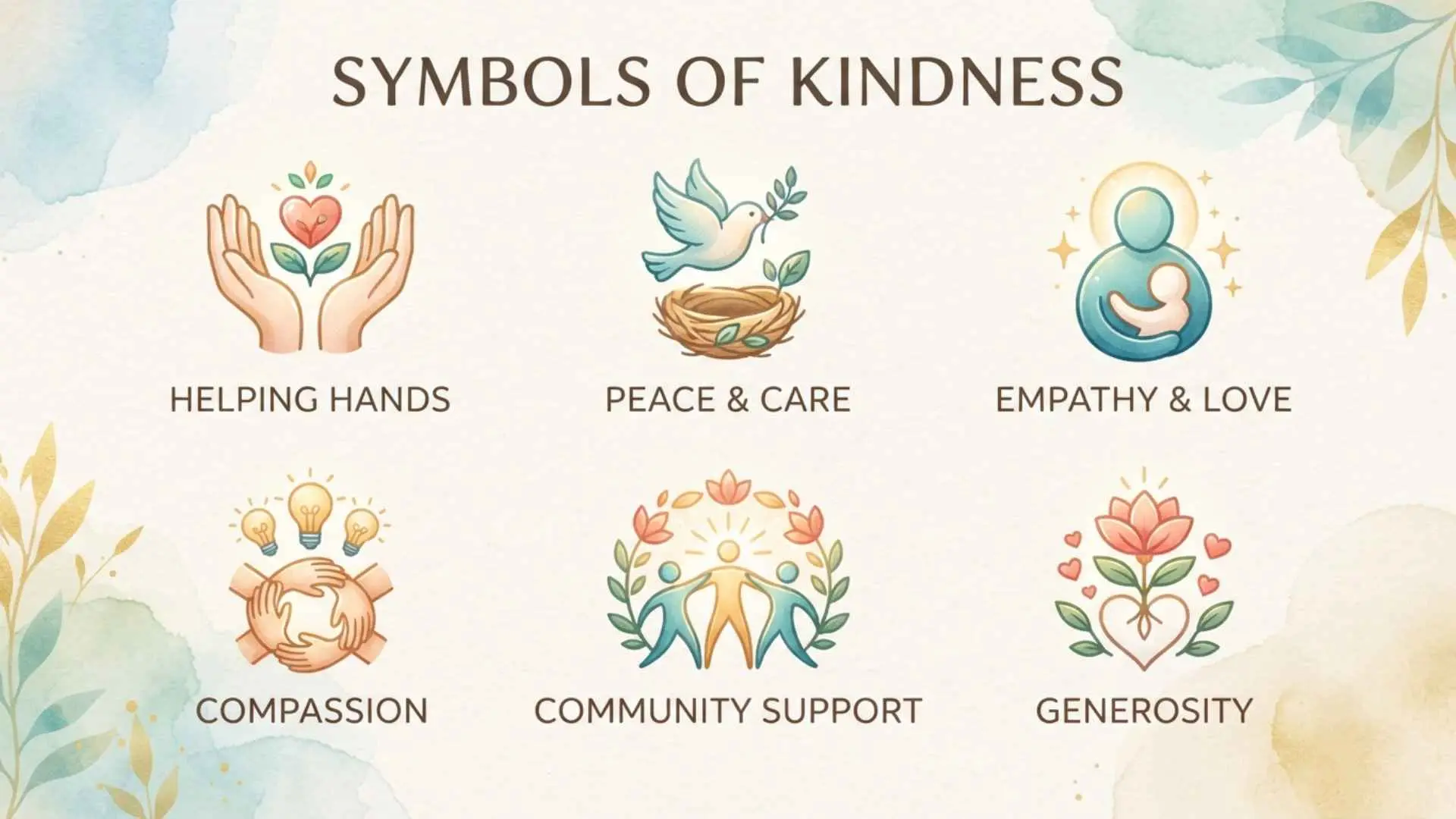
Symbols of kindness reveal how people have expressed compassion long before modern languages existed.
A gentle hand, an open heart, or a shared piece of bread can communicate care without a single word.
Across history, cultures have used plants, animals, colors, gestures, and sacred objects to represent generosity and empathy.
Understanding these symbols helps us recognize the emotional bonds that connect families, communities, and strangers.
Each symbol carries a story about humanity’s desire to comfort, protect, forgive, and belong.
Quick Answer
Symbols of kindness are images, objects, gestures, animals, plants, and colors that represent compassion, generosity, empathy, friendship, and care. Common examples include the heart, open hands, helping hands, doves, flowers, candles, rainbows, and acts of sharing. Their meanings may vary across religions and cultures, but they usually express goodwill toward others.
Quick Facts About Symbols of Kindness
| Aspect | Information |
| Origin | Developed through ancient gestures, religious traditions, community customs, art, and storytelling |
| Historical Significance | Used to represent hospitality, charity, mercy, protection, peace, and social cooperation |
| Main Meaning | Compassion, generosity, empathy, care, friendship, and support |
| Spiritual Meaning | Selfless love, mercy, healing, service, forgiveness, and unity |
| Cultural Importance | Encourages cooperation, trust, hospitality, and responsibility toward others |
| Modern Usage | Found in charity logos, jewelry, tattoos, social media, awareness campaigns, art, and public signs |
What Are Symbols of Kindness?
Symbols of kindness are visual or physical representations of caring behavior. They may appear as objects, gestures, colors, plants, animals, or simple actions.
A heart can represent love and emotional concern. An open hand may suggest generosity. A candle can symbolize hope offered during a difficult time. Even a bowl of food may become a sign of kindness when it is shared with someone in need.
These symbols developed because human beings have always needed ways to express feelings that words cannot fully capture. Before writing systems became common, people communicated through body movements, carved images, ritual objects, and natural signs.
Hospitality was one of the earliest forms of kindness. In many ancient societies, offering food, water, shelter, or protection to a traveler was considered a moral duty. Bread, cups, fires, doorways, and shared meals therefore became powerful symbols of welcome.
Religious traditions also shaped the meaning of kindness. Christianity emphasizes charity, mercy, and love for one’s neighbor. Buddhism teaches compassion toward all living beings. Islam values mercy, generosity, and charitable giving. Hindu traditions connect kindness with compassion, nonviolence, hospitality, and service.
Over time, these ideas moved from sacred spaces into art, literature, public life, and everyday communication. Today, symbols of kindness appear in nonprofit logos, school programs, hospital signs, social media campaigns, jewelry, tattoos, and community events.
Their forms have changed, but their purpose remains the same. They remind people that small acts of care can reduce suffering and strengthen human connection.
Deep Symbolic Meaning of Symbols of Kindness
Spiritual Meaning
On a spiritual level, kindness often represents the movement from self-interest toward compassion. It asks a person to notice another being’s pain and respond with patience, generosity, or protection.
Many spiritual traditions view kindness as a practice that transforms both the giver and the receiver. Helping another person can soften anger, reduce pride, and develop a deeper sense of unity.
The open heart is especially meaningful in spiritual symbolism. It suggests emotional honesty, forgiveness, and the willingness to love without demanding a reward.
A candle is another common spiritual sign. Its flame may represent hope, guidance, prayer, or compassion shining in darkness. Lighting a candle for someone can become a quiet act of remembrance or support.
Kindness can also symbolize the belief that all life is connected. When one person suffers, the wider community is affected. When one person receives care, trust can spread through families and social groups.
Psychological Meaning
Psychologically, symbols of kindness make invisible emotions easier to understand. Compassion cannot be touched, but it can be represented through a helping hand, a warm light, or an embracing figure.
These images create feelings of safety because they are linked with protection and social support. Humans are highly responsive to signs of welcome, such as relaxed facial expressions, open body language, and gentle touch.
Carl Jung’s idea of archetypes can help explain why certain kindness symbols appear across many cultures. The caregiver, healer, wise elder, protective mother, and helpful companion are recurring figures in myths and dreams.
These archetypal characters represent the human need to receive care and the moral desire to provide it.
Symbols of kindness can also reduce emotional distance. A simple heart icon in a message may make written words feel warmer. A flower given after a loss can communicate sympathy when the right sentence is difficult to find.
Cultural Meaning
At the cultural level, kindness symbols help societies teach cooperation. They show what a community considers honorable, compassionate, or socially responsible.
A shared meal may represent equality. A gift may express respect. A public memorial may show collective grief and support. A volunteer badge can communicate service to the community.
Cultures also create rules around kindness. Hospitality customs, charitable duties, gift-giving traditions, and care for elders all turn compassion into recognizable social behavior.
However, a kind action in one culture may be misunderstood in another. Direct eye contact, physical touch, gift giving, and personal space have different meanings around the world. True kindness therefore includes cultural awareness and respect.
Types and Variations of Symbols of Kindness
The Heart
Visual description: A rounded shape with two curved upper sections and a pointed base.
Meaning: Love, compassion, emotional care, and affection.
Symbolism: The heart represents sincere concern for another person’s emotional well-being.
Cultural connection: It appears widely in Western art, religious imagery, greeting cards, charity campaigns, and digital communication.
Where it appears: Jewelry, tattoos, social media reactions, medical organizations, artwork, and gifts.
Open Hands
Visual description: Hands shown with the palms facing upward or outward.
Meaning: Generosity, honesty, welcome, and peaceful intention.
Symbolism: Open hands suggest that nothing is being hidden or withheld.
Cultural connection: They appear in prayer, blessing rituals, charitable imagery, and hospitality customs.
Where it appears: Religious art, aid organization logos, public signs, tattoos, and meditation imagery.
Helping Hands
Visual description: One hand reaching down or outward to lift another.
Meaning: Support, assistance, rescue, and cooperation.
Symbolism: Helping hands show that kindness becomes meaningful through action.
Cultural connection: The image is common in community organizations, healthcare, disaster relief, and volunteer programs.
Where it appears: Posters, nonprofit branding, schools, hospitals, social campaigns, and public art.
The Dove
Visual description: A white or pale bird, sometimes carrying an olive branch.
Meaning: Peace, gentleness, forgiveness, and hope.
Symbolism: The dove represents kindness that ends conflict rather than continuing it.
Cultural connection: It appears in biblical stories, Christian art, ancient Mediterranean traditions, and modern peace movements.
Where it appears: Memorials, paintings, jewelry, tattoos, religious ceremonies, and humanitarian campaigns.
The Lotus Flower
Visual description: A layered flower rising above water.
Meaning: Compassion, purity, spiritual growth, and renewal.
Symbolism: The lotus suggests that beauty and kindness can grow even in difficult conditions.
Cultural connection: It is important in Buddhism, Hinduism, and several Asian artistic traditions.
Where it appears: Temples, meditation art, sacred texts, tattoos, jewelry, and wellness spaces.
The Rose
Visual description: A layered flower, commonly shown in red, pink, white, or yellow.
Meaning: Love, gratitude, sympathy, friendship, or remembrance.
Symbolism: A rose can express kindness when it is offered as comfort, appreciation, or reconciliation.
Cultural connection: Roses appear in Persian poetry, European art, Christian symbolism, romantic traditions, and memorial customs.
Where it appears: Funerals, celebrations, gardens, paintings, poetry, gifts, and tattoos.
The Candle
Visual description: A wax candle with a visible flame.
Meaning: Hope, remembrance, guidance, and emotional presence.
Symbolism: A candle suggests that even a small act of care can bring light into darkness.
Cultural connection: Candles are used in religious services, vigils, festivals, memorials, and private reflection.
Where it appears: Homes, temples, churches, shrines, public vigils, art, and spiritual practices.
The Rainbow
Visual description: A curved band containing several colors.
Meaning: Hope, inclusion, renewal, and connection after hardship.
Symbolism: A rainbow may represent comfort after a storm and the promise that suffering can pass.
Cultural connection: It appears in biblical tradition, Indigenous stories, folklore, political movements, and modern diversity campaigns.
Where it appears: Flags, children’s art, charities, social media, murals, and clothing.
Shared Bread
Visual description: Bread being broken, offered, or placed at the center of a meal.
Meaning: Hospitality, nourishment, equality, and generosity.
Symbolism: Sharing bread means sharing life’s basic resources.
Cultural connection: Bread has deep meaning in Mediterranean, Middle Eastern, European, Christian, Jewish, and Islamic traditions.
Where it appears: Religious rituals, family meals, community kitchens, literature, and folk art.
The Hug
Visual description: Two people with their arms around one another.
Meaning: Comfort, affection, reassurance, and emotional support.
Symbolism: A hug represents closeness and the willingness to share another person’s emotional burden.
Cultural connection: Physical affection varies across societies, but embracing is widely connected with reunion, comfort, and care.
Where it appears: Photography, greeting cards, films, illustrations, social media, and family traditions.
Symbols of Kindness Across Different Cultures
Ancient Egypt

Kindness in ancient Egypt was connected with social harmony, justice, and moral order. The concept of Ma’at represented truth, balance, fairness, and the proper relationship between people and the divine world.
The feather of Ma’at is often linked with truth and ethical responsibility. Although it was not exclusively a kindness symbol, it represented the moral balance required for a peaceful society.
Egyptian tomb inscriptions and wisdom texts encouraged generosity, fairness, respect for parents, and assistance to vulnerable people. Food offerings also symbolized care for both the living and the dead.
Ancient Greece
Ancient Greek culture valued xenia, the sacred practice of hospitality toward strangers and guests. A traveler could be offered food, shelter, bathing water, and protection before being asked to explain who they were.
This custom was linked with Zeus Xenios, the divine protector of guests. Shared cups, meals, doorways, and gifts became symbols of respectful hospitality.
The myth of Baucis and Philemon tells of an elderly couple who welcomed disguised gods into their humble home. Their generosity was rewarded, while wealthier neighbors who refused hospitality faced punishment. The story taught that kindness should not depend on status.
Roman Culture
Roman society valued humanitas, a concept connected with education, sympathy, civilization, and concern for others. Hospitality and public generosity were also respected social virtues.
The cornucopia, or horn of plenty, symbolized abundance. In a kindness context, abundance becomes meaningful when resources are shared.
Romans also practiced charitable giving, patronage, and community support, although these acts were often shaped by social rank and political influence.
Eastern Traditions
In Buddhism, the lotus and the compassionate figure of Avalokiteshvara represent mercy and concern for suffering beings. The practice of metta, often translated as loving-kindness, encourages goodwill toward oneself, loved ones, strangers, and even difficult people.
In Hindu traditions, ahimsa represents nonviolence and respect for life. The gesture of namaste, performed with palms together, can express respect for the sacred dignity within another person.
Chinese traditions often connect kindness with ren, a Confucian virtue involving benevolence, humanity, and proper care within relationships.
In Japan, the folded paper crane can symbolize hope, healing, peace, and compassionate wishes, especially when created for someone facing illness or hardship.
Indigenous Traditions
Indigenous cultures are diverse, so no single symbol represents kindness in all communities. However, many traditions emphasize reciprocity, kinship, respect for elders, care for future generations, and responsibility toward the natural world.
The circle often represents unity, continuity, and the equal value of community members. Sharing circles may create a space where each person has the opportunity to speak and be heard.
The practice of giving can also hold deep social and spiritual importance. In some communities, generosity strengthens relationships and confirms a person’s responsibilities to others.
These traditions should be discussed with care because sacred images and ceremonies cannot be separated from the specific nations and communities that created them.
Modern Interpretations
Modern kindness symbols often combine ancient meanings with digital communication. Hearts, hand emojis, ribbons, flowers, and supportive hashtags allow people to express sympathy and encouragement quickly.
Charities frequently use hands, circles, trees, hearts, and human figures in their logos. These images communicate trust, protection, unity, and positive change.
Public kindness campaigns also use murals, wristbands, badges, painted stones, and community gardens to make compassion visible in shared spaces.
Similar Symbols and Their Meanings
| Symbol | Main Meaning | Relationship to Kindness | Key Difference |
| Heart | Love and compassion | Shows emotional concern | Can also represent romance |
| Open hands | Giving and welcome | Represents generosity | May also symbolize prayer or surrender |
| Dove | Peace and hope | Reflects gentle conflict resolution | More closely linked with peace |
| Olive branch | Reconciliation | Represents an offer to end conflict | Focuses mainly on peace agreements |
| Lotus | Purity and spiritual growth | Connects kindness with compassion | Often emphasizes enlightenment |
| Candle | Hope and remembrance | Offers comfort during darkness | Commonly linked with mourning |
| Rose | Love, gratitude, and sympathy | Used as a caring gift | Meaning changes by color |
| Rainbow | Hope and inclusion | Encourages acceptance | May also symbolize diversity or divine promise |
| Circle | Unity and equality | Shows communal belonging | Has many broader spiritual meanings |
| Tree | Growth and protection | Suggests care across generations | Often represents life and ancestry |
Kindness is sometimes confused with politeness. Politeness follows social rules, while kindness responds to another person’s real needs.
Compassion is also related but slightly different. Compassion involves noticing suffering and wanting to reduce it. Kindness includes compassion but can also appear through friendliness, gratitude, patience, encouragement, or generosity.
Love is broader than kindness. A person may feel love without acting helpfully, while kindness becomes visible through behavior.
Symbols of Kindness in Mythology and Folklore
Myths often teach kindness by showing how gods, spirits, or magical beings reward generous people and punish selfish ones.
In Greek mythology, Baucis and Philemon welcomed strangers when others refused. Their humble hospitality made them symbols of generosity and moral goodness.
In many European folktales, a poor traveler shares their last piece of food with an animal, beggar, or mysterious stranger. The receiver later reveals magical power and rewards the compassionate act.
The story pattern appears because kindness toward the powerless is considered a test of character. A person who expects no reward shows genuine virtue.
In Buddhist stories, compassionate bodhisattvas delay their own final liberation to help other beings overcome suffering. These figures represent kindness as a courageous spiritual commitment.
Jataka tales, which describe previous lives of the Buddha, frequently include generosity, sacrifice, patience, and mercy toward humans and animals.
In Islamic tradition, stories and teachings often praise mercy toward children, travelers, neighbors, animals, and people in need. Water, food, shade, and charitable gifts may become symbols of compassionate service.
Folklore also contains warnings. A gift may hide manipulation, and false hospitality may lead a traveler into danger. These shadow stories remind people that appearance alone does not prove kindness. Motive and action matter.
Symbols of Kindness in Art, Literature, Movies, and Pop Culture
Paintings
Artists often use light, touch, and body position to show compassion. A figure leaning toward another person can suggest protection. Hands placed gently on a shoulder may communicate reassurance.
Religious paintings frequently show saints, healers, caregivers, and charitable figures offering food, clothing, or comfort.
Scenes of shared meals are especially powerful because they represent equality and belonging.
Literature and Poetry
Literature often presents kindness as a quiet force that changes a character’s life. A small gift, forgiving word, or unexpected act of hospitality may become more meaningful than a dramatic heroic victory.
Charles Dickens frequently explored charity, social responsibility, poverty, and moral transformation. In A Christmas Carol, generosity becomes a sign of Scrooge’s emotional rebirth.
In Victor Hugo’s Les Misérables, the bishop’s mercy toward Jean Valjean changes the direction of Valjean’s life. The gifted silver becomes a symbol of forgiveness and the possibility of moral renewal.
Poetry commonly uses flowers, rain, hands, light, birds, and shelter as images of compassion.
Movies and Television
Films often represent kindness through rescue, sacrifice, friendship, forgiveness, and loyalty. A character may offer food, protect a stranger, defend an outsider, or remain beside someone during grief.
Family films often use animals, children, or unlikely friendships to show that compassion can cross social boundaries.
Superhero stories also present kindness as a form of strength. The hero’s true moral quality is often revealed not by power, but by how they treat vulnerable people.
Tattoos and Fashion
Heart tattoos, open hands, doves, flowers, and words such as “kind,” “hope,” or “compassion” are common forms of personal symbolism.
A kindness tattoo may honor a caregiver, remember a loved one, mark recovery from hardship, or serve as a personal promise to treat others gently.
Fashion brands and charities may use heart-shaped designs, ribbons, or hand imagery to support humanitarian causes. However, a symbol has greater meaning when it is connected with real ethical action rather than used only as decoration.
Modern Design and Social Media
Digital hearts, supportive emojis, profile frames, and awareness ribbons make emotional communication fast and visible.
A heart reaction can show sympathy, while folded hands may express gratitude, prayer, or support. Their exact meaning depends on culture and context.
Social media can spread kindness campaigns quickly, but it may also encourage shallow gestures. Posting a symbol is not always equal to helping someone. Meaning becomes stronger when online concern leads to respectful action.
Spiritual and Dream Meaning of Symbols of Kindness
Dreams involving kindness often reflect emotional needs, relationships, guilt, healing, or personal growth. Their meaning depends on the dreamer’s life and feelings.
Dreaming of Helping Someone
Helping another person may suggest that you are becoming more aware of your ability to support others. It can also represent a neglected part of yourself that needs care.
Receiving Kindness in a Dream
Receiving food, shelter, flowers, or comfort may reflect a desire for reassurance. It could also show that you are learning to accept help rather than facing every struggle alone.
Seeing Open Hands
Open hands may symbolize trust, surrender, generosity, or an opportunity to give or receive.
Caution is still important. The dream may ask whether someone’s intentions are truly open or only appear generous.
Dreaming of a Heart
A heart can represent love, vulnerability, emotional healing, or the need for forgiveness. A broken heart may point to grief, while a glowing heart may suggest renewed compassion.
Seeing a Candle
A candle may symbolize guidance during uncertainty. It can also reflect remembrance, prayer, or a small source of hope that needs protection.
Meditation Experiences
During meditation, images such as light, flowers, hands, or peaceful animals may arise when a person focuses on loving-kindness or forgiveness.
These experiences can feel spiritually meaningful, but they should not be treated as universal predictions. Personal history, culture, emotion, and memory strongly shape symbolic interpretation.
Positive and Negative Meanings of Symbols of Kindness
| Positive Meaning | Negative or Cautionary Meaning |
| Genuine compassion | Performative kindness |
| Generosity | Giving to gain control |
| Emotional support | Creating unhealthy dependence |
| Forgiveness | Ignoring harmful behavior |
| Hospitality | Lack of personal boundaries |
| Service | Self-neglect |
| Empathy | Emotional exhaustion |
| Friendship | Hidden obligation |
| Peace | Avoiding necessary conflict |
| Open-heartedness | Vulnerability to manipulation |
A symbol can contain both light and shadow. An open hand may offer help, but it can also expect repayment. A gift may express love, or it may be used to create guilt.
Kindness does not mean accepting mistreatment. Healthy compassion includes honesty, boundaries, accountability, and self-respect.
Saying no can sometimes be kinder than giving false hope. Correcting harmful behavior can be more compassionate than remaining silent.
The deepest symbols of kindness therefore represent wise care, not blind approval.
Why Humans Are Attracted to Symbols of Kindness
Humans depend on cooperation for survival. From infancy, people look for signs of safety in faces, voices, touch, and body language.
A smile, open palm, or gentle tone tells the nervous system that danger may be low. These signals help build trust.
Symbols also allow people to recognize complex emotions quickly. A heart does not require a long explanation. A candle at a memorial immediately communicates remembrance and shared grief.
Pattern recognition plays an important role. When certain images repeatedly appear during caring events, the brain begins connecting them with comfort. Flowers become associated with sympathy. Shared food becomes linked with belonging. Open arms become connected with welcome.
Cultural memory strengthens these links across generations. Children learn what symbols mean by watching adults use them at celebrations, funerals, religious ceremonies, and moments of crisis.
Personal experience adds another layer. A yellow rose may remind one person of friendship and another of a loved one who died. The symbol remains public, but its emotional meaning becomes private.
People are also drawn to kindness symbols because they express the world as it could be. They represent hope that strangers can help, communities can heal, and compassion can be stronger than fear.
Modern Uses of Symbols of Kindness
Tattoos
People choose kindness tattoos as reminders of empathy, survival, forgiveness, or service. Hearts, hands, doves, lotus flowers, and short compassionate phrases are common choices.
Jewelry
Heart necklaces, angel wings, hand-shaped pendants, flowers, and symbolic bracelets can represent love and support. They are often given during illness, grief, graduation, or personal change.
Fashion
Clothing may feature messages about kindness, inclusion, peace, or mental health. Awareness ribbons and charitable merchandise also connect fashion with social causes.
Branding
Healthcare providers, charities, schools, and community groups often use hands, circles, hearts, trees, and human figures. These symbols help communicate care, trust, protection, and unity.
Social Media
Heart icons, supportive comments, digital flowers, and kindness hashtags allow people to express encouragement. Online kindness is most valuable when it remains respectful and does not invade someone’s privacy.
Contemporary Spirituality
Loving-kindness meditation, gratitude practices, compassion circles, and symbolic altars use candles, flowers, crystals, written intentions, and peaceful imagery.
Home Decor
Wall art, candles, welcome signs, family circles, and nature-inspired designs can create an atmosphere of warmth and belonging.
Personal Expression
Some people carry kindness symbols as daily reminders. A bracelet, small stone, written phrase, or phone wallpaper can encourage patience during stressful moments.
Interesting Facts About Symbols of Kindness
- Open palms are ancient signs of peaceful intention. Showing empty hands can communicate that a person is not carrying a weapon.
- Shared food is one of humanity’s oldest kindness symbols. Meals build trust because they involve giving resources necessary for survival.
- The heart shape does not closely match the human organ. Its modern form developed gradually through art, manuscripts, religious imagery, and romantic culture.
- Flowers communicate different forms of care. Pink flowers often express gratitude, white flowers may suggest sympathy, and yellow flowers commonly represent friendship.
- The olive branch became a major peace symbol. Its connection with reconciliation grew from ancient Mediterranean traditions and later religious stories.
- Kindness symbols can cross language barriers. A helping hand or offered cup of water can be understood without speech.
- Color changes symbolic meaning. White may suggest peace in some societies but mourning in others, showing why cultural context matters.
- Many kindness symbols are based on ordinary objects. Bread, lamps, doors, blankets, and cups become meaningful because they meet basic human needs.
- Compassion symbols often include circles. Circular forms suggest unity, continuity, protection, and equal belonging.
- The strongest symbol of kindness is often an action. Images can inspire compassion, but listening, sharing, protecting, and helping give the symbol real power.
Frequently Asked Questions
What is the main symbol of kindness?
The heart is the most widely recognized symbol of kindness because it represents compassion, emotional care, love, and concern for others.
What flower symbolizes kindness?
Pink roses, daisies, sunflowers, and bluebells are often linked with kindness, gratitude, warmth, and friendship. Flower meanings can vary by culture and color.
What animal represents kindness?
Doves often represent gentleness, peace, and compassionate intentions. Elephants may symbolize loyalty and care, while dogs commonly represent friendship and devotion.
What color represents kindness?
Pink is often associated with kindness, tenderness, and compassion. Yellow can represent friendliness and warmth, while green may symbolize healing and harmony.
What symbol represents helping others?
Two hands reaching toward each other are a common symbol of assistance, cooperation, charity, and community support.
Can kindness symbols have negative meanings?
Yes. A gift, smile, or helping hand may appear kind while hiding control, obligation, or manipulation. Meaning depends on intention, behavior, and context.
Conclusion
Symbols of kindness give visible form to compassion, generosity, comfort, and human connection.
From open hands and shared bread to hearts, flowers, and candlelight, each symbol carries a story of care.
Their meanings may change across cultures, but their central message remains deeply familiar.
They remind us that kindness is not weakness, but a powerful choice that can restore trust and ease suffering.
The most meaningful symbol of kindness is the one we turn into action.
 John Mercer