
Hand symbols are powerful forms of nonverbal communication that express emotions, ideas, beliefs, and cultural messages without spoken words. From a simple thumbs-up and peace sign to religious mudras and traditional greeting gestures, hand symbols appear in everyday conversations, art, spirituality, and social traditions worldwide. Some gestures communicate friendship, respect, approval, or love, while others carry deeper meanings connected to identity, protection, faith, and personal expression.
Different hand gestures can have very different meanings depending on their shape, movement, cultural background, and situation. For example, the peace sign commonly represents harmony and unity, while a raised thumb often signals approval or encouragement. In spiritual traditions, hand gestures known as mudras represent meditation, energy, wisdom, and divine connection. However, a gesture considered friendly in one country may seem offensive or confusing in another, making cultural context essential to understanding hand symbolism.
In this complete guide to hand symbols and their meanings, you will explore popular hand gestures, their historical origins, cultural significance, religious associations, and modern uses. You will also discover the meanings of common signs such as the OK gesture, crossed fingers, the heart hand, the horns sign, and various meditation mudras. Whether you are curious about body language, ancient traditions, or everyday communication, this guide will help you understand the fascinating messages behind hand symbols.
Quick Answer
Hand symbols are gestures, signs, or images made with the hands and fingers to communicate ideas, emotions, beliefs, or social messages. They may represent peace, protection, power, love, faith, warning, unity, or identity. Their meanings often depend on culture, religion, historical period, and social context.
Quick Facts About Hand Symbols
| Aspect | Information |
| Origin | Hand gestures likely began as practical forms of nonverbal communication before written language |
| Historical Significance | Used in ancient rituals, religious art, political ceremonies, storytelling, trade, and warfare |
| Main Meaning | Communication, intention, identity, emotion, and human connection |
| Spiritual Meaning | Blessing, protection, prayer, healing, divine power, and inner awareness |
| Cultural Importance | Helps communities express shared beliefs, values, traditions, and social rules |
| Modern Usage | Social media, sign languages, tattoos, meditation, protests, fashion, branding, and digital emojis |
What Are Hand Symbols?
Hand symbols are meaningful shapes, movements, or positions created with the hands and fingers. Some are performed as gestures, while others appear as drawings, sculptures, jewelry, religious icons, or decorative designs.
A hand symbol may be as simple as an open palm or as detailed as a sacred mudra involving several fingers. Certain gestures communicate quickly without words. Others carry layers of spiritual, historical, or political meaning.
Humans likely used hand movements long before formal writing developed. Early people needed ways to warn others, request food, show peaceful intentions, guide hunters, or communicate across distance. The hands naturally became tools of expression because they were visible, flexible, and closely connected to action.
Over time, communities gave particular gestures shared meanings. A raised hand could indicate authority. Two joined hands could symbolize agreement. A finger pointing upward might direct attention toward the sky, a deity, or a higher truth.
Hand imagery also appeared in prehistoric art. Stenciled handprints have been discovered in caves across Europe, Asia, Australia, and the Americas. Some were made by placing a hand against a wall and blowing pigment around it. These prints may have marked identity, participation, memory, ritual activity, or belonging.
As civilizations developed, hand symbols became part of religion, law, art, royal ceremony, healing, and public life. They continue to evolve today through emojis, protest signs, photographs, music culture, and online communication.
Deep Symbolic Meaning of Hand Symbols
Hands have symbolic power because they allow people to touch, create, protect, destroy, comfort, and communicate. They stand at the meeting point between thought and action.
Spiritual Meaning of Hand Symbols
On a spiritual level, the hand often represents divine activity, blessing, protection, and the transfer of sacred power.
Religious art frequently shows holy figures raising a hand in blessing. Worshippers may lift their hands during prayer to express surrender, openness, praise, or a desire to receive guidance.
The palm may symbolize receptivity. An open hand appears ready to accept wisdom, healing, or grace. A closed hand can represent control, secrecy, defense, or stored power.
In Hinduism and Buddhism, sacred hand positions called mudras are used in meditation, ritual, sculpture, and dance. Each arrangement may express a spiritual teaching such as fearlessness, compassion, concentration, or enlightenment.
Hands also symbolize moral action. Many spiritual traditions teach that belief should be shown through what a person does. In this sense, the hand becomes an image of service, generosity, responsibility, and karma.
Psychological Meaning of Hand Symbols
Psychologically, hands reveal emotion even when the face remains controlled.
A person may wring their hands when anxious, hide their palms when uncertain, or clench their fists when angry. Open palms often suggest honesty or vulnerability, while crossed fingers may express hope.
Carl Jung’s work on archetypes can help explain why hand imagery feels universal. The hand functions as an archetypal symbol of agency, meaning the ability to act upon the world. It connects inner intention with outer behavior.
The helping hand represents care. The pointing hand represents direction or accusation. The raised fist represents strength and resistance. The handshake represents trust, although its meaning depends on whether both sides enter the agreement freely.
People are emotionally drawn to hand symbols because hands are linked to some of our earliest experiences. A baby reaches for safety. A parent holds a child. Friends shake hands, couples join hands, and communities raise their hands together.
Cultural Meaning of Hand Symbols
At the cultural level, gestures create social order. They can welcome, dismiss, praise, insult, command, bless, or identify group membership.
Many hand symbols act like unwritten rules. People learn them through family, school, religion, media, and observation. Because these meanings are learned, they can change dramatically across borders.
For example, a gesture associated with approval in one country may be rude elsewhere. This is why cultural context is essential. A hand sign never exists completely on its own. Its meaning comes from the person using it, the audience seeing it, and the setting in which it appears.
Types and Variations of Hand Symbols
The Open Palm
Visual description: The hand is raised or extended with the fingers open and the palm visible.
Meaning: Peace, honesty, openness, surrender, greeting, or protection.
Symbolism: The visible palm suggests that no weapon is being held. For this reason, it can communicate peaceful intentions and trust.
Cultural connection: Open palms appear in blessings, courtroom oaths, greetings, religious art, and public speeches.
Where it appears: Sacred paintings, political ceremonies, meditation, protective symbols, and everyday body language.
The open palm may also mean “stop” or “stay back.” Its message changes according to direction, movement, and social context.
The Hamsa Hand
Visual description: A symmetrical hand, often with an eye placed in the center of the palm.
Meaning: Protection, blessing, good fortune, and defense against harmful attention.
Symbolism: The hand acts as a protective barrier, while the eye is commonly associated with awareness and guarding against the evil eye.
Cultural connection: The Hamsa appears in Jewish and Muslim communities and across the Middle East and North Africa. It is sometimes called the Hand of Fatima in Islamic cultural settings and the Hand of Miriam in Jewish traditions.
Where it appears: Jewelry, wall art, amulets, tattoos, ceramics, clothing, and home decor.
The Hamsa has become globally popular, but its religious and cultural roots should be treated respectfully.
The Hand of God
Visual description: A hand emerging from clouds, the sky, or a heavenly space.
Meaning: Divine authority, creation, judgment, guidance, or blessing.
Symbolism: The image represents a divine presence without showing a complete physical figure.
Cultural connection: It appears in Jewish and Christian art, especially in periods when artists avoided directly portraying God.
Where it appears: Medieval manuscripts, church mosaics, paintings, sculptures, and religious illustrations.
A famous artistic example of divine touch appears in Michelangelo’s The Creation of Adam, where the nearly touching hands of God and Adam suggest life, consciousness, and humanity’s relationship with the sacred.
Praying Hands
Visual description: Two palms placed together, usually with the fingers pointing upward.
Meaning: Prayer, gratitude, humility, respect, hope, or greeting.
Symbolism: Joining the hands can represent the meeting of body and spirit, self and others, or human and divine.
Cultural connection: Folded or joined hands appear in Christianity, Hindu traditions, Buddhism, Jainism, and many Asian greeting customs.
Where it appears: Religious art, memorials, tattoos, emojis, greeting rituals, and meditation.
In South Asian traditions, the gesture commonly known as namaste can communicate respect and recognition of the other person.
The Raised Fist
Visual description: The fingers are tightly closed into the palm, with the fist raised upward.
Meaning: Strength, unity, protest, resistance, determination, or defiance.
Symbolism: Individual fingers become more powerful when closed together, making the fist an image of collective action.
Cultural connection: Raised fists have appeared in labor movements, anti-fascist campaigns, civil rights activism, Black liberation movements, and political protests.
Where it appears: Posters, marches, murals, logos, clothing, political art, and social media.
Its meaning depends on the movement using it. It may express liberation and solidarity, but in another context it can suggest aggression or ideological allegiance.
The Peace Sign
Visual description: The index and middle fingers are raised in a V shape while the other fingers are folded.
Meaning: Peace, victory, hope, friendship, or casual positivity.
Symbolism: The V shape became strongly connected with victory during the Second World War and later with peace movements.
Cultural connection: Winston Churchill famously used the V gesture as a sign of victory. During the 1960s, antiwar activists helped turn it into an international peace symbol.
Where it appears: Photography, protests, youth culture, music, travel pictures, emojis, and fashion.
Palm direction matters in some countries. A reversed V sign may be interpreted as insulting in parts of the United Kingdom and other regions.
The Thumbs-Up Sign
Visual description: The fist is closed while the thumb points upward.
Meaning: Approval, success, agreement, encouragement, or confirmation.
Symbolism: It communicates a positive judgment or signals that something is acceptable.
Cultural connection: It is widely used in Western culture and digital communication. However, it may be offensive or inappropriate in certain social and regional contexts.
Where it appears: Social media reactions, workplaces, advertising, road communication, sports, and casual conversation.
The gesture became especially influential online through “like” buttons and reaction icons.
The Crossed Fingers Sign
Visual description: The middle finger is crossed over the index finger.
Meaning: Hope, luck, protection, or a wish for a positive outcome.
Symbolism: Crossing forms a small intersection that has sometimes been linked to protective religious symbolism.
Cultural connection: In many English-speaking cultures, people cross their fingers when hoping for good luck.
Where it appears: Everyday gestures, photographs, emojis, charms, and popular sayings.
It can also suggest hidden dishonesty when fingers are crossed behind the back, especially in children’s stories and popular culture.
The “OK” Gesture
Visual description: The thumb and index finger form a circle while the remaining fingers extend outward.
Meaning: Approval, correctness, completion, or “everything is fine.”
Symbolism: The closed circle may suggest wholeness or perfection.
Cultural connection: The gesture has very different meanings around the world. It can represent money, the number zero, or an insult depending on location. It also resembles the vitarka mudra found in Buddhist art.
Where it appears: Conversation, diving communication, meditation imagery, emojis, and photography.
Because the gesture has acquired controversial political associations in some modern contexts, viewers should consider the user’s intent and the surrounding situation rather than assuming one universal meaning.
The Horns Gesture
Visual description: The index finger and little finger are extended while the middle and ring fingers remain folded.
Meaning: Protection, celebration, musical identity, rebellion, or insult.
Symbolism: Horns may represent animal power, supernatural defense, danger, or resistance.
Cultural connection: In parts of the Mediterranean, a similar gesture has been used to guard against the evil eye. In heavy metal music, it became a symbol of energy and group identity.
Where it appears: Concerts, sports events, folklore, popular photography, and youth culture.
Its interpretation differs widely. In certain cultures, it may carry an insulting meaning connected with infidelity.
The Pointing Finger
Visual description: One finger, usually the index finger, is extended toward a person, object, or direction.
Meaning: Direction, command, selection, accusation, teaching, or warning.
Symbolism: The pointing finger directs attention and gives the user temporary control over what others notice.
Cultural connection: Pointing is normal in some places but disrespectful in others, especially when directed at a person.
Where it appears: Religious paintings, advertisements, signs, public speeches, classrooms, digital icons, and propaganda.
The well-known “I Want You” recruitment image uses a pointing figure to address the viewer directly and create a sense of personal duty.
Mudras
Visual description: Carefully arranged finger and hand positions used alone or with the body.
Meaning: Meditation, teaching, protection, compassion, concentration, or spiritual awakening.
Symbolism: Mudras are believed to express or support specific states of consciousness.
Cultural connection: They are especially important in Hinduism, Buddhism, Jainism, yoga, and classical Indian dance.
Where they appear: Temple sculpture, sacred paintings, meditation practice, ritual, yoga, dance, and religious teaching.
Examples include the abhaya mudra for fearlessness, the dhyana mudra for meditation, and the vitarka mudra for teaching and discussion.
Hand Symbols Across Different Cultures
Ancient Egypt
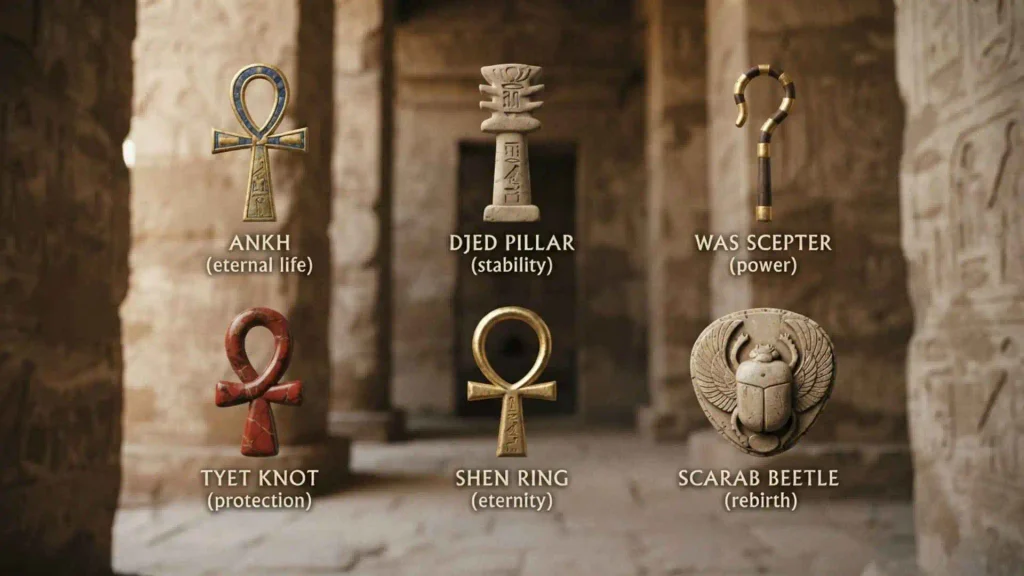
Hands in ancient Egyptian art often expressed action, offering, worship, protection, and royal authority. Figures were shown raising their arms in praise or presenting gifts to deities.
The two-finger amulet, shaped like an index and middle finger, was sometimes placed with the dead. It may have been connected with protection and the embalming process.
The concept of the protective divine hand also appeared in amulets and ritual objects. Hands were not merely body parts in Egyptian symbolism. They represented the ability of gods and humans to act.
Ancient Greece
Greek art used hands to show speech, emotion, mourning, authority, and dramatic action. Vase paintings and sculptures often relied on hand positions to make a scene understandable.
Hands were also associated with oaths, agreements, supplication, and prayer. A person seeking mercy might reach toward another’s knees or hands.
In mythology, hands could represent craftsmanship and supernatural skill. Hephaestus, the divine smith, embodied the creative power of skilled labor. The hand was therefore connected with invention, art, weapons, and civilization.
Roman Culture
Romans used gestures in public speaking, law, military command, theater, and political ceremonies. Orators trained their hands carefully because each movement could strengthen an argument.
The right hand carried special importance in promises, loyalty, and agreements. The Latin word dextrarum iunctio refers to the joining of right hands, a common image of marriage, unity, or agreement in Roman art.
Roman hand imagery appears on coins, monuments, funerary carvings, and imperial artworks. It often communicates authority, loyalty, victory, or public duty.
Eastern Traditions
Across South and East Asia, hand gestures developed rich religious, artistic, and social meanings.
In Hindu and Buddhist traditions, mudras communicate teachings and states of mind. A raised palm may represent fearlessness, while hands resting in the lap may signify meditation.
In India, joined palms are associated with respectful greeting, prayer, and recognition. Classical dance traditions such as Bharatanatyam use hand gestures called hastas or mudras to represent objects, emotions, animals, deities, and complete stories.
In China and Japan, gestures have also been shaped by etiquette, theater, martial traditions, religious practice, and social hierarchy.
Indigenous Traditions
There is no single Indigenous interpretation of hand symbols. Indigenous cultures around the world have distinct languages, beliefs, artistic practices, and histories.
Handprints appear in Aboriginal Australian rock art and in ancient sites throughout the Americas. Depending on the community and location, they may relate to identity, ancestry, storytelling, presence, ceremony, or connection with place.
Plains Indian Sign Language developed as a sophisticated form of communication among many Native nations with different spoken languages. It supported trade, diplomacy, storytelling, and social interaction.
These traditions should not be reduced to one universal meaning. Interpretation requires attention to the specific nation, community, location, and historical setting.
Modern Global Culture
Modern hand symbols move quickly across borders through film, music, sports, tourism, and social media. Emojis allow gestures to appear in billions of digital conversations.
However, global circulation does not erase local meaning. A symbol may become more popular while still carrying older religious, political, or cultural associations.
Today, hand signs can show fandom, activism, profession, humor, identity, or belonging. They may also be misunderstood when removed from their original setting.
Similar Symbols and Their Meanings
| Symbol | Main Meaning | Similarity to Hand Symbols | Key Difference |
| Eye | Awareness, protection, observation | Often appears with hands in protective designs | Focuses on seeing rather than acting |
| Heart | Love, emotion, compassion | Can be formed with the hands to express affection | Represents feeling more than physical action |
| Fist | Power, resistance, unity | Created directly from the hand | Usually carries a stronger political or emotional tone |
| Wings | Freedom, spirituality, transcendence | Like raised hands, they may suggest reaching upward | Represent movement beyond earthly limits |
| Circle | Unity, eternity, wholeness | Appears in finger gestures and mudras | More abstract and less connected with human agency |
| Handshake | Agreement, trust, cooperation | Uses two hands as a social symbol | Requires interaction between people |
| Footprint | Presence, journey, legacy | Like a handprint, it marks human presence | Emphasizes movement and travel |
| Eye in Hand | Protection and spiritual awareness | Combines action with watchfulness | Has stronger amuletic and mystical associations |
A common misconception is that all open-hand symbols are versions of the Hamsa. In reality, open palms appear independently in many cultures. Similar shape does not always prove shared origin.
Another misconception is that gestures have fixed meanings. Hand symbols are highly dependent on region, direction, movement, facial expression, and historical context.
Hand Symbols in Mythology and Folklore
Hands play major roles in myths because they symbolize the power to shape reality.
In Greek mythology, the Hundred-Handed Ones, known as the Hecatoncheires, were immense beings with extraordinary strength. Their many hands represented overwhelming physical power.
The story of King Midas turns touch into both a gift and a curse. Everything he touches becomes gold, showing how human desire can transform blessing into suffering.
In Norse mythology, the god Tyr loses his hand while helping bind the wolf Fenrir. His sacrifice becomes a symbol of courage, duty, and the personal cost of protecting the community.
Irish legend includes the Red Hand of Ulster, associated with identity, competition, kingship, and regional symbolism. Several stories attempt to explain its origin, including a dramatic tale in which a claimant cuts off his hand and throws it ashore to win a race for land.
Folklore also gives power to protective hands, healing touch, cursed fingers, and ghostly gestures. The “dead man’s hand,” the “evil hand,” and the “helping hand” appear in stories because the hand can save, harm, create, or betray.
These legends shaped modern meanings by connecting hands with fate, sacrifice, greed, power, and protection.
Hand Symbols in Art, Literature, Movies, and Pop Culture
Hand Symbols in Paintings and Sculpture
Artists use hands to reveal emotion and narrative. A face may appear calm, but tense fingers can expose fear or grief.
In religious painting, raised hands often bless, pray, warn, or receive divine knowledge. In Renaissance art, carefully painted fingers helped guide the viewer’s eye and express relationships between figures.
Auguste Rodin explored hands as emotional subjects in their own right. His sculptures show how hands can express tenderness, struggle, creation, and longing without requiring a full body.
Hand Symbols in Literature and Poetry
Writers use hands as symbols of guilt, labor, love, age, violence, and memory.
In Shakespeare’s Macbeth, bloodstained hands represent guilt that cannot easily be washed away. The hand becomes evidence of both physical action and psychological consequence.
Poetry often describes holding hands as a sign of intimacy and separation. An empty hand may represent loss, while an offered hand may represent forgiveness or rescue.
Hand Symbols in Movies and Television
Film uses recognizable hand gestures because they communicate instantly.
A raised palm may create suspense. A trembling hand may reveal hidden fear. Joined hands may show reconciliation. A villain’s gloved hand may suggest secrecy or control.
Science fiction and fantasy stories often use hand movements to cast spells, control energy, activate technology, or display allegiance. These visual choices build upon ancient associations between hands, power, and transformation.
Hand Symbols in Tattoos
Hand symbol tattoos may represent protection, faith, rebellion, memory, identity, or spiritual growth.
Popular designs include the Hamsa, praying hands, crossed fingers, open palms, mudras, skeletal hands, and hands holding flowers.
Before choosing a tattoo, it is wise to research the symbol’s original cultural meaning. A design may be aesthetically attractive but still carry sacred, political, or regional significance.
Hand Symbols in Fashion and Design
Designers use hand imagery to suggest craftsmanship, human connection, rebellion, mysticism, or individuality.
Hand patterns appear on shirts, jewelry, bags, posters, album covers, and interior decor. A hand may hold an eye, flower, moon, flame, heart, or key, creating a layered symbolic message.
Spiritual and Dream Meaning of Hand Symbols
Dreams involving hands often relate to ability, responsibility, relationships, control, and personal action. However, dream meanings are subjective rather than scientifically fixed.
Dreaming of Open Hands
Open hands may reflect generosity, honesty, acceptance, or readiness to receive help. They may also suggest vulnerability.
Dreaming of Injured Hands
An injured hand may symbolize frustration, helplessness, damaged confidence, or fear that you cannot complete an important task.
It may also reflect a real physical sensation experienced during sleep, so practical explanations should not be ignored.
Dreaming of Holding Hands
Holding hands can represent trust, emotional support, partnership, reconciliation, or fear of separation.
The identity of the other person and the feelings present in the dream matter more than the gesture alone.
Dreaming of Washing Hands
Washing hands may symbolize cleansing, relief, guilt, avoidance, or a desire to separate yourself from a difficult situation.
The image can suggest healthy renewal, but it may also reflect an attempt to escape responsibility.
Dreaming of Many Hands
Many hands may represent support, pressure, cooperation, spiritual presence, or feeling overwhelmed by other people’s demands.
Hand Symbols in Meditation
During meditation, hand positions can support attention and intention. Some practitioners use mudras to create a sense of calm, balance, grounding, or spiritual focus.
The psychological effect may come from ritual, body awareness, breathing, expectation, cultural meaning, or a combination of these elements.
A positive spiritual interpretation should encourage reflection, compassion, and responsible action. A cautionary interpretation may point toward control, fear, imbalance, or the need for stronger personal boundaries.
Positive and Negative Meanings of Hand Symbols
| Positive Meaning | Negative Meaning |
| Protection | Threat |
| Blessing | Curse |
| Unity | Group pressure |
| Strength | Aggression |
| Guidance | Control |
| Honesty | Exposure |
| Help | Dependence |
| Creation | Destruction |
| Resistance | Conflict |
| Prayer | Fear or desperation |
| Agreement | Forced obedience |
| Identity | Exclusion |
The same symbol can contain both light and shadow.
A raised fist can represent courageous resistance, but it may also appear threatening. An open hand can offer peace, yet it can also command someone to stop. A pointing finger can guide a lost person or publicly accuse someone.
Context determines meaning. The intention of the person, the experience of the viewer, and the surrounding cultural environment all influence interpretation.
Why Humans Are Attracted to Hand Symbols
Humans are naturally drawn to hands because we constantly watch them for information.
Hands tell us whether someone is approaching peacefully, preparing to strike, offering help, hiding something, or inviting connection. This awareness has practical survival value.
We also recognize patterns quickly. A simple hand outline is immediately understood as human. Even a prehistoric handprint can create an emotional connection between a modern viewer and someone who lived thousands of years ago.
Hands carry cultural memory. We remember parents holding us, teachers pointing the way, friends greeting us, and loved ones waving goodbye. These personal experiences give hand imagery emotional depth.
Collective symbolism adds another layer. Religious blessings, protest fists, wedding handclasps, and protective amulets connect private emotion with shared history.
Most importantly, hands represent possibility. They remind us that humans do not only think and feel. We act, build, touch, repair, write, defend, and create.
Modern Uses of Hand Symbols
Tattoos
Hand symbol tattoos express protection, faith, individuality, resilience, remembrance, or cultural connection. Their meaning may be deeply personal, but cultural research remains important.
Jewelry
Hamsa pendants, hand-shaped charms, mudra rings, and protective bracelets are worn for beauty, belief, luck, or emotional comfort.
Fashion
Clothing brands use hands to communicate creativity, rebellion, peace, craftsmanship, and identity. Gesture-based graphics are especially common in streetwear and music culture.
Branding
Businesses may use open hands to suggest care, trust, service, support, or community. Charities and health organizations often use hand imagery because it feels human and approachable.
Social Media
Digital hand emojis express applause, prayer, greeting, celebration, love, agreement, and humor. Skin-tone options have also made digital representation more inclusive, although interpretation can still vary across users.
Contemporary Spirituality
Meditation communities use mudras, Hamsa imagery, palm symbolism, and hand-shaped altar objects. Some practices are rooted in established traditions, while others combine ideas from several cultures.
Home Decor
Hand-shaped wall hangings, ceramic palms, sculptures, and protective symbols appear in homes as expressions of beauty, spirituality, or cultural heritage.
Personal Expression
People use hand gestures in photographs, performances, dance, sports, and everyday conversation. A gesture can communicate identity before a person says a single word.
Interesting Facts About Hand Symbols
- Prehistoric hand stencils appear on several continents. They are among humanity’s most emotionally immediate ancient images.
- Hand gestures may exist before spoken explanations. Babies often point, reach, wave, and lift their arms before developing full speech.
- The same gesture can have opposite meanings. Palm direction, finger position, and location may turn a friendly sign into an insult.
- Roman speakers studied gesture carefully. Hand movements were considered an important part of persuasive public speaking.
- Mudras can function like visual teachings. A statue’s hand position may help identify its spiritual message.
- Digital emojis continue an ancient habit. People still use simplified hand images to replace or strengthen spoken language.
- Hands are difficult for artists to draw. Their complex anatomy and expressive movement make them both challenging and symbolically powerful.
- A handshake is not universally required. Bowing, touching the heart, joining palms, or avoiding physical contact may be more respectful in certain cultures.
- Left and right hands may have different meanings. Various traditions associate the right hand with blessing, authority, or social approval, while attitudes toward the left hand differ widely.
- Hand symbols can become political very quickly. A casual gesture may acquire new meanings when adopted by a movement, online community, or protest campaign.
Frequently Asked Questions
What do hand symbols represent?
Hand symbols can represent communication, power, protection, faith, love, warning, unity, identity, resistance, or emotional connection. Their exact meaning depends on cultural and social context.
What is the most common spiritual hand symbol?
The Hamsa and praying hands are among the most widely recognized spiritual hand symbols. Mudras are also important in Hindu, Buddhist, Jain, and yogic traditions.
Why do hand gestures mean different things in different countries?
Gestures develop through local customs, history, religion, politics, and social behavior. Since cultures assign meanings differently, one sign can be friendly in one place and offensive in another.
What does an open hand symbolize?
An open hand commonly symbolizes peace, honesty, blessing, generosity, surrender, protection, or receptivity. It may also serve as a command to stop.
Are hand symbols used in dreams?
Yes. In dream interpretation, hands often relate to action, control, creativity, relationships, responsibility, and personal ability. Dream meanings are subjective and should be considered alongside personal experience.
What should I check before using a hand symbol?
Research its cultural origin, regional meaning, religious significance, political associations, finger position, and palm direction. Avoid assuming that a familiar gesture is universal.
Conclusion
Hand symbols reveal how deeply human beings depend on silent communication.
They can bless, protect, protest, guide, comfort, and connect people across generations.
Yet their meanings shift with history, culture, intention, and personal experience.
Every raised palm, joined hand, or pointing finger reminds us that our actions often speak before our words do.
 Michael Rivera