
Finding the right math symbols to copy and paste can also save time when typing on computers, smartphones, websites, and social media platforms. Mathematical symbols cover several categories, including arithmetic, algebra, geometry, calculus, statistics, logic, and set theory. Some represent basic operations, while others show equality, inequality, approximation, angles, fractions, and mathematical relationships. Many also have interesting histories rooted in ancient mathematics and the development of modern scientific notation.
In this complete guide, you’ll discover a comprehensive list of math symbols with their meanings, names, and common uses. You’ll also find easy-to-copy mathematical characters, learn how different symbols work in equations, and explore their Unicode characters and historical origins. Whether you need a simple division sign or an advanced calculus symbol, this guide will help you find, understand, and use the right mathematical symbol.
Quick Answer
Math symbols copy and paste refers to a collection of Unicode mathematical characters that you can select, copy, and insert into documents, messages, websites, equations, or social media posts. Common examples include addition (+), infinity (∞), square root (√), approximately equal (≈), pi (π), and mathematical logic symbols such as ∀ and ∃.
Math Symbols Copy and Paste Quick Tool
Select any symbol below and copy it to your clipboard:
Basic operations:
- − × ÷ ± ∓ = ≠ ≈ ≡ < > ≤ ≥
Fractions and ratios:
½ ⅓ ⅔ ¼ ¾ ⅕ ⅖ ⅗ ⅘ ⅙ ⅚ ⅛ ⅜ ⅝ ⅞ ∶ ∷
Powers and roots:
² ³ ⁴ ⁵ ⁶ ⁷ ⁸ ⁹ √ ∛ ∜
Calculus symbols:
∫ ∬ ∭ ∮ ∯ ∰ ∂ ∇ ∑ ∏ ∆
Set symbols:
∅ ∈ ∉ ∋ ⊂ ⊃ ⊆ ⊇ ∪ ∩ ∖ ℕ ℤ ℚ ℝ ℂ
Logic symbols:
∀ ∃ ∄ ¬ ∧ ∨ ⇒ ⇔ ⊢ ⊨ ∴ ∵
Geometry symbols:
∠ ∟ ⊥ ∥ ≅ ∼ △ ▽ ○ ⊙ ° ′ ″
Infinity and comparison symbols:
∞ ≈ ≃ ≅ ≡ ≠ ≤ ≥ ≪ ≫ ∝
Greek math symbols:
α β γ δ ε ζ η θ ι κ λ μ ν ξ ο π ρ σ τ υ φ χ ψ ω
Α Β Γ Δ Ε Ζ Η Θ Ι Κ Λ Μ Ν Ξ Ο Π Ρ Σ Τ Υ Φ Χ Ψ Ω
Quick Facts About Math Symbols Copy and Paste
| Aspect | Information |
| Origin | Mathematical notation developed across Mesopotamia, Egypt, India, Greece, China, the Islamic world, and Europe |
| Historical significance | Symbols allowed complex calculations and scientific ideas to be written more clearly and efficiently |
| Main meaning | Each symbol represents an operation, quantity, relationship, set, function, or logical idea |
| Spiritual meaning | Some symbols, especially infinity, circles, triangles, and numbers, are used metaphorically in spiritual traditions |
| Cultural importance | Mathematical notation acts as a shared language across countries and scientific fields |
| Modern usage | Used in education, engineering, physics, programming, statistics, economics, social media, and digital communication |
| Digital format | Most copyable symbols are encoded as Unicode characters |
| International standardization | ISO 80000-2 describes mathematical symbols, meanings, verbal equivalents, and applications |
Unicode contains dedicated blocks for mathematical operators, relations, geometric marks, and specialized notation. These include the Mathematical Operators range and several supplementary mathematical symbol ranges.
What Are Math Symbols?
Math symbols are visual marks used to represent numbers, operations, relationships, quantities, functions, and logical statements. Instead of writing “is greater than,” mathematicians can use the symbol >. Instead of writing “the sum of many terms,” they can use ∑.
A mathematical symbol is not simply decoration. It works like a compressed instruction.
For example:
- 5 + 3 tells you to add two quantities.
- x > 7 states that x is greater than seven.
- √16 asks for the number that produces 16 when multiplied by itself.
- A ∩ B represents elements shared by two sets.
- ∀x means “for every x” in mathematical logic.
International standards help scientists, engineers, teachers, and technical writers use notation consistently. ISO 80000-2:2019 specifies mathematical symbols and explains their meanings, verbal equivalents, and applications.
Why Math Symbols Became Important
Early societies could count, measure, and solve practical problems without modern notation. However, long verbal explanations made advanced mathematics difficult to record and share.
Symbols solved this problem by making mathematical communication:
- Shorter
- More precise
- Easier to compare
- Easier to translate
- More suitable for complex reasoning
- More useful across languages
A student in Pakistan, an engineer in Japan, and a scientist in the United States can usually recognize an equation even when they do not speak the same language.
The Historical Evolution of Mathematical Symbols
Mathematical notation did not appear all at once. It developed slowly as different cultures found better ways to record quantities and relationships.
Mesopotamian Number Systems
Babylonian mathematics grew from earlier Sumerian and Akkadian traditions. Babylonian scholars used a base-60, or sexagesimal, number system. Its influence remains visible in the 60 seconds of a minute, 60 minutes of an hour, and 360 degrees of a circle.
Their clay tablets contained numerical marks rather than the modern symbols used today. Still, the central idea was the same: visible signs could preserve mathematical thought.
Egyptian Mathematical Writing
Ancient Egyptians used hieroglyphic and hieratic symbols for numbers, fractions, measurements, and practical calculations. Their mathematics supported construction, land measurement, trade, taxation, and astronomy.
Fractions were especially important. Egyptian scribes often expressed quantities as sums of unit fractions, such as fractions with 1 as the numerator.
Greek Mathematical Language
Ancient Greek mathematicians often presented mathematics through words, diagrams, and geometric reasoning. Euclid’s Elements became one of history’s most influential mathematical works.
Greek letters later became essential in mathematics and science. Today, symbols such as π, θ, Σ, Δ, and λ appear in geometry, physics, statistics, and engineering.
Indian Mathematical Innovation
Indian scholars made major contributions to arithmetic, algebra, trigonometry, and the development of positional decimal notation.
The Bakhshali manuscript demonstrates that mathematical notation has not always matched modern expectations. In part of its notation, a plus-like mark placed after a number could indicate a negative value. This shows that a symbol’s meaning depends on its historical and cultural system.
Islamic Golden Age
Scholars working in Arabic and Persian intellectual centers preserved, translated, criticized, and expanded mathematical knowledge from Greece, India, Persia, and other regions.
Algebra developed into a more organized discipline through this scholarly tradition. Although early algebra often relied on words rather than symbolic equations, it helped prepare the way for later symbolic notation.
European Symbolic Mathematics
European mathematicians gradually adopted signs that made algebra faster and easier to understand.
The familiar equal sign = was introduced by Welsh mathematician Robert Recorde in his 1557 book The Whetstone of Witte. He chose parallel lines because he believed no two things could be more equal.
The plus-or-minus sign ± appeared in William Oughtred’s Clavis Mathematicae in 1631.
Carl Friedrich Gauss used ≡ for numerical congruence in his 1801 work Disquisitiones Arithmeticae.
Over time, printing, education, scientific publishing, and international cooperation helped standardize mathematical notation.
Basic Math Symbols Copy and Paste
| Symbol | Name | Meaning | Example |
| + | Plus | Addition or positive value | 4 + 3 = 7 |
| − | Minus | Subtraction or negative value | 9 − 5 = 4 |
| × | Multiplication sign | Multiply quantities | 3 × 4 = 12 |
| ÷ | Division sign | Divide one value by another | 12 ÷ 3 = 4 |
| = | Equal sign | Two expressions have the same value | 2 + 2 = 4 |
| ≠ | Not equal | Values are different | 5 ≠ 8 |
| ± | Plus or minus | Either positive or negative value | x = ±3 |
| ∓ | Minus or plus | Paired opposite of ± | a ± b ∓ c |
| % | Percent | Parts per hundred | 25% |
| ‰ | Per mille | Parts per thousand | 5‰ |
| : | Ratio or colon | Comparison between quantities | 2:3 |
| / | Slash | Division or fraction | 3/4 |
| · | Multiplication dot | Multiplication or scalar product | a · b |
| ^ | Caret | Often represents powers in plain text | 2^3 |
| ! | Factorial | Product of positive integers | 5! = 120 |
Minus Sign Versus Hyphen
The symbols − and – look similar, but they are technically different.
- − is the Unicode mathematical minus sign.
- – is usually the keyboard hyphen-minus.
- ‐ is a dedicated hyphen character.
Unicode explains that the basic keyboard hyphen-minus can serve as either punctuation or subtraction depending on context, while U+2212 is the unambiguous mathematical minus sign.
Copy the correct minus sign here:
−
Comparison and Equality Symbols
| Symbol | Meaning | Read As |
| = | Equal to | Equals |
| ≠ | Not equal to | Does not equal |
| ≈ | Approximately equal to | Approximately equals |
| ≃ | Asymptotically or approximately equal | Approximately equivalent |
| ≅ | Congruent or approximately equal | Congruent to |
| ≡ | Identical, equivalent, or congruent | Identically equal to |
| < | Less than | Is less than |
| > | Greater than | Is greater than |
| ≤ | Less than or equal to | Is at most |
| ≥ | Greater than or equal to | Is at least |
| ≪ | Much less than | Is much smaller than |
| ≫ | Much greater than | Is much larger than |
| ∝ | Proportional to | Is proportional to |
| ∼ | Similar to or distributed as | Is similar to |
| ≺ | Precedes | Precedes |
| ≻ | Succeeds | Succeeds |
Common Confusion: =, ≈, and ≡
These signs do not always mean the same thing.
- = states exact equality.
- ≈ indicates an approximate value.
- ≡ may indicate identity, equivalence, or congruence, depending on the field.
For example:
- π ≈ 3.14159
- 2 + 3 = 5
- 17 ≡ 2 mod 5
Fraction Symbols Copy and Paste
Common Fraction Characters
½ ⅓ ⅔ ¼ ¾ ⅕ ⅖ ⅗ ⅘ ⅙ ⅚ ⅐ ⅛ ⅜ ⅝ ⅞ ⅑ ⅒
| Symbol | Value |
| ½ | One-half |
| ⅓ | One-third |
| ⅔ | Two-thirds |
| ¼ | One-quarter |
| ¾ | Three-quarters |
| ⅕ | One-fifth |
| ⅖ | Two-fifths |
| ⅗ | Three-fifths |
| ⅘ | Four-fifths |
| ⅙ | One-sixth |
| ⅚ | Five-sixths |
| ⅛ | One-eighth |
| ⅜ | Three-eighths |
| ⅝ | Five-eighths |
| ⅞ | Seven-eighths |
Not every fraction has a single Unicode character. For uncommon fractions, use a slash:
- 7/12
- 11/15
- 23/40
Superscript and Subscript Symbols
Superscript Numbers
⁰ ¹ ² ³ ⁴ ⁵ ⁶ ⁷ ⁸ ⁹
Superscript Signs and Letters
⁺ ⁻ ⁼ ⁽ ⁾ ⁿ
Subscript Numbers
₀ ₁ ₂ ₃ ₄ ₅ ₆ ₇ ₈ ₉
Subscript Signs and Letters
₊ ₋ ₌ ₍ ₎ ₐ ₑ ₕ ᵢ ⱼ ₖ ₗ ₘ ₙ ₒ ₚ ᵣ ₛ ₜ ₓ
Examples
- x²
- a³
- 10⁶
- H₂O
- CO₂
- x₁
- aₙ
- E = mc²
Superscript and subscript characters are useful in plain text, but professional equations often require an equation editor, MathML, or LaTeX for accurate formatting.
Root, Power, and Exponent Symbols
| Symbol | Name | Meaning |
| √ | Square root | Number that produces a value when squared |
| ∛ | Cube root | Number that produces a value when cubed |
| ∜ | Fourth root | Number that produces a value when raised to the fourth power |
| ² | Squared | Raised to power 2 |
| ³ | Cubed | Raised to power 3 |
| ^ | Caret | Plain-text exponent indicator |
| ⁿ | Superscript n | General power |
Copy and Paste
√ ∛ ∜ ² ³ ⁴ ⁵ ⁶ ⁷ ⁸ ⁹ ⁿ
Algebra Symbols Copy and Paste
| Symbol | Meaning |
| x, y, z | Variables or unknown quantities |
| ± | Positive or negative possibility |
| ∝ | Proportional to |
| ≡ | Identity or equivalence |
| ≠ | Not equal |
| √ | Root |
| ∑ | Summation |
| ∏ | Product |
| Δ | Change or difference |
| ∆ | Increment or variation |
| ∞ | Infinity |
| f(x) | Function of x |
| |x| | Absolute value or norm, depending on context |
Common Algebra Expressions
- x + 5 = 12
- y = mx + b
- x = ±√9
- a² + b² = c²
- Δx = x₂ − x₁
- y ∝ x
Geometry Symbols Copy and Paste
| Symbol | Name | Common Meaning |
| ∠ | Angle | An angle |
| ∟ | Right angle | A 90-degree angle |
| ° | Degree | Angle or temperature unit |
| ′ | Prime | Minutes of arc or feet |
| ″ | Double prime | Seconds of arc or inches |
| ⊥ | Perpendicular | Lines meet at 90 degrees |
| ∥ | Parallel | Lines remain equally spaced |
| ∦ | Not parallel | Lines are not parallel |
| ≅ | Congruent | Same size and shape |
| ∼ | Similar | Same shape, possibly different size |
| △ | Triangle | Triangle or change |
| ▽ | Downward triangle | Inverted triangle or operator |
| ○ | Circle | Circular form |
| ⊙ | Circled dot | Circle center or specialized operation |
| π | Pi | Ratio of circumference to diameter |
Geometry Symbol Line
∠ ∟ ° ′ ″ ⊥ ∥ ∦ ≅ ∼ △ ▽ ○ ⊙ π
Calculus Symbols Copy and Paste
| Symbol | Name | Use |
| ∂ | Partial derivative | Change involving one variable |
| d | Differential | Ordinary derivative notation |
| ∫ | Integral | Accumulation or area |
| ∬ | Double integral | Integration over two dimensions |
| ∭ | Triple integral | Integration over three dimensions |
| ∮ | Contour integral | Integral around a closed path |
| ∯ | Surface integral | Integral over a closed surface |
| ∰ | Volume integral | Integral over a closed volume |
| ∇ | Nabla or del | Gradient, divergence, or curl |
| lim | Limit | Value approached by a function |
| ∞ | Infinity | Unbounded growth or range |
| Σ or ∑ | Summation | Sum of terms |
| Π or ∏ | Product | Product of terms |
| Δ | Change | Difference between values |
Calculus Symbols
∂ ∫ ∬ ∭ ∮ ∯ ∰ ∇ ∑ ∏ Δ ∞
Set Theory Symbols Copy and Paste
| Symbol | Name | Meaning |
| ∅ | Empty set | Set containing no elements |
| ∈ | Element of | Belongs to a set |
| ∉ | Not an element of | Does not belong to a set |
| ∋ | Contains as member | Set contains the element |
| ∌ | Does not contain | Set does not contain the element |
| ⊂ | Proper subset | Set is contained in another set |
| ⊃ | Proper superset | Set contains another set |
| ⊆ | Subset or equal | Contained in or equal to |
| ⊇ | Superset or equal | Contains or equals |
| ⊄ | Not a subset | Is not contained in |
| ∪ | Union | All elements from both sets |
| ∩ | Intersection | Elements shared by both sets |
| ∖ | Set difference | Elements in one set but not another |
| ℘ | Power set | Set of all subsets |
| |A| | Cardinality | Number of elements, depending on notation |
Number Set Symbols
| Symbol | Number Set |
| ℕ | Natural numbers |
| ℤ | Integers |
| ℚ | Rational numbers |
| ℝ | Real numbers |
| ℂ | Complex numbers |
| ℙ | Prime numbers or projective space, depending on context |
Copy and Paste Set Symbols
∅ ∈ ∉ ∋ ∌ ⊂ ⊃ ⊆ ⊇ ⊄ ∪ ∩ ∖ ℘ ℕ ℤ ℚ ℝ ℂ
Logic Symbols Copy and Paste
| Symbol | Name | Meaning |
| ∀ | Universal quantifier | For all |
| ∃ | Existential quantifier | There exists |
| ∄ | Negative existential quantifier | There does not exist |
| ¬ | Negation | Not |
| ∧ | Conjunction | And |
| ∨ | Disjunction | Or |
| ⊕ | Exclusive or | Either, but not both |
| ⇒ | Implication | Implies |
| ⇐ | Reverse implication | Is implied by |
| ⇔ | Biconditional | If and only if |
| ⊢ | Syntactic consequence | Can be formally proved |
| ⊨ | Semantic consequence | Logically entails |
| ∴ | Therefore | Conclusion follows |
| ∵ | Because | Gives a reason |
| ⊤ | True | Logical truth |
| ⊥ | False or contradiction | Logical falsehood |
Unicode identifies symbols such as ∀, ∃, ∂, and ∅ within its Mathematical Operators block.
Probability and Statistics Symbols
| Symbol | Meaning |
| P(A) | Probability of event A |
| P(A|B) | Probability of A given B |
| μ | Population mean |
| x̄ | Sample mean |
| σ | Population standard deviation |
| s | Sample standard deviation |
| σ² | Variance |
| ∑ | Sum |
| n | Sample size |
| N | Population size |
| ρ | Population correlation |
| r | Sample correlation |
| χ² | Chi-square statistic |
| α | Significance level |
| β | Type II error probability or coefficient |
| θ | Parameter |
| λ | Rate parameter |
| ~ | Distributed as |
| ± | Margin in an interval |
Statistics Symbols Copy and Paste
μ x̄ σ σ² ρ χ² α β θ λ ∑ √ ±
Greek Math Symbols Copy and Paste
Greek letters appear throughout mathematics, physics, engineering, astronomy, and statistics.
Lowercase Greek Letters
| Symbol | Name | Common Mathematical Use |
| α | Alpha | Angle, coefficient, significance level |
| β | Beta | Angle, coefficient, probability parameter |
| γ | Gamma | Angle, gamma function |
| δ | Delta | Small change |
| ε | Epsilon | Small positive quantity or error |
| ζ | Zeta | Zeta function |
| η | Eta | Efficiency or parameter |
| θ | Theta | Angle or parameter |
| ι | Iota | Inclusion map or index |
| κ | Kappa | Curvature or constant |
| λ | Lambda | Eigenvalue or wavelength |
| μ | Mu | Mean or micro prefix |
| ν | Nu | Frequency or degree of freedom |
| ξ | Xi | Random variable |
| ο | Omicron | Rarely used due to similarity with o |
| π | Pi | Circle constant |
| ρ | Rho | Density or correlation |
| σ | Sigma | Standard deviation |
| τ | Tau | Torque, time constant, or circle constant |
| υ | Upsilon | Specialized variable |
| φ | Phi | Golden ratio or angle |
| χ | Chi | Chi-square distribution |
| ψ | Psi | Wave function |
| ω | Omega | Angular frequency |
Uppercase Greek Letters
Α Β Γ Δ Ε Ζ Η Θ Ι Κ Λ Μ Ν Ξ Ο Π Ρ Σ Τ Υ Φ Χ Ψ Ω
Common uppercase forms include:
- Δ for change
- Σ for summation
- Π for products
- Ω for a sample space, asymptotic lower bound, or electrical resistance
- Γ for the gamma function
Arrow Symbols Used in Mathematics
| Symbol | Meaning |
| → | Maps to, approaches, or points right |
| ← | Points left or receives mapping |
| ↔ | Two-way relationship |
| ⇒ | Implies |
| ⇐ | Is implied by |
| ⇔ | If and only if |
| ↦ | Maps an element to an output |
| ↑ | Increasing or upward direction |
| ↓ | Decreasing or downward direction |
| ↗ | Increasing diagonally |
| ↘ | Decreasing diagonally |
| ⟶ | Long right arrow |
| ⟵ | Long left arrow |
| ⟷ | Long two-way arrow |
Copy and Paste Arrows
→ ← ↔ ⇒ ⇐ ⇔ ↦ ↑ ↓ ↗ ↘ ⟶ ⟵ ⟷
Infinity and Special Number Symbols
| Symbol | Meaning |
| ∞ | Infinity |
| π | Pi |
| e | Euler’s number |
| i | Imaginary unit |
| φ | Golden ratio |
| ℵ | Aleph, used for infinite cardinal numbers |
| ℵ₀ | Cardinality of the natural numbers |
| ∞̸ | Not infinite, informal and not universally standardized |
The Meaning of Infinity
In mathematics, ∞ does not usually represent an ordinary real number. It expresses something without a finite bound, such as endless growth, an unbounded interval, or a limiting process.
Outside mathematics, the infinity sign often represents:
- Eternal love
- Endless possibility
- Continuity
- Balance
- Cycles
- Timelessness
These emotional and spiritual interpretations are cultural metaphors, not formal mathematical definitions.
Currency and Measurement Symbols Used With Math
Currency Symbols
$ € £ ¥ ₹ ₨ ₽ ₩ ₺ ₫ ₱ ฿ ₦ ₡ ₴ ₵
Measurement Symbols
% ‰ ° ℃ ℉ ′ ″ µ Ω
| Symbol | Meaning |
| % | Percent |
| ‰ | Per thousand |
| ° | Degree |
| ℃ | Degrees Celsius |
| ℉ | Degrees Fahrenheit |
| µ | Micro prefix |
| Ω | Ohm |
| ′ | Feet or arcminutes |
| ″ | Inches or arcseconds |
Deep Symbolic Meaning of Mathematical Symbols
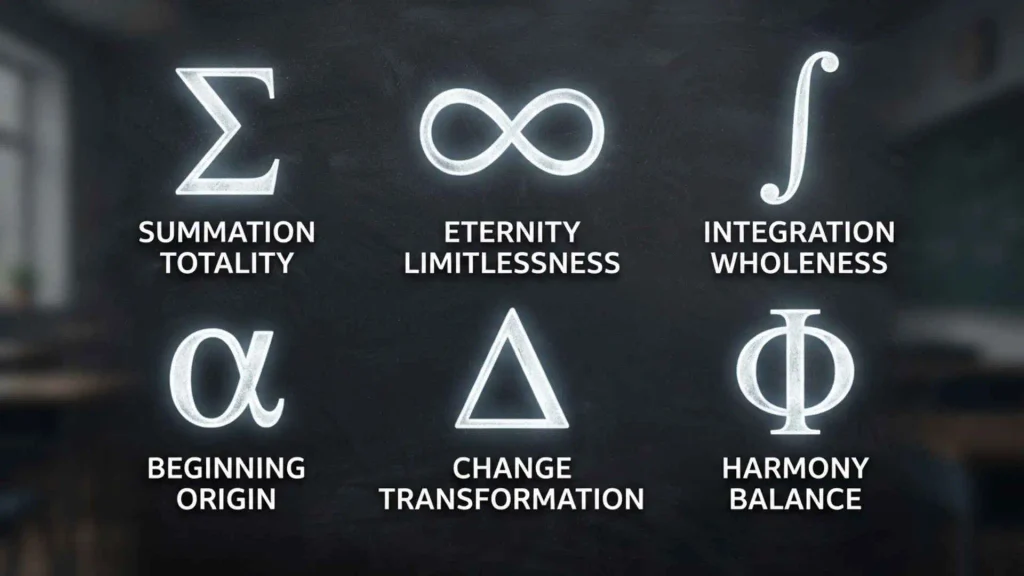
Mathematical symbols have formal meanings, but people also attach emotional, philosophical, and cultural ideas to their shapes.
These interpretations should be understood as metaphorical. A plus sign does not have an official spiritual definition, and an equation does not predict a person’s destiny. Still, symbols can inspire reflection.
Spiritual Level
Mathematics often creates a feeling of order. Patterns in spirals, circles, symmetry, proportion, and repetition can make people feel connected to something larger than themselves.
Certain symbols are commonly interpreted in spiritual or philosophical ways:
- ∞ may suggest eternity or endless consciousness.
- ○ may suggest unity, wholeness, or cycles.
- △ may suggest growth, balance, or upward movement.
- + may suggest union, addition, or positive energy.
- = may suggest balance, fairness, or harmony.
- ∅ may suggest emptiness, potential, or freedom from attachment.
These meanings come from human interpretation rather than mathematical law.
Psychological Level
The mind naturally looks for patterns. This ability helps us recognize faces, predict movement, understand language, and solve problems.
Mathematical symbols appeal to the brain because they reduce complex ideas into manageable shapes. The symbol = gives a sense of balance. The symbol ∞ creates the impression of uninterrupted movement. A triangle feels stable because its shape resists distortion.
From a Jungian perspective, repeated forms such as circles, crosses, and balanced opposites can resemble archetypal images. However, Jungian symbolism is a psychological interpretation, not a mathematical explanation.
Cultural Level
Math symbols carry social meaning because communities agree on how to read them. The meaning of + depends on shared convention, just as the meaning of a word depends on language.
This shared system allows mathematics to cross borders. It supports:
- International science
- Global trade
- Engineering standards
- Education
- Software development
- Medical research
- Space exploration
A small mark can therefore become part of humanity’s collective memory.
Types and Variations of Math Symbols
The Plus Sign (+)
Visual description: Two crossing lines.
Mathematical meaning: Addition or a positive value.
Symbolism: Growth, combination, benefit, and connection.
Cultural connection: Also appears in medical crosses, flags, logos, and religious imagery, although those uses are not always mathematical.
Where it appears: Arithmetic, algebra, programming, calculators, branding, and healthcare-related design.
The Minus Sign (−)
Visual description: A single horizontal line.
Mathematical meaning: Subtraction, negativity, or difference.
Symbolism: Reduction, separation, loss, or simplification.
Cultural connection: Commonly associated with disadvantage or removal in everyday language.
Where it appears: Mathematics, finance, temperature, science, and digital interfaces.
The Equal Sign (=)
Visual description: Two parallel horizontal lines.
Mathematical meaning: Two expressions represent the same value.
Symbolism: Balance, fairness, equivalence, and mutual worth.
Cultural connection: Used in social campaigns and graphic design to represent equality.
Where it appears: Equations, programming, logic, activism, and branding.
The Infinity Symbol (∞)
Visual description: A sideways figure eight.
Mathematical meaning: An unbounded quantity, process, or range.
Symbolism: Eternity, continuity, limitless potential, and lasting connection.
Cultural connection: Popular in jewelry, tattoos, wedding designs, and personal symbols.
Where it appears: Calculus, topology, art, fashion, spirituality, and social media.
The Pi Symbol (π)
Visual description: A Greek lowercase letter with a horizontal top and two downward strokes.
Mathematical meaning: The ratio of a circle’s circumference to its diameter.
Symbolism: Mystery, cycles, continuity, and the hidden order of nature.
Cultural connection: Celebrated on Pi Day, March 14, because 3/14 resembles the opening digits 3.14.
Where it appears: Geometry, trigonometry, physics, engineering, education, and popular culture.
The Empty Set Symbol (∅)
Visual description: A circle crossed by a diagonal line.
Mathematical meaning: A set containing no elements.
Symbolism: Absence, emptiness, boundaries, or unrealized possibility.
Cultural connection: Sometimes confused with the Scandinavian letter Ø or a prohibition mark.
Where it appears: Set theory, logic, algebra, linguistics, and computer science.
Math Symbols Across Different Cultures
Ancient Egypt
Egyptian mathematics was closely connected to agriculture, architecture, taxation, and land measurement. Numerical hieroglyphs represented powers of ten, while special methods handled fractions.
Their notation shows that mathematics first grew from practical human needs.
Ancient Greece
Greek mathematics emphasized proof, geometry, proportion, and logical argument. Although Greek mathematicians did not write equations exactly as we do, Greek letters later became central to global mathematical notation.
Symbols such as π, Σ, Δ, θ, and Ω preserve this cultural influence.
Roman Culture
Roman numerals used letters such as I, V, X, L, C, D, and M.
Copy them here:
I V X L C D M
Roman numerals remain common on clocks, monuments, book chapters, film titles, royal names, and sporting events. However, they are less efficient than positional decimal notation for advanced calculation.
Indian Traditions
Indian mathematicians played a central role in the development of decimal place-value notation and sophisticated ideas about zero.
Zero became more than a sign for “nothing.” In positional notation, it holds a place and changes the value of surrounding digits. The difference between 25 and 205 demonstrates its power.
Chinese Traditions
Chinese mathematics developed counting rods, mathematical classics, geometric methods, and practical calculation systems.
Rod arrangements could represent positive and negative quantities. These traditions show that mathematical symbolism can be expressed through position, color, orientation, and physical objects, not only printed marks.
Indigenous Traditions
There is no single Indigenous mathematical system. Indigenous cultures around the world developed distinct methods for counting, navigation, architecture, calendars, weaving, measurement, trade, and environmental observation.
Patterns in baskets, textiles, beadwork, buildings, and land knowledge may reflect symmetry, repetition, geometry, and proportion. These designs should be understood within their own cultural contexts rather than treated as generic “sacred geometry.”
Modern Global Culture
Today, mathematical notation is supported by international standards, digital fonts, equation editors, programming languages, and Unicode.
The ISO/IEC 80000 standards support international consistency in scientific and engineering terms, definitions, quantities, and symbols. This shared notation reduces misunderstanding and improves technical communication.
Similar Symbols and Their Meanings
| Symbols | Similarity | Important Difference |
| – and − | Both may look like a short line | – is commonly a keyboard hyphen-minus, while − is the mathematical minus sign |
| Ø and ∅ | Both are crossed circles | Ø is a letter, while ∅ represents the empty set |
| × and x | Both may indicate multiplication informally | × is an operator, while x is usually a variable or letter |
| · and . | Both are dots | · may show multiplication, while . is often a decimal point |
| = and ≡ | Both indicate a form of sameness | = is ordinary equality, while ≡ may mean identity, equivalence, or congruence |
| ≈ and = | Both compare values | ≈ is approximate, while = is exact |
| ∑ and Σ | Both come from Greek sigma | ∑ is a mathematical summation operator, while Σ is the Greek capital letter |
| ∏ and Π | Both come from Greek pi | ∏ is a product operator, while Π is the Greek capital letter |
| 0 and O | Both are rounded characters | 0 is a number, while O is a letter |
| ∂ and d | Both appear in calculus | ∂ commonly indicates partial differentiation, while d is used in ordinary differentiation |
Math Symbols in Mythology and Folklore
Modern mathematical symbols were not generally worshipped as sacred objects in ancient mythology. However, mathematical shapes, numbers, and patterns often appeared in stories, philosophy, architecture, and ritual.
The Circle
Circles have represented the sun, cycles, unity, protection, and eternity in many traditions. Mathematically, the circle inspired the study of radius, diameter, circumference, area, angles, and π.
The Triangle
Triangles appear in pyramids, temple design, decorative art, and religious imagery. Their structural stability also makes them important in architecture and engineering.
In symbolic interpretations, a triangle may represent:
- A group of three
- Balance
- Hierarchy
- Ascent
- Fire
- Transformation
These meanings vary greatly by culture.
Sacred Numbers
Numbers such as three, seven, nine, twelve, and forty appear frequently in myths and religious stories. Their importance may come from counting systems, astronomy, calendars, storytelling patterns, and cultural traditions.
Formal mathematics does not assign spiritual power to these numbers, but human societies often do.
The Endless Knot and Infinity
Looping designs in art and religion sometimes resemble the modern infinity symbol. However, visual similarity does not prove that every ancient loop had the same meaning as mathematical infinity.
Historical context must come before modern interpretation.
Math Symbols in Art, Literature, Movies, and Pop Culture
Paintings and Visual Art
Artists use geometry, proportion, repetition, perspective, and symmetry to organize visual space. Mathematical forms may create calm, tension, movement, or balance.
Circles can suggest unity. Spirals suggest growth. Grids create order. Broken symmetry can create unease.
Literature and Poetry
Writers use mathematical language as metaphor:
- Love may feel infinite.
- Two lives may become one.
- A relationship may lack balance.
- A person may search for an unknown x.
- A loss may leave an empty set.
These metaphors work because readers already understand the emotional associations of mathematical ideas.
Movies and Television
Mathematical notation often appears in stories about:
- Scientific discovery
- Artificial intelligence
- Space travel
- Cryptography
- Time
- Probability
- Genius
- Hidden codes
- Alternate realities
A wall covered in equations quickly signals mystery, intelligence, or a difficult problem.
Tattoos
Popular math tattoo symbols include:
∞ π φ Δ Σ = ≠ √
Possible personal meanings include:
- ∞ for eternal connection
- π for love of mathematics
- Δ for change
- = for equality
- ≠ for individuality
- √ for finding one’s roots
- Σ for life as the sum of experiences
Before choosing a tattoo, confirm the symbol’s actual mathematical meaning. Small changes can produce a completely different interpretation.
Fashion and Modern Design
Mathematical symbols appear on shirts, jewelry, notebooks, phone cases, logos, and home decor. Their simple shapes fit minimalist design and often communicate intelligence, mystery, balance, or individuality.
Spiritual and Dream Meaning of Math Symbols
Dream interpretation is subjective. There is no scientific dictionary proving that one symbol always has the same dream meaning.
Still, a dream involving mathematics may reflect how the dreamer feels about order, pressure, uncertainty, or control.
Dreaming About an Equation
An equation may suggest that you are trying to balance two parts of life. You may be comparing effort and reward, logic and emotion, or personal needs and social expectations.
Dreaming About Infinity
Infinity may reflect:
- A lasting relationship
- Fear that a problem will never end
- Expanding possibility
- Repeating emotional cycles
- A desire for spiritual continuity
The feeling of the dream matters more than the symbol alone.
Dreaming About the Number Zero
Zero may represent emptiness, a fresh beginning, lack of progress, or unlimited potential.
A frightening zero may suggest loss. A peaceful zero may suggest release or a clean slate.
Dreaming About Solving a Math Problem
Successfully solving a problem may represent confidence and mental clarity. Being unable to solve it may reflect pressure, confusion, or fear of making the wrong decision.
Meditation and Geometric Symbols
Some people use circles, triangles, spirals, mandalas, and repeating patterns during meditation. Their symmetry may support concentration and create a sense of order.
This effect can be psychologically meaningful without requiring supernatural claims.
Positive and Negative Meanings of Math Symbols
| Symbol | Positive Meaning | Negative or Cautionary Meaning |
| + | Growth, connection, benefit | Overload, excess, unhealthy accumulation |
| − | Simplification, release | Loss, lack, separation |
| = | Equality, balance, fairness | Forced sameness or lack of individuality |
| ≠ | Uniqueness, independence | Division, inequality, exclusion |
| ∞ | Endless possibility, eternal love | Repetition, obsession, lack of closure |
| 0 | New beginning, openness | Emptiness, isolation, absence |
| ∆ | Change, growth, transformation | Instability, disruption |
| ∅ | Freedom from clutter | Loneliness or complete absence |
| √ | Discovery, foundation, solution | Searching too deeply for certainty |
| ∑ | Unity, combined effort | Losing individuality within a group |
The symbol itself is neutral. Context creates the emotional interpretation.
For example, subtraction may feel negative when money is lost, but positive when stress is removed. Infinity may represent eternal love, but it can also represent a problem that feels endless.
Why Humans Are Attracted to Math Symbols
They Turn Complexity Into Clarity
A symbol can hold an entire instruction inside one small shape. This gives the mind a feeling of control.
The expression a² + b² = c² communicates a geometric relationship far more efficiently than a long paragraph.
The Brain Loves Patterns
Human survival has always depended on pattern recognition. People notice seasons, animal tracks, facial expressions, sounds, distances, and repeated events.
Mathematics extends this natural ability into a formal system.
Symmetry Feels Balanced
Balanced designs often feel stable and complete. Symbols such as =, ∞, and ○ have strong visual symmetry, which may explain part of their emotional appeal.
Symbols Create Belonging
Understanding a symbol can make someone feel part of a community.
Students, programmers, engineers, scientists, and mathematicians share specialized notation. A symbol becomes a sign that says, “I understand this language.”
They Leave Room for Personal Meaning
A symbol is precise in mathematics but flexible in art. The infinity sign has a technical role in calculus, yet someone may wear it as a reminder of lifelong love.
That combination of logic and emotion makes mathematical symbols unusually powerful.
Modern Uses of Math Symbols
Education
Teachers and students use mathematical signs in worksheets, textbooks, presentations, exams, digital classrooms, and online learning platforms.
Programming
Programming languages use symbols such as:
- / % = == != < > <= >= && || !
Their exact meanings depend on the programming language. For example, a single = may assign a value, while == may test equality.
Science and Engineering
Mathematical notation helps express:
- Physical laws
- Chemical relationships
- Statistical results
- Electrical measurements
- Structural calculations
- Astronomical models
- Medical data
Social Media
People copy and paste math symbols into:
- Usernames
- Bios
- Captions
- Educational posts
- Aesthetic text
- Study accounts
- Puzzle content
- Romantic messages
Examples:
- Love ∞
- You + Me
- Be ≠ ordinary
- Change = Growth
- ∑ of small steps
- Find your √
Branding
Brands may use plus signs, circles, geometric shapes, or infinity marks to suggest:
- Innovation
- Connection
- Precision
- Health
- Technology
- Continuity
- Growth
A symbol must be checked carefully before commercial use because some designs may be protected trademarks.
Home Decor
Equations, geometric prints, number patterns, and infinity designs appear in classrooms, offices, study rooms, and modern homes.
Accessible Digital Content
Copyable Unicode symbols are useful, but accessibility still matters. Screen readers may pronounce symbols differently, and unsupported fonts may display empty boxes.
For important equations, provide explanatory text or properly formatted MathML rather than relying only on decorative symbols.
How to Copy and Paste Math Symbols
- Find the symbol you need.
- Highlight it with your mouse or finger.
- Select Copy.
- Open your document, message, website editor, or social media app.
- Select Paste.
- Check that the symbol displays correctly.
Keyboard Shortcuts
Windows
- Copy: Ctrl + C
- Paste: Ctrl + V
Mac
- Copy: Command + C
- Paste: Command + V
Mobile devices
Press and hold the symbol, select Copy, and then press and hold where you want to insert it.
Why Some Math Symbols Do Not Display Correctly
A symbol may appear as a square, blank box, or question mark when:
- The selected font does not contain the character.
- The operating system has limited Unicode support.
- The website strips special characters.
- The app replaces mathematical symbols with plain text.
- The symbol is part of a newer Unicode range.
- The platform uses a different encoding.
Try switching to a widely supported font or using an equation editor.
Unicode includes mathematical characters not only in the basic Mathematical Operators block but also in Miscellaneous Mathematical Symbols-A, Miscellaneous Mathematical Symbols-B, and Supplemental Mathematical Operators.
Unicode Math Symbols Versus LaTeX
Unicode and LaTeX solve different problems.
| Feature | Unicode Symbols | LaTeX |
| Best for | Short symbols in ordinary text | Complete professional equations |
| Example | √, ∞, ∑, π | \sqrt{x}, \infty, \sum, \pi |
| Copy and paste | Easy | Requires rendering |
| Complex fractions | Limited | Excellent |
| Matrices | Difficult | Excellent |
| Social media use | Usually suitable | Usually unsupported without conversion |
| Academic publishing | Useful for text | Widely used for mathematical layout |
Use Unicode when you need a quick symbol. Use LaTeX or an equation editor when you need a full mathematical expression.
Interesting Facts About Math Symbols
- The equal sign is almost 500 years old. Robert Recorde introduced it in print in 1557.
- The modern minus sign is not the same character as a keyboard hyphen. Unicode encodes the mathematical minus sign separately as U+2212.
- The symbol ≡ has several meanings. It may represent identity, logical equivalence, modular congruence, or a definition, depending on context.
- A symbol can change meaning across time. The Bakhshali manuscript used notation that can look surprising to modern readers, including a plus-like sign associated with negative values.
- Greek letters are not decorative additions. They help distinguish constants, parameters, angles, functions, sets, and variables.
- The multiplication sign and the letter x should not always be treated as identical. Using x for multiplication can confuse readers when x is also a variable.
- Unicode contains hundreds of specialized mathematical operators. Its mathematical ranges include relations, geometric symbols, logic signs, and advanced operators.
- Mathematical symbols do not always have one universal meaning. The same character can mean different things in algebra, logic, geometry, physics, or computer science.
- The base-60 system still affects daily life. Babylonian mathematical traditions influenced how time and angles are divided.
- Standard notation improves safety. Consistent mathematical and measurement symbols reduce misunderstanding in science, engineering, medicine, and technology.
Frequently Asked Questions
What are the most common math symbols to copy and paste?
The most common symbols are +, −, ×, ÷, =, ≠, ≤, ≥, √, π, ∞, %, ∑, ∫, ∆, and ±.
How do I type the infinity symbol?
You can copy this infinity symbol directly: ∞. On some devices, it is also available through the symbol keyboard, character map, or special character menu.
What is the difference between × and x?
× is the multiplication sign. Lowercase x is a letter commonly used as a variable. They may look similar in plain text, but their mathematical roles are different.
What does ∑ mean in mathematics?
The symbol ∑ is the summation operator. It tells you to add a sequence or collection of terms.
What does ∅ mean?
The symbol ∅ represents the empty set, which is a set containing no elements. It should not be confused with the letter Ø.
Can I use copied math symbols on social media?
Yes. Most platforms support common Unicode math symbols. However, rare symbols may display differently depending on the device, app, font, or operating system.
Conclusion
Math symbols copy and paste resources give you more than a convenient collection of characters.
They open a window into thousands of years of counting, reasoning, discovery, and shared human knowledge.
Every sign, from + to ∞, turns a complex idea into a small but powerful visual language.
When you use these symbols carefully, you join a global conversation that connects history, science, creativity, and everyday life.
 Michael Rivera