
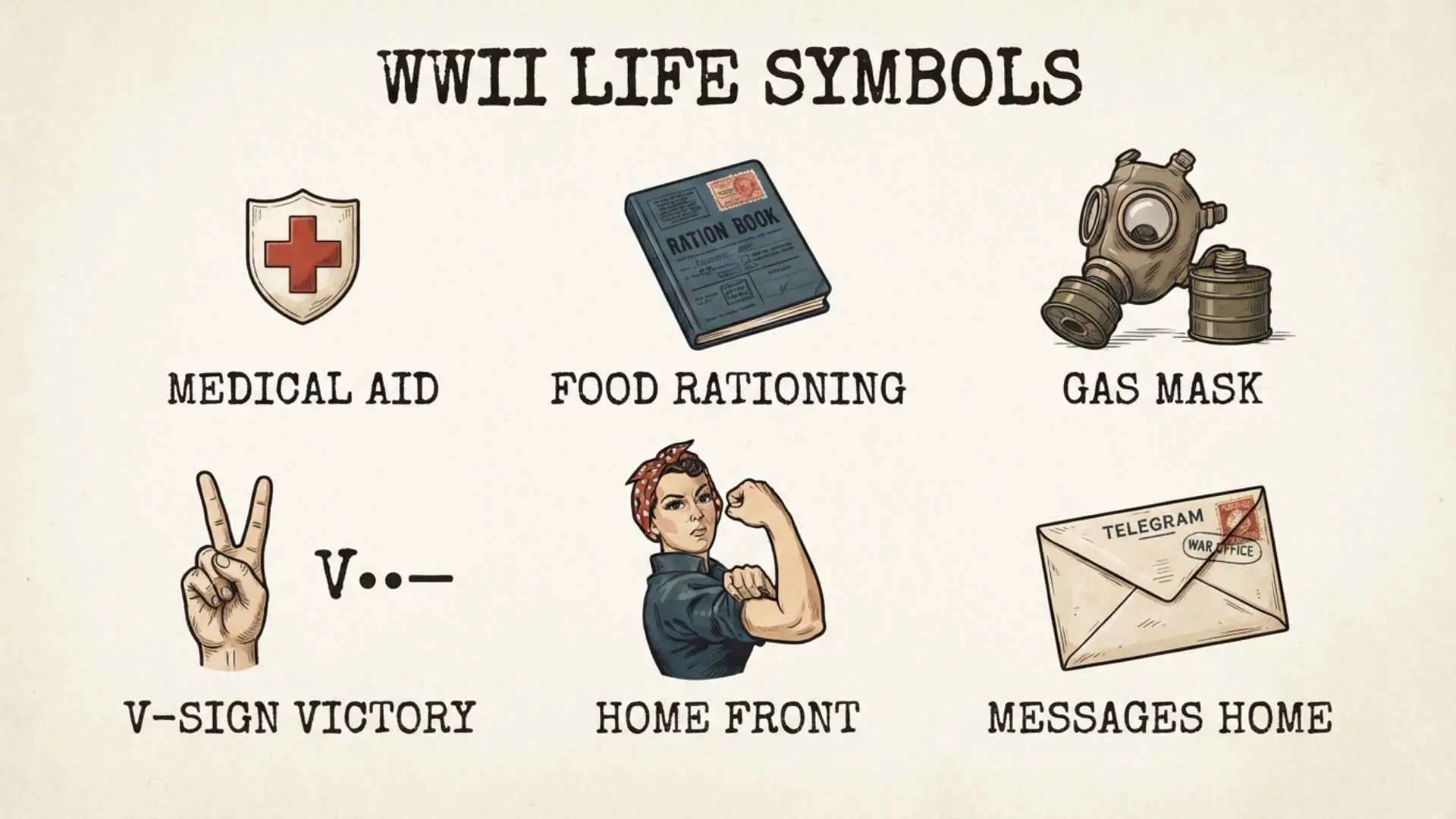
World War II symbols tell powerful stories about one of the most significant conflicts in modern history. From national flags and military insignia to propaganda posters, resistance emblems, medals, and battlefield markings, these symbols helped communicate identity, loyalty, power, and political beliefs. Some became lasting reminders of courage and sacrifice, while others represented oppression, persecution, and the devastating consequences of war. Understanding WW2 symbols provides a deeper look into the ideas, movements, and historical events that shaped the Second World War.
During World War II, governments, military forces, resistance groups, and political organizations used distinctive symbols to influence public opinion and identify their supporters. The Allied star, Soviet hammer and sickle, British Union Jack, German Iron Cross, and French Resistance emblems each carried specific historical associations. Nazi symbols, including the swastika, became closely connected with dictatorship, antisemitism, genocide, and the atrocities committed by the Nazi regime. These images were more than simple decorations; they served as powerful tools of propaganda, recognition, and communication.
In this complete guide to WW2 symbols, you will explore their origins, meanings, historical significance, and influence on modern culture. You will discover military insignia, national emblems, resistance symbols, propaganda imagery, and symbols of remembrance. This guide also explains how different symbols were used by the Allied and Axis powers, why certain images remain controversial today, and how historical context helps distinguish symbols of resistance and liberation from those associated with hatred and persecution.
Quick Answer
WW2 symbols refer to the visual emblems, insignia, and propaganda icons utilized by Allied and Axis powers during World War II. These symbols served as critical tools for national identity, military recognition, psychological operations, and ideological messaging. They range from repurposed ancient spiritual signs like the swastika to democratic icons of hope like the Allied V for Victory.
Quick Facts About WW2 Symbols
| Aspect | Information |
| Origin | Ancient cultural traditions, Roman military heritage, and early 20th century political movements. |
| Historical Significance | Galvanized entire nations, marked military equipment, and divided the world into distinct ideological camps. |
| Main Meaning | Ideological alignment, national sovereignty, totalitarian control, or democratic resistance. |
| Spiritual Meaning | The ultimate battle between cosmic order, distortion of sacred geometry, and the resilience of the human soul. |
| Cultural Importance | Shaped modern political taboos, pop culture iconography, and global memorial traditions. |
| Modern Usage | Historical education, anti-hate legislation, entertainment media, and memorials. |
What Are WW2 Symbols?
WW2 symbols are the visual markers that defined the graphic identity of World War II between 1939 and 1945. At their core, these symbols acted as a visual shorthand for complex political beliefs and military alliances. Long before the war broke out, nations began searching for imagery that could unite their citizens and strike fear into their enemies.
The origin of these symbols varies wildly. Some were pulled directly from ancient history, while others were birthed in the heat of military necessity. Over time, these marks evolved from simple unit identifiers into massive psychological tools. They became important because World War II was the first truly industrialized, total war where mass media and public morale determined the outcome of battles.
Deep Symbolic Meaning of WW2 Symbols
Spiritual Level
On a spiritual level, the symbols of World War II represent a profound clash of cosmic energies. Fascist regimes deliberately hijacked ancient, sacred geometric shapes that originally symbolized harmony and cosmic order. By distorting these symbols, they attempted to claim a divine or destiny-driven right to rule. Conversely, Allied symbols often invoked spiritual themes of light overcoming darkness, justice, and the preservation of human dignity against overwhelming evil.
Psychological Level
Psychologically, these symbols tap into what Carl Jung called the collective unconscious. They function as powerful archetypes that trigger primal human emotions like fear, tribal loyalty, and the desire for protection. The sharp, aggressive angles of Axis iconography were engineered to project absolute authority and invincibility. Meanwhile, the balanced, familiar shapes of Allied iconography aimed to evoke feelings of security, unity, and shared sacrifice among everyday citizens.
Cultural Level
Culturally, WW2 symbols served as the ultimate social glue. In Germany and Japan, state-sanctioned imagery replaced traditional community beliefs, forcing a uniform identity upon the public. In occupied territories, secret resistance symbols became a quiet way for oppressed communities to say, “We are still here.” These signs built an instant, unspoken bond among strangers who shared the same perilous struggle for survival.
Types and Variations of WW2 Symbols
The Swastika
The swastika is a hooked cross with arms bent at right angles. While it was originally a Sanskrit symbol for well-being and good fortune, the Nazi Party tilted it at 45 degrees and placed it inside a white circle on a red background. In this context, it came to symbolize racial purity, Aryan supremacy, and the totalitarian power of the Third Reich. It appeared on flags, uniforms, buildings, and every piece of official state documentation.
The Allied White Star
The Allied Star is a simple, five-pointed white star, often enclosed within a solid or broken white circle. It symbolized freedom, unity, and the collective push of the democratic nations to liberate Europe and the Pacific. This emblem appeared on almost every American and Western Allied tactical vehicle, including tanks, jeeps, and airplanes, ensuring troops could identify friendly forces from afar.
The V for Victory
The V for Victory consists of the letter V, frequently paired with the Morse code signal for V, which is three dots and a dash. It symbolized defiance, hope, and the inevitable triumph of freedom over tyranny. Championed by Winston Churchill, this symbol appeared in graffiti across occupied Europe, in BBC radio broadcasts, on posters, and was even expressed through the opening notes of Beethoven’s Fifth Symphony.
The Rising Sun
The Rising Sun features a red sun disk with 16 red rays radiating outward against a white background. It symbolized the divine mandate of the Japanese Empire, national pride, and the expansionist military power of the state. This iconic emblem appeared on the naval ensign flags of Japanese warships, military aircraft, and propaganda posters throughout the Pacific theater.
The Hammer and Sickle
The Hammer and Sickle features a crossed hammer and sickle, representing the industrial factory worker and the agricultural peasant. It symbolized the proletarian revolution, communist ideology, and the state power of the Soviet Union. This emblem appeared prominently on the Soviet national flag, military medals, monuments, and state propaganda across the Eastern Front.
WW2 Symbols Across Different Cultures
Ancient Egypt
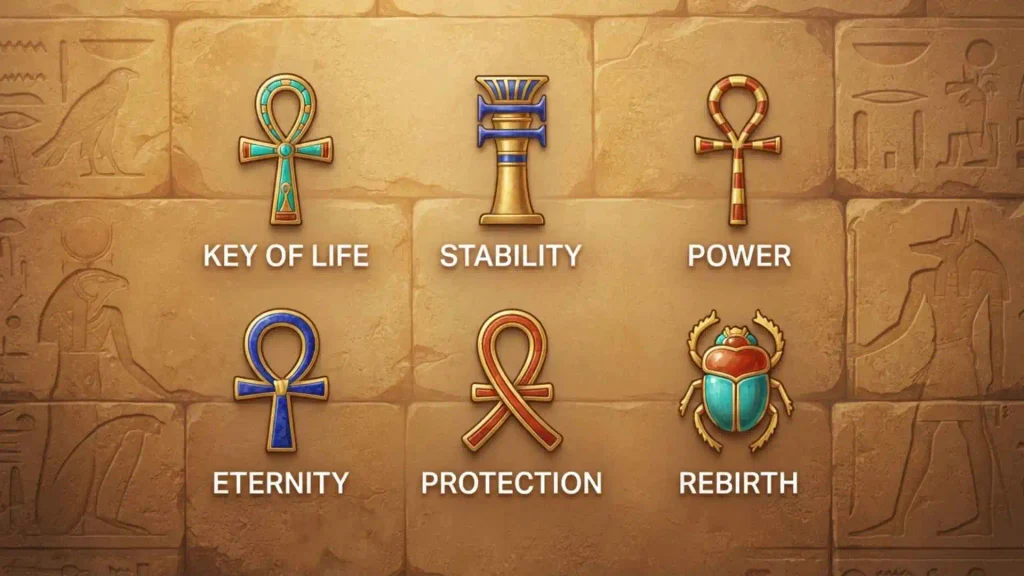
The influence of Ancient Egypt crept into WW2 iconography through the concept of the solar disk and the eagle. The German eagle, while strictly Roman in its immediate design, mirrored the pharaonic tradition of using raptors to symbolize absolute, sun-like authority over the earth.
Ancient Greece
Ancient Greece provided the foundation for many military ideals during the war. The concept of the Spartan shield and the laurel wreath of victory were heavily adapted by both Axis and Allied nations to honor heroism, martial discipline, and the pursuit of historic glory.
Roman Culture
Roman culture was heavily mined by the Axis powers. Benito Mussolini adopted the Fasces, a bundle of rods bound around an axe, which was an ancient Roman symbol of civic authority and power. The Nazis also adopted the Roman eagle and the straight-armed salute, attempting to frame their regimes as the rightful heirs to the Roman Empire.
Eastern Traditions
Eastern traditions faced massive disruption due to the war. In Japan, the traditional Shinto reverence for the sun was militarized through the Rising Sun flag, transforming a peaceful symbol of nature and creation into an emblem of imperial conquest. Meanwhile, the ancient Buddhist and Hindu swastika was deeply stigmatized in the Western mind due to its European misuse.
Indigenous Traditions
Indigenous traditions played a unique, hidden role in the war, particularly through the United States military. Native American code talkers used their sacred languages as unbreakable codes. Additionally, several American bomb groups and regiments adapted indigenous thunderbird and warrior symbols for their unit patches, honoring the brave warrior spirits of the Americas.
Modern Interpretations
Modern interpretations of these symbols vary drastically depending on geography. In the West, Axis symbols are heavily restricted, legally banned, or viewed with intense cultural taboo. However, Allied symbols have transitioned into historical icons of the greatest generation, representing a monumental victory for global democracy.
Similar Symbols and Their Meanings
Understanding these icons requires looking at how different factions used similar shapes for opposing purposes. The table below highlights the crucial differences between prominent wartime markers.
| Symbol | Used By | Key Similarities | Major Differences | Common Misconceptions |
| Balkenkreuz | German Wehrmacht | Uses a cross design similar to the Allied Star’s geometric simplicity. | A stylized, straight-armed Greek cross used strictly for vehicle identification. | Often confused with the Iron Cross, which was a specific military medal. |
| Allied Star | Western Allies | Functions as the primary vehicle marker, just like the Balkenkreuz. | A five-pointed star representing democracy and freedom. | People often think it was only used by the United States, but British and Canadian forces used it too. |
| Fasces | Italian Fascists | Utilizes ancient Roman authority motifs, mirroring Nazi eagle designs. | A bundle of wooden rods with an axe, symbolizing strength through unity. | Many assume it was invented by Mussolini, but it is thousands of years old. |
WW2 Symbols in Mythology and Folklore
The propaganda machines of World War II frequently turned to ancient folklore to justify their actions. The Nazi regime created a pseudo-scientific department called the Ahnenerbe, which hunted for ancient Germanic myths and Runic symbols. They believed that by reviving symbols like the Siegrune, the lightning bolt shape used by the SS, they could tap into the mythical power of Thor and ancient Nordic warriors.
On the flip side, British and American folklore evolved rapidly during the war to help soldiers cope with stress. The famous myth of the Gremlin, a mythical creature that sabotaged aircraft electronics, became a legendary piece of aviation folklore. By blaming mechanical failures on these mythical pests, pilots managed the immense psychological pressure of high-altitude combat.
WW2 Symbols in Art, Literature, Movies, and Pop Culture
Following the war, WW2 symbols exploded into the creative arts. In paintings and anti-war literature, these icons were used to process the trauma of the global conflict. Comic books immediately adopted the imagery; Captain America famously debuted by punching Adolf Hitler, establishing the Allied star as a pop culture shield against tyranny.
In modern movies and television, these symbols are used as instant visual shorthand to establish good versus evil. Film directors rely on the heavy contrast of the black swastika or the clean white Allied star to build immediate tension. Today, these symbols also appear in tattoo art, fashion subcultures, and video game designs, serving as permanent reminders of the high-stakes struggle for the future of the world.
Spiritual and Dream Meaning of WW2 Symbols
When WW2 symbols show up in dreams or spiritual practices today, they rarely relate to the literal historical events. Instead, they usually point to deep, internal conflicts. Dreaming of an oppressive wartime symbol often signifies that you are feeling overwhelmed, controlled, or trapped by an authoritarian force in your waking life, such as a toxic boss or a rigid routine.
Conversely, dreaming of liberation symbols like the V for Victory or the Allied Star points to a positive internal breakthrough. It suggests that your subconscious mind is rallying its strength to overcome a personal hardship. These dreams serve as a reminder that the human spirit possesses an incredible capacity to resist negativity and find hope even in the darkest corners of the mind.
Positive and Negative Meanings of WW2 Symbols
A single symbol can hold completely opposite meanings depending on the context of who is holding it and how it is framed.
| Positive Meaning | Negative Meaning |
| Liberation and Hope: Representing the end of tyranny, the rescue of concentration camps, and the return of peace. | Oppression and Terror: Representing totalitarian control, genocide, racial hatred, and military occupation. |
| Unity and Sacrifice: Honoring the millions of soldiers and civilians who worked together for a global cause. | Destruction and Domination: Showcasing the aggressive desire to erase cultures and conquer sovereign nations. |
| Resilience: Standing as a testament to the survival of human dignity under extreme pressure. | Propaganda and Deception: Highlighting how easily mass psychology can be manipulated by visual messaging. |
Why Humans Are Attracted to WW2 Symbols
Our ongoing fascination with WW2 symbols comes down to basic human psychology and pattern recognition. The human brain is naturally wired to look for simple shapes that carry deep emotional survival data. Because World War II was a clear, global struggle between dramatically different worldview systems, the symbols associated with it became highly concentrated capsules of human emotion.
Furthermore, these symbols tap into our shared cultural memory. We look at them and instantly connect with the real stories of our grandparents and ancestors. They provide a tangible link to a pivotal historical moment when the entire destiny of human civilization hung in the balance, satisfying our deep psychological need to understand where we came from.
Modern Uses of WW2 Symbols
In the modern era, these symbols have taken on entirely new roles. Historical education relies heavily on them to teach younger generations about the dangers of extremism. Museums and memorials across the globe preserve these items as physical evidence of the past, ensuring that the lessons of the mid-20th century are never forgotten.
\ / _______ _______
V | * | | O O |
/ \ |_______| | V |
(Victory) (Allied) (Resistance)
In the realm of personal expression, the Allied Star and various regiment patches are frequently featured in vintage fashion, historical reenactments, and commemorative tattoos. Meanwhile, strict legal frameworks in many democratic countries restrict the public display of Axis symbols, transforming them into modern legal benchmarks for fighting hate speech and promoting peace.
Interesting Facts About WW2 Symbols
- The British V for Victory sign was so effective that the Germans actually tried to adopt it for themselves, plastering the letter V on buildings in occupied Paris to confuse the public.
- The famous Kilroy Was Here graffiti symbol, featuring a bald man peeking over a wall, was left by American soldiers all over the world as a lighthearted calling card.
- The Nazi party specifically chose the colors red, white, and black for their flag because those were the traditional colors of the old Imperial German Empire.
- The Soviet Hammer and Sickle was designed during the Russian Revolution but reached its absolute peak of global recognition on the battlefields of Berlin in 1945.
- The iconic Rosie the Riveter We Can Do It poster was not actually widely famous during the war; it was rediscovered decades later and turned into a global symbol of female empowerment.
Frequently Asked Questions
Why did the Nazis change the meaning of the swastika?
The Nazi party sought a powerful, ancient symbol to represent their false theory of Aryan heritage. They took the traditional Eurasian swastika, which had meant well-being for thousands of years, and rebranded it as a symbol of racial purity and aggressive nationalism.
What did the white star on Allied tanks mean?
The white star was the primary national identification symbol for Western Allied vehicles. It helped ground troops and friendly aircraft quickly distinguish American, British, and Canadian vehicles from enemy German forces, reducing accidental friendly fire incidents.
What is the origin of the Kilroy Was Here symbol?
The symbol started as a shipyard inspection mark by a man named James J. Kilroy. American soldiers saw the chalk phrase on ships, copied the doodle, and began drawing it on walls worldwide to signal that American troops had successfully arrived at a location.
Why is the Rising Sun flag controversial today?
While it has deep historic roots in Japan, the Rising Sun flag was used by the Imperial Japanese Military during their wartime expansions across Asia. For many nations that suffered under occupation, it remains a painful symbol of military aggression.
Conclusion
WW2 symbols remain some of the most influential visual markers ever created, serving as lasting testaments to a time when the world was fractured by competing ideologies. By looking past the surface of these emblems, we gain vital insights into the psychological, cultural, and spiritual forces that drive human behavior during times of crisis. Ultimately, these historic marks remind us that symbols hold incredible power. It is our collective responsibility to remember their true history, ensuring we use our shared visual language to build a future rooted in peace, liberty, and mutual understanding.
 John Mercer