
Crest symbols and meanings reveal fascinating stories about family heritage, history, identity, and tradition. From powerful lions and majestic eagles to royal crowns, swords, flowers, and mythical creatures, these designs have been used for centuries to represent courage, loyalty, authority, faith, and achievement. Whether you have seen a crest on an old family document, a historic building, a military badge, or a university emblem, understanding its symbolism can help you discover the history and ideas behind its design.
In heraldry, every detail can contribute to a crest’s appearance and interpretation. Animals may represent strength or protection, wings can suggest freedom or ambition, and anchors often symbolize hope and stability. Colors, shapes, objects, and decorative patterns also play important roles in traditional heraldic designs. However, crest symbols do not have one universal meaning, and their significance often depends on the historical period, cultural background, and individual or family associated with the emblem.
In this complete guide to crest symbols and meanings, you will explore their origins, historical development, popular heraldic animals, religious imagery, cultural significance, and modern uses. You will also learn the difference between a crest and a coat of arms, discover common misconceptions about family crests, and understand how to research an authentic heraldic design. Whether you are interested in genealogy, symbolism, history, or decorative emblems, this guide will help you appreciate the stories these timeless symbols can tell.
Quick Answer
Army symbols are visual signs used to represent military identity, rank, units, duties, values, and achievements. They include insignia, badges, flags, crests, medals, animals, weapons, colors, and geometric designs. Their meanings often connect with courage, honor, authority, sacrifice, unity, protection, and service to a nation.
Quick Facts About Army Symbols
| Aspect | Information |
| Origin | Early armies used flags, shields, animals, colors, and standards to identify leaders and military groups |
| Historical Significance | Symbols helped soldiers recognize allies, commanders, formations, and battlefield positions |
| Main Meaning | Duty, courage, authority, unity, discipline, and national service |
| Spiritual Meaning | Protection, sacrifice, inner strength, purpose, and loyalty to something greater than oneself |
| Cultural Importance | Preserve military traditions, national history, unit pride, and remembrance |
| Modern Usage | Uniform insignia, unit patches, flags, medals, memorials, tattoos, branding, and ceremonies |
What Are Army Symbols?
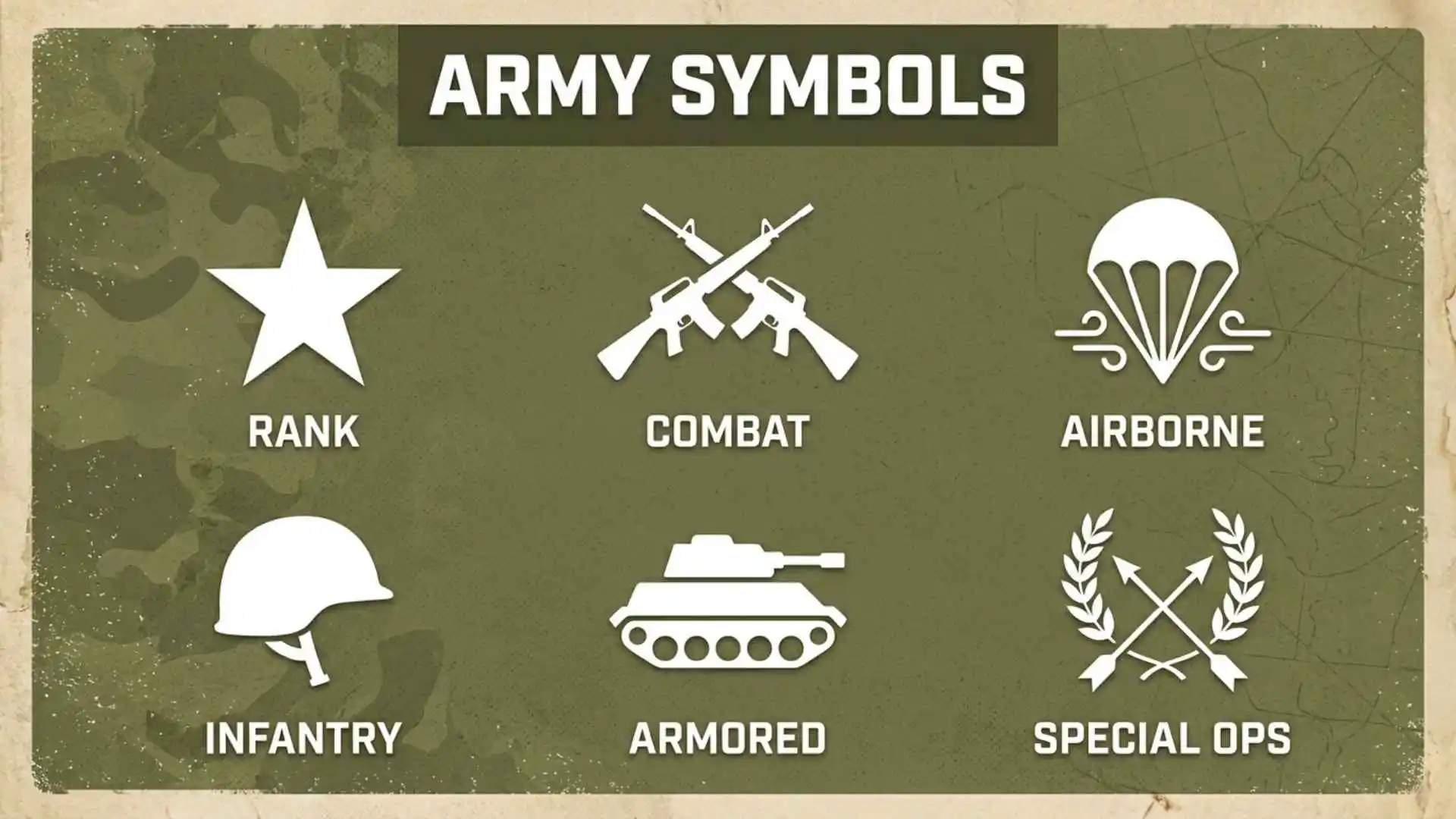
Army symbols are images, objects, colors, letters, and designs that communicate military meaning. They may identify a soldier’s rank, professional role, branch, unit, country, qualification, or achievement.
Common examples include stars, eagles, swords, shields, crossed rifles, wings, arrows, wreaths, crowns, lions, and unit mottos. Uniform patches, shoulder insignia, medals, flags, and regimental crests also belong to this symbolic system.
The origin of military symbolism reaches back thousands of years. Ancient armies needed clear ways to identify their leaders and formations during battle. Soldiers could not depend on spoken commands alone, especially in noisy and confusing conditions. Standards, banners, helmets, shields, and painted emblems became visual communication tools.
Roman legions famously carried standards, including the eagle known as the aquila. Losing such a standard was considered a terrible dishonor. Medieval armies later used coats of arms, banners, crosses, animals, and family colors to separate allies from enemies.
As military organizations became more structured, their symbols also became more precise. Modern armies use official systems of rank insignia, unit patches, branch emblems, medals, and qualification badges. Each design follows rules and usually carries a documented meaning.
Army symbols became important because they create order while strengthening identity. A soldier may see a patch as a reminder of training, responsibility, friendship, sacrifice, and belonging.
Deep Symbolic Meaning of Army Symbols
Spiritual Meaning
On a spiritual level, army symbols often represent service to a cause greater than the individual. A shield may suggest protection, while a sword may symbolize truth, justice, or the struggle between right and wrong.
Military service can involve personal sacrifice, fear, discipline, and moral responsibility. Because of this, symbols connected with soldiers often carry meanings related to courage, faith, endurance, and remembrance.
Wreaths and memorial flames may symbolize eternal memory. Wings can suggest protection or the soul’s movement beyond physical limits. Stars may represent guidance, excellence, or hope during darkness.
These meanings are not universal. Their spiritual value depends on a person’s culture, beliefs, experience, and relationship with military history.
Psychological Meaning
Psychologically, army symbols build identity and group unity. Wearing the same emblem can help individuals feel connected to a larger community with shared goals and standards.
Swiss psychiatrist Carl Jung wrote about archetypes, which are recurring patterns and images found across human cultures. The warrior is one such archetypal figure. It represents courage, discipline, protection, struggle, and the willingness to confront danger.
However, the warrior archetype also has a shadow side. When courage loses compassion, it may become aggression. When loyalty becomes blind obedience, it can weaken personal judgment. This is why army symbols can inspire both admiration and serious reflection.
Badges and medals also carry emotional power because they provide visible proof of achievement. They may remind veterans of pride, hardship, friendship, grief, or experiences that civilians cannot easily understand.
Cultural Meaning
Army symbols preserve collective memory. They connect present-day soldiers with earlier generations, historic campaigns, national struggles, and unit traditions.
A regimental crest may include a local animal, historical weapon, battle honor, landscape, or motto. These details turn military history into a visual story.
During public ceremonies, army flags and emblems can represent national unity. At memorials, the same symbols may express grief and respect. Their meaning changes with the setting, but their cultural power remains strong.
Types and Variations of Army Symbols
Stars
Stars appear in many military rank systems, flags, medals, and unit designs.
Visually, they may have five or more points and appear alone or in groups. Stars commonly symbolize guidance, high rank, excellence, authority, or achievement.
They appear on generals’ insignia, national emblems, military decorations, flags, memorials, and ceremonial objects.
Eagles
The eagle is one of the oldest military animals. It has sharp vision, powerful wings, and an imposing presence.
It often represents courage, command, freedom, victory, and the ability to see danger from a distance. Roman legions used eagle standards, while many modern nations include eagles in military seals and insignia.
The eagle appears on badges, flags, crests, coins, memorials, uniforms, and military buildings.
Swords
A sword usually symbolizes strength, readiness, justice, leadership, or honorable combat.
Straight swords may suggest discipline and authority. Curved blades can reflect particular regional or historical traditions. Crossed swords often identify combat-related units or represent military cooperation.
Swords appear in crests, branch insignia, ceremonial uniforms, medals, monuments, tattoos, and military art.
Shields
The shield is a symbol of defense, protection, duty, and security.
A shield-shaped emblem may suggest that an army exists to protect a nation, community, border, or set of values. It can also represent resilience against danger.
Shields commonly appear in unit patches, police and military badges, coats of arms, monuments, and national seals.
Crossed Rifles
Crossed rifles are strongly associated with infantry in several military traditions.
Their visual form communicates direct ground combat, readiness, teamwork, and battlefield service. They may also represent the long history of the foot soldier.
This symbol appears on branch insignia, collar devices, training emblems, plaques, and unit memorabilia.
Wings
Wings symbolize speed, elevation, freedom of movement, and service in the air.
In army aviation, airborne, and parachute units, wings may identify specialized training or operational roles. They can also symbolize ambition and the ability to rise above fear.
Wings appear on aviation badges, parachutist insignia, unit patches, medals, and memorial art.
Wreaths
A wreath, especially one made from laurel leaves, represents honor, victory, achievement, and remembrance.
Ancient Greek and Roman societies used laurel wreaths to recognize victory and distinction. Military organizations later adopted the image for medals, seals, badges, and memorials.
Animals
Lions, wolves, tigers, bears, horses, snakes, and falcons frequently appear in army symbols.
Each animal communicates a quality. Lions suggest bravery and authority. Wolves represent teamwork and endurance. Horses symbolize mobility and power. Snakes can represent alertness, danger, healing, or transformation.
Animal symbols appear on unit crests, flags, vehicles, patches, tattoos, and military mascots.
Army Symbols Across Different Cultures
Ancient Egypt
Ancient Egyptian armies used standards decorated with sacred animals and divine emblems. The falcon was connected with Horus and royal power, while the cobra represented protection and authority.
Military and religious symbolism often overlapped because pharaohs were viewed as both rulers and sacred figures. Symbols helped present warfare as a defense of cosmic and political order.
Ancient Greece
Greek soldiers used designs on shields to identify cities, groups, or values. The Spartans are often associated with the Greek letter lambda, linked with Lacedaemon, the region ruled by Sparta.
Athena, goddess of wisdom and strategic warfare, represented disciplined intelligence rather than uncontrolled violence. The owl, helmet, spear, and shield became connected with careful military planning.
Roman Culture
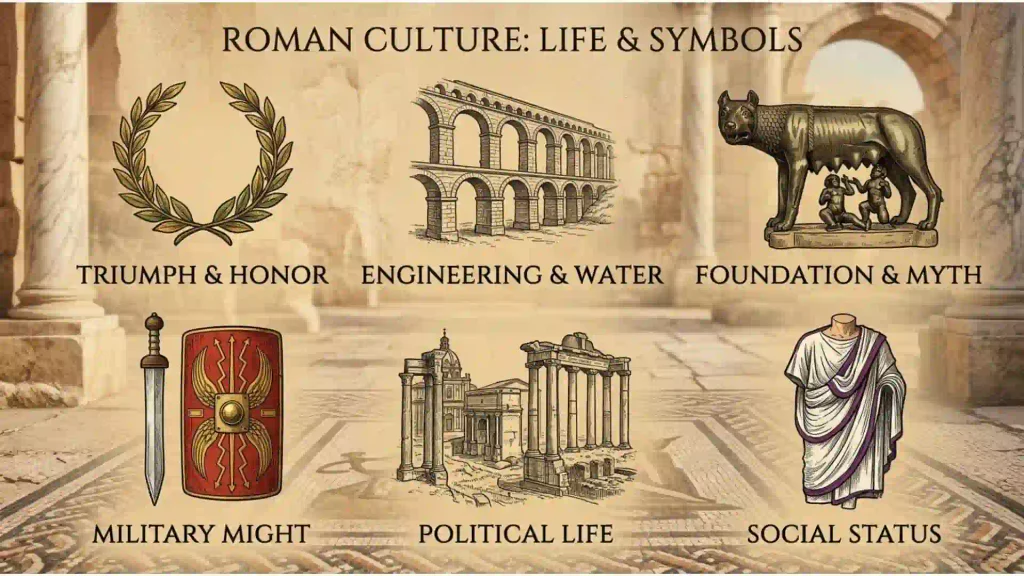
Roman military symbolism centered on standards, eagles, wreaths, gods, and imperial authority. The legionary eagle was both a practical marker and a sacred object.
Roman soldiers also used images connected with Mars, the god of war. Victory figures, laurel wreaths, thunderbolts, and animals appeared on military equipment, coins, monuments, and standards.
Eastern Traditions
Chinese military banners historically used colors, animals, characters, and directional symbols. Dragons could represent imperial authority and power, while tigers were associated with courage and military strength.
Japanese samurai clans used family crests called mon. These simple designs appeared on armor, banners, clothing, and equipment. They helped identify warriors and communicate clan loyalty.
Indigenous Traditions
Indigenous military and warrior symbols vary widely and should never be treated as one universal system. In many communities, animals, feathers, colors, weapons, and sacred objects carried specific meanings based on local traditions.
Some symbols represented bravery, spiritual protection, family identity, leadership, or achievements. Their meanings belonged to particular nations and cultural practices, not to a single generalized idea of Indigenous warfare.
Modern Interpretations
Modern army symbols combine ancient imagery with practical identification. National flags, digital unit logos, camouflage patches, vehicle markings, and official seals continue the same basic purpose.
Today, symbols also appear in recruitment campaigns, video games, movies, veteran organizations, social media profiles, and clothing. This wider use sometimes separates the image from its original military meaning.
Similar Symbols and Their Meanings
| Symbol | Main Meaning | Connection to Army Symbols | Key Difference |
| Sword | Strength, justice, combat | Represents military readiness and leadership | Can also have religious or ceremonial meanings |
| Shield | Protection and defense | Reflects the protective role of armed forces | Often used by civilian security organizations |
| Eagle | Authority, vision, victory | Common in military and national insignia | Meaning changes across countries and cultures |
| Crown | Sovereignty and command | Appears in armies connected with monarchies | Represents royal authority more than combat |
| Laurel wreath | Victory and honor | Used in medals and military seals | Originated in ancient civic and athletic traditions |
| Wings | Speed and elevation | Linked with aviation and airborne troops | Also symbolizes spirituality and freedom |
| Skull | Mortality and fearlessness | Sometimes used by specialized units | Can be misunderstood as supporting violence or death |
A common misconception is that every military-looking image has one fixed meaning. In reality, the same symbol can communicate very different ideas.
A skull may represent awareness of death, courage under danger, intimidation, or remembrance. An eagle may symbolize freedom in one country and imperial authority in another. Context, history, and official documentation matter.
Army Symbols in Mythology and Folklore
Mythology has strongly influenced military symbolism. Ancient cultures often connected warfare with gods, heroic warriors, sacred animals, and supernatural protection.
In Greek mythology, Ares represented the violent force of war, while Athena represented strategy, wisdom, and disciplined defense. These two figures reveal an important contrast between uncontrolled aggression and purposeful courage.
In Roman mythology, Mars became associated with military strength and the protection of the state. Norse stories celebrated figures such as Odin, Tyr, and the Valkyries. Their symbols became connected with fate, sacrifice, courage, and the warrior’s journey.
Dragons appear in both Eastern and Western traditions, but their meanings differ. In many East Asian cultures, dragons symbolize authority, energy, wisdom, and good fortune. In European folklore, dragons often appear as dangerous creatures that heroes must overcome.
These stories shaped modern ideas about bravery, leadership, protection, and victory. As a result, mythological animals and weapons still appear on military patches, crests, statues, and mottos.
Army Symbols in Art, Literature, Movies, and Pop Culture
Military symbols have appeared in art for centuries. Paintings of battles often include banners, uniforms, swords, horses, standards, and national colors to show identity and power.
Literature uses army symbols to explore courage, loyalty, fear, duty, and the human cost of war. A torn flag may represent defeat or sacrifice. A polished medal may symbolize honor, but it can also remind a character of trauma or loss.
Movies and television use insignia, uniforms, helmets, and unit patches to establish authority quickly. These details help audiences understand rank and role without lengthy explanations.
However, fictional productions sometimes invent symbols or use real ones inaccurately. Viewers should not assume every on-screen badge follows actual military regulations.
Army imagery also appears in tattoos and fashion. Veterans may choose unit crests, dates, dog tags, wings, or memorial symbols as deeply personal reminders. Civilian use is more complicated because wearing official insignia without understanding its meaning may seem disrespectful.
Spiritual and Dream Meaning of Army Symbols
Dreaming about army symbols may reflect discipline, conflict, pressure, protection, authority, or the need for structure. The meaning depends on the dreamer’s emotions and personal experiences.
Seeing a shield may suggest a need for emotional protection. A sword could represent a difficult decision or a struggle for truth. A uniform may point to identity, responsibility, conformity, or a desire to belong.
A medal in a dream might reflect a wish for recognition. A damaged flag could symbolize disappointment, grief, or a crisis of loyalty. Marching soldiers may represent cooperation, but they may also suggest that the dreamer feels controlled by strict expectations.
Dream interpretations are not scientific predictions. They are best used as tools for personal reflection rather than fixed spiritual messages.
Positive and Negative Meanings of Army Symbols
| Positive Meaning | Negative Meaning |
| Courage | Aggression |
| Protection | Control |
| Discipline | Rigidity |
| Unity | Loss of individuality |
| Service | Forced obedience |
| Honor | Glorification of conflict |
| Sacrifice | Trauma and grief |
| Leadership | Abuse of authority |
| Readiness | Constant fear |
| National pride | Exclusion or extreme nationalism |
One symbol can represent both light and shadow. A sword can defend the innocent or cause harm. A flag can unite people or be used to divide them.
The deeper meaning depends on who uses the symbol, why it is displayed, and how people experience its history.
Why Humans Are Attracted to Army Symbols
Humans naturally search for patterns and shared meanings. Strong shapes, bold colors, animals, stars, weapons, and shields are easy to recognize and remember.
Army symbols also answer emotional needs. They offer belonging, order, identity, purpose, and connection with a larger story. For soldiers, a patch may represent people who trained, suffered, and served together.
For families, military symbols may preserve the memory of a loved one. For civilians, they can represent respect, patriotism, bravery, or fascination with history.
Collective memory also plays a role. People repeatedly see military images during ceremonies, public holidays, films, school lessons, and national events. Over time, those images become emotionally charged.
Modern Uses of Army Symbols
Army symbols remain important in official military life, but they also appear in many civilian settings.
Tattoos may honor a unit, deployment, fallen friend, or family member. Jewelry may feature dog tags, wings, swords, shields, or national emblems. Fashion brands sometimes use military colors, badges, and camouflage for visual impact.
Veteran organizations use recognizable symbols to build community and support remembrance. Museums and memorials use flags, crests, medals, and statues to teach history.
Army-style symbols also appear in branding, gaming, sports teams, social media graphics, and home decor. Responsible use requires understanding the difference between general military imagery and insignia earned through real service.
Interesting Facts About Army Symbols
- Military standards were once essential battlefield communication tools because soldiers needed visible markers through dust, smoke, and confusion.
- The Roman legionary eagle was treated as a sacred symbol, and its loss could bring deep shame to an entire legion.
- Laurel wreaths were used in the ancient world long before they appeared on modern military medals and seals.
- Crossed weapons often identify a military function, such as infantry, artillery, cavalry, or engineering.
- Colors can carry official meanings, but their interpretation differs between countries and military branches.
- Unit patches often contain local geography, historical events, animals, mottos, and battle honors.
- Some badges show qualifications rather than rank, such as parachuting, aviation, medical, or specialist training.
- Military symbols may change when units merge, reorganize, or receive new official honors.
- Wearing an emblem does not always mean the wearer served in the unit it represents, especially in fashion and costume settings.
- Many modern army symbols combine ancient warrior imagery with strict contemporary design rules.
Frequently Asked Questions
What do army symbols represent?
Army symbols represent rank, branch, unit identity, qualifications, courage, discipline, honor, sacrifice, protection, and national service.
What is the most common army symbol?
There is no single universal symbol, but stars, eagles, swords, shields, wreaths, flags, and crossed weapons are widely used.
Why do army units have different patches?
Different patches help identify a soldier’s unit, formation, command, history, location, or mission. They also strengthen pride and group identity.
What do crossed swords mean in military symbols?
Crossed swords usually represent combat readiness, courage, military cooperation, or a branch connected with battlefield operations.
Can civilians wear army symbols?
Civilians can usually wear general military-inspired designs, but official insignia, medals, and unit symbols should be treated respectfully. Laws and customs vary by country.
What does an army symbol mean in a dream?
It may symbolize discipline, authority, conflict, protection, responsibility, or a need for structure. Personal feelings and life experiences shape the interpretation.
Conclusion
Army symbols turn history, identity, courage, and sacrifice into images people can instantly recognize.
They connect modern soldiers with ancient warriors, national traditions, unit stories, and fallen companions.
At their best, these symbols remind us that strength should serve responsibility, protection, and honorable purpose.
Behind every star, shield, sword, or eagle lies a human story of belonging, struggle, memory, and meaning.
 Sarah Thompson
 John Mercer