
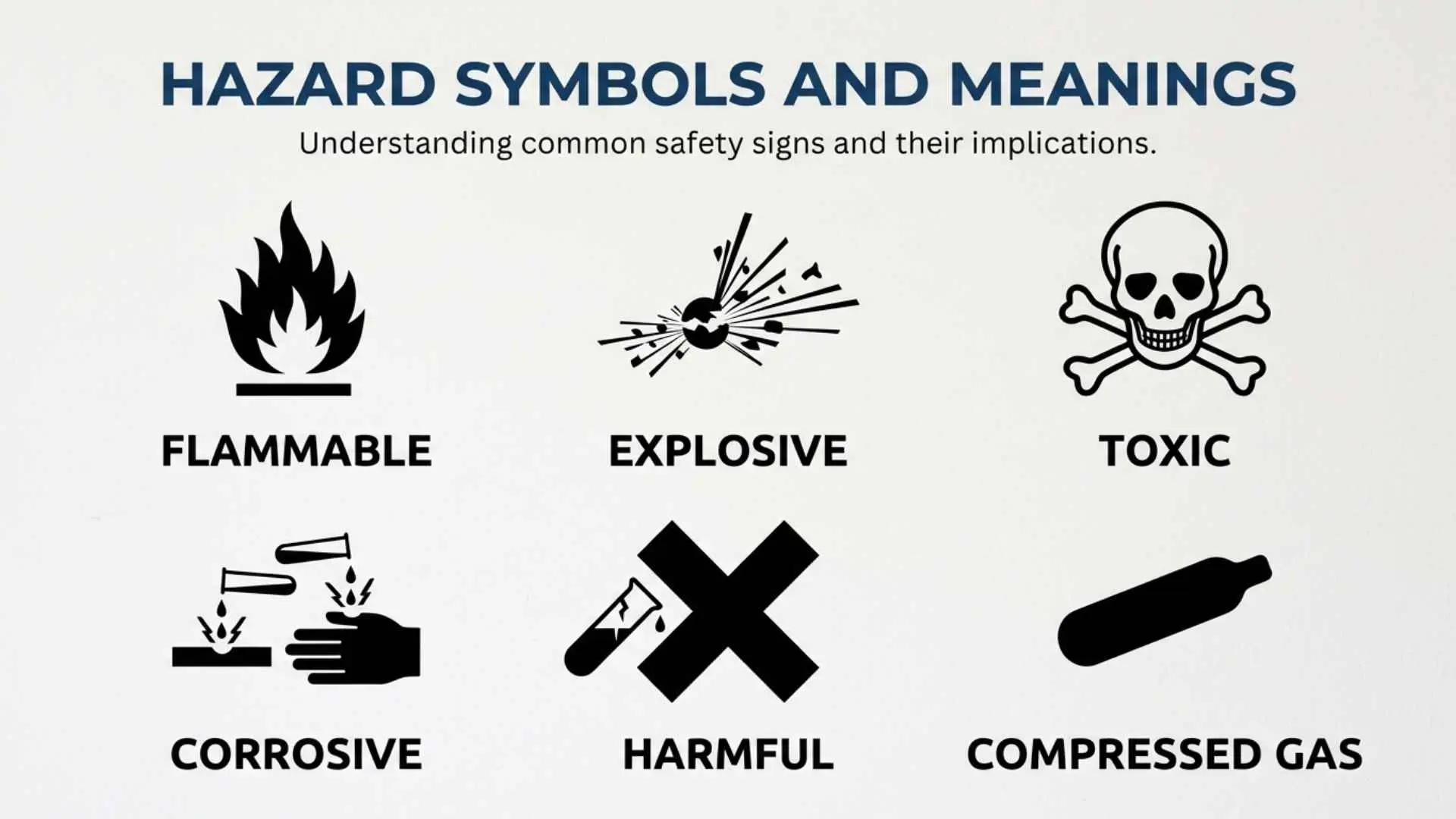
Hazard symbols are important safety signs that warn people about potential dangers in their surroundings. You can find these symbols on chemical containers, electrical equipment, industrial machinery, cleaning products, road signs, laboratories, and workplaces. Each symbol communicates a specific type of risk, such as fire, explosion, toxicity, radiation, electrical shock, or environmental damage. Recognizing these warning signs helps you identify dangerous situations and take appropriate precautions before an accident occurs.
Different hazard symbols use recognizable shapes, colors, images, and warning labels to communicate risks quickly. For example, a flame indicates flammable materials, a skull and crossbones warns of acute toxicity, and a lightning bolt represents electrical hazards. Other common signs identify corrosive substances, biohazards, radioactive materials, explosive chemicals, and general workplace dangers. International systems such as the Globally Harmonized System (GHS) help standardize chemical hazard labels so people can understand important safety information across different countries.
In this complete guide to hazard symbols and meanings, you will discover the most common danger signs, their visual characteristics, and the risks they represent. You will also learn about workplace safety symbols, chemical warning labels, biological hazards, radiation signs, electrical warnings, and environmental hazard markings. Whether you are a student, employee, traveler, or simply interested in safety awareness, understanding these symbols will help you recognize potential dangers and make safer decisions in everyday life.
Quick Answer
Hazard symbols are standardized images used to warn people about dangerous chemicals, materials, equipment, environments, or actions. Their meanings may include toxicity, fire risk, explosion, corrosion, radiation, electrical danger, biological contamination, or environmental harm. They allow people to recognize hazards quickly before handling or approaching them.
Quick Facts About Hazard Symbols and Meanings
| Aspect | Information |
| Origin | Developed from older warning marks, industrial safety signs, transport labels, and scientific symbols |
| Historical Significance | Became increasingly important during industrialization as factories and chemical use expanded |
| Main Meaning | Warns people about a possible source of injury, illness, death, property damage, or environmental harm |
| Spiritual Meaning | Not an official function, but danger signs may symbolically represent caution, boundaries, mortality, or transformation |
| Cultural Importance | Creates a shared visual language that can cross national and language barriers |
| Modern Usage | Chemical labels, factories, laboratories, hospitals, transport vehicles, construction sites, electrical systems, and public areas |
What Are Hazard Symbols?
Hazard symbols are graphical warnings that identify a source of possible harm. A hazard may be a chemical, object, biological agent, physical condition, or activity capable of causing injury, illness, death, environmental damage, or property loss.
Modern hazard communication relies on standardized shapes, colors, borders, and pictograms. The Globally Harmonized System of Classification and Labelling of Chemicals, known as GHS, classifies chemical hazards and provides common label elements, including pictograms, signal words, hazard statements, and precautionary statements.
In the United States, the Occupational Safety and Health Administration aligns its Hazard Communication Standard with GHS principles. This creates a clearer and more consistent way to communicate chemical dangers through labels and safety data sheets.
However, hazard symbols are not limited to chemicals. Safety signs also warn about electricity, slippery surfaces, radiation, moving machinery, biohazards, falling objects, fire equipment, and restricted actions.
ISO 7010 provides standardized safety signs for accident prevention, fire protection, health hazards, and emergency evacuation. Its system helps make signs more recognizable in workplaces and public spaces around the world.
Historical Development of Hazard Symbols
Early societies often used simple marks, colors, animal imagery, or frightening figures to signal danger. A skull could represent death, while fire represented destruction and uncontrollable power.
During the Industrial Revolution, workplaces became filled with engines, chemicals, electrical systems, and heavy machinery. Written warnings were not always enough, especially in crowded factories where workers spoke different languages or had limited literacy.
The skull and crossbones became widely associated with poison during the nineteenth century. Later, governments, scientific organizations, transport authorities, and workplace safety agencies developed more consistent visual systems.
The modern GHS emerged from international efforts to create a harmonized method for classifying and labeling chemicals. Its goal is to make information about physical, health, and environmental hazards easier to understand during chemical handling, transport, storage, and use.
Main Types of Hazard Symbols and Their Meanings
Exploding Bomb
Visual description: An object bursting apart with fragments flying outward.
Meaning: Warns about explosives, highly reactive substances, and certain self-reactive chemicals or organic peroxides.
Where it appears: Chemical laboratories, industrial storage areas, explosives packaging, fireworks facilities, and transport labels.
This symbol tells you that heat, shock, friction, pressure, or improper handling may trigger an explosion.
Flame
Visual description: A black flame inside a red diamond border.
Meaning: Identifies flammable gases, liquids, solids, aerosols, self-heating materials, pyrophoric substances, and chemicals that may release flammable gas.
Where it appears: Fuel containers, solvents, paint products, propane cylinders, laboratories, and industrial workplaces.
The flame symbol does not simply mean that something is already burning. It means the substance can catch fire under certain conditions.
Flame Over Circle
Visual description: A flame positioned above a circular shape.
Meaning: Identifies oxidizing substances.
Oxidizers may not burn by themselves, but they can cause or intensify a fire by supplying oxygen or supporting combustion. They must be kept away from fuels, oils, paper, clothing, and other combustible materials.
Gas Cylinder
Visual description: A horizontal cylinder.
Meaning: Warns that gas is stored under pressure.
Compressed, liquefied, dissolved, or refrigerated gases may explode if heated. Refrigerated gases can also cause severe cold burns or frostbite.
Corrosion
Visual description: Liquid dripping from test tubes onto a hand and a metal surface.
Meaning: Warns about substances that can cause severe skin burns, serious eye damage, or corrosion of metals.
This pictogram requires immediate respect. Even a small splash may destroy tissue or permanently damage eyesight.
Skull and Crossbones
Visual description: A human skull above crossed bones.
Meaning: Indicates acute toxicity that may be fatal or toxic after swallowing, inhalation, or skin contact.
It is one of the most universally recognized warning images because people have long connected the skull with death.
Health Hazard
Visual description: A human silhouette with a starburst shape in the chest.
Meaning: Warns about serious or long-term health effects, including cancer, respiratory sensitization, reproductive toxicity, organ damage, aspiration hazards, or genetic damage.
Unlike the skull symbol, which commonly points to immediate poisoning, the health hazard pictogram may represent harm that develops slowly or after repeated exposure.
Exclamation Mark
Visual description: A black exclamation mark.
Meaning: May indicate skin irritation, eye irritation, harmful acute toxicity, respiratory irritation, skin sensitization, or drowsiness and dizziness.
Although it may represent less severe hazards than the skull symbol, it should never be ignored.
Environment
Visual description: A dead tree beside a dead fish.
Meaning: Warns that a chemical may be toxic to aquatic life or harmful to aquatic ecosystems.
OSHA displays nine major hazard communication pictograms, although the environmental pictogram is not mandatory under every part of the United States OSHA system.
Biohazard
Visual description: Three curved shapes arranged around a central circle.
Meaning: Warns about biological substances that may threaten human health.
It appears on containers, laboratories, medical waste bags, clinical samples, and areas containing infectious organisms or contaminated materials.
Radiation
Visual description: A central circle surrounded by three blade-like shapes.
Meaning: Warns about ionizing radiation or radioactive materials.
It may appear in hospitals, research centers, nuclear facilities, industrial inspection areas, and laboratories using radioactive sources.
Electrical Hazard
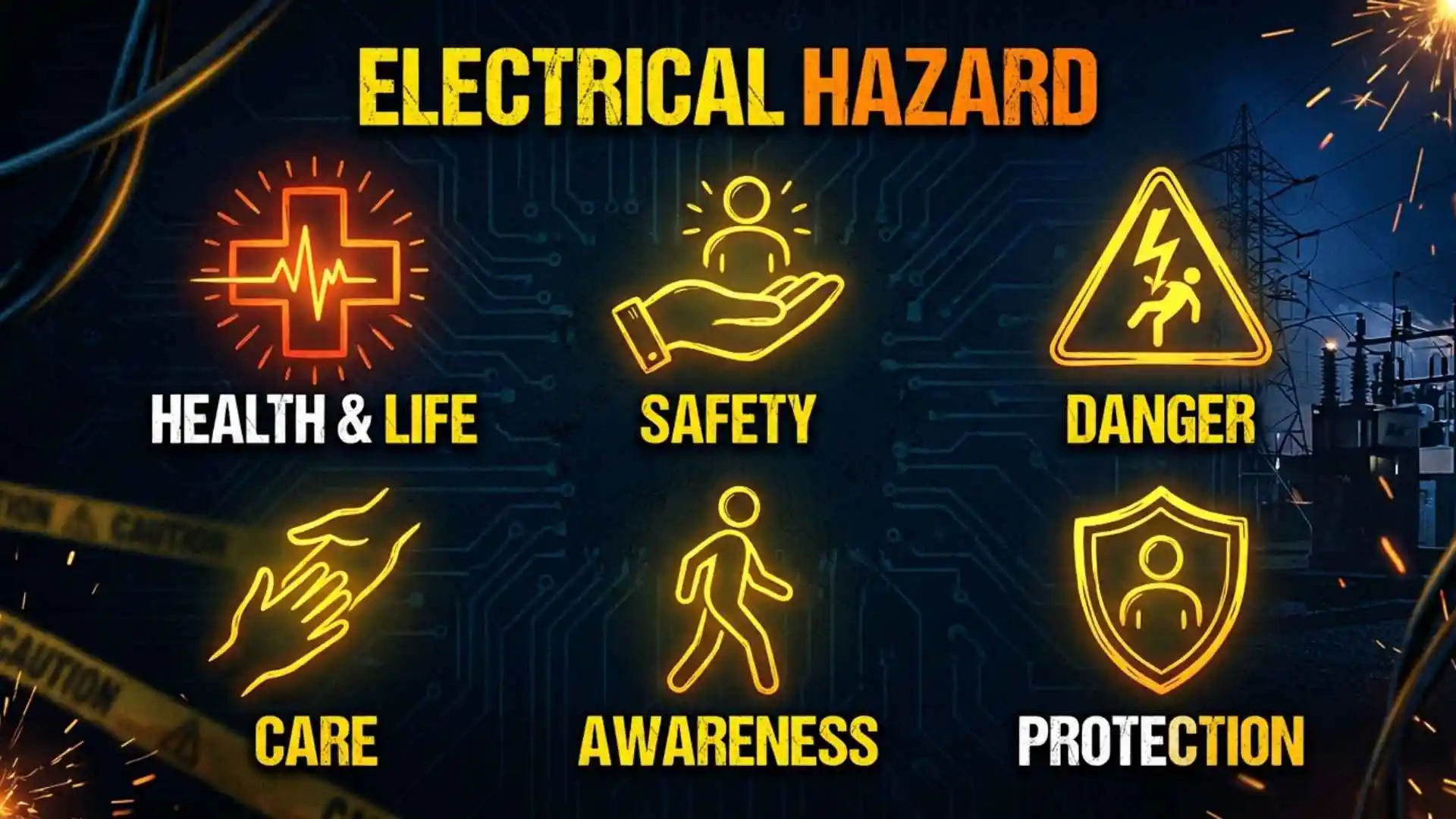
Visual description: A lightning bolt, often inside a yellow triangle.
Meaning: Warns about electric shock, high voltage, energized equipment, or electrocution risk.
The sign reminds people that electricity may be present even when there is no visible movement, sound, or smell.
Understanding Hazard Sign Shapes and Colors
The pictogram is only one part of a safety sign. Shape and color also communicate meaning.
| Shape or Color | Common Meaning |
| Yellow triangle | Warning about a hazard |
| Red circle with diagonal line | Prohibited action |
| Blue circle | Mandatory action |
| Green square or rectangle | Safe condition, first aid, or emergency exit |
| Red square or rectangle | Fire equipment or firefighting information |
| Red diamond border | GHS chemical hazard pictogram |
These patterns allow the brain to recognize a category before reading any words.
A yellow triangle may tell you to slow down and inspect the situation. A red prohibition sign tells you what must not be done. A blue sign usually tells you what protective action is required, such as wearing safety glasses.
Deep Symbolic Meaning of Hazard Symbols
Psychological Meaning
Hazard symbols are designed to interrupt normal attention. Strong contrast, sharp shapes, red borders, and familiar danger images make the brain pause.
Humans naturally look for patterns that may signal threats. A skull suggests death. A flame suggests pain and destruction. A lightning bolt suggests sudden, invisible energy.
Research considered during OSHA’s adoption of red-bordered pictograms indicated that red helps make warnings noticeable and is commonly perceived as representing a high level of danger.
Cultural Meaning
Hazard signs create a shared visual vocabulary. A traveler may not understand a written warning in another language, but a flame or skull can still communicate danger.
This shared system is especially important in international shipping, manufacturing, healthcare, construction, and scientific research.
Spiritual and Symbolic Interpretation
Hazard symbols do not have official spiritual meanings. Still, people may interpret them symbolically in dreams, art, tattoos, or personal reflection.
A flame may represent destruction followed by renewal. A skull can symbolize mortality and the limited nature of life. A warning triangle may represent intuition telling someone to stop before making a harmful decision.
These interpretations are personal and cultural. They should never replace the symbol’s real safety meaning.
Hazard Symbols Across Different Cultures
Ancient Egypt
Ancient Egyptians did not use modern workplace hazard signs, but they used powerful visual symbols connected with protection, death, poison, and divine danger. Cobras, scorpions, and protective deities communicated both threat and sacred power.
Ancient Greece
Greek stories often used monsters, fire, poisoned weapons, and divine punishment as warnings. The image of Medusa, for example, appeared on shields and buildings as an apotropaic symbol intended to frighten away evil.
Roman Culture
Roman signs and inscriptions warned people about dangerous animals, restricted areas, and social boundaries. Mosaics showing guard dogs could serve as early visual warnings near property entrances.
Eastern Traditions
Chinese and Japanese cultures have long used colors, written characters, animals, and symbolic imagery to communicate protection or danger. Modern industries now combine local language with internationally recognized safety pictograms.
Indigenous Traditions
Indigenous communities have used environmental knowledge, markings, stories, and oral traditions to communicate dangers such as poisonous plants, unstable land, dangerous animals, strong currents, and seasonal risks.
Modern Global Culture
Today, international standards help reduce confusion. Although countries may apply safety regulations differently, standardized pictograms make hazards easier to recognize across borders.
Similar Safety Symbols and Their Meanings
| Symbol Category | Main Purpose | Example |
| Hazard warning | Identifies a source of possible harm | High voltage |
| Prohibition sign | Stops a dangerous action | No smoking |
| Mandatory sign | Requires a protective action | Wear eye protection |
| Emergency sign | Directs people toward safety | Emergency exit |
| Fire safety sign | Identifies firefighting equipment | Fire extinguisher |
| Chemical pictogram | Describes a chemical hazard class | Corrosive substance |
A common misconception is that every safety symbol is a hazard symbol. In reality, some signs warn, while others prohibit actions, require protective equipment, or guide people toward safety.
Hazard Symbols in Mythology and Folklore
Modern hazard pictograms are scientific and regulatory tools, but many use images with ancient emotional power.
Fire has represented danger, punishment, purification, and transformation in stories around the world. Skulls have represented death, ancestors, warfare, poison, and the temporary nature of human life.
Serpents often symbolize both poison and healing. This double meaning appears in medical symbolism, mythology, religion, and folklore. Such images remain powerful because they connect modern warnings with deep human fears and memories.
Hazard Symbols in Art, Movies, and Pop Culture
Artists often use warning symbols to create tension or criticize technology, pollution, war, or industrial society.
Movies use radiation signs, biohazard symbols, and warning tape to suggest contamination, secret experiments, abandoned laboratories, or global catastrophe. Video games use them to identify poisonous areas, explosive objects, infected zones, and dangerous equipment.
Hazard imagery also appears in streetwear, album artwork, tattoos, jewelry, and graphic design. In these settings, it may represent rebellion, danger, emotional intensity, survival, or attraction to forbidden places.
However, decorative use can weaken a symbol’s impact. Real hazard labels should never be covered, altered, or used as jokes in ways that could confuse people.
Spiritual and Dream Meaning of Hazard Symbols
Dreaming about a hazard sign may suggest that your mind has noticed a risk you have not fully addressed.
A flame symbol may reflect anger, passion, conflict, or fear of losing control. A skull may point to an ending, major change, or awareness of mortality. A corrosion symbol could represent a relationship or situation that feels emotionally damaging.
These dream interpretations are not scientific predictions. The most useful question is often simple: What currently feels unsafe, harmful, unstable, or ignored in your life?
Positive and Negative Meanings of Hazard Symbols
| Positive Meaning | Negative Meaning |
| Protection | Danger |
| Awareness | Fear |
| Prevention | Injury |
| Responsibility | Neglect |
| Preparedness | Panic |
| Respect for boundaries | Restriction |
| Environmental care | Pollution or contamination |
A hazard symbol represents danger, but its purpose is positive. It gives people information before harm occurs.
The symbol contains both shadow and light. It shows what could go wrong while offering a chance to make a safer choice.
Why Humans Notice Hazard Symbols
People are attracted to hazard symbols because the human brain is built to notice possible threats.
Bright colors, sharp angles, facial imagery, and high contrast create fast emotional responses. Repeated exposure also builds cultural memory. After seeing the flame symbol on fuel containers, most people learn to associate it with fire risk even before studying its official definition.
Personal experience strengthens the connection. Someone who has suffered a chemical burn may react more strongly to the corrosion symbol. A healthcare worker may recognize the biohazard sign immediately because it is part of daily professional life.
Modern Uses of Hazard Symbols
Hazard symbols are commonly used on:
- Household cleaning products
- Chemical containers
- Safety data sheets
- Laboratory doors
- Medical waste
- Construction sites
- Industrial machinery
- Fuel storage areas
- Electrical panels
- Transport vehicles
- Shipping packages
- Emergency response documents
- Agricultural chemicals
- Workplace training materials
A pictogram should be read together with the full label. Signal words such as “Danger” or “Warning,” hazard statements, precautionary instructions, product identifiers, and supplier details provide information that the image alone cannot communicate.
Interesting Facts About Hazard Symbols
- The GHS chemical pictograms normally use black images on white backgrounds with red diamond-shaped borders.
- A hazard and a risk are related but different. A hazard is a potential source of harm, while risk considers the likelihood and possible severity of that harm.
- The skull and crossbones generally represents severe acute toxicity, not every harmful chemical.
- The exclamation mark may indicate irritation or harmful effects, but it does not automatically mean the substance is harmless.
- The flame and flame-over-circle symbols have different meanings. One warns about flammability, while the other identifies oxidizing substances.
- Some hazards require more than one pictogram because a chemical may be flammable, toxic, corrosive, and environmentally harmful at the same time.
- Empty red diamonds should not normally appear on chemical labels because they may create confusion.
- Safety symbols are designed to support written instructions, not replace training or protective equipment.
- The same substance may require different markings for workplace use and dangerous-goods transport.
- Symbols work best when people receive training and know what action to take after recognizing them.
Frequently Asked Questions
What are the nine main chemical hazard symbols?
The commonly recognized GHS pictograms are exploding bomb, flame, flame over circle, gas cylinder, corrosion, skull and crossbones, health hazard, exclamation mark, and environment.
What does the skull hazard symbol mean?
It warns that a substance may cause severe acute poisoning and may be toxic or fatal if swallowed, inhaled, or absorbed through the skin.
What does the exclamation mark hazard symbol mean?
It may indicate skin or eye irritation, harmful toxicity, respiratory irritation, skin sensitization, or effects such as dizziness and drowsiness.
What is the difference between a hazard symbol and a safety sign?
A hazard symbol identifies possible harm. A broader safety sign may also prohibit an action, require protective equipment, identify fire equipment, or point toward an emergency exit.
Why are many warning signs yellow?
Yellow is highly visible and is widely associated with caution. When combined with black text or symbols, it creates strong contrast that can be recognized quickly.
What should you do when you see a hazard symbol?
Stop and read the entire label or sign. Follow the listed precautions, wear required protective equipment, avoid unauthorized handling, and consult the safety data sheet when working with chemicals.
Conclusion
Hazard symbols and meanings form a visual language created to protect human life, health, property, and nature.
Each flame, skull, warning triangle, or chemical pictogram carries information that should never be ignored.
Learning these signs turns fear into awareness and awareness into safer action.
Sometimes the smallest image offers the most important warning.
 Sarah Thompson
 Michael Rivera