
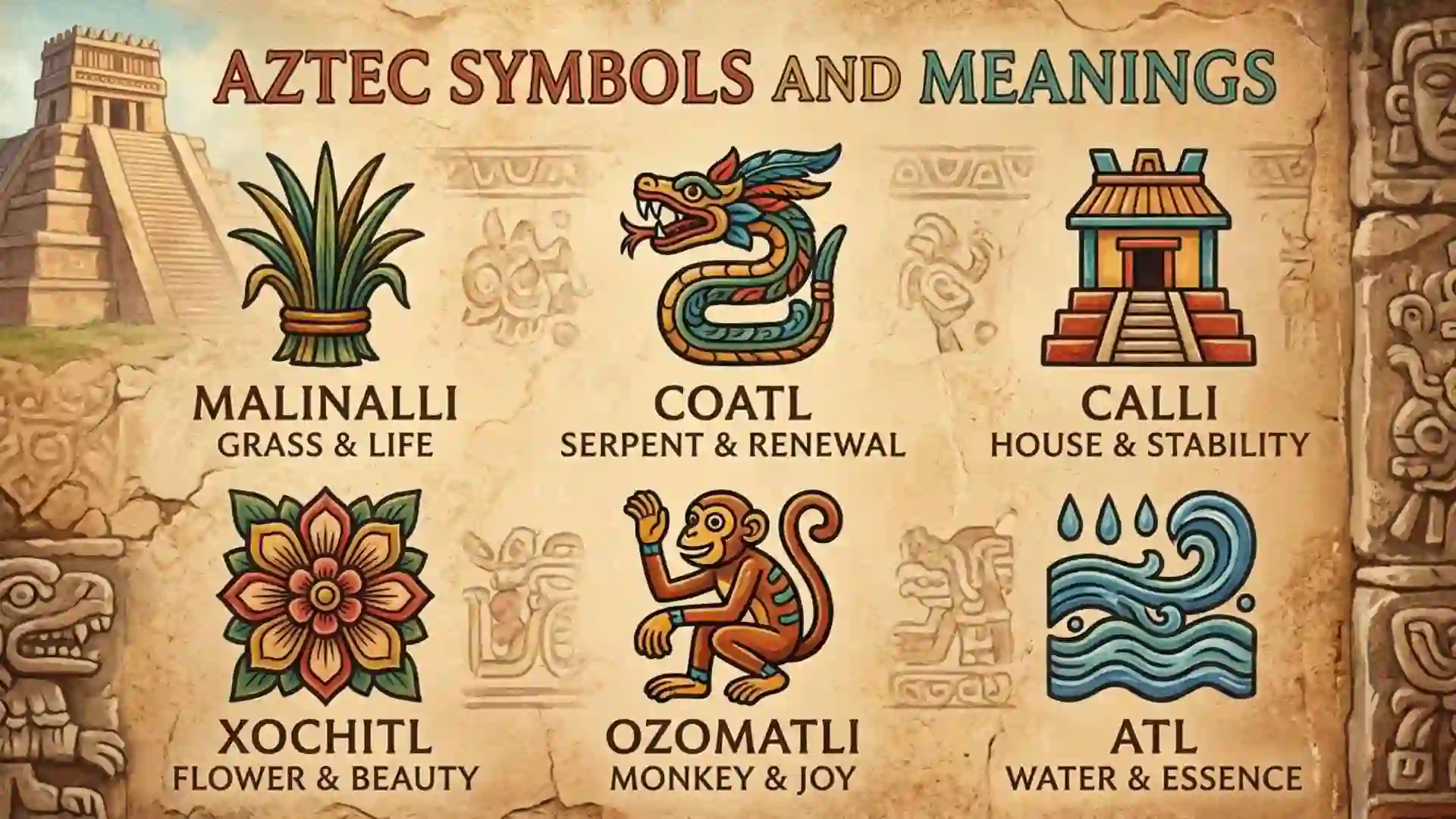
Aztec symbols offer a fascinating glimpse into the beliefs, traditions, and worldview of one of ancient Mesoamerica’s most influential civilizations. From powerful gods and sacred animals to the sun, moon, water, and cosmic elements, these images carried deep meanings connected to life, death, nature, warfare, and spirituality. The Aztecs used symbols in temples, stone carvings, codices, jewelry, architecture, and religious ceremonies to communicate stories and preserve their cultural identity.
Many Aztec symbols represented powerful forces that shaped everyday life and the universe. The Aztec sun symbol reflected the importance of solar energy and cosmic cycles, while the eagle represented strength, courage, and warrior identity. Other important symbols included the serpent, jaguar, feathered serpent, skull, calendar stone, and sacred flower. Each image had its own cultural and religious significance, often connected to particular deities, creation stories, natural elements, or beliefs about the afterlife.
In this complete guide to Aztec symbols and meanings, you will explore their historical origins, religious significance, popular designs, and connections to nature and the cosmos. You will also discover the meanings behind important Aztec gods, animals, geometric patterns, and sacred objects. Whether you are researching ancient Mexican culture, exploring symbolic meanings, or looking for inspiration for artwork and tattoos, this guide will help you understand the rich visual language of the Aztec civilization.
Quick Answer
Aztec symbols were visual signs used by the Mexica and other Nahua-speaking peoples of central Mexico to communicate religious beliefs, historical events, social rank, calendar dates, and cosmic ideas. Common symbols included the eagle, jaguar, feathered serpent, sun, skull, butterfly, maize, water, flowers, and calendar glyphs.
Quick Facts About Aztec Symbols and Meanings
| Aspect | Information |
| Origin | Central Mexico, especially the Mexica civilization |
| Historical Significance | Recorded religion, warfare, genealogy, tribute, time, and political authority |
| Main Meaning | Connection between humans, gods, nature, society, and cosmic order |
| Spiritual Meaning | Transformation, divine energy, sacrifice, renewal, destiny, and balance |
| Cultural Importance | Appeared in temples, codices, clothing, jewelry, shields, sculpture, and ceremonies |
| Modern Usage | Tattoos, Mexican identity, jewelry, fashion, art, branding, and spiritual imagery |
What Are Aztec Symbols?
Aztec symbols were images, glyphs, objects, colors, and artistic patterns that communicated important ideas. They belonged mainly to the Mexica, the people who established Tenochtitlan and became the leading power within the Aztec Triple Alliance during the fifteenth and early sixteenth centuries.
The word “Aztec” is now commonly used for several Nahua-speaking societies of central Mexico. However, the people most closely associated with Tenochtitlan called themselves Mexica.
Their symbolic system was not a simple alphabet. Scribes combined pictures, phonetic signs, numbers, calendar symbols, place names, and personal emblems. These appeared in painted manuscripts known as codices, as well as on monuments, pottery, clothing, weapons, and temple walls.
Symbols helped explain where a person came from, which god was being honored, when an event occurred, and what authority a ruler claimed. Art also supported political power. Major works such as the Sun Stone and the Stone of Tizoc linked rulers and military victories with sacred history and cosmic order.
Deep Symbolic Meaning of Aztec Symbols
Spiritual Level
Aztec spirituality viewed the universe as active, fragile, and dependent on continuing exchanges between gods, humans, and nature. Rain, sunlight, crops, wind, warfare, birth, and death were connected parts of one sacred system.
Many symbols therefore represented movement rather than permanent stillness. The sun crossed the sky, maize died and returned, rain created life but could also destroy it, and human beings passed through stages of birth, duty, death, and spiritual transformation.
Tláloc, for example, symbolized rain, agriculture, lightning, and fertility. Yet he could bring both life-giving water and destructive storms or drought. His imagery expressed the belief that sacred power could nourish and threaten at the same time.
Psychological Level
Psychologically, Aztec imagery reflects universal human concerns. The eagle represents the desire to rise above danger. The jaguar expresses hidden strength and fear of darkness. The serpent suggests transformation because it sheds its skin.
In Jungian terms, these animals can be understood as archetypal images. The eagle resembles the heroic or solar self, while the jaguar resembles the shadow, the powerful part of the personality that lives beneath conscious control.
This does not mean the Aztecs followed modern psychology. Rather, their symbols address emotional patterns that people still recognize: ambition, fear, courage, loss, renewal, and the struggle to find meaning in an uncertain world.
Cultural Level
Symbols also communicated social identity. Clothing, feathers, jewelry, shields, and military insignia showed rank and achievement. High-ranking warriors and officers could display particular ornaments and elaborate feathered standards.
A symbol could therefore carry several meanings at once. An eagle might represent the sun, a warrior, political power, sacred destiny, and the community of Tenochtitlan.
Types and Variations of Aztec Symbols
The Eagle
Visual description: A powerful bird with spread wings, curved talons, and a sharp beak.
Meaning: Solar energy, courage, victory, nobility, and military strength.
Symbolism: Because the eagle flies high in the sky, it was associated with the sun’s journey across the heavens. It represented the force required for the sun to survive the darkness and rise again.
Cultural connection: Eagle imagery appeared in military symbolism, mythology, sculpture, ceremonial clothing, and stories about the founding of Tenochtitlan.
The Jaguar
Visual description: A muscular spotted cat, sometimes shown with open jaws and visible claws.
Meaning: Night, power, stealth, danger, courage, and the hidden world.
Symbolism: The jaguar’s ability to hunt in darkness made it a natural symbol of nighttime force and controlled aggression.
Cultural connection: Eagle and jaguar imagery formed the paired expression cuauhtli, ocelotl, meaning “eagle, jaguar.” This metaphor referred to distinguished warriors and joined solar and nocturnal strength.
The Feathered Serpent
Visual description: A serpent covered with precious feathers, often linked with Quetzalcoatl.
Meaning: Creation, wind, knowledge, life, authority, and the union of opposites.
Symbolism: The serpent moves along the earth, while feathers belong to the sky. Together, they connect earthly existence with celestial power.
Cultural connection: Quetzalcoatl was one of Mesoamerica’s most important divine figures. Related feathered-serpent traditions appeared among the Toltec, Mexica, Maya, and other peoples, although local names and stories differed.
The Sun and Sun Stone
Visual description: A circular design containing a central face, directional forms, calendar signs, claws, and concentric bands.
Meaning: Cosmic time, divine power, movement, sacrifice, and the continuing age of the world.
Symbolism: The famous monument called the Aztec Sun Stone is often mistakenly described as a simple calendar. Its imagery is more complex, combining cosmology, previous world ages, sacred time, and imperial ideology.
Cultural connection: Scholars have debated whether the central figure represents Tonatiuh, another solar form, or the earth deity Tlaltecuhtli. This uncertainty shows why Aztec symbols should not be reduced to one fixed meaning.
The Skull
Visual description: A human skull, skeletal face, jawbone, or row of skulls.
Meaning: Death, sacrifice, mortality, spiritual transition, and regeneration.
Symbolism: Skulls were reminders that death supported continuing life within Aztec cosmology. They could express fear, but also transformation and sacred obligation.
Where it appeared: Temple art, ritual displays, stone carving, codices, and modern Day of the Dead inspired designs. However, modern sugar-skull imagery should not be treated as identical to pre-Hispanic Aztec symbolism.
The Butterfly
Visual description: A winged insect shown naturally or in stylized geometric form.
Meaning: Transformation, fire, movement, souls, beauty, and warrior energy.
Symbolism: The butterfly’s change from caterpillar to winged creature made it a fitting sign of transformation. Certain butterfly images were also connected with fire and the souls of honored dead warriors or women who died in childbirth.
Ollin
Visual description: A balanced, cross-like or interlocking sign often seen near the center of the Sun Stone.
Meaning: Movement, earthquake, change, and cosmic instability.
Symbolism: Ollin was one of the twenty day signs in the 260-day ritual calendar. It is also associated with the present cosmic era, often called the Fifth Sun.
Modern interpretation: Ollin is frequently used to express personal movement, cultural awakening, or social transformation.
Maize
Visual description: Ears of corn, stalks, leaves, kernels, or maize deities.
Meaning: Food, fertility, life, abundance, agriculture, and community survival.
Symbolism: Maize was not merely a crop. It formed part of everyday diet, tribute, seasonal ritual, and the relationship between people and the land.
Water
Visual description: Blue-green streams, shells, droplets, waves, or flowing bands.
Meaning: Life, fertility, cleansing, agriculture, danger, and renewal.
Symbolism: Water nourished crops and cities, yet floods and storms could bring destruction. It expressed the double nature of sacred power.
Flowers
Visual description: Blossoms, flowering plants, decorated scrolls, or floral ornaments.
Meaning: Beauty, poetry, pleasure, truth, nobility, fertility, and the temporary nature of life.
Cultural connection: Xochipilli, whose name means “Prince of Flowers,” was connected with flowers, music, dance, pleasure, and artistic expression. Flower symbolism often joined beauty with awareness that life does not last forever.
Aztec Symbols Across Different Cultures
Aztec symbols should not be claimed as Egyptian, Greek, Roman, or Asian symbols. Still, comparing cultures helps reveal how different societies used similar natural images.
Ancient Egypt
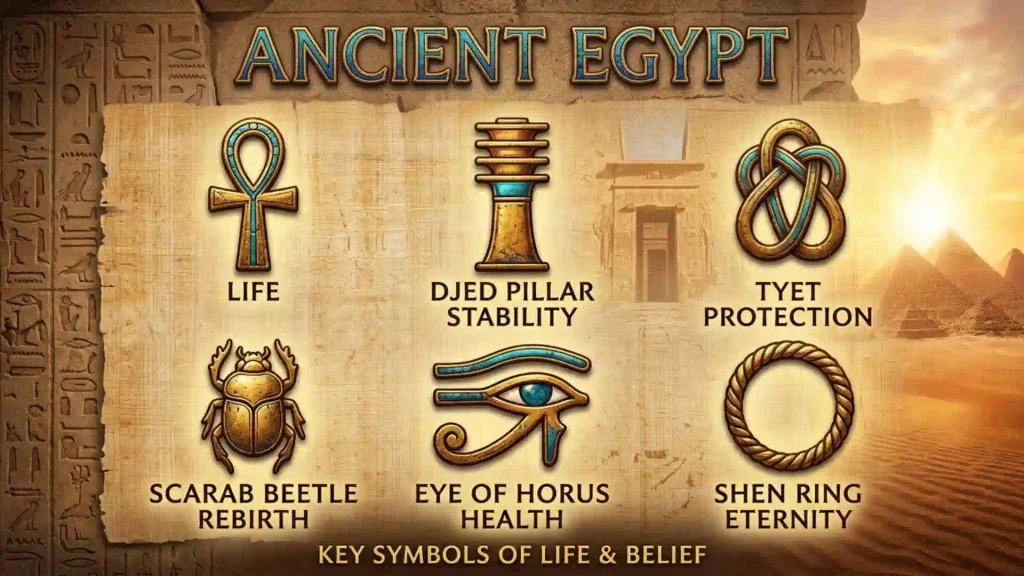
Egyptian solar disks, scarabs, and falcons represented kingship, rebirth, and divine order. Like the Aztec eagle, the Egyptian falcon connected political leadership with the sky and sun. However, each image belonged to a separate religious tradition.
Ancient Greece
Greek mythology used eagles, serpents, owls, and thunderbolts as signs of particular gods. The eagle of Zeus represented authority, while Aztec eagle imagery was closely tied to solar force, warfare, and Mexica identity.
Roman Culture
Romans used the eagle as a military standard and symbol of imperial power. This resembles the Aztec connection between eagles and elite warfare, but Roman symbolism developed from different historical and religious foundations.
Eastern Traditions
In Chinese culture, dragons often symbolize rain, authority, and good fortune. Their association with weather can be compared with Mesoamerican serpent and rain imagery, though the Chinese dragon and Quetzalcoatl are not the same being.
Indigenous Traditions of the Americas
Many Indigenous cultures use birds, serpents, jaguars, maize, water, and celestial signs. Meanings vary greatly between nations. Aztec symbols should be understood within central Mexican history rather than combined into a single general “Native American” system.
Modern Interpretations
Today, Aztec-inspired images may represent Mexican ancestry, cultural pride, endurance, resistance, personal strength, or spiritual curiosity. Modern meanings can be sincere, but they do not always match historical Mexica interpretations.
Similar Symbols and Their Meanings
| Aztec Symbol | Related Symbol | Similarity | Important Difference |
| Eagle | Roman eagle | Power and military authority | Aztec eagle also carried strong solar meaning |
| Jaguar | Lion | Courage and royal strength | Jaguar imagery was tied to Mesoamerican night and wilderness |
| Feathered serpent | Chinese dragon | Sky, rain, power, and transformation | They come from separate mythological systems |
| Sun Stone | Zodiac wheel | Circular cosmic organization | The Sun Stone is not an Aztec zodiac |
| Skull | Memento mori | Awareness of death | Aztec skulls also related to sacrifice and cosmic renewal |
| Butterfly | Phoenix | Transformation and rebirth | Butterfly symbolism included beauty, fire, and warrior souls |
Aztec Symbols in Mythology and Folklore
One of the best-known Mexica traditions tells how the people found the place where they would establish Tenochtitlan. An eagle on a cactus signaled the chosen location. Later representations made the eagle a major emblem of sacred destiny and political identity. The image eventually influenced Mexico’s national coat of arms.
Quetzalcoatl stories connected the feathered serpent with creation, wind, knowledge, priesthood, and civilization. Huitzilopochtli, the patron deity of the Mexica, was linked with the sun, warfare, and the sacred center of Tenochtitlan. His temple stood at the Templo Mayor, where he was honored alongside Tláloc.
Xolotl, often shown with canine features, was associated with lightning, sunset, death, and difficult journeys. Dogs were believed to have connections with passage into the afterlife, showing how even familiar animals could carry sacred responsibilities.
Aztec Symbols in Art, Literature, Movies, and Pop Culture
Aztec imagery appears in stone sculpture, painted codices, gold ornaments, ceramics, mosaics, architecture, and featherwork. Gold objects were linked with elite status and the sun’s sacred power. One surviving Mexica gold labret shaped like a striking serpent shows the skill and intimidating beauty of Aztec metalwork.
Modern novels, movies, television programs, and video games often use temples, skulls, calendars, and warriors to create mystery or danger. These portrayals can increase public interest, but they sometimes reduce a complex civilization to violence, treasure, and prophecy.
In tattoos, fashion, and graphic design, eagle, jaguar, serpent, and Ollin motifs often represent strength or heritage. Responsible use begins with learning the symbol’s specific cultural background.
Spiritual and Dream Meaning of Aztec Symbols
Dream interpretations are personal and are not fixed teachings inherited directly from the Aztecs. Still, people may use historically informed symbolism for reflection.
Dreaming of an eagle may suggest ambition, clarity, responsibility, or a desire for freedom. A jaguar may point toward hidden courage, fear, instinct, or a part of the self that needs recognition.
A serpent can symbolize change, knowledge, healing, temptation, or a difficult transition. Water may reflect emotional renewal or feelings that have become overwhelming. An Ollin design may suggest that life is moving and resistance to change is creating tension.
These interpretations should be treated as reflective possibilities, not supernatural predictions.
Positive and Negative Meanings of Aztec Symbols
| Positive Meaning | Negative Meaning |
| Courage | Aggression |
| Transformation | Instability |
| Sacred duty | Burden or fear |
| Fertility | Destructive natural force |
| Leadership | Domination |
| Renewal | Death or loss |
| Community identity | Political control |
| Spiritual power | Dangerous divine anger |
Aztec symbols often contain both light and shadow because nature itself contains both. Rain creates crops but can cause floods. The sun gives life but demands energy. The jaguar protects yet also hunts. Meaning depends on the object, ceremony, deity, and historical setting.
Why Humans Are Attracted to Aztec Symbols
People are naturally drawn to bold patterns, powerful animals, symmetrical forms, and images connected with mystery. Aztec art combines all of these qualities.
These symbols also speak to emotional needs. An eagle can help someone imagine courage. A serpent can provide a picture of personal change. A flower can express beauty that survives only briefly.
Pattern recognition plays another role. The human mind searches for order, especially in circular calendars, repeated geometric designs, and paired opposites such as sky and earth or light and darkness.
Cultural memory makes the attraction even stronger for people with Mexican or Indigenous ancestry. A symbol may become a bridge between personal identity and a history that survived conquest, destruction, and change.
Modern Uses of Aztec Symbols
Aztec-inspired designs now appear in:
- Tattoos representing heritage, strength, transformation, or courage
- Jewelry featuring eagles, serpents, suns, and geometric patterns
- Clothing and fashion influenced by Mesoamerican visual traditions
- Murals celebrating Mexican history and Indigenous identity
- Logos and branding that suggest power or ancient knowledge
- Social media art and educational illustrations
- Home decor using calendar or animal motifs
- Contemporary spiritual practices focused on nature and transformation
Modern use should avoid presenting invented meanings as ancient truth. It is also respectful to distinguish historically documented Mexica symbols from generic patterns marketed as “tribal.”
Interesting Facts About Aztec Symbols
- The Aztec Sun Stone was not designed as an ordinary wall calendar.
- Aztec calendars used combinations of day signs and numbers to identify sacred dates.
- The ritual calendar contained 260 days, while the solar calendar contained 365 days.
- Clothing and jewelry could communicate social rank and military achievement.
- Eagle and jaguar imagery worked as a symbolic pair, not only as separate animal signs.
- Gold was associated with divine and solar power among Mexica elites.
- Symbols in codices could represent sounds, names, dates, objects, and complete ideas.
- Many Aztec symbols were inherited or adapted from older Mesoamerican traditions.
- Colors could carry religious, directional, political, and ceremonial meanings.
- A single symbol could change meaning depending on where it appeared and which deity accompanied it.
Frequently Asked Questions
What is the most important Aztec symbol?
There is no single most important symbol, but the sun, eagle, feathered serpent, Ollin sign, jaguar, and sacred calendar imagery were especially influential.
What does the Aztec eagle symbolize?
The eagle commonly represents the sun, courage, military power, nobility, victory, and the sacred destiny of Tenochtitlan.
What does the Aztec serpent mean?
Serpent imagery may represent transformation, fertility, earthly power, water, time, or divine knowledge. The feathered serpent especially connects earth with sky.
Are Aztec symbols religious?
Many were religious, but symbols also recorded dates, places, names, tribute, warfare, political authority, family history, and social status.
What does an Aztec skull symbolize?
An Aztec skull can represent mortality, sacrifice, death, spiritual transition, ancestral memory, and the renewal of life within cosmic cycles.
Is it respectful to get an Aztec symbol tattoo?
It can be respectful when you research the symbol, understand its historical context, avoid false meanings, and do not claim sacred or Indigenous identity that is not yours.
Conclusion
Aztec symbols and meanings reveal a civilization that understood life as a relationship between people, nature, gods, time, and community.
The eagle, jaguar, serpent, sun, flower, and skull each carried layers of spiritual, political, and emotional meaning.
They remind us that strength and vulnerability, creation and destruction, and life and death often exist together.
To understand these symbols is not simply to study ancient art, but to listen to a culture explaining its place in the universe.
Their deepest message is that every life forms part of a larger and constantly moving story.
 Sarah Thompson
 John Mercer