
Minecraft symbols are everywhere in the game, from inventory icons and crafting menus to enchantment tables, banners, maps, and player commands. Some symbols serve practical purposes, helping you identify items, understand game mechanics, and navigate different menus. Others add creativity and mystery through decorative characters, hidden messages, secret codes, and unusual text designs. Whether you’re a beginner exploring your first world or an experienced player building something impressive, understanding Minecraft symbols can make your gameplay more interesting.
Different Minecraft symbols have different meanings and uses. Item icons represent blocks, tools, weapons, food, and resources, while status-effect symbols show helpful or harmful conditions affecting your character. You can also encounter enchanting table characters, Unicode symbols, keyboard characters, command-related signs, and decorative text used in server names, signs, chat messages, and player profiles. Learning how these symbols work helps you communicate clearly, customize your creations, and recognize important information throughout the game.
In this complete guide to Minecraft symbols, you’ll discover popular icons, their meanings, hidden references, special characters, and creative ways to use them. We’ll also explore Minecraft text symbols, enchantment language, banner patterns, command symbols, and decorative icons that can make your builds and messages stand out. Whether you want to understand mysterious game symbols, create stylish signs, or personalize your Minecraft experience, this guide will help you explore their meanings and uses.
Quick Answer
Minecraft symbols include interface icons, status-effect signs, banner patterns, map markers, formatting codes, Unicode characters, and the mysterious writing seen around enchanting tables. They help players communicate, navigate, decorate, organize information, and express identity. Some have official gameplay meanings, while others gain symbolic meaning through player culture and personal interpretation.
Quick Facts About Minecraft Symbols
| Aspect | Information |
| Origin | Introduced through Minecraft’s visual interface, game mechanics, text system, and community creations |
| Historical Significance | Developed alongside Minecraft from its early survival versions into a global creative platform |
| Main Meaning | Communication, navigation, status, identity, danger, achievement, and creativity |
| Spiritual Meaning | Often interpreted by players as transformation, mystery, protection, balance, or personal growth |
| Cultural Importance | Used in servers, online communities, videos, fan art, roleplay, and digital storytelling |
| Modern Usage | Banners, signs, usernames, commands, maps, builds, social media posts, skins, and server branding |
What Are Minecraft Symbols?
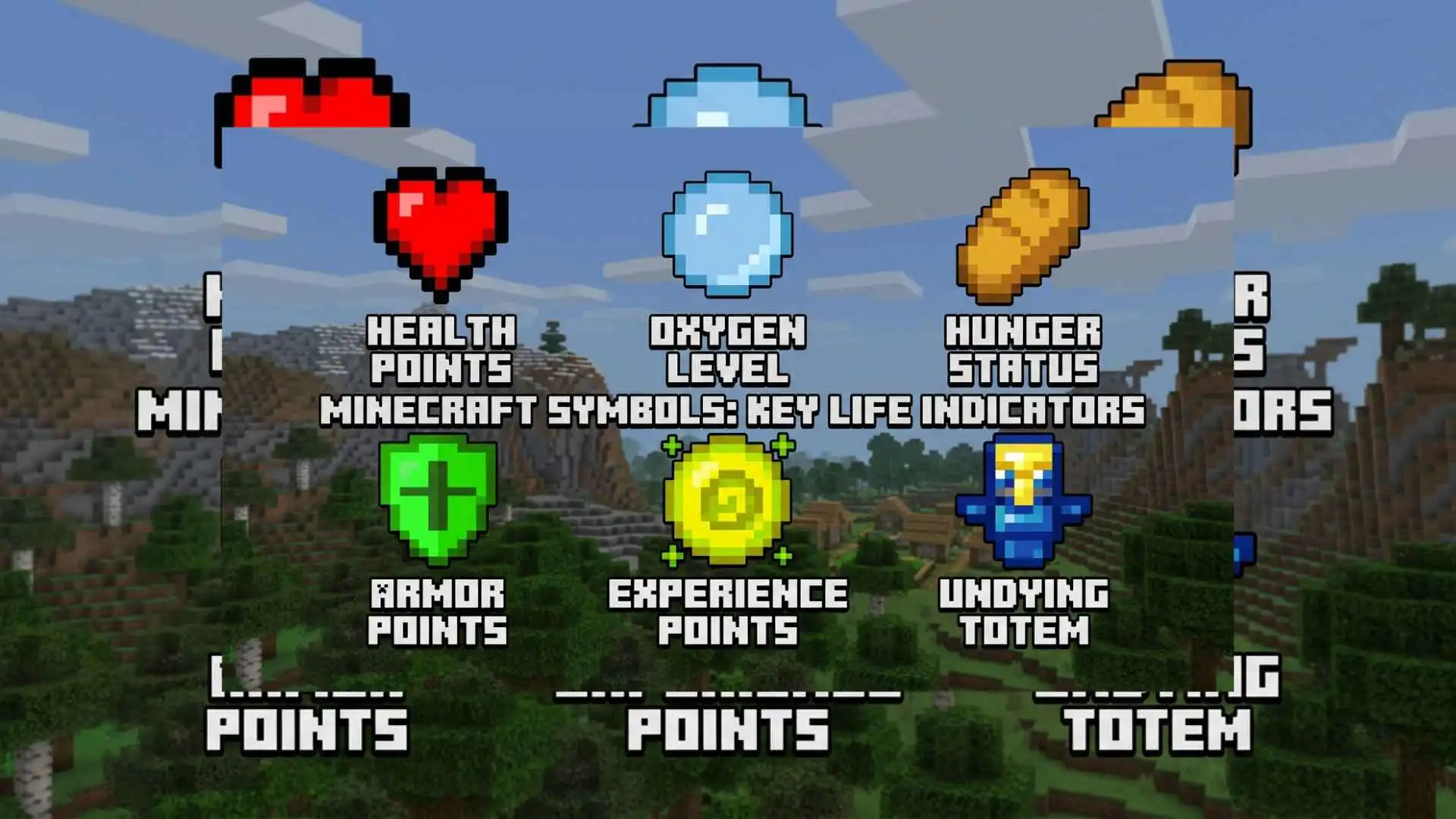
Minecraft symbols are visual signs, characters, icons, and patterns that communicate information within or around the game. They include familiar interface images such as hearts, armor icons, hunger bars, bubbles, and experience levels. They also include banner designs, potion-effect icons, text characters, map markers, and decorative Unicode symbols.
Some symbols have fixed meanings created by the developers. For example, red hearts represent health, armor icons show protection, and hunger icons reveal how much food energy a player has remaining.
Other symbols are created by players. A skull banner placed outside a fortress may warn visitors to stay away. A flower symbol on a village sign may represent peace. A star beside a username may identify an administrator, donor, champion, or trusted community member.
Minecraft began as a simple sandbox game, but its visual language expanded as new systems were added. Enchanting, potion brewing, maps, banners, shields, commands, scoreboards, and multiplayer servers all introduced new ways to communicate through symbols.
Today, Minecraft symbols form a flexible language. Their meaning may be mechanical, decorative, social, or emotional depending on where they appear.
Deep Symbolic Meaning of Minecraft Symbols
Spiritual Level
Minecraft does not officially assign spiritual meanings to most symbols. However, players often connect game imagery with ideas such as growth, transformation, protection, and renewal.
The enchanting table is a strong example. It changes ordinary tools into objects with unusual abilities. Symbolically, this can represent inner transformation, knowledge, or the belief that hidden potential can be awakened.
The Nether portal may represent crossing a threshold into the unknown. Its purple movement, dark frame, and strange sound create the feeling of entering another state of existence. Meanwhile, the End portal can symbolize a final journey, confrontation, or passage beyond the familiar world.
Respawn mechanics also carry symbolic weight. A player may lose possessions, return, rebuild, and try again. This repeated cycle can remind people of resilience, renewal, and the ability to recover after failure.
Psychological Level
Minecraft symbols work because the human brain quickly recognizes patterns. Players do not need long written explanations when a flashing heart, poison icon, or warning banner gives immediate information.
Psychologist Carl Jung used the idea of archetypes to describe recurring images and patterns that appear across human stories. Although Minecraft was not designed as a Jungian system, many of its images resemble familiar archetypes.
The sword represents the warrior. The crafting table represents the creator. The village represents community. The dark cave represents the unknown. The dragon represents a final challenge.
These images attract players because they connect simple game objects with deep emotional experiences such as fear, courage, curiosity, safety, and accomplishment.
Cultural Level
Minecraft symbols also create social meaning. On multiplayer servers, a crown may identify leadership, a shield may represent a faction, and a colored name may show rank.
Communities often develop their own symbolic rules. A redstone torch near a door might be a technical signal. A certain banner might mark protected land. A diamond icon may represent wealth, quality, or membership status.
This makes Minecraft more than a building game. It becomes a shared cultural space where players invent traditions, visual codes, and group identities.
Types and Variations of Minecraft Symbols
Health Hearts
Visual description: Red heart icons displayed above the hotbar.
Meaning: The player’s remaining health.
Symbolism: Life, vulnerability, survival, and recovery.
Cultural connection: Hearts are widely associated with life and emotion in art, games, and popular culture.
Where they appear: Survival mode, combat, health displays, custom servers, and player-made designs.
Armor Icons
Visual description: Small chestplate-shaped icons above the health bar.
Meaning: The amount of protection provided by worn armor.
Symbolism: Defense, preparation, safety, and strength.
Cultural connection: Armor has represented warriors, guardians, and protection throughout history.
Where they appear: Player interfaces, combat guides, server menus, and Minecraft-themed graphics.
Hunger Symbols
Visual description: Meat or drumstick-shaped icons.
Meaning: The player’s food level and ability to regenerate health.
Symbolism: Physical need, survival, energy, and balance.
Cultural connection: Food has always represented life, abundance, scarcity, and hospitality.
Where they appear: Survival and Adventure modes.
Experience Orbs and Levels
Visual description: Glowing green or yellow orbs that fill an experience bar.
Meaning: Progress used for enchanting and other game systems.
Symbolism: Learning, achievement, accumulated knowledge, and personal growth.
Cultural connection: The idea of gaining experience mirrors education, training, and self-development.
Where they appear: Mining, combat, breeding, smelting, enchanting, and advancement.
Enchanting Table Glyphs
Visual description: Strange letters floating around an enchanting table.
Meaning: Decorative magical writing associated with enchanting.
Symbolism: Secret knowledge, mystery, transformation, and hidden power.
Cultural connection: The characters come from the Standard Galactic Alphabet, a fictional writing system known from the Commander Keen game series.
Where they appear: Around enchanting tables and in fan-made Minecraft designs.
The translated glyphs do not reveal the exact enchantment a player will receive. They mainly create atmosphere rather than functioning as a direct secret code for enchantment results.
Banner Symbols
Visual description: Colored fabric blocks decorated with shapes, borders, stripes, creatures, or patterns.
Meaning: Identity, decoration, territory, warning, or storytelling.
Symbolism: Loyalty, belonging, authority, memory, and personal expression.
Cultural connection: Real civilizations have used flags and standards to represent families, armies, nations, and religious groups.
Where they appear: Bases, castles, shields, villages, maps, faction headquarters, and roleplay servers.
Potion-Effect Symbols
Visual description: Small icons linked to effects such as speed, strength, poison, regeneration, or invisibility.
Meaning: An active condition affecting the player.
Symbolism: Temporary power, danger, weakness, change, or altered ability.
Cultural connection: Potions connect with legends of alchemy, magical medicine, and transformation.
Where they appear: The player interface, beacons, potions, suspicious stews, commands, and mob effects.
Map Symbols and Markers
Visual description: Colored pointers, banner markers, and location indicators.
Meaning: Position, direction, destination, or a named place.
Symbolism: Guidance, exploration, memory, and control over space.
Cultural connection: Maps have helped humans understand territory and preserve knowledge for thousands of years.
Where they appear: Maps, locator maps, item frames, exploration rooms, and multiplayer planning.
Formatting and Unicode Symbols
Players often use decorative characters in server names, chat messages, books, signs, scoreboards, and usernames. Examples may include stars, arrows, hearts, music notes, check marks, crosses, and geometric shapes.
The section sign, written as §, has historically been associated with Minecraft text-formatting codes in certain versions, files, and server environments. Formatting codes can change text colors or styles, although access depends on the platform, edition, permissions, and input method.
Minecraft Symbols Across Different Cultures
Minecraft symbols are modern digital creations, but many resemble signs used in older cultures.
Ancient Egypt
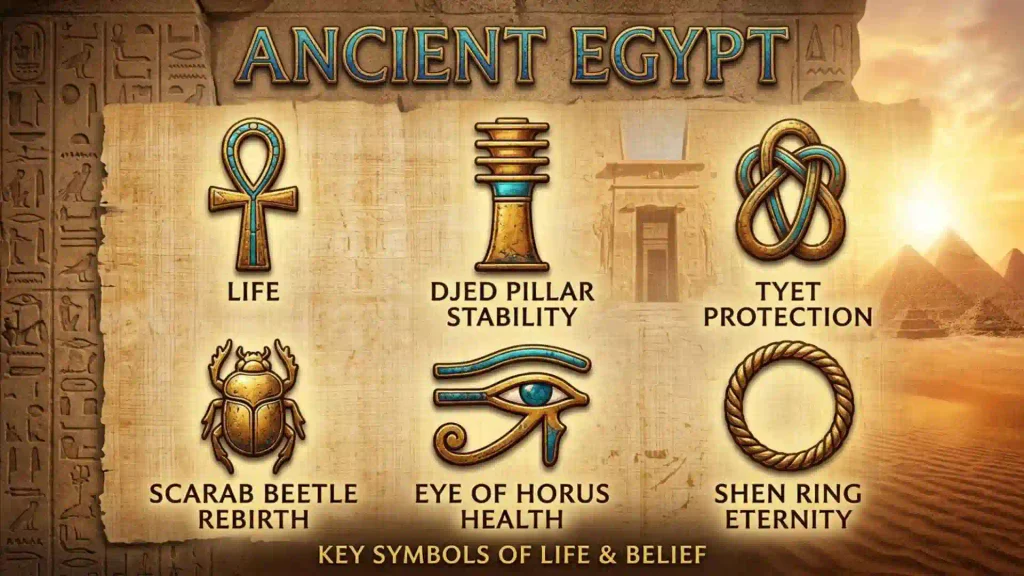
Egyptian hieroglyphs combined pictures and writing to communicate names, actions, beliefs, and sacred ideas. Minecraft’s blocky signs and visual icons serve a different purpose, but both systems show how images can communicate quickly.
A Minecraft pyramid may remind players of Egyptian monuments, hidden chambers, royal power, or the journey into the afterlife. However, these meanings come from wider cultural associations rather than official Minecraft symbolism.
Ancient Greece
Greek myths often feature heroes entering caves, confronting monsters, and returning with wisdom or treasure. Minecraft adventures follow a similar story pattern.
Swords, labyrinth-like strongholds, dangerous journeys, and dragon battles can remind players of heroic myths. The connection is thematic rather than a direct retelling of Greek religion.
Roman Culture
Roman military standards represented legions, leadership, honor, and unity. Minecraft banners perform a similar social function when players use them to identify kingdoms, clans, armies, or territories.
A banner above a castle tells visitors who controls the area before a single word is spoken.
Eastern Traditions
In several Eastern philosophical traditions, balance, discipline, nature, and cycles of change are important themes. Minecraft players may create circular gardens, balanced temples, mountain shrines, or peaceful landscapes to express harmony.
Symbols such as lotus flowers, dragons, clouds, and geometric patterns may be recreated in blocks. Players should use culturally important imagery respectfully and learn its original meaning before using it casually.
Indigenous Traditions
There is no single Indigenous symbolic system. Different Indigenous nations have their own histories, artistic traditions, spiritual beliefs, and cultural rules.
Players sometimes build patterns inspired by Indigenous art, but respectful representation requires care. Sacred symbols should not be copied without understanding their cultural context. Minecraft can support education and appreciation, but it should not reduce living traditions to decoration.
Modern Digital Culture
Modern players use symbols as a form of online identity. A creeper face, diamond sword, grass block, or Enderman silhouette can immediately signal Minecraft fandom.
These images appear in profile pictures, clothing, videos, memes, school projects, server logos, and online communities.
Similar Symbols and Their Meanings
| Minecraft Symbol | Related Symbol | Similarity | Key Difference |
| Health heart | Medical or romantic heart | Represents life and well-being | In Minecraft, it measures health rather than love |
| Sword | Warrior weapon | Represents power and conflict | It also functions as a practical game item |
| Banner | National flag | Shows identity and belonging | Minecraft banners are highly customizable |
| Enchanting glyphs | Magical runes | Create mystery and hidden knowledge | They are fictional alphabet characters, not ancient runes |
| Nether portal | Mythic gateway | Represents transition into another realm | It is a functional transportation structure |
| Experience bar | Progress meter | Shows development and achievement | It is spent through gameplay systems |
| Totem of Undying | Protective amulet | Suggests safety and preservation | It prevents death under specific game conditions |
A common misconception is that enchanting table glyphs are runes connected to real magic. They are fictional characters used for atmosphere. Similarly, Minecraft banners may resemble historical flags, but their meaning is usually created by the player.
Minecraft Symbols in Mythology and Folklore
Minecraft borrows broad fantasy ideas found in mythology and folklore.
Dragons appear in stories from Europe, Asia, the Middle East, and many other regions. Their meanings vary greatly. Some represent destruction and chaos, while others symbolize wisdom, rain, imperial authority, or protection. The Ender Dragon functions mainly as a powerful final opponent, but players may interpret it as a guardian of the unknown.
Zombies, skeletons, witches, and enchanted objects also reflect old storytelling traditions. Cultures around the world have told stories about restless dead, magical healers, dangerous spirits, and objects carrying supernatural power.
The totem resembles protective charms found in many societies. In Minecraft, the Totem of Undying saves a player from death when held correctly. Symbolically, it represents protection, a second chance, and survival against overwhelming danger.
These connections do not mean Minecraft accurately represents any one mythology. Instead, the game uses recognizable fantasy patterns that modern audiences already understand.
Minecraft Symbols in Art, Literature, Movies, and Pop Culture
Minecraft’s square visual style has become a cultural symbol of creativity. A grass block can represent the game even without its title.
In art, players use blocks like pixels to create portraits, sculptures, murals, and optical illusions. Each block becomes part of a larger image, similar to mosaic art.
In literature and fan fiction, symbols such as the diamond sword, abandoned mineshaft, portal, or Enderman may represent courage, isolation, discovery, or fear.
Minecraft videos and animated stories often use banners, skins, colored names, and item icons to show alliances and character roles. Tattoos may feature creeper faces, hearts, tools, coordinates, or meaningful builds.
Fashion and merchandise commonly use grass blocks, pickaxes, TNT, mobs, and pixel hearts because they are instantly recognizable. Their appeal comes from nostalgia as much as design.
Spiritual and Dream Meaning of Minecraft Symbols
Dreams about Minecraft usually reflect personal memories, emotions, habits, or concerns rather than universal spiritual messages.
Dreaming of building may suggest that you are creating stability, planning your future, or trying to gain control. Mining may symbolize searching beneath the surface for knowledge, value, or hidden emotions.
A creeper in a dream might represent an unexpected problem. Losing items could reflect fear of failure or wasted effort. Finding diamonds may symbolize reward, opportunity, or confidence.
A portal may suggest change or entry into a new stage of life. An unfinished house could represent insecurity, while a protected base might symbolize emotional safety.
Dream meanings are personal. Consider what happened in the dream, how you felt, and what Minecraft means in your own life before accepting any interpretation.
Positive and Negative Meanings of Minecraft Symbols
| Positive Meaning | Negative Meaning |
| Creativity | Obsession |
| Exploration | Feeling lost |
| Protection | Fear and isolation |
| Progress | Pressure to achieve |
| Community | Conflict between groups |
| Transformation | Uncertainty |
| Survival | Anxiety about losing progress |
| Freedom | Lack of direction |
| Mystery | Confusion |
| Second chances | Fear of failure |
The same symbol can carry both light and shadow. A strong fortress may represent safety, but it may also suggest emotional walls. A sword may symbolize courage, yet it can also represent aggression.
Context determines meaning.
Why Humans Are Attracted to Minecraft Symbols
Humans naturally search for patterns. We give meaning to colors, shapes, sounds, and repeated images because symbolic thinking helps us understand complex experiences.
Minecraft supports this instinct by using clear visual signals. Red suggests danger or damage. Green experience points suggest growth. Bright diamonds suggest rarity and value. Dark caves create uncertainty.
The game also allows personal symbolism. A simple block house may mean little to another player, but to its builder it may represent a first night survived, an old friendship, or a childhood memory.
This emotional ownership makes Minecraft symbols powerful. Players do not only discover meaning. They create it.
Modern Uses of Minecraft Symbols
Minecraft symbols now appear far beyond normal gameplay.
Players use them in tattoos to remember friendships, family members, childhood experiences, or major creative projects. Jewelry may feature pickaxes, swords, hearts, bees, or creepers.
Server owners use symbols in branding, ranks, chat prefixes, menus, and promotional images. Social media users add Minecraft-style icons to usernames, biographies, captions, and fan pages.
Builders place symbols in homes, castles, temples, shops, and city centers. Redstone engineers use signs, lamps, and color systems to label machines. Roleplay communities design banners for fictional kingdoms and political groups.
In personal expression, Minecraft symbols communicate creativity, nostalgia, humor, achievement, and belonging.
Interesting Facts About Minecraft Symbols
- Enchanting table characters use the Standard Galactic Alphabet, but the displayed words do not directly reveal the enchantment result.
- The creeper face became one of the most recognizable symbols of Minecraft because of the creature’s unusual design and explosive behavior.
- Banner designs can be layered to create complex flags, logos, letters, faces, and heraldic patterns.
- A banner can be connected to a map location in supported gameplay situations, helping players label important places.
- Pixel hearts were common in video games before Minecraft, but Minecraft gave them a distinctive block-based appearance.
- Many server symbols have meanings created entirely by administrators and community members.
- The Totem of Undying combines a practical survival function with imagery similar to protective charms.
- Minecraft symbols often become emotionally meaningful because they are tied to player memories rather than official lore.
- Coordinates can function as personal symbols when they mark a first home, shared world, memorial, or major discovery.
- The meaning of a banner, color, or icon may change completely from one multiplayer server to another.
Frequently Asked Questions
What do Minecraft symbols mean?
Minecraft symbols communicate health, hunger, armor, effects, locations, identity, danger, progress, and other gameplay information. Decorative symbols may also express personal or community meanings.
What are the strange symbols in the enchanting table?
They are characters from the Standard Galactic Alphabet. They create a magical appearance but do not provide a reliable translation of the enchantment result.
Can you use special symbols in Minecraft names?
Special-character support depends on the Minecraft edition, server settings, platform, font support, and username rules. Some characters may appear in chat or signs but not in official account names.
What does the heart symbol mean in Minecraft?
The heart represents health. Losing hearts means the player has taken damage, while healing restores them.
Do Minecraft symbols have spiritual meanings?
Most do not have official spiritual meanings. Players may personally interpret portals, totems, enchanting tables, and other images as symbols of transformation, protection, mystery, or renewal.
What is the most famous Minecraft symbol?
The creeper face and grass block are among the most widely recognized Minecraft symbols. Both can identify the game even when no title is shown.
Conclusion
Minecraft symbols create a visual language built from survival, creativity, mystery, and community.
Some deliver clear gameplay information, while others gain meaning through memories, friendships, and imagination.
Their power comes from the way simple shapes can represent fear, growth, protection, identity, or hope.
In Minecraft, a symbol is rarely just decoration. It becomes meaningful when a player gives it a story.
 Sarah Thompson
 Michael Rivera