
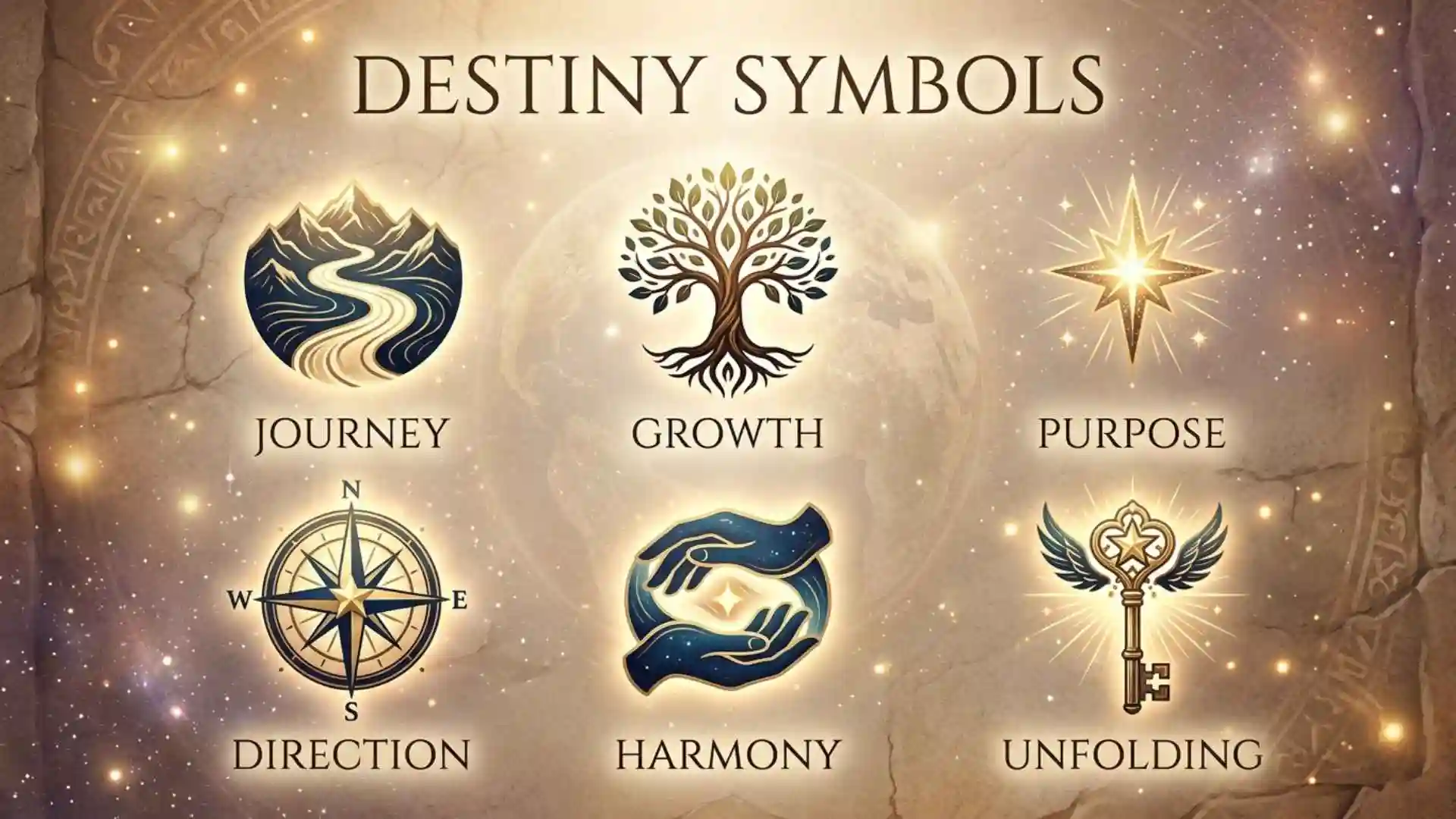
Destiny symbols have fascinated people for centuries because they represent fate, life purpose, spiritual guidance, and the mysterious forces believed to shape human experiences. Across different cultures and spiritual traditions, ancient signs such as the Wheel of Fortune, North Star, ouroboros, infinity symbol, and Tree of Life have represented life’s journey, transformation, divine timing, and the connection between past, present, and future. These symbols offer meaningful ways to explore the deeper questions surrounding why we are here and where our life paths may lead.
Different destiny symbols carry unique meanings depending on their cultural, historical, and spiritual origins. Some represent fate and the cycle of life, while others symbolize free will, new beginnings, divine protection, personal growth, or alignment with the universe. Astrology, mythology, ancient religions, sacred geometry, and philosophical traditions have all contributed to the symbolism associated with destiny. Although these signs can inspire reflection and spiritual understanding, their interpretations aren’t universal or scientific predictions of the future.
In this guide to destiny symbols, you’ll discover their meanings, ancient origins, spiritual significance, and cultural interpretations. From symbols associated with fate and karma to signs representing life purpose, divine guidance, and personal transformation, we’ll explore how different traditions understand the journey of destiny. Whether you’re searching for a meaningful tattoo, exploring spiritual symbolism, or simply curious about ancient signs, these symbols can offer fascinating perspectives on life’s hidden path.
Quick Answer
Destiny symbols are visual signs that represent fate, life purpose, divine guidance, time, choice, and the unfolding of future events. Common examples include the thread of fate, Wheel of Fortune, crossroads, stars, infinity symbol, world tree, compass, and ouroboros. Their meanings differ across religions, myths, cultures, and personal beliefs.
Quick Facts About Destiny Symbols
| Aspect | Information |
| Origin | Ancient mythology, religion, astrology, philosophy, and folklore |
| Historical Significance | Used to explain fate, divine will, life cycles, death, and human purpose |
| Main Meaning | The path, events, or purpose believed to shape a person’s life |
| Spiritual Meaning | Divine guidance, soul contracts, karma, transformation, and cosmic order |
| Cultural Importance | Helps communities explain uncertainty, suffering, luck, and major life changes |
| Modern Usage | Tattoos, jewelry, books, films, spiritual practices, branding, and personal art |
What Are Destiny Symbols?
Destiny symbols are images, objects, animals, or patterns associated with the direction and meaning of life. They express ideas that are difficult to see, such as fate, free will, divine plans, time, luck, and personal purpose.
There is no single universal destiny symbol. Different civilizations created their own visual language for understanding why events happen.
The ancient Greeks imagined destiny as a thread controlled by the Moirai, commonly called the Fates. Clotho spun the thread of life, Lachesis measured it, and Atropos cut it. Their work represented birth, the length of life, and unavoidable death.
Roman culture developed similar ideas through the Parcae and the goddess Fortuna. Fortuna was often shown with a wheel, globe, rudder, or cornucopia. Her wheel symbolized how quickly human fortune could rise or fall.
Over time, destiny symbols evolved beyond religion. They entered paintings, poetry, psychology, tattoos, novels, movies, and everyday speech. Today, a person may wear a compass necklace to represent direction or choose a crossroads tattoo to remember a life-changing decision.
Deep Symbolic Meaning of Destiny Symbols
Spiritual Meaning
On a spiritual level, destiny symbols often suggest that human life belongs to a larger pattern.
A thread may represent the soul’s journey. A star can symbolize divine guidance. A wheel may show the repeating cycles of karma, birth, death, and renewal. A tree can connect the physical world with higher and lower spiritual realms.
These symbols do not always teach that everything is fixed. In many traditions, destiny is viewed as a relationship between what is given and what is chosen. A person may not control every event, but they can control how they respond.
Psychological Meaning
Psychologically, destiny symbols help people manage uncertainty.
Humans naturally search for patterns. When a painful event, unexpected meeting, or major opportunity appears, the mind tries to place it within a meaningful story. Thinking of the event as “part of my path” can provide comfort and emotional order.
Carl Jung’s idea of archetypes can help explain this attraction. Archetypal images such as the journey, circle, wise guide, tree, and hero appear across cultures because they reflect shared human experiences.
A crossroads feels powerful because everyone must make difficult choices. A maze feels meaningful because life rarely moves in a straight line. These images speak to emotions before they are fully explained through words.
Cultural Meaning
At the cultural level, destiny symbols preserve shared beliefs.
They can teach that life is controlled by gods, ancestors, karma, nature, chance, or moral action. Communities use these symbols in ceremonies, storytelling, clothing, architecture, funerals, marriage customs, and protection rituals.
For example, a family heirloom may become a symbol of inherited destiny. A royal crown may represent a ruler’s supposed divine purpose. A protective amulet may express the hope that harmful events can be prevented or redirected.
Types and Variations of Destiny Symbols
The Thread of Fate
Visual description: A single thread, woven cord, spindle, or connected red string.
Meaning: The course and duration of a human life.
Symbolism: Connection, predetermined events, relationships, mortality, and divine planning.
Cultural connection: Greek mythology connects life’s thread with the Moirai. East Asian folklore also uses a red thread to describe people joined by fate.
Where it appears: Mythology, romantic art, wedding jewelry, tattoos, novels, and fantasy stories.
The Wheel of Fortune
Visual description: A turning wheel, sometimes carrying people upward and downward.
Meaning: Changing luck and the unstable nature of worldly success.
Symbolism: Cycles, chance, rise and fall, karma, and circumstances beyond human control.
Cultural connection: The Roman goddess Fortuna became strongly associated with the wheel. During medieval Europe, the Wheel of Fortune became a popular image in literature and moral teaching.
Where it appears: Tarot, medieval manuscripts, paintings, literature, games, and popular media.
The Crossroads
Visual description: Two or more roads separating in different directions.
Meaning: A moment of decision that can change the future.
Symbolism: Free will, uncertainty, transition, temptation, and opportunity.
Cultural connection: Crossroads appear in Greek myth, African diasporic traditions, European folklore, and modern storytelling.
Where it appears: Dreams, paintings, songs, films, religious stories, and tattoos.
Stars and Constellations
Visual description: A single bright star or a pattern of stars in the night sky.
Meaning: Guidance, heavenly order, hope, and a future written in the cosmos.
Symbolism: Divine purpose, navigation, ambition, destiny, and spiritual protection.
Cultural connection: Astrology in Mesopotamian, Greek, Roman, Indian, Chinese, and Islamic traditions connected celestial movements with earthly events.
Where it appears: Astrology charts, flags, jewelry, religious art, navigation tools, and literature.
The Compass
Visual description: A circular instrument with a directional needle.
Meaning: Finding the correct path through uncertainty.
Symbolism: Purpose, guidance, moral direction, travel, and self-discovery.
Cultural connection: Unlike older mythological signs, the compass became a modern destiny symbol through exploration, navigation, and personal development.
Where it appears: Tattoos, necklaces, logos, maps, travel art, and motivational design.
The World Tree
Visual description: A great tree with roots below and branches reaching toward the sky.
Meaning: The structure of existence and the connection between worlds.
Symbolism: Growth, ancestry, fate, life cycles, wisdom, and cosmic order.
Cultural connection: In Norse cosmology, Yggdrasil stood at the center of the universe. The Norns were associated with the tree and the fates of living beings.
Where it appears: Norse art, spiritual jewelry, mythology, fantasy fiction, carvings, and tattoos.
The Ouroboros
Visual description: A snake or dragon biting its own tail.
Meaning: Endless renewal and the unity of beginnings and endings.
Symbolism: Eternity, rebirth, repetition, transformation, and self-creation.
Cultural connection: Variations appeared in ancient Egyptian imagery and later Greek, alchemical, mystical, and psychological traditions.
Where it appears: Manuscripts, alchemical art, tattoos, jewelry, fantasy media, and spiritual design.
Destiny Symbols Across Different Cultures
Ancient Egypt
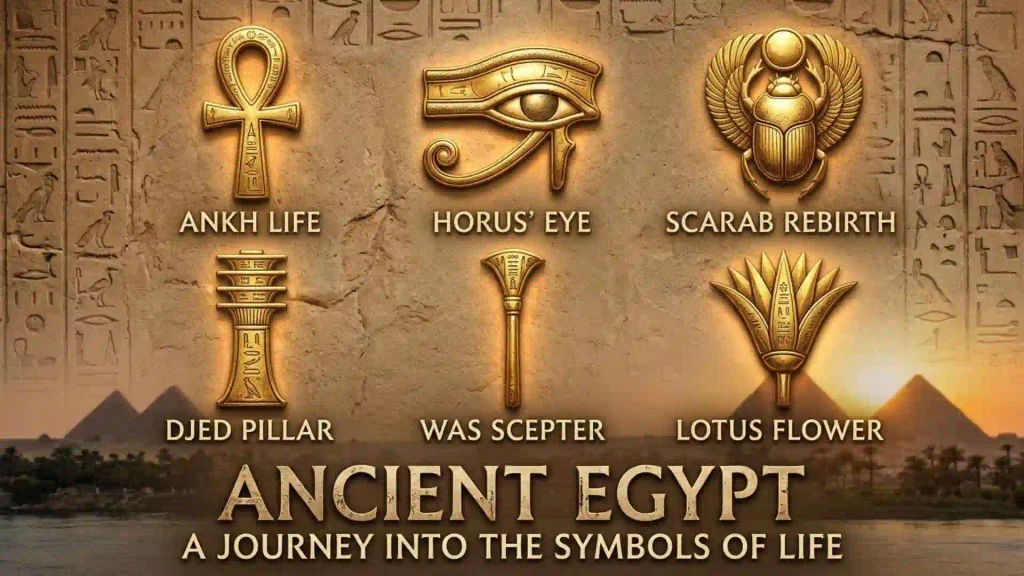
Ancient Egyptians often viewed existence as a repeating process of death and renewal. The scarab became a powerful symbol of regeneration because it was linked with the rising sun and the god Re.
Scarab amulets were used for protection, rebirth, and continued existence after death. Winged scarabs were especially common in funerary settings and were intended to support the rebirth of the deceased.
Although scarabs were not simply “destiny symbols,” they expressed the belief that death belonged to a larger cosmic journey.
Ancient Greece
The Greeks personified destiny through the Moirai. Their spinning, measuring, and cutting of life’s thread presented fate as a power even heroes could not easily escape.
Greek tragedies often explore the painful relationship between prophecy and choice. Characters may struggle against predicted events, only to help bring them about through their own actions.
Roman Culture
Roman ideas about destiny included both fixed fate and changing fortune.
Fortuna’s wheel reminded people that wealth, power, health, and reputation could quickly disappear. Her rudder suggested that she directed the course of human lives, while her globe represented the unstable world.
Eastern Traditions
In Hindu and Buddhist traditions, karma links actions with consequences. The wheel can therefore symbolize cycles of existence and the spiritual conditions created by behavior.
Chinese and Japanese folklore also contains the idea of a red thread connecting people destined to meet. The thread may stretch or become tangled, but its symbolic connection remains.
Indigenous Traditions
Indigenous cultures are highly diverse, so their beliefs should never be treated as one system. Still, many traditions understand destiny through relationships among people, ancestors, animals, land, dreams, and the spirit world.
A significant animal encounter, vision, natural event, or inherited story may guide a person toward responsibility. In such contexts, destiny is often less about individual fame and more about one’s role within family, community, and nature.
Modern Interpretations
Modern people often combine ancient symbolism with personal meaning.
A maze may represent surviving confusion. A phoenix can symbolize rebuilding life after loss. Angel numbers may be interpreted as signs of spiritual alignment. A map or compass may represent the courage to choose a new future.
These meanings are personal rather than historically universal, yet they show that humanity still wants visible signs of purpose.
Similar Symbols and Their Meanings
| Symbol | Main Meaning | Relationship to Destiny | Important Difference |
| Thread | Life path and connection | Represents events being woven together | Often suggests an ordered or measured fate |
| Wheel | Changing fortune | Shows destiny moving through cycles | Emphasizes instability and chance |
| Crossroads | Decision and transition | Represents a future shaped by choice | Focuses more on free will |
| Compass | Guidance and direction | Helps a person follow a meaningful path | Suggests active navigation |
| Star | Hope and divine guidance | Points toward a higher purpose | Often represents aspiration rather than fixed fate |
| Maze | Confusion and discovery | Shows an indirect journey toward purpose | Emphasizes struggle and learning |
| Ouroboros | Eternal return | Represents repeating patterns and renewal | Focuses on cycles instead of one final outcome |
| World Tree | Cosmic connection | Places individual life inside a larger order | Emphasizes unity between realms and generations |
A common misconception is that all destiny symbols mean life cannot be changed. In reality, some represent fixed fate, while others represent guidance, choice, consequences, or transformation.
Destiny Symbols in Mythology and Folklore
Myths often present destiny as a force that creates tension between knowledge and freedom.
In the Greek story of Oedipus, attempts to escape prophecy become part of the path leading toward its fulfillment. The story shaped Western ideas about tragic fate and the danger of believing we can fully control the future.
Norse mythology offers another powerful vision. The Norns are linked with the destinies of gods and humans near Yggdrasil. Even powerful divine figures move toward Ragnarök, the foretold destruction and renewal of the world.
Folklore also uses omens as signs of destiny. Birds, dreams, unusual weather, broken objects, or unexpected meetings may be interpreted as warnings or invitations. These beliefs vary widely, but they reveal the same human wish to read tomorrow through today’s events.
Destiny Symbols in Art, Literature, Movies, and Pop Culture
Artists use destiny symbols because they communicate complex ideas quickly.
In paintings, a road disappearing into the distance may suggest an unknown future. A spinning wheel can represent life controlled by larger forces. A fading star may symbolize lost hope or a dream that remains out of reach.
Literature often uses prophecy, inherited objects, family marks, maps, and mysterious letters to move characters toward their destinies. Shakespeare’s tragedies repeatedly examine fate, personal weakness, ambition, and consequence.
Movies and television frequently show “chosen one” figures marked by scars, birth signs, special weapons, or prophecies. These signs tell audiences that the character has a larger role to fulfill.
In tattoos and fashion, destiny symbols become deeply personal. A red thread may honor a relationship. A compass may remember a difficult journey. An infinity sign may represent love, time, or an unbroken connection.
Spiritual and Dream Meaning of Destiny Symbols
Dreaming of destiny symbols may reflect change, fear, hope, or an important decision. Dream interpretation is subjective, so the emotional setting matters more than any fixed definition.
A crossroads may suggest a major choice.
A broken thread can symbolize fear of separation, loss, or interrupted plans.
A turning wheel may reflect changing circumstances or repeated emotional patterns.
A bright star may represent hope, guidance, or a goal that feels spiritually important.
A maze may show confusion, while finding its center may suggest growing self-understanding.
A compass pointing nowhere can reflect uncertainty or distrust in one’s current direction.
Spiritually, these images may encourage reflection. However, they should not automatically be treated as literal predictions. Their greatest value often lies in the questions they awaken.
Positive and Negative Meanings of Destiny Symbols
| Positive Meaning | Negative Meaning |
| Divine guidance | Loss of control |
| Life purpose | Fatalism |
| Hope for the future | Fear of unavoidable events |
| Meaningful relationships | Unhealthy attachment |
| Transformation | Painful disruption |
| Protection | Superstition |
| Personal direction | Confusion |
| Spiritual awakening | Obsession with signs |
| Acceptance | Passivity |
| Connection to a larger order | Belief that choices do not matter |
The same symbol can carry light and shadow. A thread may represent loving connection, but it can also suggest being trapped. A wheel may offer a new beginning, yet it can warn that good fortune never remains permanent.
Context gives the symbol its emotional meaning.
Why Humans Are Attracted to Destiny Symbols
Human beings struggle with uncertainty. We know that our choices matter, yet accidents, illness, chance meetings, and social conditions also shape our lives.
Destiny symbols bring these forces into a form the mind can hold.
A person standing at a crossroads can imagine two possible futures. Someone wearing a compass can feel less lost during a difficult transition. A grieving person may see a star as a continuing connection with someone who has died.
Pattern recognition also plays a role. The human mind is skilled at finding relationships between events. This ability helps us learn, but it can also cause us to see deliberate meaning in coincidences.
Destiny symbols remain powerful because they do not offer only one answer. They create a space between mystery and understanding.
Modern Uses of Destiny Symbols
Today, destiny symbols appear in many forms:
- Tattoos: Threads, stars, wheels, trees, clocks, compasses, and crossroads mark important life stories.
- Jewelry: Pendants express guidance, protection, love, transformation, or spiritual connection.
- Fashion: Celestial patterns and mythological signs create a mysterious, symbolic style.
- Branding: Compasses, paths, arrows, and stars communicate progress, direction, or achievement.
- Social media: Symbolic images accompany messages about healing, relationships, manifestation, and personal growth.
- Contemporary spirituality: People use tarot wheels, astrology charts, sacred geometry, and numerology to reflect on life direction.
- Home decor: World trees, mandalas, and celestial art create spaces associated with balance and purpose.
- Personal expression: A symbol may represent an experience that is too emotional or private to explain directly.
Interesting Facts About Destiny Symbols
- The Greek word connected with the Moirai refers to an allotted share, suggesting that fate was understood as each person’s assigned portion in life.
- The Roman goddess Fortuna represented both blessing and instability, which explains why her wheel could signal success one moment and disaster the next.
- Scarabs in ancient Egypt could function as protective amulets, funerary objects, and administrative seals.
- Medieval images of the Wheel of Fortune often showed rulers rising to power and then falling, reminding viewers that status was temporary.
- The thread of fate appears in both European and East Asian traditions, although the stories and religious meanings are different.
- Crossroads are frequently treated as spiritually powerful because they exist between destinations rather than belonging fully to one path.
- Compasses became popular modern destiny symbols because they combine direction with personal freedom.
- Destiny symbols are often circular because circles naturally suggest wholeness, return, eternity, and repeating time.
- A destiny tattoo does not need a traditional meaning. Its symbolism may come from the wearer’s own experiences.
- Many myths combine fate with choice, showing that destiny and free will are not always complete opposites.
Frequently Asked Questions
What is the most common symbol of destiny?
The thread of fate is one of the most recognized destiny symbols because Greek mythology describes the Fates spinning, measuring, and cutting the thread of every life.
What symbol represents finding your destiny?
A compass commonly represents finding your destiny because it symbolizes guidance, direction, purpose, and the courage to continue through uncertainty.
What animal symbolizes destiny?
The scarab, phoenix, butterfly, spider, and owl can all carry destiny-related meanings. Their symbolism may involve rebirth, transformation, weaving life’s path, wisdom, or spiritual guidance.
Does the infinity symbol represent destiny?
The infinity symbol can represent an eternal bond, endless time, repeating patterns, or a connection believed to continue across different stages of life.
What symbolizes destiny and love?
The red thread of fate symbolizes two people connected by destiny. It is especially associated with East Asian stories about relationships that are meant to occur.
Are destiny symbols religious?
Some destiny symbols come from religion and mythology, while others are philosophical, psychological, artistic, or personal. Their meaning depends on cultural background and individual belief.
Conclusion
Destiny symbols turn the unseen forces of life into images we can recognize and remember.
They speak of fate, choice, time, purpose, transformation, and the mystery surrounding every human journey.
Whether you believe the future is written or created through daily decisions, these symbols can inspire deeper reflection.
Perhaps their greatest message is that life’s path gains meaning not only from where it leads, but from how courageously we walk it.
 Michael Rivera
 John Mercer