
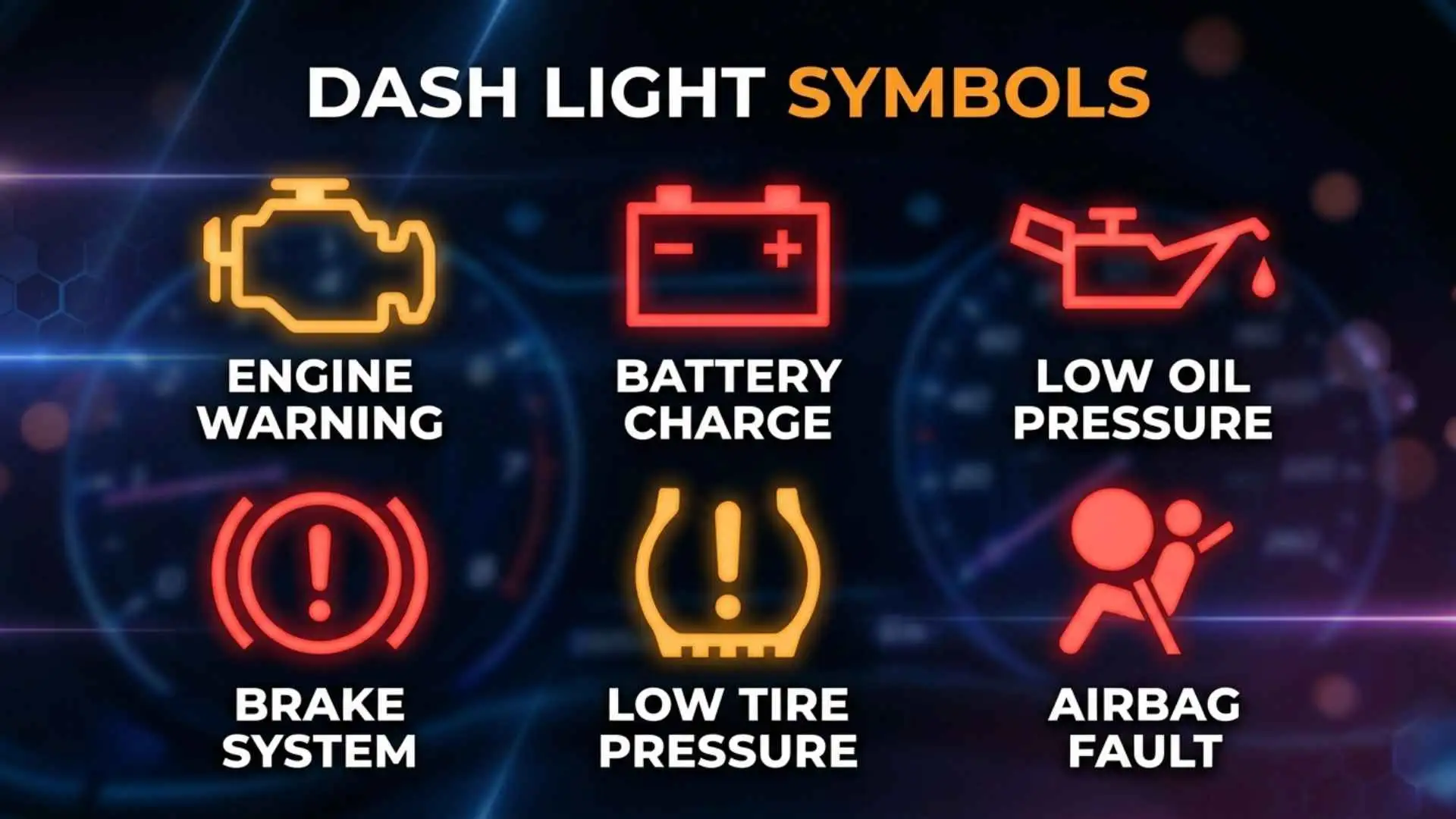
Dash light symbols are important warning and information indicators that help you understand your vehicle’s condition while driving. From the check engine light and battery warning to oil pressure, tire pressure, and brake system indicators, each dashboard symbol communicates something about your car. Some lights simply remind you to perform routine maintenance, while others warn of problems that could affect your safety or damage the vehicle.
Understanding dashboard warning lights and their meanings can help you recognize potential problems before they become expensive repairs. Most vehicles use different light colors to communicate urgency. Red dashboard lights generally indicate serious warnings that may require you to stop driving immediately. Yellow or amber lights usually signal problems that need attention soon, while green and blue indicators provide information about active vehicle features. However, the exact meaning of a symbol can vary depending on your vehicle’s make, model, and year.
In this complete guide to dash light symbols, you will discover the meanings of common dashboard warning lights, their colors, and the problems they indicate. You will also learn which warning lights are safe to monitor, which require a mechanic, and when you should pull over or stop driving immediately. Whether you drive a car, truck, SUV, or hybrid vehicle, understanding these symbols can help you make safer decisions and keep your vehicle running smoothly.
Quick Answer
Dash light symbols are illuminated icons on a vehicle’s instrument panel that communicate system status, warnings, faults, and safety information. Green or blue lights usually show that a feature is active, yellow or orange lights suggest attention is needed, and red lights often indicate an urgent problem requiring immediate action.
Quick Facts About Dash Light Symbols
| Aspect | Information |
| Origin | Developed from early automobile gauges and mechanical warning lamps |
| Historical Significance | Helped drivers monitor oil pressure, temperature, fuel, charging, and braking systems |
| Main Meaning | Communicates vehicle status, system activity, faults, and safety risks |
| Symbolic Meaning | Acts as the vehicle’s visual language between its electronic systems and the driver |
| Cultural Importance | Many dashboard icons are standardized so drivers can recognize them across different vehicles |
| Modern Usage | Used in gasoline, diesel, hybrid, electric, and autonomous-assisted vehicles |
What Are Dash Light Symbols?
Dash light symbols are warning lamps and indicator icons displayed in the instrument cluster, digital dashboard, head-up display, or central information screen.
Some symbols confirm that a system is operating normally. Others warn that a component has failed, a safety feature is unavailable, or immediate action may be necessary.
For example, the blue high-beam icon simply tells you that your bright headlights are active. A red oil can symbol, however, may mean that engine oil pressure is dangerously low.
Many warning lights briefly illuminate when you start the vehicle. This is normally a self-test that confirms the bulbs, display, and monitoring systems are working. Lights that remain on after startup should be checked in the owner’s manual.
How Dashboard Symbols Evolved
Early automobiles depended on mechanical gauges. Drivers had to watch needles for oil pressure, engine temperature, battery charging, and fuel level.
As vehicles became more complex, manufacturers added colored warning lamps. Electronic control units, onboard diagnostics, cameras, radar, and hundreds of sensors now monitor modern vehicles.
Today’s dashboards may display warnings for:
- Engine and emissions problems
- Brake system faults
- Tire pressure
- Airbag systems
- Driver-assistance technology
- Battery charging
- Electric vehicle power systems
- Lane departure
- Forward collision risk
- Keyless entry and immobilizers
This evolution transformed the dashboard from a collection of gauges into a real-time communication center.
What Do Dashboard Light Colors Mean?
Color is often the fastest way to judge the seriousness of a dashboard warning.
| Color | General Meaning | Recommended Response |
| Red | Serious fault, safety warning, or urgent condition | Stop safely and investigate immediately |
| Yellow or orange | Fault, maintenance need, or condition requiring attention | Drive cautiously and arrange inspection soon |
| Green | System is active or operating normally | Usually no corrective action needed |
| Blue | A feature such as high beams is active | Confirm the feature is appropriate |
| White or gray | General information or system status | Read the message or indicator |
Toyota explains that yellow icons identify important conditions that are not always emergencies, while red icons usually require immediate attention. Ford similarly distinguishes warning lamps from indicators that simply show when a feature is being used.
Color rules are helpful, but they are not universal. The exact meaning may differ by manufacturer, model, year, or market. Always consult the correct owner’s manual.
Most Important Dash Light Symbols and Their Meanings
Check Engine Light
Visual description: An outline shaped like an engine, sometimes displaying “CHECK.”
Meaning: The vehicle’s computer has detected a fault involving the engine, fuel, ignition, or emissions system.
A steady check engine light often means the vehicle should be inspected soon. Possible causes include a loose fuel cap, faulty oxygen sensor, ignition misfire, catalytic converter problem, or emissions fault.
A flashing check engine light is more serious. It may indicate an active misfire that can damage the catalytic converter. Reduce speed, avoid hard acceleration, and seek professional assistance.
Oil Pressure Warning Light
Visual description: A red oil can with a drop coming from its spout.
Meaning: The engine may not have enough oil pressure to protect internal parts.
Pull over safely and switch off the engine. Check the oil level only after the vehicle is parked on level ground and the engine has cooled sufficiently.
Do not assume that adding oil will always solve the problem. A failed oil pump, clogged filter, damaged sensor, or internal engine fault may also trigger the warning.
Engine Temperature Warning
Visual description: A thermometer resting over waves.
Meaning: The engine coolant temperature is too high.
Turn off the air conditioning, pull over safely, and shut down the engine. Never open a hot radiator cap because pressurized coolant can cause serious burns.
Overheating may result from low coolant, a leaking hose, failed water pump, damaged radiator fan, or thermostat problem.
Battery or Charging System Light
Visual description: A battery containing plus and minus signs.
Meaning: The vehicle’s charging system is not operating correctly.
Although the symbol looks like a battery, the problem may involve the alternator, drive belt, wiring, terminals, or voltage-control system. A vehicle may continue running briefly on stored battery power, but it can eventually stall.
Switch off unnecessary electrical accessories and arrange inspection as soon as possible.
Brake Warning Light
Visual description: An exclamation mark or the word “BRAKE” inside a circle.
Meaning: The parking brake may be engaged, brake fluid may be low, or the hydraulic braking system may have a fault.
First, confirm that the parking brake is completely released. If the light remains on, stop in a safe location.
A red brake warning combined with a soft pedal, unusual noise, fluid leak, or poor braking performance should be treated as an emergency.
ABS Warning Light
Visual description: The letters “ABS” inside a circle.
Meaning: The anti-lock braking system has detected a fault.
Normal braking may still function, but the system that helps prevent wheel lock during emergency braking may be unavailable. Drive carefully and schedule an inspection.
If both the ABS light and red brake warning light appear, the braking system may have a more serious problem.
Tire Pressure Warning Light
Visual description: A horseshoe-shaped tire cross-section with an exclamation mark.
Meaning: One or more tires may be significantly underinflated, or the tire pressure monitoring system may have a fault.
Stop somewhere safe and inspect the tires. Use a pressure gauge and inflate them to the pressure listed on the driver’s door label, not the maximum pressure printed on the tire.
NHTSA notes that tire pressure monitoring systems normally activate only after a tire becomes significantly underinflated. Drivers should still check tire pressure regularly.
Airbag or SRS Warning
Visual description: A seated person facing a circle.
Meaning: The supplemental restraint system has detected a problem.
A faulty airbag system may not deploy correctly during a crash. The light may relate to airbags, seat-belt pretensioners, crash sensors, wiring, or occupancy sensors.
Have the vehicle inspected promptly.
Traction Control and Stability Control Light
Visual description: A car with wavy skid marks.
Meaning: The traction or stability system is active, switched off, or experiencing a fault.
A flashing light often means the system is actively reducing wheelspin. Slow down and steer smoothly.
A continuously illuminated light may indicate that the system has been disabled or needs service.
Power Steering Warning
Visual description: A steering wheel, sometimes with an exclamation mark.
Meaning: The hydraulic or electric power steering system has a fault.
The steering wheel may become much harder to turn. Reduce speed, avoid sudden movements, and stop safely if steering control feels limited.
Low Fuel Indicator
Visual description: A fuel pump, sometimes with an arrow showing which side contains the fuel door.
Meaning: The fuel level has reached the reserve range.
Refuel soon. Frequently driving with very little fuel may place extra strain on the fuel pump in some vehicles.
Seat Belt Warning
Visual description: A seated figure wearing a diagonal belt.
Meaning: A driver or passenger seat belt is not fastened, or an object is triggering a seat sensor.
Seat belts remain one of the vehicle’s most important safety systems. Secure every occupant before moving.
Door, Hood, or Trunk Open Warning
Visual description: A vehicle viewed from above with one or more panels open.
Meaning: A door, the hood, or the trunk is not fully latched.
Stop safely and close the indicated opening. An improperly secured hood can block the driver’s view if it opens while driving.
Diesel Glow Plug Light
Visual description: A yellow coil or spiral.
Meaning: A diesel engine’s glow plugs are heating the combustion chambers.
Wait for the light to switch off before starting. If it flashes or stays on while driving, the engine-management system may require inspection.
Diesel Particulate Filter Warning
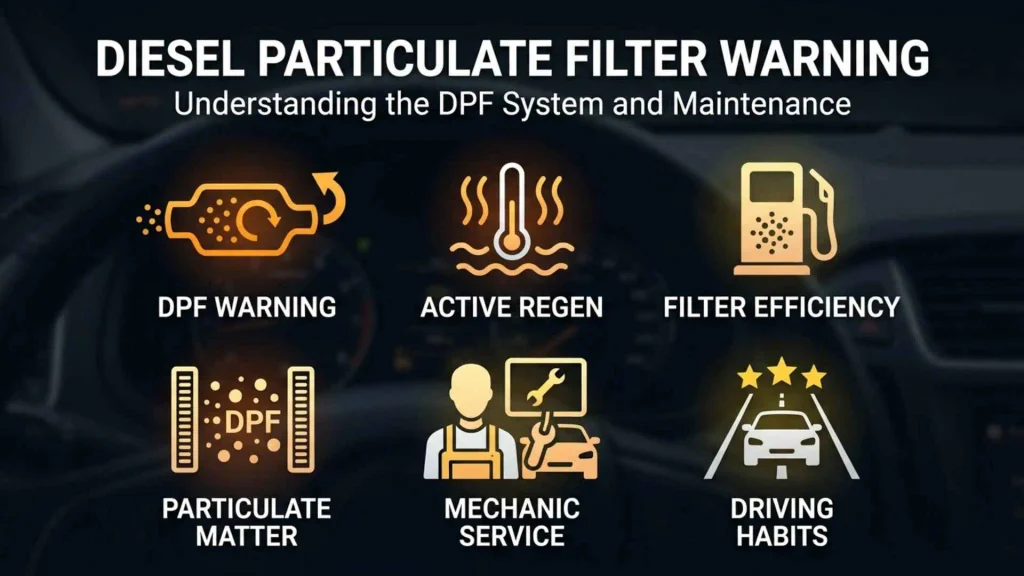
Visual description: A filter or exhaust-shaped icon containing dots.
Meaning: The diesel particulate filter may be filling with soot.
Some vehicles can clean the filter through a regeneration cycle during sustained driving. However, procedures differ, so follow the owner’s manual rather than attempting a generic solution.
Electric Vehicle Battery Warning
Visual description: A battery, plug, turtle, or reduced-power message.
Meaning: The high-voltage battery may be low, overheated, too cold, or experiencing a system fault.
A turtle icon commonly indicates reduced propulsion power. Stop charging or driving if the vehicle displays a red battery-system warning and follow the manufacturer’s instructions.
Similar Dash Light Symbols and Common Confusion
| Symbol | Often Confused With | Main Difference |
| Oil can | Low oil level reminder | Usually warns about oil pressure, not simply oil quantity |
| Battery icon | Weak battery only | Often indicates a charging-system fault |
| ABS light | Red brake warning | ABS affects anti-lock assistance, while the red light may signal a hydraulic brake problem |
| Skidding car | Slippery road warning | It may show active traction control, a disabled system, or a fault |
| Tire pressure light | Flat tire indicator | It warns of low pressure but may not identify which tire |
| Engine temperature icon | Low coolant reminder | It usually warns that temperature is too high |
The most dangerous misunderstanding is assuming that every dashboard icon identifies the failed part. In reality, symbols often identify the affected system, not the exact cause.
The Psychology Behind Dash Light Symbols
Dashboard icons are designed for rapid recognition. A driver may have only a few seconds to notice, understand, and respond to a warning.
Red creates urgency because people commonly connect it with danger, stopping, heat, fire, and blood. Yellow attracts attention while allowing more time to evaluate the situation. Green and blue feel calmer and usually communicate normal operation.
Shapes also matter. A thermometer suggests heat. A battery shows electrical energy. Wavy lines beneath a car suggest loss of grip.
This visual system reduces the need for long written messages, especially when drivers speak different languages. However, unfamiliar symbols can still cause anxiety. The best response is not panic, but a safe and organized check of the light’s color, behavior, accompanying message, and vehicle performance.
Dash Light Symbols Across Vehicle Markets
Automotive symbols are widely shared across North America, Europe, Asia, and other markets, but they are not perfectly identical.
European vehicles may use rear fog-light, diesel, and emissions symbols that are less familiar to some American drivers. Japanese manufacturers often combine symbols with text messages. Modern American vehicles increasingly use digital displays that explain the warning in plain language.
Electric and hybrid vehicles add icons for regenerative braking, charging status, high-voltage batteries, reduced propulsion power, and energy flow.
Because designs and meanings vary, a general guide should never replace the manual created for the exact vehicle.
Positive and Negative Meanings of Dash Light Symbols
| Positive Meaning | Negative Meaning |
| Confirms that a feature is active | Warns that a system has malfunctioned |
| Helps prevent mechanical damage | May indicate an unsafe driving condition |
| Encourages timely maintenance | Can create stress when poorly understood |
| Improves communication between car and driver | May be ignored if the driver experiences warning fatigue |
| Supports safer decision-making | Can be misleading without model-specific information |
A dashboard light is not automatically bad news. Many icons simply confirm that headlights, cruise control, turn signals, or safety systems are active.
Even warning lights have a positive purpose. They give the driver an opportunity to act before a small fault becomes a breakdown or serious accident.
What to Do When a Dash Light Appears
Follow a simple safety process:
- Notice the color. Red usually demands faster action than yellow, green, or blue.
- Observe the light’s behavior. A flashing warning may be more urgent than a steady one.
- Check vehicle performance. Look for smoke, smells, unusual sounds, weak brakes, overheating, or loss of power.
- Move to a safe place. Do not study the dashboard while driving through traffic.
- Read the owner’s manual. Find the exact symbol and recommended response.
- Contact professional help. Use roadside assistance or a qualified technician when the vehicle may be unsafe.
AAA advises drivers to have yellow warnings checked soon and to stop the engine as safely and quickly as possible when a serious red warning appears.
Interesting Facts About Dash Light Symbols
- Many dashboard lights illuminate briefly during startup as part of a system check.
- A warning symbol may identify a system rather than the exact failed component.
- The small arrow beside the fuel-pump icon often points toward the fuel-door side.
- A flashing check engine light is generally more urgent than a steady one.
- Cold weather can temporarily lower tire pressure and activate the TPMS light.
- Some green or blue lights are indicators, not warnings.
- Advanced vehicles may show warnings in the windshield through a head-up display.
- Electric cars use several symbols that do not exist in traditional gasoline vehicles.
- Disconnecting the battery may temporarily clear some lights without repairing the cause.
- Diagnostic trouble codes provide clues, but they do not always prove which part needs replacement.
Frequently Asked Questions
What is the most serious dashboard warning light?
Red oil pressure, engine temperature, brake-system, and charging warnings can all be serious. Stop safely and check the vehicle manual, especially when the light appears with unusual sounds, smoke, weak braking, or loss of power.
Can I drive with a yellow dashboard light?
Sometimes, but it depends on the symbol and vehicle behavior. Yellow usually means that attention is required soon. Reduce unnecessary driving and arrange diagnosis before the problem becomes worse.
What does a flashing dashboard light mean?
Flashing often signals an active or urgent condition. A flashing check engine light may indicate severe misfiring, while a flashing traction-control light may simply show that the system is preventing wheelspin.
Why do all dashboard lights turn on when I start the car?
The vehicle briefly illuminates many lights to test the warning system. Most should switch off after the engine or power system starts.
Can a dashboard warning light reset itself?
Yes. A temporary condition may disappear after the fault ends. However, the vehicle’s computer may still store a diagnostic code. Repeated or unexplained warnings should be inspected.
Why is my dashboard symbol different from pictures online?
Dashboard designs vary by manufacturer, model year, powertrain, country, and equipment level. Use your exact owner’s manual or manufacturer’s digital manual for the correct meaning.
Conclusion
Dash light symbols are the voice of your vehicle, offering guidance before a hidden problem becomes a dangerous one.
Their colors and shapes help you judge whether a system is active, needs attention, or demands an immediate stop.
Learning the most common icons gives you greater confidence and control behind the wheel.
When a warning appears, stay calm, move safely, and listen carefully to what your vehicle is trying to tell you.
 Michael Rivera
 John Mercer