
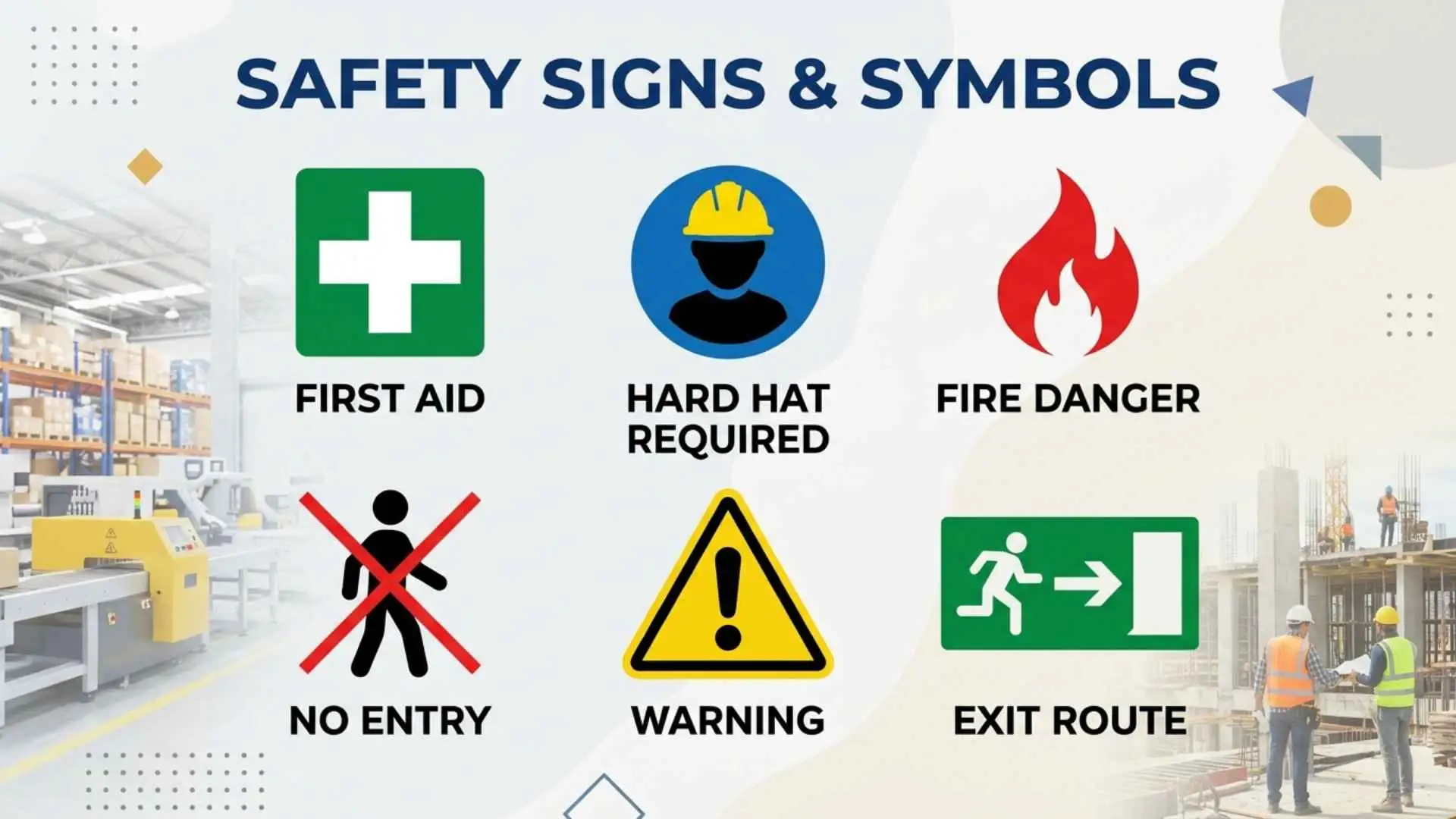
Safety signs and symbols play an essential role in protecting people from accidents, injuries, and potential hazards. You can find them everywhere, including workplaces, factories, construction sites, hospitals, schools, roads, laboratories, and public spaces. From warning triangles and emergency exit signs to fire safety symbols and mandatory instruction signs, these visual messages communicate important information quickly. They help people recognize danger, understand safety requirements, and make better decisions, even when language differences create communication barriers.
Different safety signs use specific colors, shapes, pictograms, and symbols to communicate different types of information. Red commonly indicates fire equipment, prohibition, or danger, while yellow warns people about potential hazards. Blue generally communicates mandatory actions, and green identifies safe conditions, emergency exits, and first-aid facilities. Each design serves a purpose, helping people understand risks and respond appropriately. The psychology behind these visual elements also influences how quickly people notice, recognize, and react to safety warnings.
In this complete guide to safety signs and symbols, you will explore their meanings, colors, classifications, common designs, and psychological significance. You will learn how to recognize warning signs, prohibition signs, mandatory signs, emergency information signs, and fire safety symbols. Whether you need to understand workplace safety, improve hazard awareness, or recognize signs in everyday environments, this guide will help you interpret important safety messages with greater confidence.
Quick Answer
Safety signs and symbols are standardized visual messages used to warn people about hazards, prohibit unsafe behavior, require protective action, identify emergency facilities, and guide evacuation. They combine recognizable colors, geometric shapes, pictograms, and sometimes words so people can understand important safety information quickly, even when they speak different languages.
Quick Facts About Safety Signs and Symbols
| Aspect | Information |
| Origin | Developed from ancient warning marks, military signals, road signs, industrial notices, and public health symbols |
| Historical Significance | Became essential during industrialization as machinery, chemicals, transportation, and crowded workplaces created new dangers |
| Main Meaning | Warning, prohibition, mandatory action, emergency guidance, or safety information |
| Spiritual Meaning | Protection, awareness, responsibility, boundaries, and respect for life |
| Cultural Importance | Creates a shared visual language that can cross language and literacy barriers |
| Modern Usage | Workplaces, roads, hospitals, laboratories, construction sites, products, public spaces, and digital systems |
What Are Safety Signs and Symbols?
Safety signs are visual communication tools designed to help people recognize danger and respond correctly. A sign may tell someone to stop, wear protective equipment, avoid an area, locate an emergency exit, or prepare for a specific hazard.
A safety symbol is usually the pictogram within the sign. For example, a flame represents a fire risk, while a skull and crossbones can indicate acute toxicity. The surrounding color and shape help explain how the symbol should be understood.
Modern safety signage follows established systems rather than personal artistic choice. ISO 7010 prescribes registered signs for accident prevention, fire protection, health hazards, and emergency evacuation. It also connects sign shapes and colors with the design principles found in other ISO standards.
In the United States, OSHA regulations cover accident-prevention signs, tags, safety colors, and hazard communication. ANSI Z535 standards also provide widely used guidance for safety colors, symbols, facility signs, product labels, and safety messages.
Historical Development
Early humans used smoke, fire, carved marks, barriers, and spoken warnings to communicate danger. Ancient roads, mines, fortifications, and religious sites also used visual markers to indicate boundaries or forbidden spaces.
However, standardized safety signs became especially important during the Industrial Revolution. Large machines, electrical systems, railways, mines, and chemical processes introduced hazards that were unfamiliar to many workers.
As international travel and global trade expanded, written warnings alone became less effective. A worker might not understand a foreign language, but a clear pictogram of a falling object, electrical bolt, or fire extinguisher could still communicate the essential message.
Today, safety signs form a visual language built around speed, consistency, and recognition.
Deep Symbolic Meaning of Safety Signs and Symbols
Safety signs have a practical function, but they also carry deeper psychological and cultural meaning.
Spiritual Level
On a spiritual level, a safety symbol can represent awareness. It asks a person to pause, observe, and act consciously instead of moving through life without attention.
A prohibition sign creates a boundary. Symbolically, boundaries protect what is valuable. A warning sign reminds us that freedom must be balanced with responsibility. An emergency exit sign represents hope and a path away from danger.
Safety symbols also express respect for human life. Their presence communicates a simple ethical message: your well-being matters.
Psychological Level
The human brain reacts quickly to strong contrasts, familiar shapes, and emotionally charged colors. Red may create urgency, while yellow attracts attention because it stands out clearly in many environments.
From a Jungian perspective, some safety images resemble universal archetypes. Fire can represent both transformation and destruction. Darkness may suggest uncertainty. A protective shield symbolizes defense, while an open doorway can symbolize escape or transition.
Safety symbols work because they reduce complex information into simple patterns. Instead of reading a full paragraph about an electrical hazard, a person sees a lightning bolt and immediately connects it with shock, power, and danger.
Cultural Level
A reliable safety system creates shared expectations. Workers, visitors, drivers, and emergency responders can recognize the same basic message without needing a long explanation.
This shared visual vocabulary strengthens trust. When signs are designed and placed correctly, people feel that risks have been considered. When signs are confusing, damaged, or missing, confidence falls.
Safety signage therefore reflects a culture’s attitude toward prevention, public responsibility, and human welfare.
Types and Variations of Safety Signs and Symbols
Safety signs are usually classified by their purpose, shape, and color.
Warning Signs
Visual description: Usually a yellow triangle with a dark border and symbol.
Meaning: A hazard is present nearby.
Symbolism: Attention, uncertainty, caution, and preparation.
Where they appear: Construction sites, electrical rooms, factories, laboratories, roads, and storage areas.
Common examples include:
- High voltage
- Slippery floor
- Falling objects
- Toxic substances
- Forklift traffic
- Radiation
- Hot surfaces
Yellow is strongly associated with caution. OSHA identifies yellow as a basic color for marking physical hazards such as tripping, falling, striking against objects, or becoming caught between hazards.
Prohibition Signs
Visual description: A red circle with a diagonal slash over a black pictogram.
Meaning: A particular action is not allowed.
Symbolism: Limits, control, restraint, and protection.
Where they appear: Hospitals, workplaces, fuel stations, public buildings, and restricted areas.
Examples include no smoking, no entry, no open flames, and no mobile phones.
Mandatory Signs
Visual description: Usually a blue circle containing a white symbol.
Meaning: A specific action must be completed.
Symbolism: Duty, discipline, responsibility, and preparation.
Where they appear: Industrial sites, workshops, laboratories, and construction areas.
Examples include:
- Wear eye protection
- Use a safety helmet
- Wear hearing protection
- Use protective gloves
- Wear respiratory equipment
Emergency and Safe-Condition Signs
Visual description: Commonly a green square or rectangle with a white image.
Meaning: A safe route, emergency facility, or first-aid resource is available.
Symbolism: Hope, assistance, recovery, and escape.
Where they appear: Schools, offices, factories, shopping centers, airports, and hospitals.
Examples include emergency exits, assembly points, first-aid stations, safety showers, and eyewash facilities.
Fire-Safety Signs
Visual description: Often a red square or rectangle with a white fire-related pictogram.
Meaning: Identifies firefighting equipment or fire-response facilities.
Symbolism: Urgency, defense, control, and rapid action.
Examples include fire extinguishers, fire alarms, fire hoses, and emergency call points.
Chemical Hazard Pictograms
Chemical labels often use diamond-shaped pictograms with red borders, white backgrounds, and black symbols. OSHA’s Hazard Communication Standard specifies this basic format for regulated hazard pictograms.
Examples include symbols for:
- Flammable substances
- Corrosive chemicals
- Explosives
- Oxidizers
- Gases under pressure
- Acute toxicity
- Serious health hazards
- Environmental hazards
These symbols should not be confused with ordinary workplace warning triangles. Their shape and labeling system relate specifically to chemical hazard communication.
Safety Signs and Symbols Across Different Cultures
Although modern safety signs are standardized, the human desire to mark danger has appeared across many civilizations.
Ancient Egypt
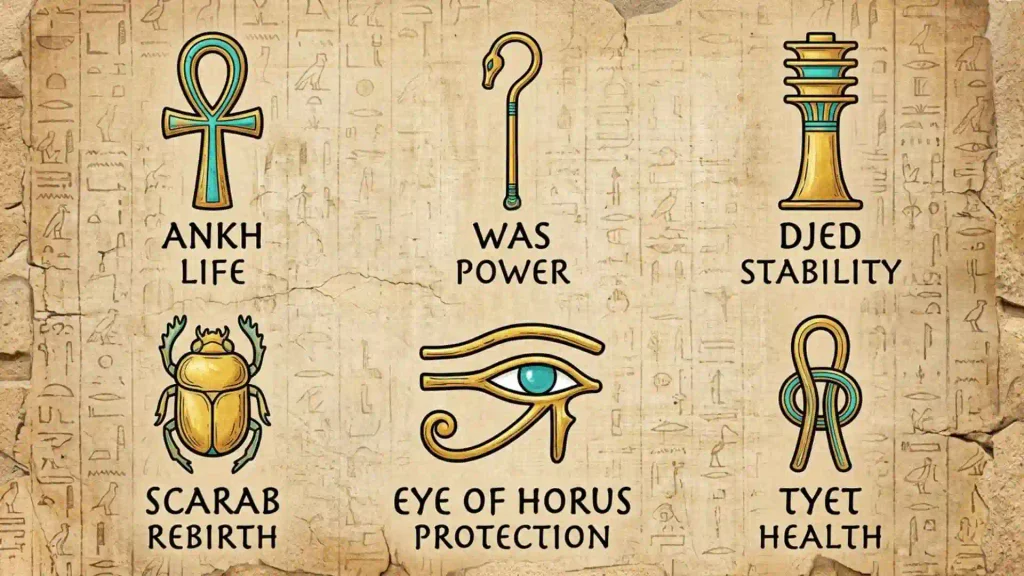
Ancient Egyptian temples, tombs, and sacred spaces used symbols to mark authority, protection, purity, and restricted access. Images such as protective eyes, cobras, and guardian figures were not modern safety signs, but they warned people that certain places or powers demanded respect.
Ancient Greece
Greek myths often used dangerous creatures and divine punishment as symbolic warnings. Medusa’s face, for example, became an apotropaic image intended to repel evil or danger. Such images combined fear with protection.
Roman Culture
Romans used inscriptions, military markers, road signs, and boundary stones to guide behavior and define restricted areas. Public notices communicated rules in cities, ports, military camps, and construction zones.
Eastern Traditions
Chinese and Japanese traditions have long used colors, written characters, guardian figures, lanterns, and directional markers to communicate warnings or protected spaces. Modern Asian safety systems now combine local languages with international pictograms.
Indigenous Traditions
Indigenous communities around the world have used trail markers, rock arrangements, carvings, smoke signals, stories, and environmental knowledge to communicate hazards. Warnings about dangerous water, animals, weather, or sacred land were often carried through oral tradition and community memory.
Modern Global Culture
Today, airports, ships, factories, hotels, and public buildings increasingly use internationally recognizable pictograms. This consistency is especially important during emergencies, when there may be no time to translate instructions.
Similar Symbols and Their Meanings
| Symbol Type | Main Purpose | Common Appearance | Typical Message |
| Warning sign | Alerts people to a hazard | Yellow triangle | Be careful |
| Prohibition sign | Stops an unsafe action | Red circle and slash | Do not do this |
| Mandatory sign | Requires an action | Blue circle | You must do this |
| Emergency sign | Shows safety or escape | Green rectangle | Safety is this way |
| Fire-equipment sign | Locates fire resources | Red rectangle | Fire equipment is here |
| Chemical pictogram | Identifies chemical hazards | Red diamond | This substance has a specific hazard |
| Traffic sign | Controls road movement | Various shapes and colors | Follow road rules |
| Security sign | Protects property or access | Text, icons, or shields | Entry or activity is controlled |
A common misconception is that every red sign means the same thing. Red can indicate prohibition, immediate danger, emergency stopping, or firefighting equipment depending on the sign system and context.
Another mistake is assuming that a symbol alone always provides enough information. Some general warning symbols require supplementary text or another sign to identify the exact hazard. ISO notes, for example, that its general warning sign should be supported by additional information.
Safety Signs and Symbols in Mythology and Folklore
Ancient myths did not contain modern hard-hat or fire-exit signs, but they often delivered warnings through memorable symbols.
The forbidden door, cursed object, dangerous forest, guardian serpent, and boundary stone all served as narrative warnings. These symbols told listeners that crossing a limit could bring harm.
Greek stories warned against pride through the fall of Icarus. European folklore used dark woods to represent uncertainty and hidden danger. Sea legends warned sailors through monsters, storms, and supernatural lights.
Such stories shaped the way humans still understand warning imagery. Danger is often pictured as darkness, fire, poison, sharp teeth, broken ground, or an approaching force.
Safety Signs and Symbols in Art, Literature, Movies, and Pop Culture
Artists and filmmakers often use safety signs to create tension or irony. A faded warning sign can suggest that disaster has already occurred. A flashing emergency symbol can signal that characters have little time left.
In literature, warnings may represent ignored wisdom. A character who crosses a forbidden boundary often begins a journey into danger, guilt, or transformation.
In movies and television, symbols for radiation, biohazards, toxic chemicals, and restricted areas quickly establish risk without lengthy dialogue. These images are especially common in science fiction, disaster films, thrillers, and post-apocalyptic stories.
The same symbols appear in fashion, tattoos, album artwork, street art, and digital culture. A hazard symbol may express rebellion, emotional danger, environmental concern, or attraction to forbidden ideas.
However, using genuine safety symbols decoratively can create confusion when they appear in real workplaces or public environments. Functional safety communication should always remain clear.
Spiritual and Dream Meaning of Safety Signs and Symbols
Dreaming about a warning sign may reflect a concern that your waking mind has not fully addressed. It can suggest that you need to slow down, reconsider a decision, or protect a personal boundary.
A stop sign in a dream may represent emotional exhaustion or a relationship limit. An emergency exit may symbolize a desire to escape pressure. A danger symbol may reflect anxiety, while a first-aid sign can represent healing and support.
These interpretations are symbolic rather than scientific predictions. The most useful meaning usually depends on the dreamer’s emotions, personal experiences, and current situation.
During meditation, an imagined safety symbol may serve as a reminder of protection, awareness, or self-control. It can also encourage the person to distinguish between healthy caution and fear that prevents growth.
Positive and Negative Meanings of Safety Signs and Symbols
| Positive Meaning | Negative Meaning |
| Protection | Fear |
| Awareness | Anxiety |
| Prevention | Restriction |
| Responsibility | Control |
| Guidance | Confusion when poorly designed |
| Emergency support | Reminder of danger |
| Shared understanding | Overreliance on visual warnings |
| Respect for life | Sign fatigue from excessive use |
The same sign can represent both light and shadow. A barrier may feel restrictive, yet it may prevent someone from entering a deadly area. A warning may create fear, but that fear can encourage life-saving action.
Context determines the final meaning.
Why Humans Are Attracted to Safety Signs and Symbols
Humans naturally search for patterns. Our survival has always depended on noticing movement, contrast, danger, shelter, and possible escape routes.
Safety signs satisfy this instinct by turning risk into a visible pattern. Their shapes organize meaning before the words are read. A triangle appears pointed and unstable, which supports the feeling of warning. A circle feels complete and controlling, making it useful for prohibitions and required actions. A rectangle presents information clearly and calmly.
Color adds emotional force. Red attracts attention and can suggest stopping, fire, blood, or urgency. Yellow is highly visible and often signals caution. Green is linked with safe movement, assistance, and permission.
Yet design alone is not enough. People must be trained to understand the symbols they may encounter. OSHA states that employers should communicate hazards and provide safety training in language and vocabulary workers can understand.
Modern Uses of Safety Signs and Symbols
Safety signs now appear in nearly every part of modern life.
In workplaces, they identify machinery hazards, restricted zones, protective equipment requirements, emergency exits, and chemical risks.
In hospitals, they help control infection, identify radiation areas, mark emergency equipment, and guide patients.
In public spaces, they communicate evacuation routes, accessibility information, fire procedures, and behavioral rules.
Digital systems also use warning symbols for dangerous downloads, weak passwords, privacy risks, battery problems, and system failures. ANSI has even developed guidance concerning safety information presented through electronic media.
Safety symbols also appear in product manuals, packaging, vehicle dashboards, mobile applications, and online training.
However, signs should support a larger safety system, not replace it. Britain’s Health and Safety Executive explains that signs are needed when significant risks cannot be avoided or adequately controlled in other ways. It also warns against displaying so many signs that they create confusion.
Interesting Facts About Safety Signs and Symbols
- Symbols can cross language barriers. A strong pictogram may communicate danger even when viewers cannot read the accompanying words.
- Shape carries meaning. Triangles commonly warn, circles regulate behavior, and rectangles provide directions or information.
- Not all red signs mean “stop.” Red can indicate prohibition, danger, emergency controls, or firefighting equipment.
- A blank chemical diamond is not valid. OSHA states that a red diamond frame without an appropriate hazard symbol is not a permitted pictogram.
- Safety signs cannot remove hazards. They warn or guide people, but physical controls, safe procedures, maintenance, and training remain essential.
- Too many signs reduce attention. When every surface contains warnings, people may stop noticing the messages that matter most.
- General warning signs may need explanation. A triangle with an exclamation mark tells people that danger exists, but it may not identify the exact danger.
- International standards improve consistency. ISO 7010 helps organizations use recognizable signs for emergencies, fires, health hazards, and accident prevention.
- Signal words describe different risk levels. In many U.S. safety systems, terms such as “Danger,” “Warning,” and “Caution” are not interchangeable.
- Placement matters as much as design. A clear symbol is ineffective if it is hidden, poorly lit, damaged, or located after the hazard.
Frequently Asked Questions
What are the main types of safety signs and symbols?
The main categories are warning, prohibition, mandatory, emergency or safe-condition, fire-equipment, and chemical hazard signs.
What do safety sign colors mean?
Red commonly marks prohibition, danger, stopping, or fire equipment. Yellow warns of hazards, blue requires an action, and green identifies safety, first aid, or escape routes.
Why are symbols used instead of words?
Symbols can be recognized faster, viewed from a distance, and understood by people who speak different languages. Words may still be added when the exact hazard needs clarification.
What is the difference between a warning sign and a danger sign?
A warning sign broadly alerts people to a hazard. In formal U.S. workplace labeling, “Danger” generally identifies a more severe or immediate risk, while “Warning” and “Caution” indicate lower levels of hazard.
Are safety signs legally required?
Requirements depend on the country, industry, and hazard. In many workplaces, laws require signs when they are necessary to communicate risks, prohibited actions, emergency facilities, or protective measures.
Can a safety sign replace employee training?
No. Signs remind and guide people, but they cannot replace hazard controls, clear procedures, protective equipment, supervision, and training that workers understand.
Conclusion
Safety signs and symbols are more than bright colors placed on walls.
They are a shared language built from history, psychology, design, and the human desire to protect life.
Each symbol asks us to notice what could happen and choose a safer path before it is too late.
When we understand these signs, we do not merely follow rules. We become active participants in protecting ourselves and others.
 Sarah Thompson
 John Mercer