
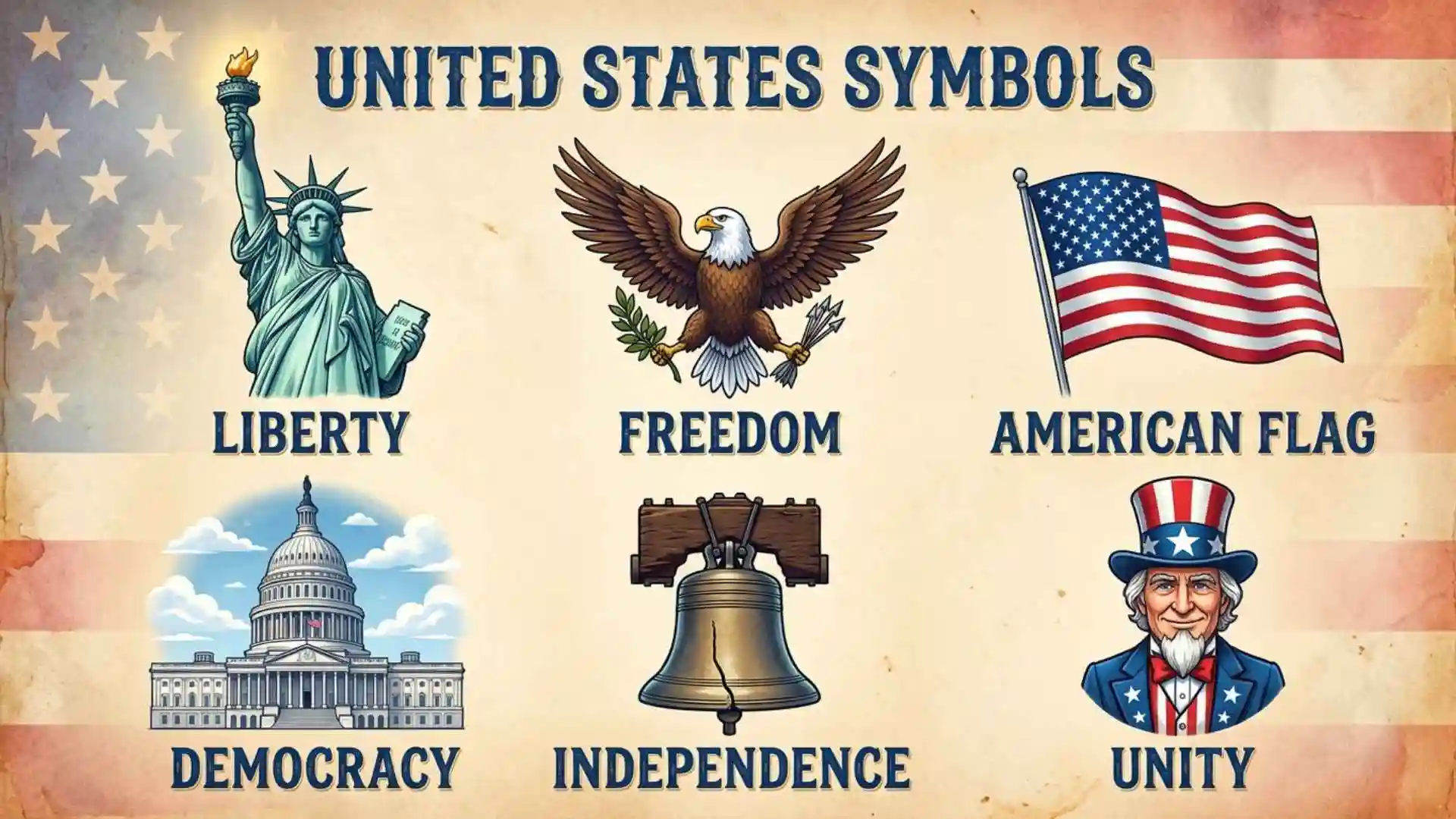
United States symbols represent the nation’s history, identity, freedom, and cultural values. From the American flag and bald eagle to the Statue of Liberty, the Great Seal, and the Liberty Bell, these iconic emblems tell powerful stories about the country’s founding and development. Each symbol carries a unique meaning connected to American independence, democracy, patriotism, unity, courage, and national pride. Whether displayed on government buildings, currency, monuments, or official documents, these symbols help express what America represents.
Many American symbols have deep historical roots and fascinating stories behind their designs. The 50 stars on the United States flag represent the 50 states, while its 13 stripes honor the original British colonies. The bald eagle symbolizes strength and freedom, and the Statue of Liberty represents liberty and hope. Other important emblems, including the Great Seal of the United States, the Liberty Bell, the Washington Monument, and the American bison, reflect different aspects of the nation’s heritage, political ideals, and cultural identity.
In this complete guide to United States symbols, you will explore America’s most recognizable national emblems, their origins, historical significance, and hidden meanings. You will also discover the symbolism behind American flags, national monuments, animals, flowers, patriotic icons, and official government insignia. Whether you are a student, history enthusiast, traveler, or simply curious about American culture, this guide will help you understand the stories and values behind the symbols that represent the United States.
Quick Answer
United States symbols are official and cultural emblems that represent the country’s history, values, government, people, and natural heritage. Important examples include the American flag, bald eagle, Great Seal, Statue of Liberty, Liberty Bell, national anthem, and Uncle Sam. Together, they express freedom, unity, independence, strength, and patriotism.
Quick Facts About United States Symbols
| Aspect | Information |
| Origin | Many developed during the American Revolution and the early years of the republic |
| Historical Significance | They helped create a shared identity among people from different colonies, states, and backgrounds |
| Main Meaning | Freedom, independence, courage, unity, democracy, and national pride |
| Spiritual Meaning | Hope, sacrifice, moral responsibility, renewal, and belief in a higher purpose |
| Cultural Importance | They connect citizens through shared history, ceremonies, holidays, and traditions |
| Modern Usage | Government seals, currency, schools, sports, memorials, advertising, fashion, tattoos, and social media |
What Are United States Symbols?
United States symbols are images, objects, songs, animals, plants, buildings, and figures associated with American identity. Some are officially recognized by federal law, while others became national symbols through history, public tradition, or popular culture.
The need for national symbols grew during the American Revolution. Before independence, the thirteen colonies had separate governments and identities. As they united against British rule, they needed images that could communicate a shared purpose.
The American flag became one of the earliest and most important symbols. The Continental Congress adopted the basic Stars and Stripes design on June 14, 1777. Its stars came to represent the states, while its stripes honored the original thirteen colonies.
Soon afterward, national leaders created the Great Seal of the United States. Adopted in 1782, it features a bald eagle holding an olive branch and arrows. This design communicates both a desire for peace and a readiness to defend the nation.
Over time, monuments, songs, fictional characters, landmarks, and natural species joined the symbolic language of America. Each one added a new chapter to the national story.
Deep Symbolic Meaning of United States Symbols
Spiritual Meaning
On a spiritual level, many United States symbols express hope, sacrifice, renewal, and responsibility.
The Statue of Liberty carries a torch, which represents light overcoming darkness. It can be interpreted as the light of knowledge, justice, freedom, and moral awakening. For immigrants arriving by sea, the statue became a powerful sign of possibility and a new beginning.
The stars on the American flag can suggest guidance and higher purpose. Stars have long represented heaven, destiny, and direction in many cultures. In the national flag, they also show that separate states can remain distinct while belonging to one union.
The bald eagle rises high above the ground, making it a symbol of vision and spiritual elevation. Its flight may represent the human desire to move beyond fear, limitation, and oppression.
Psychological Meaning
Psychologically, national symbols create emotional belonging. People often attach memories of family, military service, school ceremonies, national tragedies, sporting events, and public celebrations to familiar symbols.
Carl Jung’s idea of archetypes helps explain their power. Archetypes are universal patterns that appear across cultures. The eagle fits the archetype of the powerful sky creature. The torch represents illumination. The shield suggests protection. The motherly figure of Liberty represents care, guidance, and moral authority.
However, symbols can also trigger different emotional responses. One person may see the flag as a sign of sacrifice and unity. Another may connect it to a struggle for rights that has not yet been completed. The meaning depends partly on personal experience.
Cultural Meaning
Culturally, United States symbols create a shared national language. A citizen does not need a long speech to recognize the message of a flag raised at half-staff, a military eagle, or the ringing of a historic bell.
These symbols also connect different generations. Children learn about them in school, families display them during national holidays, and communities use them during ceremonies of remembrance.
Their strongest cultural meaning is not simple pride. It is the idea that citizenship includes both rights and responsibilities.
Types and Variations of United States Symbols
The American Flag
The American flag contains thirteen horizontal stripes and fifty white stars on a blue field.
The stripes represent the original thirteen colonies. The stars represent the fifty states. Red is commonly associated with courage and sacrifice, white with purity and principle, and blue with justice, loyalty, and perseverance.
The flag appears on government buildings, military uniforms, schools, ships, homes, memorials, and public stages. It is also central to Independence Day, Memorial Day, Veterans Day, and presidential events.
The Bald Eagle
The bald eagle has been connected to the United States since its appearance on the Great Seal in 1782.
Its broad wings, sharp vision, and powerful flight symbolize strength, independence, authority, and freedom. Because the species is native to North America, it also connects the nation to its natural landscape.
The eagle appears on seals, passports, currency, military emblems, government documents, and presidential symbols.
The Great Seal of the United States
The Great Seal features a bald eagle carrying an olive branch in one talon and thirteen arrows in the other. A shield rests on its chest, and thirteen stars appear above its head.
The olive branch represents peace. The arrows represent defense and military readiness. The eagle faces toward the olive branch, suggesting that peace is preferred.
The Latin phrase “E Pluribus Unum” means “Out of many, one.” It expresses the idea that many states and people can form a single nation.
The Statue of Liberty
The Statue of Liberty depicts a robed female figure holding a torch and a tablet. Broken chains rest near her feet.
The torch represents enlightenment. The tablet displays the date of the Declaration of Independence. The broken chains symbolize liberation from oppression.
France presented the statue to the United States, and it was dedicated in 1886. It later became closely associated with immigration because of its location near the entrance to New York Harbor.
The Liberty Bell
The Liberty Bell is a historic bell in Philadelphia known for its famous crack.
Its inscription refers to proclaiming liberty throughout the land. Although the bell became especially famous long after the American Revolution, reformers adopted it as a symbol of abolition, civil rights, and freedom.
The crack gives the bell an additional emotional meaning. It suggests that an imperfect object can still carry a powerful message.
Uncle Sam
Uncle Sam is a fictional personification of the United States government. He is usually shown as an older man with white hair, a pointed beard, and clothing decorated with stars and stripes.
His most famous appearance came in the World War I recruitment poster with the words “I Want You.”
Uncle Sam can represent national duty, federal authority, military service, or government policy. Depending on the context, he may appear serious, patriotic, humorous, or critical.
The National Anthem
“The Star-Spangled Banner” became the national anthem in 1931.
Francis Scott Key wrote the words after witnessing the British attack on Fort McHenry during the War of 1812. Seeing the American flag still flying inspired the poem that later became the anthem.
Its central image is endurance. The flag survives through darkness, violence, and uncertainty, becoming a symbol of national resilience.
United States Symbols Across Different Cultures
Ancient Egypt
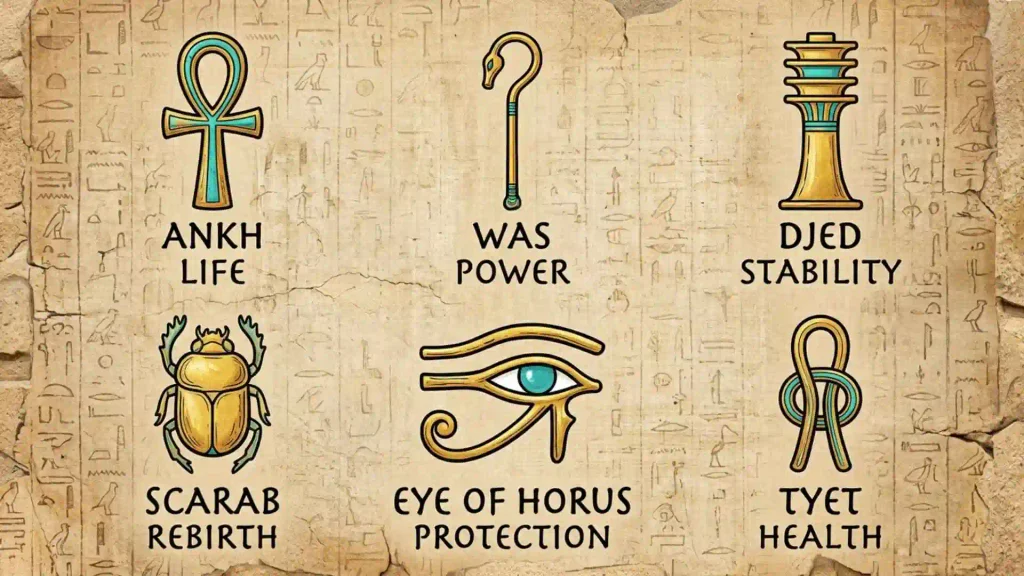
Ancient Egyptian rulers used the falcon to represent divine kingship, protection, and the sky god Horus. This offers an interesting comparison with the American bald eagle.
Both birds communicate height, vision, and authority. However, the Egyptian falcon was tied closely to divine monarchy, while the American eagle represents a constitutional republic.
Ancient Greece
Greek culture used Athena as a symbol of wisdom, strategy, and civic protection. Her connection to organized government and responsible warfare resembles some qualities later associated with American Liberty.
The olive branch also came from ancient Mediterranean traditions. In Greek culture, it represented peace, victory, and honor. Its appearance in the Great Seal links American imagery to older classical ideals.
Roman Culture
Roman symbols strongly influenced the visual language of the early United States. Eagles represented military power and imperial authority. Classical columns suggested order, law, stability, and civic virtue.
American government buildings often use Roman and Greek architectural styles because the founders admired ancient republican ideas. However, they also understood the dangers of corruption and concentrated power.
Eastern Traditions
In many Eastern traditions, light symbolizes wisdom, awakening, and truth. This creates a universal connection with the torch of the Statue of Liberty.
Stars, mountains, birds, and rising light also appear across Asian spiritual and artistic traditions as signs of guidance, transcendence, and renewal. These shared patterns help explain why American symbols can be understood beyond national borders.
Indigenous Traditions
Eagles hold deep spiritual importance in many Indigenous nations, although beliefs differ among tribes. Eagle feathers may represent honor, prayer, courage, leadership, or a connection between the human and spiritual worlds.
It is important not to treat Indigenous eagle symbolism as identical to federal American symbolism. Indigenous traditions are much older, spiritually specific, and connected to individual nations with their own histories.
Modern Global Interpretations
Outside the United States, American symbols may represent democracy, opportunity, popular culture, military power, economic influence, or political controversy.
The Statue of Liberty often has the most positive global meaning because it is associated with human freedom and migration. Uncle Sam may be used more critically to represent American foreign policy or economic power.
Similar Symbols and Their Meanings
| United States Symbol | Related Symbol | Similarity | Main Difference |
| Bald eagle | Roman eagle | Both represent power and authority | The Roman eagle served an empire, while the bald eagle represents a republic |
| Statue of Liberty | Athena | Both are female figures connected to civic ideals | Liberty emphasizes freedom, while Athena emphasizes wisdom and strategy |
| American flag | Other national flags | Both create identity and unity | The stars represent states within a federal union |
| Liberty Bell | Church or civic bells | Both call communities together | The Liberty Bell is linked specifically to political freedom |
| Uncle Sam | Britannia or Marianne | All personify nations | Uncle Sam often represents government, duty, and public authority |
| Olive branch | Dove | Both symbolize peace | The olive branch is botanical, while the dove is an animal symbol |
A common misconception is that every popular American image is an official federal symbol. Mount Rushmore, the White House, the cowboy, and the bison are powerful cultural images, but they do not all hold the same legal or official status.
United States Symbols in Mythology and Folklore
Because the United States is relatively young, its mythology often blends history with legend.
The story of George Washington and the cherry tree is one example. Although historians do not accept it as a reliable event, the tale helped create Washington’s image as an honest national father.
The bald eagle also carries mythic qualities. Like sacred sky birds in older civilizations, it appears as a guardian watching over the nation.
Lady Liberty resembles classical goddesses and personifications. She is not a religious deity, yet her crown, robes, torch, and monumental size give her an almost mythological presence.
American folklore also includes figures such as Paul Bunyan, Johnny Appleseed, John Henry, and Pecos Bill. These characters symbolize strength, labor, expansion, invention, and the struggle between people, nature, and technology.
United States Symbols in Art, Literature, Movies, and Pop Culture
American symbols often change meaning when artists place them in new settings.
In paintings and political cartoons, the flag may represent pride, protest, grief, or division. Artists sometimes alter its colors or arrangement to comment on war, inequality, civil rights, or national identity.
In literature and poetry, symbols such as the open road, the frontier, the eagle, and the Statue of Liberty can represent freedom and possibility. They may also reveal the gap between national ideals and lived reality.
Movies frequently use the White House, Capitol, flag, or bald eagle to establish an American setting quickly. Superhero films often connect national colors with courage, protection, and moral conflict.
In fashion and tattoos, stars and stripes may express patriotism, military service, family history, rebellion, or cultural style. The meaning depends on the wearer and the setting.
Spiritual and Dream Meaning of United States Symbols
Dreaming about the American flag may reflect identity, belonging, duty, pride, or conflict with authority. A bright, raised flag may suggest confidence or unity. A damaged or falling flag may point to disappointment, fear, or concern about social stability.
Dreaming of an eagle may represent freedom, ambition, spiritual vision, or the need to see a situation from a higher perspective.
A dream about the Statue of Liberty may suggest personal independence, escape from control, or the desire to begin a new life. Her torch may symbolize guidance during uncertainty.
These dream meanings are not fixed predictions. Dreams are personal, and their meaning depends on emotions, memories, and current life circumstances.
Positive and Negative Meanings of United States Symbols
| Positive Meaning | Negative or Cautionary Meaning |
| Freedom | Freedom not equally experienced |
| Unity | Pressure to conform |
| Courage | Aggression or militarism |
| Patriotism | Extreme nationalism |
| Hope | Broken promises |
| Strength | Misuse of power |
| Opportunity | Inequality or exclusion |
| Tradition | Resistance to needed change |
A national symbol can contain both light and shadow. This does not make the symbol meaningless. Instead, it shows that symbols are living ideas. They can inspire people while also reminding them to examine whether national ideals are being honored.
Why Humans Are Attracted to United States Symbols
Humans naturally search for patterns that make large ideas easier to understand. Freedom, democracy, sacrifice, and national identity are complex concepts. A flag, eagle, bell, or torch turns those ideas into something visible.
Symbols also create emotional shortcuts. A person may look at a folded flag and immediately think of military service, loss, or family sacrifice. Another may see the Statue of Liberty and remember immigration, courage, or a parent’s journey.
Collective memory makes these images stronger. The more often a symbol appears in ceremonies, schools, news reports, monuments, and family stories, the more emotional meaning it gains.
People are also attracted to symbols because they allow personal interpretation. The same eagle can represent national pride, spiritual freedom, environmental protection, or individual ambition.
Modern Uses of United States Symbols
Today, United States symbols appear in both formal and creative settings.
Government agencies use eagles, stars, shields, and seals to communicate authority and legitimacy. Schools display flags during civic ceremonies. Military organizations use national imagery to express service and protection.
In branding, American symbols may suggest heritage, strength, reliability, freedom, or domestic production. Businesses must use them carefully because official seals and government insignia may be legally protected.
People also wear national symbols on clothing, jewelry, and tattoos. Home decor often includes flags, maps, eagles, and patriotic colors, especially around national holidays.
On social media, these symbols can express celebration, remembrance, political opinion, military support, or protest. Their meaning often changes according to the accompanying words and event.
Interesting Facts About United States Symbols
- The current fifty-star American flag has been in use since July 4, 1960, after Hawaii became a state.
- The Great Seal was approved in 1782 after several committees worked on possible designs.
- The eagle on the Great Seal holds thirteen arrows, matching the number of original states.
- The Statue of Liberty’s full name is “Liberty Enlightening the World.”
- The Liberty Bell was not commonly called the Liberty Bell until abolitionists popularized the name in the nineteenth century.
- “The Star-Spangled Banner” began as a poem titled “Defence of Fort M’Henry.”
- The rose became the official national floral emblem of the United States in 1986.
- The bison was designated the national mammal in 2016.
- The oak became the national tree after a public vote organized by the National Arbor Day Foundation, followed by official federal recognition in 2004.
- The phrase “In God We Trust” became the official national motto in 1956.
Frequently Asked Questions
What are the main symbols of the United States?
The main United States symbols include the American flag, bald eagle, Great Seal, Statue of Liberty, Liberty Bell, national anthem, Uncle Sam, rose, oak tree, and American bison.
What is the most important symbol of the United States?
The American flag is generally considered the most recognized national symbol because it represents the states, original colonies, federal union, national history, and shared identity.
Why is the bald eagle a symbol of America?
The bald eagle was chosen because it is native to North America and represents strength, independence, courage, freedom, and the ability to rise above challenges.
What does the Statue of Liberty symbolize?
The Statue of Liberty symbolizes freedom, enlightenment, hope, immigration, democracy, and liberation from oppression. Its torch represents the guiding light of liberty.
Are all American symbols officially recognized?
No. Some symbols are established by federal law or official government use, while others became culturally important through history, art, education, folklore, and public tradition.
What do the stars and stripes represent?
The fifty stars represent the fifty states. The thirteen stripes represent the original thirteen colonies that declared independence from Great Britain.
Conclusion
United States symbols are more than decorations placed on buildings, flags, and coins.
They preserve stories of freedom, conflict, sacrifice, unity, and unfinished national promises.
Their meanings continue to change as each generation interprets America through its own experiences.
At their best, these symbols remind people not only of what the nation has been, but also of what it still hopes to become.
 Sarah Thompson
 Michael Rivera