
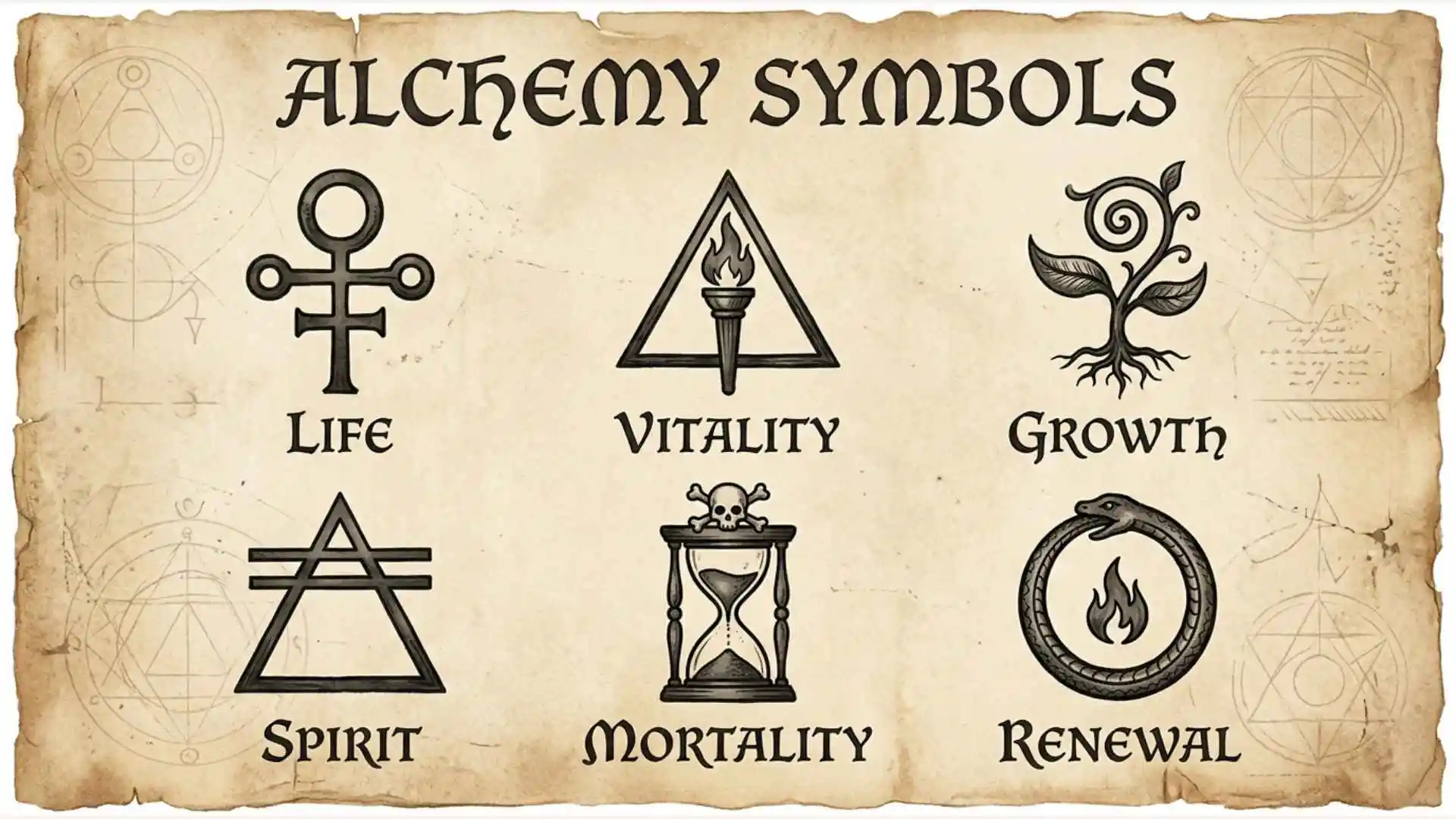
Alchemy symbols are fascinating signs that ancient alchemists used to represent elements, planets, substances, processes, and ideas about transformation. Long before modern chemistry developed, alchemists created a visual language to record their experiments and describe complex concepts. Symbols for gold, silver, mercury, sulfur, fire, water, and other substances often carried meanings that went beyond their physical properties.
The meaning of alchemy symbols can be both scientific and symbolic. Alchemists were interested in changing one substance into another, but many traditions also connected physical transformation with personal growth, purification, wisdom, and spiritual development. This is why the same symbol may have a practical meaning in an old alchemical text and a deeper philosophical meaning in art, literature, or modern spiritual traditions.
In this guide, we will explore the most important alchemy symbols, their meanings, origins, and historical uses. You will learn how ancient symbols represented the four classical elements, planets, metals, and major alchemical processes, as well as why these mysterious signs continue to appear in books, artwork, tattoos, jewelry, and popular culture today.
Quick Answer
Alchemy symbols are ancient signs used by alchemists to represent elements, planets, substances, processes, and spiritual ideas. They were part of a symbolic language that combined chemistry, philosophy, astrology, and mysticism. These symbols represented transformation, especially the journey from ordinary matter toward perfection and enlightenment.
Quick Facts About Alchemy Symbols
| Aspect | Information |
| Origin | Ancient Greek, Egyptian, Islamic, and European philosophical traditions |
| Historical Significance | Used by alchemists to record experiments and represent hidden knowledge |
| Main Meaning | Transformation, purification, balance, and creation |
| Spiritual Meaning | Inner growth, enlightenment, and personal transformation |
| Cultural Importance | Connected science, philosophy, religion, and mystical traditions |
| Modern Usage | Found in tattoos, books, movies, games, jewelry, and spiritual artwork |
What Are Alchemy Symbols?
Alchemy symbols are a collection of ancient signs that represented materials, natural forces, cosmic influences, and philosophical ideas. Alchemists used them as a secret visual language to describe their studies of matter and transformation.
Alchemy was an early tradition that existed before modern chemistry. Practitioners believed that substances could be changed from one form into another. A famous goal was turning base metals such as lead into gold, but many alchemists also searched for something deeper: personal perfection and spiritual awakening.
The roots of alchemy can be traced to several civilizations, including Ancient Egypt, Greece, China, India, and the Islamic world. During the medieval and Renaissance periods in Europe, alchemy became closely connected with astrology, medicine, philosophy, and religious thought.
Important historical figures such as Paracelsus explored ideas that combined natural science with spiritual understanding. Later, alchemical writings influenced the development of chemistry and inspired philosophers and psychologists.
Alchemy symbols helped practitioners communicate complex ideas without openly revealing their methods. Many texts used symbolic drawings instead of simple descriptions because alchemy was considered both a scientific and mystical practice.
Deep Symbolic Meaning of Alchemy Symbols
Spiritual Level
On a spiritual level, alchemy symbols represent transformation of the self. The famous idea of turning lead into gold was often interpreted as a metaphor for improving the human spirit.
Lead symbolized the imperfect or unrefined self, while gold represented wisdom, purity, and spiritual achievement. The process was not only about changing metals but also about changing consciousness.
Many spiritual traditions view transformation as a journey. Alchemy symbols reflect themes such as:
- Personal growth
- Renewal
- Inner healing
- Awakening of awareness
- Balance between physical and spiritual worlds
The symbol of the philosopher’s stone is one of the strongest examples of this idea. It represented the ultimate achievement of wisdom, perfection, and harmony.
Psychological Level
Alchemy symbols have strong connections with human psychology. Swiss psychologist Carl Jung studied alchemical imagery and believed these symbols reflected the unconscious mind.
According to Jungian psychology, alchemical processes represented inner psychological changes. Symbols such as transformation, death, rebirth, and purification reflected the human journey toward self-understanding.
For example:
- Darkness represented hidden emotions or unconscious thoughts.
- Fire represented change and purification.
- Gold represented a complete and balanced personality.
Humans are naturally attracted to alchemy symbols because they reflect universal experiences. Everyone faces challenges, changes, and moments of personal growth.
Cultural Level
Across cultures, alchemy symbols became powerful representations of human curiosity. They showed humanity’s desire to understand nature and discover hidden patterns in the universe.
Different societies interpreted these symbols through their own beliefs. Some saw them as scientific tools, while others viewed them as spiritual guides.
Their cultural importance continues because they connect ancient wisdom with modern ideas about creativity, discovery, and self-improvement.
Types and Variations of Alchemy Symbols
Alchemy includes many symbols, each carrying different meanings. These symbols appeared in manuscripts, laboratory notes, paintings, and philosophical writings.
The Philosopher’s Stone Symbol
Visual Description: Often shown as a circle, square, triangle, or combination of geometric shapes.
Meaning: Represents the legendary substance believed to transform ordinary metals into gold and create the elixir of life.
Symbolism: The philosopher’s stone represents perfection, immortality, wisdom, and spiritual completion.
Cultural Connection: It appears in European alchemy, Renaissance philosophy, and modern fantasy stories.
Where It Appears:
- Alchemical manuscripts
- Literature
- Movies
- Fantasy artwork
The Four Classical Elements
Alchemy used symbols for the four classical elements:
Earth Symbol
Visual Description: A downward-pointing triangle crossed by a horizontal line.
Meaning: Stability, physical matter, and grounding.
Symbolism: Earth represented strength, structure, and the material world.
Water Symbol
Visual Description: A downward-pointing triangle.
Meaning: Emotion, intuition, and flexibility.
Symbolism: Water represented purification and emotional transformation.
Air Symbol
Visual Description: An upward-pointing triangle crossed by a horizontal line.
Meaning: Thought, communication, and intellect.
Symbolism: Air represented ideas and higher understanding.
Fire Symbol
Visual Description: An upward-pointing triangle.
Meaning: Energy, passion, and transformation.
Symbolism: Fire represented destruction of the old and creation of the new.
Planetary Symbols
Alchemy connected metals with planets and celestial forces.
Examples include:
- Gold connected with the Sun
- Silver connected with the Moon
- Iron connected with Mars
- Copper connected with Venus
- Tin connected with Jupiter
- Lead connected with Saturn
- Mercury connected with Mercury
These connections reflected the belief that earthly materials were influenced by cosmic energies.
Mercury Symbol
Visual Description: A symbol combining a circle, cross, and crescent.
Meaning: Represents the planet Mercury, the metal mercury, and the idea of transformation.
Symbolism: Mercury was associated with change, movement, communication, and the connection between opposites.
Cultural Connection: It was one of the most important symbols in European and Islamic alchemical traditions.
Alchemy Symbols Across Different Cultures
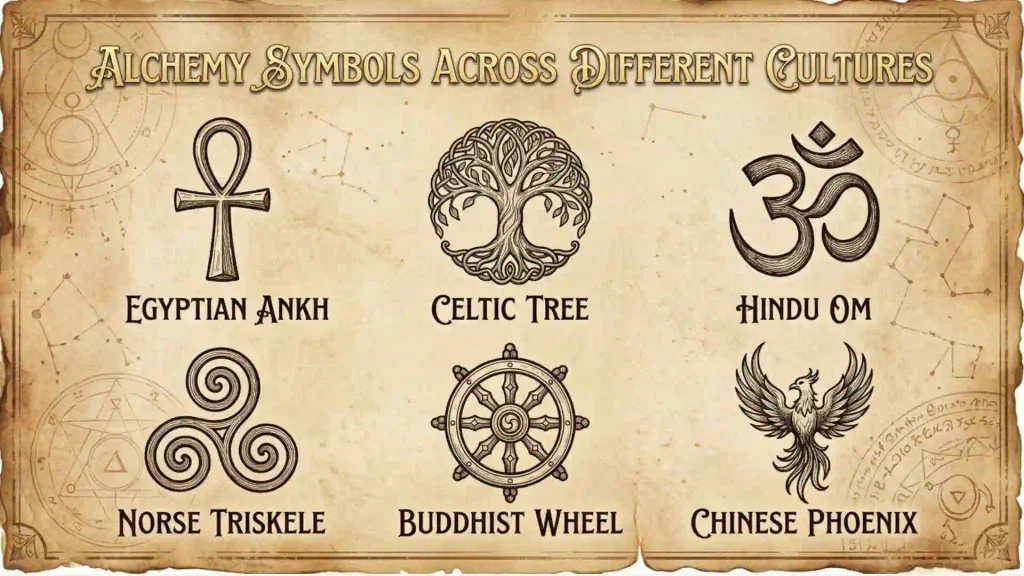
Ancient Egypt
Ancient Egyptian traditions strongly influenced later alchemy. Egyptian beliefs about death, rebirth, and spiritual transformation shaped many alchemical ideas.
The Egyptian god Thoth was later associated with Hermes, creating the figure known as Hermes Trismegistus, a legendary source of alchemical wisdom.
Egyptian symbolism focused on:
- Hidden knowledge
- Transformation after death
- Sacred balance
- Connection between humans and the universe
Ancient Greece
Greek philosophers contributed important ideas about matter and transformation.
Thinkers such as Aristotle believed that all substances were made from combinations of basic qualities. These ideas influenced later alchemical theories about changing materials.
Greek alchemy focused on:
- Elements
- Nature’s hidden laws
- The relationship between matter and spirit
Roman Culture
Roman scholars preserved and spread Greek philosophical ideas. Although Rome was less focused on mystical alchemy, Roman writings helped transmit classical knowledge.
Alchemy symbols continued to develop through connections between medicine, metallurgy, and philosophy.
Eastern Traditions
Chinese alchemy focused heavily on immortality, balance, and harmony with nature. Taoist alchemists searched for substances and practices that could improve life and spiritual energy.
Indian traditions also explored transformation through concepts involving metals, medicine, and spiritual development.
Indigenous Traditions
Many Indigenous cultures around the world used symbolic systems connected to nature, healing, and transformation.
Although not identical to European alchemy, these traditions shared similar themes:
- Respect for natural forces
- Spiritual balance
- Transformation through knowledge
Modern Interpretations
Today, alchemy symbols appear in psychology, art, fashion, and entertainment. Many people use them as reminders of personal change and creativity.
Similar Symbols and Their Meanings
| Symbol | Similarity | Difference |
| Yin Yang | Represents balance and opposites | Focuses on harmony between forces rather than material transformation |
| Mandala | Represents spiritual wholeness | Focuses more on meditation and cosmic order |
| Ouroboros | Represents cycles and renewal | Focuses on endless cycles rather than chemical transformation |
| Sacred Geometry | Uses patterns and universal concepts | Focuses more on mathematical and cosmic design |
Alchemy symbols are often misunderstood as simple magical signs. In reality, they represent a complex mixture of philosophy, science, and spirituality.
Alchemy Symbols in Mythology and Folklore
Alchemy has inspired countless myths about hidden knowledge and magical transformation.
One famous legend involves the philosopher’s stone, a mysterious substance believed to grant unlimited wisdom and possibly eternal life.
Stories about alchemists often portray them as seekers searching for secrets beyond ordinary human understanding. These legends created the image of the wise scholar working in a secret laboratory filled with ancient books and mysterious symbols.
The idea of transformation appears in many myths worldwide. Heroes often begin as ordinary individuals and become something greater through challenges, knowledge, and change.
Alchemy Symbols in Art, Literature, Movies and Pop Culture
Alchemy symbols continue to influence modern creativity.
Literature
Authors use alchemical themes to explore transformation, identity, and hidden knowledge. Stories about magical objects and personal growth often borrow ideas from alchemy.
Movies and Television
Alchemy appears frequently in fantasy and science fiction. A well-known example is Harry Potter and the Philosopher’s Stone, which introduced many audiences to the idea of the philosopher’s stone.
Tattoos and Fashion
People choose alchemy symbols as tattoos because they represent:
- Personal transformation
- New beginnings
- Self-discovery
- Inner strength
Modern Design
Graphic designers use alchemical imagery because the symbols feel mysterious, historical, and visually meaningful.
Spiritual and Dream Meaning of Alchemy Symbols
Dreams involving alchemy symbols are often interpreted as signs of change and personal development.
Common meanings include:
- Seeing gold may represent success or self-worth.
- Seeing fire may symbolize transformation.
- Seeing ancient symbols may suggest hidden knowledge or self-discovery.
- Seeing chemical processes may represent emotional change.
In meditation and spiritual practices, alchemy symbols may help people reflect on growth, balance, and inner transformation.
However, dream meanings are personal. A symbol’s meaning depends on individual experiences and emotions.
Positive and Negative Meanings of Alchemy Symbols
| Positive Meaning | Negative Meaning |
| Transformation | Obsession with perfection |
| Wisdom | Searching for impossible answers |
| Growth | Desire for control |
| Healing | Hidden fears |
| Creativity | Misunderstanding ancient knowledge |
A symbol can represent both light and shadow. Alchemy reminds people that transformation requires accepting both strengths and weaknesses.
Why Humans Are Attracted to Alchemy Symbols
Humans have always searched for meaning. Symbols provide a way to express ideas that words cannot fully explain.
Alchemy symbols attract people because they represent:
- Mystery and discovery
- The hope of improvement
- Connection with ancient wisdom
- The journey of becoming better
Psychologically, humans recognize patterns and attach emotions to images. A simple symbol can carry centuries of stories, beliefs, and personal interpretations.
Modern Uses of Alchemy Symbols
Today, alchemy symbols appear in many areas:
Tattoos
People use them to represent personal journeys, overcoming struggles, and transformation.
Jewelry
Alchemy-inspired jewelry often symbolizes protection, wisdom, and spiritual growth.
Branding
Some brands use alchemical designs to create feelings of mystery, creativity, and uniqueness.
Social Media
Alchemy symbols are popular in digital art, usernames, and aesthetic communities.
Home Decor
Ancient symbols are used in artwork because they create a connection with history and imagination.
Interesting Facts About Alchemy Symbols
- Alchemy influenced the development of modern chemistry.
- Many alchemical symbols combined astrology with early scientific ideas.
- Mercury was considered one of the most important substances in alchemy.
- The philosopher’s stone became one of history’s most famous legendary objects.
- Carl Jung used alchemical images to explain psychological transformation.
- Alchemical manuscripts often used pictures because written explanations could be misunderstood.
- The word “alchemy” comes from Arabic traditions connected with earlier Egyptian and Greek knowledge.
- Many fantasy stories today still use alchemical concepts.
Frequently Asked Questions
What do alchemy symbols represent?
Alchemy symbols represent transformation, balance, purification, wisdom, and the connection between physical matter and spiritual growth.
Are alchemy symbols real magic?
Alchemy symbols were not proven magical tools. They were symbolic representations used in philosophical, spiritual, and early scientific traditions.
What is the most famous alchemy symbol?
The philosopher’s stone is one of the most famous alchemical symbols because it represents ultimate transformation and perfection.
Why are alchemy symbols popular today?
They remain popular because they represent personal growth, mystery, creativity, and the desire for self-improvement.
Did alchemy create modern chemistry?
Alchemy contributed important ideas, tools, and experiments that helped influence the development of modern chemistry.
Conclusion
Alchemy symbols are more than ancient drawings. They represent humanity’s timeless search for transformation, knowledge, and meaning. From ancient civilizations to modern art, these symbols continue to inspire curiosity and imagination.
They remind us that transformation is not only about changing the world around us but also about changing ourselves. The true power of alchemy symbols lies in their ability to connect history, psychology, spirituality, and human dreams.
 John Mercer
 Michael Rivera