
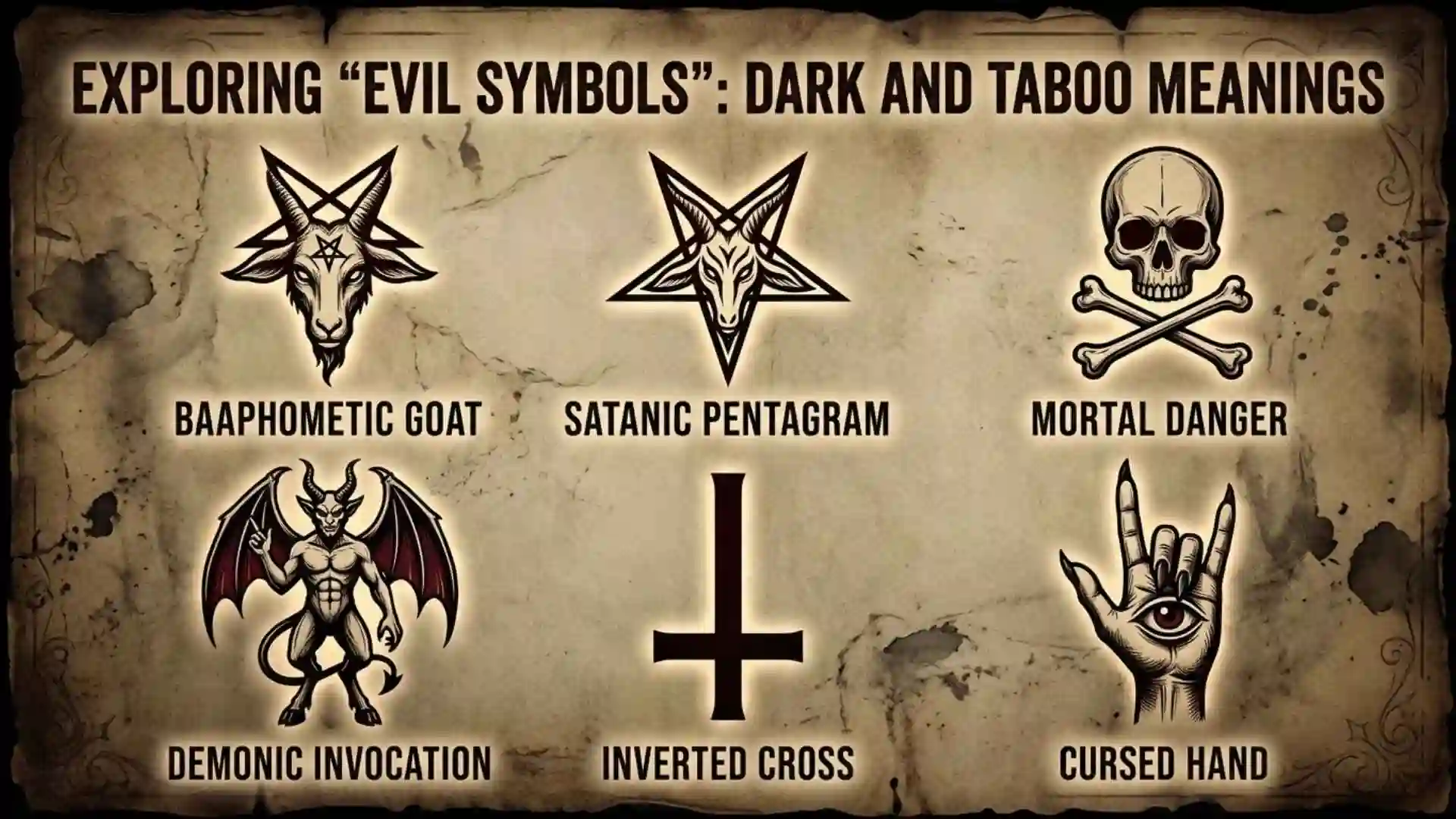
Evil symbols have fascinated and frightened people throughout history. From ancient religious emblems and mythological creatures to mysterious signs associated with darkness, death, and supernatural forces, these images carry powerful meanings across different cultures. Symbols such as the inverted pentagram, the evil eye, skulls, serpents, demons, and the number 666 often appear in stories about danger, temptation, destruction, and spiritual conflict. Some have ancient religious roots, while others gained darker associations through folklore, literature, popular culture, and modern media.
The meaning of an evil symbol isn’t always as simple as it looks. An image considered frightening or negative in one culture may represent protection, wisdom, transformation, or spiritual power in another. For example, serpents can symbolize deception and danger, but they also represent healing and renewal in certain traditions. Similarly, skulls may represent death and mortality while reminding people of life’s temporary nature. Understanding these differences requires exploring each symbol’s historical origins, religious associations, cultural interpretations, and psychological impact.
In this complete guide to evil symbols, you’ll discover their hidden meanings, ancient origins, spiritual connections, and significance in different cultures. We’ll explore dark symbols associated with demons, witchcraft, occult traditions, death, supernatural beliefs, and negative energy. You’ll also learn why certain images create feelings of fear, how their meanings have changed over time, and why some supposedly evil symbols have completely different interpretations. Whether you’re interested in mythology, history, religion, psychology, or dark symbolism, this guide will help you understand the stories behind these mysterious images.
Quick Answer
Evil symbols are images, signs, or objects associated with harmful forces, danger, corruption, death, forbidden knowledge, or spiritual darkness. However, symbols are not naturally evil. Their meaning depends on culture, historical context, religious interpretation, personal intention, and how they are used in art, ritual, politics, or popular culture.
Quick Facts About Evil Symbols
| Aspect | Information |
| Origin | Ancient religion, mythology, folklore, warfare, magic, and social traditions |
| Historical Significance | Used to represent danger, chaos, enemies, death, forbidden powers, or protection from harm |
| Main Meaning | Evil, fear, destruction, rebellion, corruption, or moral warning |
| Spiritual Meaning | Temptation, spiritual conflict, shadow work, protection, transformation, or separation from divine order |
| Cultural Importance | Reflects how societies define good, evil, purity, danger, and social boundaries |
| Modern Usage | Movies, tattoos, fashion, horror art, music, games, online communities, and personal expression |
What Are Evil Symbols?
Evil symbols are visual signs that people connect with dark powers, harmful intentions, supernatural threats, death, or moral corruption. They may appear as animals, geometric shapes, religious images, colors, numbers, masks, weapons, or mythical creatures.
The idea of an evil symbol is not universal. Symbols gain meaning through stories, beliefs, historical events, and repeated use. For example, a snake may symbolize temptation in some Christian traditions, while in other cultures it represents medicine, rebirth, fertility, wisdom, or divine power.
Ancient societies often created frightening images to explain illness, natural disasters, war, and death. These symbols gave visible form to dangers that could not easily be understood. A monster might represent chaos. A demon might explain destructive behavior. A dark animal might warn people about the wilderness or the night.
Some images described today as satanic, demonic, or cursed originally had protective or sacred meanings. Political propaganda, religious conflict, colonial interpretation, horror entertainment, and internet rumors have changed how many symbols are understood.
Therefore, identifying evil symbols requires careful attention to origin, intention, and cultural setting.
Deep Symbolic Meaning of Evil Symbols
Spiritual Meaning
On a spiritual level, evil symbols often represent conflict between order and chaos, truth and deception, compassion and cruelty, or consciousness and uncontrolled desire.
In religious traditions, dark imagery may serve as a warning against temptation, pride, violence, greed, or spiritual separation. It can remind believers that harmful choices often begin with smaller emotional struggles.
Some spiritual systems use frightening images for protection rather than worship. Fierce guardian figures may look terrifying because they are believed to scare away destructive forces. Tibetan Buddhist art, for example, includes wrathful deities whose alarming appearance can represent the destruction of ignorance and inner obstacles.
Dark symbols may also represent transformation. Entering darkness can symbolize facing pain, uncertainty, or hidden parts of the self before reaching greater wisdom.
Psychological Meaning
Psychologically, evil symbols give shape to emotions people may struggle to express. Fear, rage, shame, jealousy, grief, and destructive desire can become monsters, shadows, demons, or dangerous animals in stories and dreams.
Swiss psychiatrist Carl Jung used the idea of the shadow to describe rejected or unconscious parts of the personality. The shadow is not always evil. However, when people deny anger, fear, selfishness, or harmful impulses, those qualities may appear in dreams and stories as threatening figures.
This helps explain why dark symbols attract attention. They allow people to examine danger from a safe distance. Horror stories, masks, and fictional villains can become emotional tools for exploring fear without facing real physical harm.
Cultural Meaning
At the cultural level, evil symbols help communities communicate social rules. They may identify forbidden behavior, enemies, dangerous places, criminals, supernatural threats, or moral failures.
However, these labels can be misused. Throughout history, societies have described the symbols of rival religions or minority groups as evil. This can create fear, prejudice, and persecution.
A responsible interpretation asks who called the symbol evil, why they did so, and whether the original culture understood it differently.
Types and Variations of Evil Symbols
The Inverted Pentagram
An inverted pentagram is a five-pointed star with two points facing upward.
It is commonly associated with Satanism, rebellion, or the reversal of traditional spiritual order. In modern occult imagery, it may include a goat’s head, especially in representations connected with the Sigil of Baphomet.
However, the upright pentagram has a much broader history. It has represented health, protection, the five elements, the human form, and spiritual harmony. Orientation and context strongly affect its meaning.
The Number 666
The number 666 appears in the Book of Revelation as the number of the beast.
Many Christian interpretations connect it with evil, opposition to God, persecution, or a corrupt political power. Scholars have also examined the number through gematria, a system in which letters have numerical values. Some historical interpretations connect it to the Roman emperor Nero.
Today, 666 frequently appears in horror films, heavy metal imagery, tattoos, jokes, and rebellious fashion.
The Evil Eye
The evil eye is the belief that an envious or hostile gaze can cause harm, illness, or misfortune.
The eye itself is not necessarily an evil symbol. In Mediterranean, Middle Eastern, South Asian, and North African traditions, eye-shaped charms are often worn to protect against the evil eye.
This is an important distinction. The harmful gaze is feared, while the amulet is usually protective.
The Serpent
The serpent can represent temptation, deceit, poison, death, or hidden danger. This interpretation is especially familiar through the story of the serpent in the Garden of Eden.
Yet serpent symbolism is highly diverse. Ancient Egyptians associated cobras with royal protection. Greek traditions connected snakes with healing. Hindu and Buddhist traditions include powerful naga beings associated with water, protection, fertility, and spiritual energy.
The serpent is one of the clearest examples of a symbol carrying both feared and sacred meanings.
The Goat or Goat-Headed Figure
Goats have sometimes been associated with lust, wildness, stubbornness, witchcraft, or the devil in European religious art and folklore.
The image of Baphomet, especially the famous nineteenth-century drawing by French occultist Éliphas Lévi, is often misunderstood as a simple symbol of evil. Lévi’s image combined human, animal, masculine, feminine, celestial, and earthly qualities to express balance and occult philosophy.
Modern Satanic groups have interpreted goat imagery in different ways, often emphasizing individualism, skepticism, or rebellion rather than belief in a literal devil.
Skulls and Skeletons
Skulls symbolize death, danger, mortality, poison, war, and the temporary nature of life.
They appear on warning labels, pirate flags, military insignia, religious art, tombs, and jewelry. In Christian art, skulls may encourage reflection on mortality. In Mexico’s Day of the Dead traditions, decorated skulls can honor deceased loved ones and celebrate continuing family bonds.
A skull can therefore represent fear, remembrance, equality, courage, or acceptance of death.
The Raven and Crow
Dark birds are often linked with death, battlefields, omens, witchcraft, or misfortune because they feed on carrion and have black feathers.
In Norse mythology, Odin’s ravens Huginn and Muninn represent thought and memory. In many Indigenous traditions, Raven may appear as a creator, transformer, messenger, or trickster.
Calling these birds evil ignores their intelligence and wide symbolic importance.
Demonic Masks
Demonic or monstrous masks appear in theater, ritual, festivals, folk traditions, and religious ceremonies.
Some represent dangerous spirits, but others are worn to drive evil away, teach moral lessons, honor ancestors, or transform the wearer into a sacred character. Japanese oni masks, for example, may represent destructive forces, yet they are also used in protective customs and stories about punishment and moral change.
Evil Symbols Across Different Cultures
Ancient Egypt
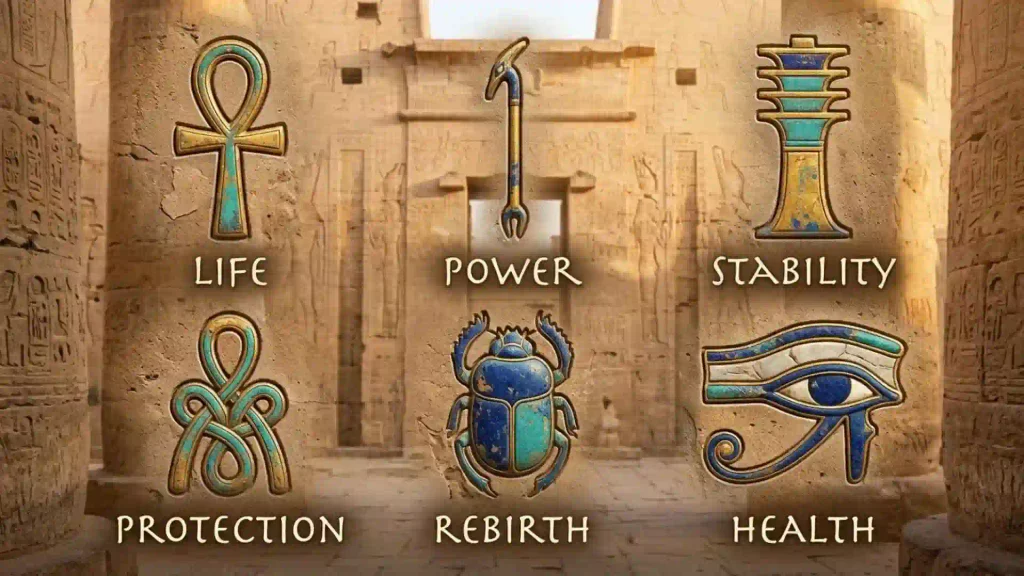
Ancient Egyptian religion included forces of disorder, but its symbolism was rarely divided into simple modern categories of good and evil.
Apep, a giant serpent, represented chaos and threatened the sun god Ra’s nightly journey. In contrast, the cobra could symbolize divine protection and royal authority. The god Set was connected with deserts, storms, violence, and disorder, yet he also defended Ra against Apep in some traditions.
Ancient Greece
Greek mythology used monsters to represent chaos, punishment, dangerous desires, and the boundaries between civilization and wilderness.
Medusa became a feared figure whose gaze turned people to stone. Yet images of her head, called the Gorgoneion, were used protectively on shields, buildings, and objects. A terrifying face could guard against danger.
Roman Culture
Romans adopted and transformed many Greek symbols. They used protective charms, frightening faces, phallic symbols, and images of gods to resist bad luck or hostile magic.
Roman curse tablets asked supernatural powers to punish enemies, thieves, rivals, or unfaithful lovers. These objects show that symbols of harm were connected not only with religion but also with ordinary conflict and personal emotion.
Eastern Traditions
In Hinduism and Buddhism, fierce-looking beings are not automatically evil. Some terrifying deities symbolize protection, time, transformation, or the destruction of ignorance.
Kali’s dark appearance, weapons, and necklace of heads can appear frightening to outsiders. Within Hindu traditions, however, she may represent divine power, liberation, maternal protection, and the destruction of ego.
In Japanese folklore, oni are powerful ogre-like beings associated with punishment and disaster. Their image is also used in festivals and protective practices.
Indigenous Traditions
Indigenous cultures are highly diverse, so their spiritual symbols should never be grouped under a single meaning.
Colonial writers often labeled unfamiliar spirits, masks, rituals, and sacred beings as demonic. These descriptions frequently reflected outsider prejudice rather than the beliefs of the communities themselves.
Animals such as owls, coyotes, ravens, wolves, and snakes may carry complex meanings involving ancestry, wisdom, danger, transformation, or ecological knowledge.
Modern Interpretations
Today, evil symbols are shaped heavily by horror movies, video games, conspiracy theories, political movements, and online culture.
A symbol may be used seriously, ironically, artistically, or simply for shock value. Context is essential, especially when identifying extremist, hateful, occult, or religious imagery.
Similar Symbols and Their Meanings
| Symbol | Common Interpretation | Alternative Meaning | Common Misconception |
| Inverted pentagram | Satanism or spiritual reversal | Rebellion, identity, occult philosophy | Every pentagram is satanic |
| Evil eye | Harmful envy or curse | Protection against jealousy | Eye charms create evil |
| Serpent | Temptation and deceit | Healing, rebirth, wisdom, fertility | Snakes always represent evil |
| Skull | Death and danger | Remembrance, courage, equality | Skull art promotes violence |
| Raven | Death or bad omens | Memory, intelligence, creation | Black birds are supernatural threats |
| Goat figure | Devil or witchcraft | Fertility, nature, independence, balance | All goat imagery represents Satan |
| Black color | Mourning, secrecy, evil | Power, elegance, protection, mystery | Black has one universal meaning |
Evil Symbols in Mythology and Folklore
Myths often present evil as a monster that disturbs the natural or moral order. Dragons guard forbidden treasure. Demons tempt heroes. Witches place curses. Serpents hide dangerous knowledge. Ghosts return because a wrong has not been corrected.
These stories helped ancient communities explain suffering and teach values. A monster could warn against greed. A haunted place could preserve the memory of violence. A trickster could reveal the dangers of pride or foolishness.
Yet mythological beings are rarely one-dimensional. Loki causes chaos but also helps the Norse gods in several stories. Greek underworld gods are linked with death but are not identical to the Christian devil. Folklore changes as stories pass between cultures, religions, and generations.
Modern ideas about evil symbols often combine details from traditions that were originally separate.
Evil Symbols in Art, Literature, Movies, and Pop Culture
Artists use dark symbols to create tension, explore moral conflict, and challenge social rules. Medieval paintings used devils and monsters to warn viewers about sin. Renaissance artists included skulls, fading flowers, and extinguished candles as reminders that life is temporary.
In literature, darkness may represent fear, guilt, secrecy, or the unknown. Shakespeare used ghosts, blood, storms, and unnatural events to reflect political and psychological disorder. Gothic writers filled ruined castles and shadowed landscapes with signs of buried trauma.
Movies and television often simplify symbols for quick emotional impact. Inverted crosses, ravens, pentagrams, candles, and strange markings immediately tell viewers that something dangerous may be present.
Tattoos and fashion use the same imagery in more personal ways. A skull tattoo might honor survival. A serpent may represent healing. A dark angel may express grief, rebellion, or the struggle between destructive and compassionate impulses.
Meaning depends on the wearer, creator, audience, and setting.
Spiritual and Dream Meaning of Evil Symbols
Dreams involving evil symbols do not prove that a supernatural attack is occurring. Dreams usually combine memory, emotion, stress, beliefs, and imagination.
A demon may represent guilt, addiction, fear, or a controlling person. A snake may symbolize danger, healing, sexuality, change, or hidden knowledge. A skull may reflect grief, mortality, or the end of an important life stage.
During meditation or spiritual practice, frightening images can arise from anxiety, past experiences, religious expectations, or unconscious material. It is wise to approach them calmly rather than assuming a fixed meaning.
Common messages may include:
- Face a fear you have avoided.
- Examine a harmful habit or relationship.
- Protect your emotional boundaries.
- Accept an ending or personal transformation.
- Question beliefs based only on fear.
- Seek professional support if disturbing experiences affect daily life.
Positive and Negative Meanings of Evil Symbols
| Positive Meaning | Negative Meaning |
| Protection from danger | Threat or intended harm |
| Courage in facing fear | Violence or cruelty |
| Personal transformation | Moral corruption |
| Awareness of mortality | Obsession with death |
| Rebellion against injustice | Destructive rebellion |
| Shadow work and self-knowledge | Uncontrolled harmful impulses |
| Cultural identity | Misrepresentation of a culture |
| Artistic freedom | Hate, intimidation, or extremist messaging |
One symbol can hold both light and shadow. A frightening mask may protect a village, entertain an audience, honor a tradition, or intimidate an enemy. Intention and context determine which meaning is most relevant.
Why Humans Are Attracted to Evil Symbols
Humans naturally notice possible threats. Dark faces, sharp teeth, staring eyes, blood-like colors, and unusual shapes can trigger attention because the brain is designed to detect danger quickly.
People are also drawn to mystery. Forbidden or frightening symbols create questions. What does this image mean? Who created it? Is it dangerous? Does it reveal hidden knowledge?
Dark symbolism can also offer a sense of control. Wearing a skull, serpent, or fierce creature may help someone express courage after trauma. Exploring fictional evil allows audiences to face fear in a controlled space.
Collective memory also plays a role. Repeated stories teach people to associate certain colors, animals, numbers, and shapes with danger. Over time, these associations can feel natural even when they are culturally learned.
Modern Uses of Evil Symbols
Evil symbols appear in many areas of modern life:
- Tattoos: Used to express survival, rebellion, grief, strength, spirituality, or fascination with darkness.
- Jewelry: Pentagrams, skulls, eyes, snakes, and gothic crosses may serve as fashion, protection, or identity.
- Fashion: Dark imagery is common in gothic, punk, metal, alternative, and horror-inspired styles.
- Branding: Entertainment companies use threatening symbols to create excitement, mystery, or danger.
- Social media: Symbols may appear in usernames, memes, digital art, emojis, or online communities.
- Contemporary spirituality: Some people use ancient symbols for meditation, protection, ritual, or self-exploration.
- Home decor: Skulls, ravens, candles, masks, and occult designs are popular in seasonal and gothic interiors.
- Personal expression: Dark symbols can communicate emotions that ordinary words fail to capture.
Before using an unfamiliar cultural or religious image, research its origin. This helps prevent disrespect, harmful stereotypes, or accidental association with hate movements.
Interesting Facts About Evil Symbols
- The upright pentagram was used by some early Christians to represent the five wounds of Christ.
- Medusa’s frightening face was often displayed as a protective image rather than a celebration of evil.
- The evil eye charm is intended to prevent harm, not cause it.
- Black cats were not viewed negatively in every culture. In some traditions, they represented luck and protection.
- Skulls appear in religious art as reminders to live wisely and remember mortality.
- The number 666 may have referred to a historical political figure through ancient numerical wordplay.
- Fierce Buddhist deities can symbolize compassion acting powerfully against ignorance.
- Snakes appear in medical symbolism because of their ancient association with healing.
- Many so-called demonic symbols were labeled evil only after religious or political conflict.
- Horror films often combine unrelated symbols because audiences recognize them quickly as signs of danger.
Frequently Asked Questions
What is the most recognized evil symbol?
The inverted pentagram is among the most recognized symbols associated with evil in modern Western culture, especially when combined with a goat’s head. Its interpretation still depends on context.
Are pentagrams always evil?
No. Upright pentagrams have represented protection, health, harmony, humanity, and the five elements. Only certain uses and orientations are associated with Satanism or dark occult imagery.
Is the evil eye actually an evil symbol?
The evil eye refers to a harmful gaze caused by envy or hostility. Eye-shaped amulets are usually protective symbols believed to defend the wearer from that harm.
Why are snakes considered evil?
Some religious stories connect snakes with temptation and deception. Other traditions view them as symbols of healing, wisdom, rebirth, fertility, protection, and spiritual energy.
Can a symbol become evil because of how it is used?
Yes. A neutral or ancient symbol can gain harmful associations when it is repeatedly used for intimidation, hatred, violence, propaganda, or extremist identity.
What should I do before wearing a dark or occult symbol?
Research its history, cultural origin, religious meaning, and modern associations. Understanding context can help you avoid misinformation, disrespect, or an unintended message.
Conclusion
Evil symbols reveal more about human fear and imagination than they do about simple ideas of darkness.
Many images called evil have also represented protection, healing, wisdom, transformation, or cultural identity.
Understanding their origins helps us avoid fear-based assumptions and harmful stereotypes.
The deeper lesson is that symbols have power because people, stories, and communities give meaning to them.
 John Mercer