
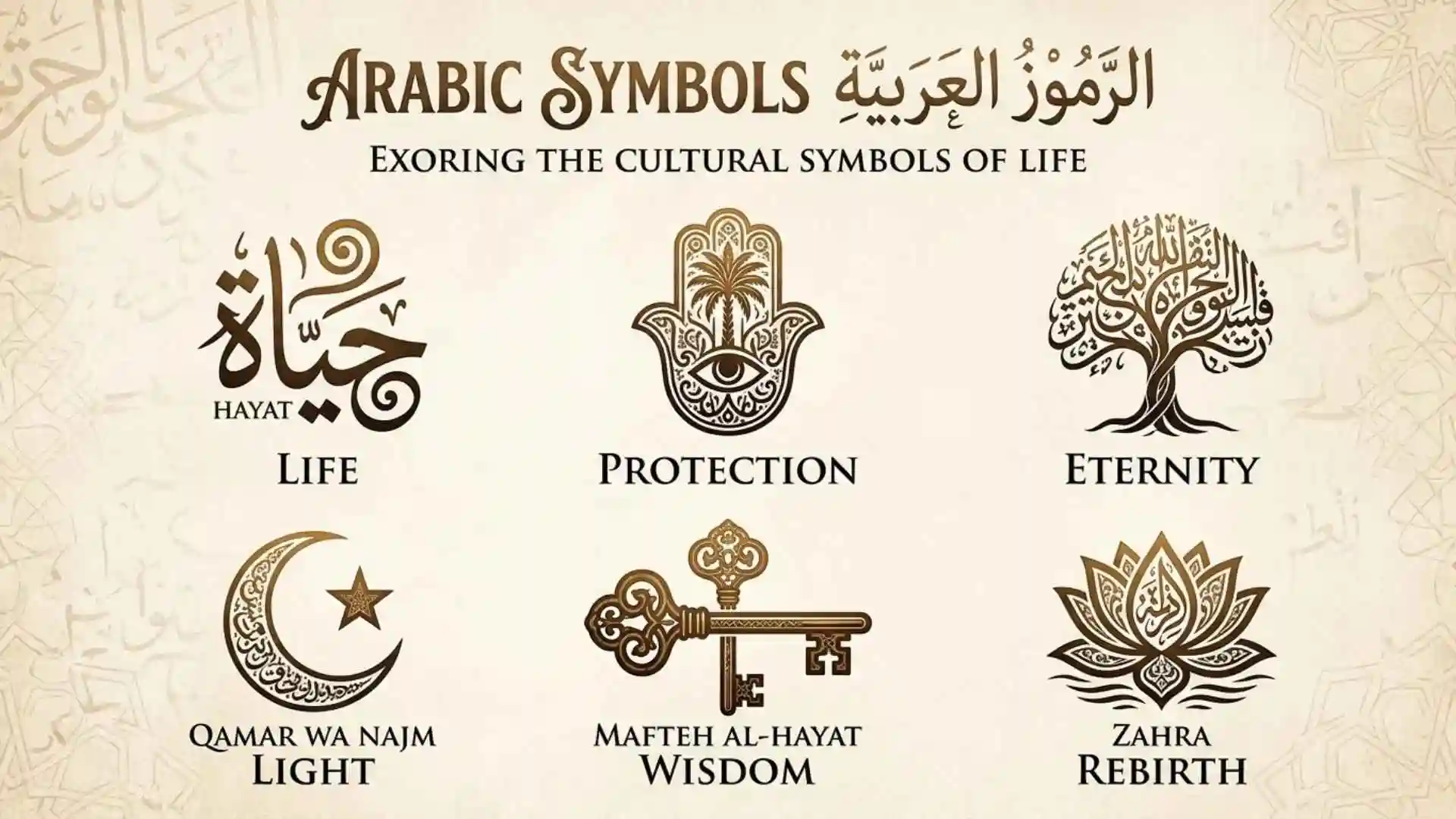
Arabic symbols carry stories of faith, identity, knowledge, beauty, and human connection.
From graceful calligraphy to protective hand signs, these symbols can express ideas that ordinary words may struggle to capture.
Some come from the Arabic language, while others developed through Islamic art, Middle Eastern traditions, mathematics, astronomy, and folklore.
Understanding them reveals how people used visual signs to preserve memory, express belief, and create meaning across generations.
Quick Answer
Arabic symbols are written signs, calligraphic forms, numbers, religious motifs, cultural emblems, and traditional designs associated with the Arabic-speaking world. They may represent language, spirituality, protection, identity, wisdom, beauty, or historical tradition. Their meanings often change depending on religion, region, artistic style, and cultural context.
Quick Facts About Arabic Symbols
| Aspect | Information |
| Origin | The Arabian Peninsula, the wider Middle East, North Africa, and earlier Semitic writing traditions |
| Historical Significance | Used in writing, mathematics, religion, architecture, trade, science, and artistic expression |
| Main Meaning | Communication, identity, knowledge, beauty, unity, and cultural memory |
| Spiritual Meaning | Faith, divine guidance, protection, patience, gratitude, and remembrance |
| Cultural Importance | Connects Arabic-speaking communities through language, history, art, and shared traditions |
| Modern Usage | Tattoos, jewelry, logos, digital media, fashion, architecture, calligraphy, and home décor |
What Are Arabic Symbols?
Arabic symbols are visual signs connected to Arabic language, history, religion, mathematics, art, and everyday culture. They include Arabic letters, numerals, punctuation marks, calligraphic designs, geometric patterns, religious phrases, stars, crescents, and traditional protective motifs.
The Arabic alphabet developed from earlier Semitic scripts, especially the Nabataean writing system. By the early centuries of Islam, Arabic writing became increasingly important because the Quran was recorded and preserved in Arabic.
As Muslim societies expanded across the Middle East, North Africa, Spain, Central Asia, and parts of South Asia, Arabic script became a major tool for scholarship, government, science, poetry, and trade.
Arabic symbols evolved over time. Early writing was practical and simple, but later calligraphers created refined styles such as Kufic, Naskh, Thuluth, Diwani, and Nastaliq. Letters were no longer only tools for communication. They became artistic symbols of order, beauty, and spiritual devotion.
It is important to remember that not every symbol used in the Arab world is originally Arabic. Some symbols come from Islamic civilization, ancient Mediterranean cultures, Persian traditions, African customs, or regional folklore.
Deep Symbolic Meaning of Arabic Symbols
Spiritual Meaning
Many Arabic symbols are connected to remembrance, prayer, divine unity, and moral guidance.
The written name of Allah, for example, represents belief in one God within Islam. It may appear in mosques, calligraphy, books, pendants, and wall art. Muslims generally treat this name with deep respect because it refers directly to God.
Arabic calligraphy also carries spiritual meaning. Since figurative images were limited in many religious spaces, artists used Quranic verses, geometric designs, and flowing letters to create sacred beauty.
Words such as sabr, meaning patience, shukr, meaning gratitude, and tawakkul, meaning trust in God, have become popular symbols of spiritual strength.
Psychological Meaning
Symbols help the mind turn complex ideas into memorable images. An Arabic word written in elegant calligraphy may create an emotional response even before a person fully understands its translation.
Carl Jung described archetypes as repeating patterns that appear across cultures. Arabic symbols can work in a similar way. The circle may suggest wholeness, the star may represent guidance, and flowing script may feel connected to movement, growth, or continuity.
People are often attracted to Arabic calligraphy because its curves and balance feel both mysterious and ordered. The eye recognizes rhythm even when the reader cannot understand the words.
Cultural Meaning
Arabic symbols often express family identity, faith, regional pride, hospitality, wisdom, and belonging.
A symbol placed above a doorway may offer a blessing. A calligraphic family name may preserve ancestry. A decorative pattern may connect a modern home to centuries of architectural tradition.
For many Arabic speakers, these symbols are not distant historical objects. They remain part of daily life through books, signs, coins, clothing, celebrations, and religious practice.
Types and Variations of Arabic Symbols
Arabic Letters
Arabic uses 28 basic letters. The shape of most letters changes depending on whether the letter appears at the beginning, middle, or end of a word.
Letters can carry personal or artistic symbolism. The letter alif, written as a tall vertical line, is sometimes associated with unity, uprightness, and the oneness of God.
Arabic letters appear in manuscripts, logos, tattoos, jewelry, architecture, and digital design.
Arabic Calligraphy
Arabic calligraphy transforms writing into visual art. Each style communicates a different mood.
Kufic script has strong, angular forms and often appears in early Quranic manuscripts and architectural decoration. Naskh is rounded and readable, making it common in books and printed text. Thuluth is large and elegant, often used in mosques. Diwani is flowing and decorative, with roots in Ottoman administration.
Arabic Numerals
Two numeral systems are commonly associated with Arabic culture.
Western Arabic numerals are the familiar 0, 1, 2, 3, 4, 5, 6, 7, 8, and 9 used internationally. Eastern Arabic numerals include ٠, ١, ٢, ٣, ٤, ٥, ٦, ٧, ٨, and ٩.
The spread of the Hindu-Arabic numeral system transformed mathematics, commerce, astronomy, and science. The concept of zero became especially important because it made advanced calculation far easier.
The Crescent and Star
The crescent and star are widely associated with Islam today, but they are not official symbols of the religion.
Crescent imagery existed in ancient Mesopotamia, Greece, Byzantium, and other cultures before Islam. It became strongly connected with Muslim political identity through the Ottoman Empire and later appeared on the flags of several Muslim-majority nations.
The Hamsa Hand
The hamsa is shaped like an open hand, often with an eye in the center. It is associated with protection from envy or the evil eye.
In Muslim traditions, it is sometimes called the Hand of Fatima, referring to Fatima, the daughter of the Prophet Muhammad. Similar hand symbols also appear in Jewish and North African traditions.
It is commonly seen in jewelry, wall decorations, keychains, tattoos, and amulets.
The Evil Eye Symbol
The evil eye symbol usually appears as a blue circular design resembling an eye. It is believed in many cultures to protect against harmful jealousy, envy, or negative attention.
Although common in Middle Eastern societies, the blue eye amulet is not exclusively Arabic. It appears in Turkish, Greek, Persian, Mediterranean, and South Asian traditions.
Geometric Patterns
Geometric patterns are central to Islamic and Arabic decorative art. They include stars, polygons, circles, and repeating interlocking shapes.
These designs may symbolize infinity, unity, order, balance, and the complexity of creation. They appear in mosques, palaces, tiles, manuscripts, carpets, and carved wood.
The Rub el Hizb
The Rub el Hizb is an eight-pointed star created from two overlapping squares. In Quranic manuscripts, it marks divisions of text that help readers organize recitation.
Today, it also appears in architecture, flags, decoration, and cultural emblems. Its balanced shape may symbolize harmony, guidance, and structure.
Arabic Symbols Across Different Cultures
Ancient Egypt
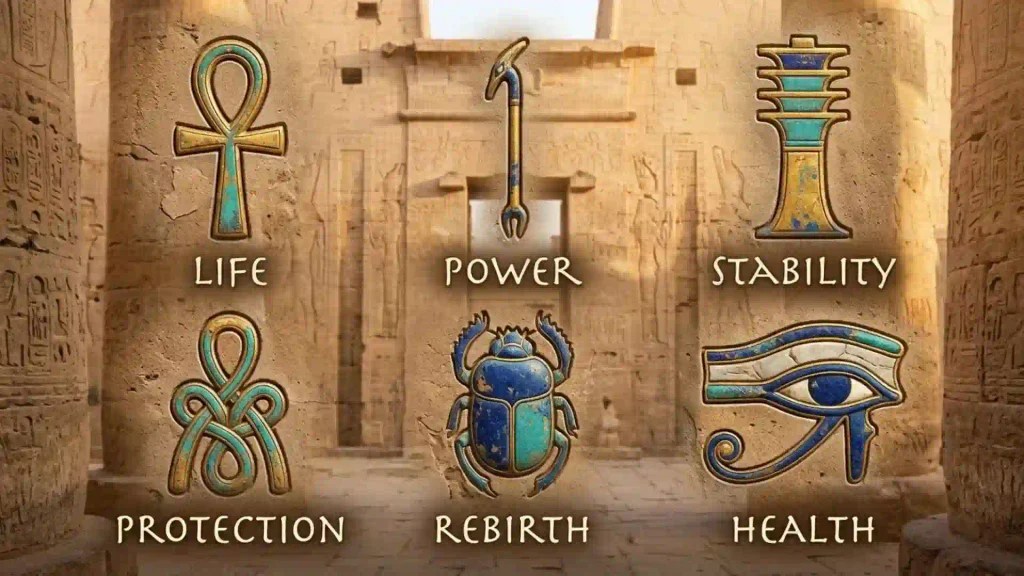
Ancient Egyptian symbols such as the ankh, scarab, and Eye of Horus are not Arabic in origin. However, Egypt later became one of the most influential centers of Arabic language and Islamic culture.
Modern Egyptian design sometimes combines Arabic calligraphy with Pharaonic imagery to express both ancient heritage and Arab identity.
Ancient Greece
Greek astronomy, philosophy, and mathematics influenced scholars writing in Arabic during the Islamic Golden Age.
Arabic translators preserved and expanded Greek works. As a result, symbols linked to astronomy, medicine, and mathematics traveled between Greek and Arabic intellectual traditions.
Roman and Byzantine Culture
The Byzantine Empire influenced architecture, coin design, government systems, and decorative art in regions later ruled by Arabic-speaking Muslim dynasties.
The crescent, for example, had earlier associations with Byzantium before becoming widely connected with Ottoman and Muslim identity.
Persian Traditions
Persian culture deeply influenced Arabic calligraphy, poetry, manuscript art, and court design.
Although Persian is a different language, it uses a modified Arabic script. Persian artists developed styles such as Nastaliq, known for its graceful and hanging appearance.
South Asian Traditions
Arabic symbols appear throughout South Asia in mosques, Quranic schools, amulets, textiles, and calligraphy.
Arabic phrases may be combined with Persian, Urdu, Bengali, or regional artistic forms. In these settings, the symbols often represent faith, blessing, protection, and learning.
Indigenous North African Traditions
Amazigh, Tuareg, and other North African communities have their own symbols, scripts, and artistic traditions.
Over centuries, Arabic and Islamic motifs blended with local geometric patterns, jewelry designs, protective markings, and textile art. The result is a rich visual culture shaped by both regional identity and wider Arabic influence.
Modern Global Culture
Today, Arabic symbols appear in fashion, tattoos, music videos, brand identities, digital art, and social media.
Global interest has increased appreciation for Arabic design, but it has also created mistakes. Words are sometimes written backward, letters are disconnected, or sacred phrases are placed in disrespectful locations.
Similar Symbols and Their Meanings
| Symbol | Main Meaning | Connection to Arabic Culture | Common Misconception |
| Crescent and star | Identity, history, political heritage | Common on flags and Islamic architecture | Often wrongly treated as the universal symbol of Islam |
| Hamsa hand | Protection and blessing | Common in North Africa and the Middle East | Not exclusively Arabic or Islamic |
| Evil eye | Protection from envy | Used in homes and jewelry | The eye itself is often meant to repel harm, not cause it |
| Rub el Hizb | Quranic division, balance | Used in manuscripts and design | Sometimes confused with other eight-pointed stars |
| Arabic calligraphy | Language, faith, art | Central to manuscripts and architecture | Decorative writing may contain meaningful sacred text |
| Geometric star | Order, unity, infinity | Common in Islamic art | It does not always have one fixed religious meaning |
Arabic Symbols in Mythology and Folklore
Arabic folklore contains stories of jinn, magical seals, protective writings, hidden treasure, sacred names, and mysterious letters.
Jinn are supernatural beings mentioned in Islamic tradition and older Arabian beliefs. In folklore, certain symbols, inscriptions, or spoken phrases were sometimes believed to protect people from harmful spirits.
The Seal of Solomon also appears in Middle Eastern stories. It was described as a powerful sign connected with the Prophet and King Solomon, who was believed to command jinn. Over time, the seal was represented in different forms, including stars and engraved rings.
Protective squares, number patterns, and written prayers were also used in some folk traditions. However, religious scholars have often disagreed about these practices, especially when symbols were treated as magical objects rather than reminders of faith.
Arabic Symbols in Art, Literature, Movies, and Pop Culture
Arabic calligraphy appears on mosque walls, ceramic tiles, metalwork, carpets, manuscripts, and modern paintings. Artists often use letters to explore identity, exile, faith, language, and memory.
In literature and poetry, Arabic letters may symbolize longing, divine love, homeland, or the difficulty of expressing emotion. Classical poets such as Al-Mutanabbi and later writers across the Arab world helped make language itself a symbol of dignity and cultural power.
Movies and television often use Arabic writing to create a sense of mystery or location. Unfortunately, foreign productions sometimes display meaningless or incorrectly connected Arabic letters.
Arabic tattoos have also become popular. Common choices include words meaning freedom, love, family, patience, strength, and hope. Accurate translation is essential because a small spelling or letter-shaping error can completely change the meaning.
Fashion designers use Arabic typography on shirts, scarves, jewelry, and handbags. When used thoughtfully, it can celebrate heritage. When sacred text is used carelessly, it may cause cultural or religious offense.
Spiritual and Dream Meaning of Arabic Symbols
Dreams involving Arabic symbols may reflect identity, faith, mystery, communication, or the search for guidance.
Seeing Arabic writing in a dream may suggest that you are trying to understand an important message. If the words are readable, their actual meaning matters. If they are unclear, the dream may represent uncertainty, hidden knowledge, or emotional distance.
Dreaming of Quranic verses may feel comforting to a believer and may symbolize protection, conscience, repentance, or spiritual focus.
A crescent moon may represent a new beginning, changing emotions, or the passage of time. A protective hand may reflect the need for boundaries or safety.
Dream interpretation is personal. Symbols should be considered alongside the dreamer’s beliefs, memories, emotions, and life situation.
Positive and Negative Meanings of Arabic Symbols
| Positive Meaning | Negative or Cautionary Meaning |
| Faith and devotion | Religious misuse or disrespect |
| Protection and blessing | Fear of envy or superstition |
| Knowledge and learning | Misinterpretation of unfamiliar text |
| Beauty and artistic harmony | Decorative use without understanding |
| Cultural identity | Stereotyping or political misuse |
| Unity and belonging | Exclusion or identity conflict |
| Spiritual guidance | Dependence on symbols instead of personal responsibility |
One symbol can represent both light and shadow. A protective symbol may give comfort, but it may also increase fear if someone becomes obsessed with hidden danger. Arabic writing can express beauty and faith, yet careless use can distort sacred or cultural meaning.
Why Humans Are Attracted to Arabic Symbols
People are naturally drawn to patterns, mystery, rhythm, and visual balance. Arabic script offers all four.
Its connected letters flow like movement across a page. Even people who cannot read Arabic may feel that the writing carries emotion or hidden knowledge.
Cultural memory also shapes attraction. Symbols remind communities of family, homeland, religious practice, childhood, and shared history.
Personal meaning matters most. Someone may wear an Arabic word because it reflects patience after hardship, love for family, or pride in cultural roots.
Modern Uses of Arabic Symbols
Arabic symbols are widely used in:
- Tattoos expressing love, strength, freedom, or faith
- Jewelry featuring names, Quranic words, hamsa hands, or crescents
- Fashion using Arabic typography and regional patterns
- Branding for restaurants, airlines, media companies, and cultural organizations
- Social media graphics, usernames, and digital calligraphy
- Contemporary spiritual art
- Home décor, including framed verses and geometric wall designs
- Wedding invitations and personalized gifts
- Architecture inspired by Islamic patterns and calligraphic forms
Before using Arabic text permanently, especially in a tattoo or business logo, ask a fluent Arabic speaker and a professional calligrapher to review it.
Interesting Facts About Arabic Symbols
- Arabic is written from right to left, but Arabic numerals are usually read from left to right.
- Most Arabic letters connect to neighboring letters, although a small group does not connect to the following letter.
- The Arabic alphabet influenced writing systems used for Persian, Urdu, Pashto, Kurdish, and several other languages.
- The word “algebra” comes from the Arabic term al-jabr, linked to the mathematician Al-Khwarizmi.
- Arabic calligraphy developed several major styles, each designed for different uses such as books, architecture, government documents, and decoration.
- The crescent and star appeared in many pre-Islamic cultures before becoming associated with Muslim empires and modern national flags.
- Geometric Islamic patterns can repeat endlessly, which is often interpreted as a visual reminder of infinity and divine order.
- Some decorative objects sold as Arabic art contain reversed or disconnected letters that native readers cannot understand.
Frequently Asked Questions
What are the most common Arabic symbols?
Common Arabic symbols include Arabic letters, calligraphy, Eastern Arabic numerals, the crescent and star, the hamsa hand, the evil eye, geometric patterns, and the Rub el Hizb.
Is the crescent moon an official symbol of Islam?
No. Islam has no single official universal symbol. The crescent became associated with Muslim identity largely through historical empires, especially the Ottoman Empire.
What does the hamsa hand mean in Arabic culture?
The hamsa usually represents protection, blessing, strength, and defense against envy or the evil eye. Its meaning varies across Muslim, Jewish, and North African traditions.
Are Arabic symbols suitable for tattoos?
They can be, but the spelling, grammar, letter connections, and cultural meaning must be checked carefully. Sacred names or Quranic verses may also require respectful placement.
What do Arabic geometric patterns symbolize?
They often represent order, balance, unity, infinity, and the interconnected nature of creation. However, not every design has one fixed spiritual meaning.
Are Arabic and Islamic symbols the same?
No. Arabic refers mainly to a language and cultural world, while Islamic refers to a religion followed by people from many ethnic and linguistic backgrounds.
Conclusion
Arabic symbols connect language, spirituality, art, history, and personal identity.
Their power comes not only from how they look, but from the memories, beliefs, and stories they carry.
Understanding their true context helps us appreciate their beauty without reducing them to decoration.
When approached with knowledge and respect, these symbols become meaningful bridges between people, cultures, and generations.
 Michael Rivera