
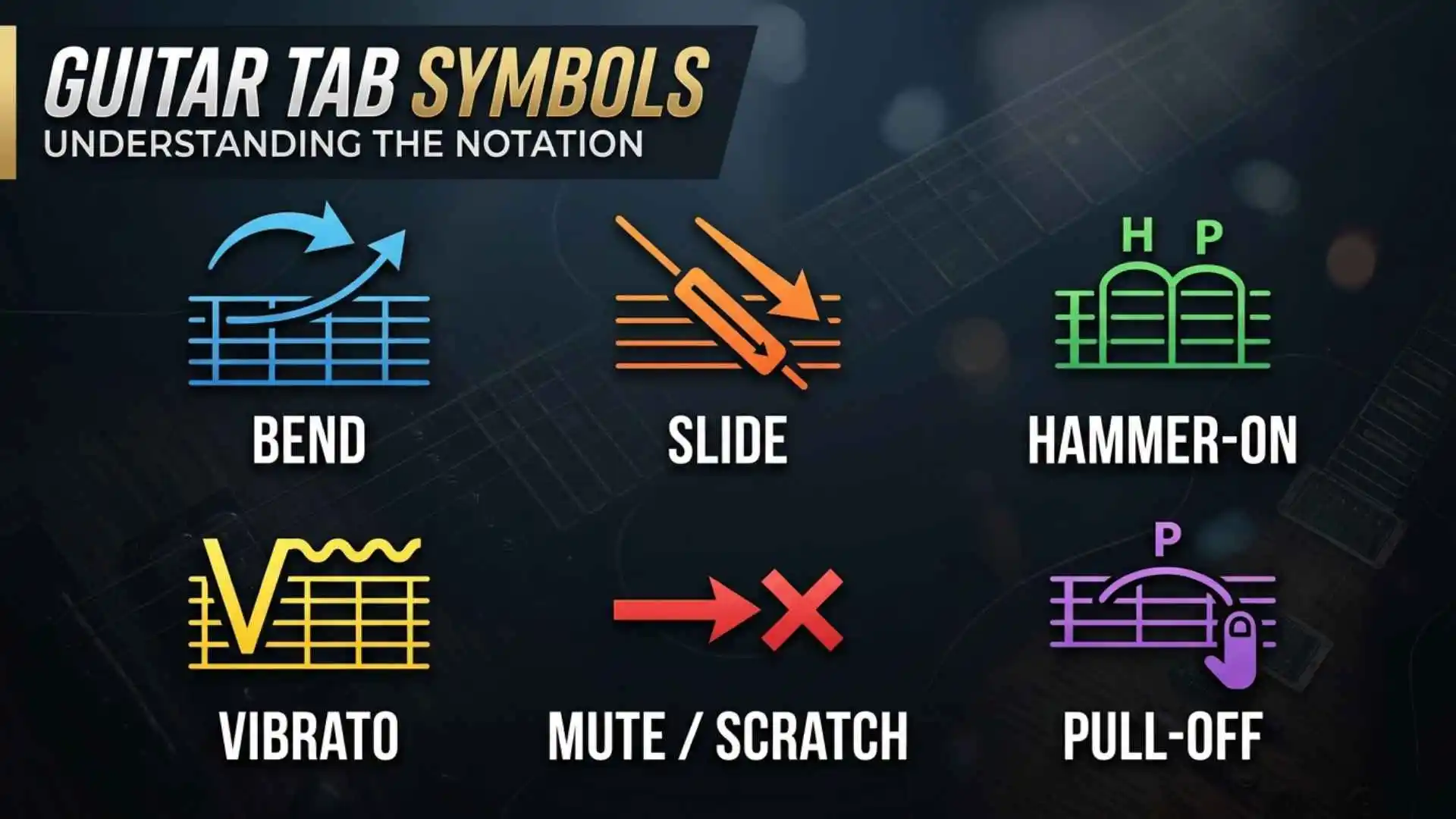
Learning to read guitar tabs can make playing your favorite songs much easier, especially if you are new to guitar. Unlike traditional sheet music, guitar tablature (tabs) uses six horizontal lines and numbers to show exactly where to place your fingers on the fretboard. However, understanding guitar tab symbols is just as important as recognizing the numbers. These symbols provide instructions for playing notes, creating rhythms, and using different guitar techniques.
Guitar tab symbols represent a variety of playing techniques, including hammer-ons, pull-offs, bends, slides, vibrato, palm muting, and harmonics. Other symbols help you understand open strings, muted notes, repeated sections, and rhythmic patterns. Each sign has a specific purpose, helping guitarists reproduce the sound and style of a song more accurately. Once you understand these markings, reading tabs becomes faster, easier, and more enjoyable.
In this complete guide to guitar tab symbols, you will discover the meanings of common tablature signs, learn how to read guitar tabs step by step, and explore the techniques represented by different symbols. Whether you play acoustic, electric, or bass guitar, this guide will help you understand tab notation, avoid common reading mistakes, and build confidence as you learn new songs.
Quick Answer
Guitar tab symbols are marks, letters, numbers, and lines used in guitar tablature to show frets, strings, rhythm, and playing techniques. Common symbols include h for hammer-on, p for pull-off, b for bend, / for slide up, \ for slide down, x for a muted note, and ~ for vibrato.
Quick Facts About Guitar Tab Symbols
| Aspect | Information |
| Origin | Developed from older tablature systems used for fretted instruments |
| Historical Significance | Allowed musicians to record finger positions before modern notation became standard |
| Main Meaning | Shows where and how notes should be played on a guitar |
| Spiritual Meaning | Can represent emotional expression, discipline, creativity, and connection through music |
| Cultural Importance | Helped spread guitar music across folk, blues, rock, metal, country, jazz, and pop |
| Modern Usage | Used in books, websites, music apps, teaching platforms, and notation software |
What Are Guitar Tab Symbols?
Guitar tab symbols are visual instructions written on a tablature staff. Standard guitar tablature usually contains six horizontal lines, with each line representing one guitar string. The top line normally represents the high E string, while the bottom line represents the low E string.
Numbers placed on the lines tell you which fret to press. For example, 0 means play an open string, 3 means press the third fret, and 12 means press the twelfth fret.
However, fret numbers alone cannot explain how a note should sound. That is why guitar tabs use additional symbols for techniques such as bends, slides, hammer-ons, pull-offs, harmonics, tapping, palm muting, and vibrato.
Fender’s guitar tablature guide identifies h as a hammer-on, p as a pull-off, b as a bend, / as a slide upward, and \ as a slide downward. These symbols may vary slightly between publishers, so reading the legend provided with a tab is always wise.
The Origin and Evolution of Guitar Tablature
Tablature is much older than the electric guitar. Musicians used early tab systems during the Renaissance to write music for fretted instruments such as the lute, vihuela, and early guitar.
Unlike standard notation, which mainly identifies musical pitch and rhythm, tablature focuses on physical placement. It tells the player where to put a finger on the instrument.
This practical approach made tablature especially helpful for instruments with multiple ways to play the same pitch. A single note may appear in several places on a guitar neck, but a tab number tells the guitarist exactly which string and fret to use.
Modern guitar tabs became especially popular through lesson books, magazines, fan transcriptions, and early internet forums. Today, software such as Guitar Pro can represent detailed bends, harmonics, slides, tapping, palm muting, pick direction, custom tunings, and many other techniques.
Deep Symbolic Meaning of Guitar Tab Symbols
Spiritual Meaning
Guitar tab symbols do not have an ancient religious meaning, but music itself often carries spiritual importance. A bend can sound like a cry, vibrato can feel like a trembling voice, and a ringing chord can create a sense of peace.
For many players, reading tablature becomes part of a personal journey. Repeating a difficult passage teaches patience, concentration, and emotional control. The symbols guide the fingers, but the musician gives them life.
Psychological Meaning
From a psychological view, guitar tab symbols reduce a complicated musical action into small, manageable instructions. This lowers the mental barrier for beginners.
A mark such as 5h7 gives the brain a clear sequence: play the fifth fret, then strike the seventh fret with the fretting hand. Each successful movement builds confidence and strengthens coordination.
The process also uses pattern recognition. Over time, guitarists stop seeing separate numbers and begin recognizing familiar shapes, phrases, chord patterns, and techniques.
Cultural Meaning
Guitar tab symbols form a shared language among musicians. A guitarist in one country can read a tab written by someone thousands of miles away, even when they do not speak the same verbal language.
This visual system has helped preserve riffs, solos, folk melodies, worship songs, and regional guitar styles. It has also made music education more accessible to players who do not read traditional sheet music.
Common Guitar Tab Symbols and Their Meanings
Numbers: Frets
Numbers show which fret to press.
e|–0–3–5–|
In this example:
- 0 means play the open string
- 3 means play the third fret
- 5 means play the fifth fret
Read the notes from left to right.
h: Hammer-On
A hammer-on is shown with a lowercase or uppercase h.
e|–5h7–|
Play the fifth fret, then press the seventh fret firmly with another finger without picking the second note.
Fender confirms that hammer-ons are commonly marked with H or h in guitar tablature.
p: Pull-Off
A pull-off is shown with p.
e|–7p5–|
Fret both notes, play the seventh fret, then pull the finger away so the fifth-fret note sounds.
Hammer-ons and pull-offs are forms of legato playing. They help notes flow smoothly without every note being picked.
b: Bend
A bend is commonly marked with b.
e|–7b9–|
Play the seventh fret and bend the string until it reaches the pitch normally heard at the ninth fret.
A bend must reach the correct target pitch. The number after b usually describes the pitch you should hear, not the fret where your finger moves.
Bending is one of the guitar’s most expressive techniques because it allows a note to rise smoothly in a voice-like way.
r: Release Bend
The letter r means release a bent note.
e|–7b9r7–|
Bend the seventh-fret note to the pitch of the ninth fret, then lower the string back to its original pitch.
/: Slide Up
A forward slash means slide toward a higher fret.
e|–5/7–|
Pick the fifth fret, keep pressure on the string, and slide your finger to the seventh fret.
: Slide Down
A backslash means slide toward a lower fret.
e|–7\5–|
Pick the seventh fret and slide down to the fifth fret.
Slides create a smooth transition between pitches and often add a vocal quality to blues, rock, jazz, and country phrases.
~ or Wavy Line: Vibrato
A tilde or wavy line means apply vibrato.
e|–7~~~–|
Hold the note and gently move the string so the pitch rises and falls slightly.
Vibrato should support the mood of the phrase. Slow vibrato can sound warm or mournful, while fast vibrato can feel tense or intense.
x: Muted or Dead Note
An x usually represents a muted note.
e|–x-x-x-x–|
Touch the string lightly without pressing it fully against the fret. Pick or strum it to create a short, percussive sound.
Muted notes appear often in funk, rock, metal, reggae, and rhythm guitar.
PM: Palm Muting
PM means palm mute.
PM—-|
E|–0-0-0-0–|
Rest the edge of your picking hand lightly near the bridge while playing. The notes should sound controlled and heavy rather than fully open.
Modern notation software treats palm muting as an expressive guitar marking that can affect playback.
< > or Accent Marks
A symbol such as > above a note may mean accent it. Play that note more strongly than the surrounding notes.
Some ASCII tabs use angle brackets differently, such as showing volume swells or grouped harmonic notes. Check the tab legend when the meaning is uncertain.
let ring
The words let ring tell you not to stop earlier notes while playing new ones.
let ring——–
e|–0—–0—–|
B|—-1—–1—|
G|——0—–0-|
This instruction is common in arpeggios and clean guitar passages. MuseScore describes “let ring” as a guitar line that allows sustained playback.
Harmonic Symbols in Guitar Tabs
Natural Harmonics: < >
Natural harmonics are often written inside angle brackets.
e|–<12>–|
Lightly touch the string directly above the twelfth fret, pick it, and quickly lift your finger. The result is a clear, bell-like note.
Some tabs may use N.H. to mean natural harmonic.
Artificial Harmonics: A.H.
A.H. usually means artificial harmonic. The player frets one note while creating a harmonic at another point on the string.
Pinch Harmonics: P.H.
P.H. commonly means pinch harmonic. The pick attacks the string while the thumb lightly touches it, producing a sharp, high-pitched squeal.
Because harmonic notation varies between tab systems, always look for explanatory notes near the transcription.
Advanced Guitar Tab Symbols
t: Tapping
The letter t shows a note tapped with the picking hand.
e|–5h8t12p8p5–|
This phrase begins with a hammer-on, taps the twelfth fret, then uses pull-offs to return down the string.
tr: Trill
tr means trill, a rapid alternation between two notes.
e|–5tr7–|
Usually, the guitarist repeatedly combines hammer-ons and pull-offs. Trills build speed, finger strength, and fluidity.
/// or Rapid Picking Marks
A repeated mark above a note may show tremolo picking. Pick the same note rapidly and evenly for the indicated duration.
v and ^: Pick Direction
Some tabs use:
- v for a downstroke
- ^ for an upstroke
Other publishers reverse the visual interpretation or use standard notation symbols. Follow the transcription’s legend.
Ties and Curved Lines
A curved line may connect notes played with hammer-ons, pull-offs, slides, or sustained phrasing. In professional tablature, curved markings often work with standard notation to show legato articulation.
Parentheses: Ghost Notes or Sustained Notes
A number in parentheses may mean a ghost note, optional note, previously ringing note, or very quiet note.
e|–5–(5)–|
Its precise meaning depends on context. In one tab, it may show a soft repeat. In another, it may show that the note is still ringing.
Guitar Tab Symbols Across Musical Cultures
Blues
Blues guitar relies heavily on bends, slides, vibrato, and muted notes. These techniques imitate the human voice and help players express sadness, longing, confidence, and tension.
Rock
Rock tabs often combine power chords, hammer-ons, pull-offs, slides, and expressive bends. The symbols help preserve the exact character of famous riffs and solos.
Metal
Metal guitar tablature frequently uses palm muting, tremolo picking, tapping, pinch harmonics, dead notes, and rapid slides. Accurate symbols are essential because small technique changes can completely alter the rhythm.
Country
Country tabs often include bends, pre-bends, release bends, hybrid picking, slides, and open-string phrases. These details create the bright, vocal quality associated with country lead guitar.
Classical and Flamenco Traditions
Classical and flamenco transcriptions may include right-hand fingering, left-hand fingering, harmonics, rasgueado marks, and detailed rhythm notation. These systems often combine tablature with standard musical notation.
Modern Online Guitar Culture
Online tabs made guitar learning available to millions of self-taught musicians. However, plain-text tabs are not fully standardized. One author may use x for a muted note, while another may use it for a percussive strike.
Professional tab books and notation programs usually provide more detailed rhythm, technique, and performance information than basic ASCII tabs.
Similar Music Symbols and Their Meanings
| Symbol System | What It Shows | Main Strength | Main Limitation |
| Guitar tablature | Strings, frets, and guitar techniques | Easy physical guidance | Rhythm may be unclear in simple tabs |
| Standard notation | Pitch, rhythm, dynamics, and harmony | Musically detailed and universal | Does not always show the best fret position |
| Chord diagrams | Finger placement for chords | Fast chord learning | Does not show a full melody |
| Nashville Number System | Chord relationships by scale degree | Easy transposition | Limited melodic detail |
| Lead sheets | Melody, lyrics, and chord names | Useful for performance | Does not show exact guitar technique |
The strongest guitar transcriptions often combine standard notation and tablature. Standard notation explains when and how long a note sounds, while the tab explains where it should be played.
Positive and Negative Meanings of Guitar Tab Symbols
| Positive Meaning | Negative Meaning |
| Makes guitar music easier to learn | May cause dependence on visual instructions |
| Preserves riffs and techniques | Simple tabs may leave out rhythm |
| Supports self-taught musicians | Symbols are not always standardized |
| Builds confidence and coordination | Inaccurate tabs can teach mistakes |
| Connects players across cultures | Numbers alone may hide musical theory |
| Encourages creative exploration | Technique can become mechanical without listening |
Guitar tablature is most effective when players combine reading with careful listening. A tab can show the movement, but the recording reveals the timing, tone, dynamics, and emotional character.
Why Humans Are Attracted to Guitar Tab Symbols
People naturally search for patterns. Guitar tablature turns sound into a visible path that the hands can follow.
This is emotionally rewarding because progress becomes measurable. A difficult riff that once looked impossible slowly becomes familiar. The player begins by decoding one symbol at a time, then eventually performs the entire phrase without thinking.
Tabs also create a direct connection between imitation and self-expression. A beginner may use symbols to copy a favorite guitarist, but over time those techniques become part of the player’s own musical voice.
Modern Uses of Guitar Tab Symbols
Guitar tab symbols now appear in:
- Printed guitar lesson books
- Songbooks and licensed transcriptions
- Music education websites
- Mobile learning apps
- Video lessons
- Guitar notation software
- Digital sheet music
- Social media tutorials
- Band rehearsals
- Personal songwriting notes
Programs such as Guitar Pro support multiple stringed instruments, alternate tunings, rhythmic playback, detailed bends, harmonics, slides, tapping, and pick directions.
Interesting Facts About Guitar Tab Symbols
- Tablature existed centuries before electric guitars.
- The six tab lines represent strings, not musical staff lines.
- Guitar tabs are read from left to right.
- The top tab line represents the thinnest guitar string in standard six-string tablature.
- A higher fret number does not always mean a visually higher line.
- The same pitch can often be played on several strings.
- Plain-text tabs may not show rhythm accurately.
- Parentheses and harmonic symbols can mean different things in different publications.
- Professional tabs often place standard notation above the tablature.
- Learning tab does not prevent someone from learning traditional music notation.
Frequently Asked Questions
What do the symbols in guitar tabs mean?
They show how notes should be played. Symbols may indicate hammer-ons, pull-offs, bends, slides, vibrato, muting, harmonics, tapping, picking direction, or other guitar techniques.
What does 5h7 mean in guitar tabs?
It means play the fifth fret, then hammer a finger onto the seventh fret without picking the string again.
What does 7p5 mean in guitar tablature?
It means play the seventh fret and pull your finger off so the note at the fifth fret sounds.
What do / and \ mean in guitar tabs?
A forward slash usually means slide up to a higher fret. A backslash usually means slide down to a lower fret.
What does x mean on a guitar tab?
An x usually means play a muted or dead note. Touch the string without pressing it fully to the fretboard, then pick or strum it.
Are guitar tab symbols universal?
Many symbols are widely recognized, but tablature is not completely standardized. Meanings can vary between websites, books, and software, so check the tab legend when available.
Conclusion
Guitar tab symbols transform silent numbers into bends, slides, rhythms, textures, and emotions.
Learning them helps you understand not only where to place your fingers, but how a musical phrase should speak.
Begin with the most common marks, listen closely to the original music, and practice each technique slowly.
Soon, the symbols will stop looking like code and start feeling like a familiar musical language.
 Michael Rivera