
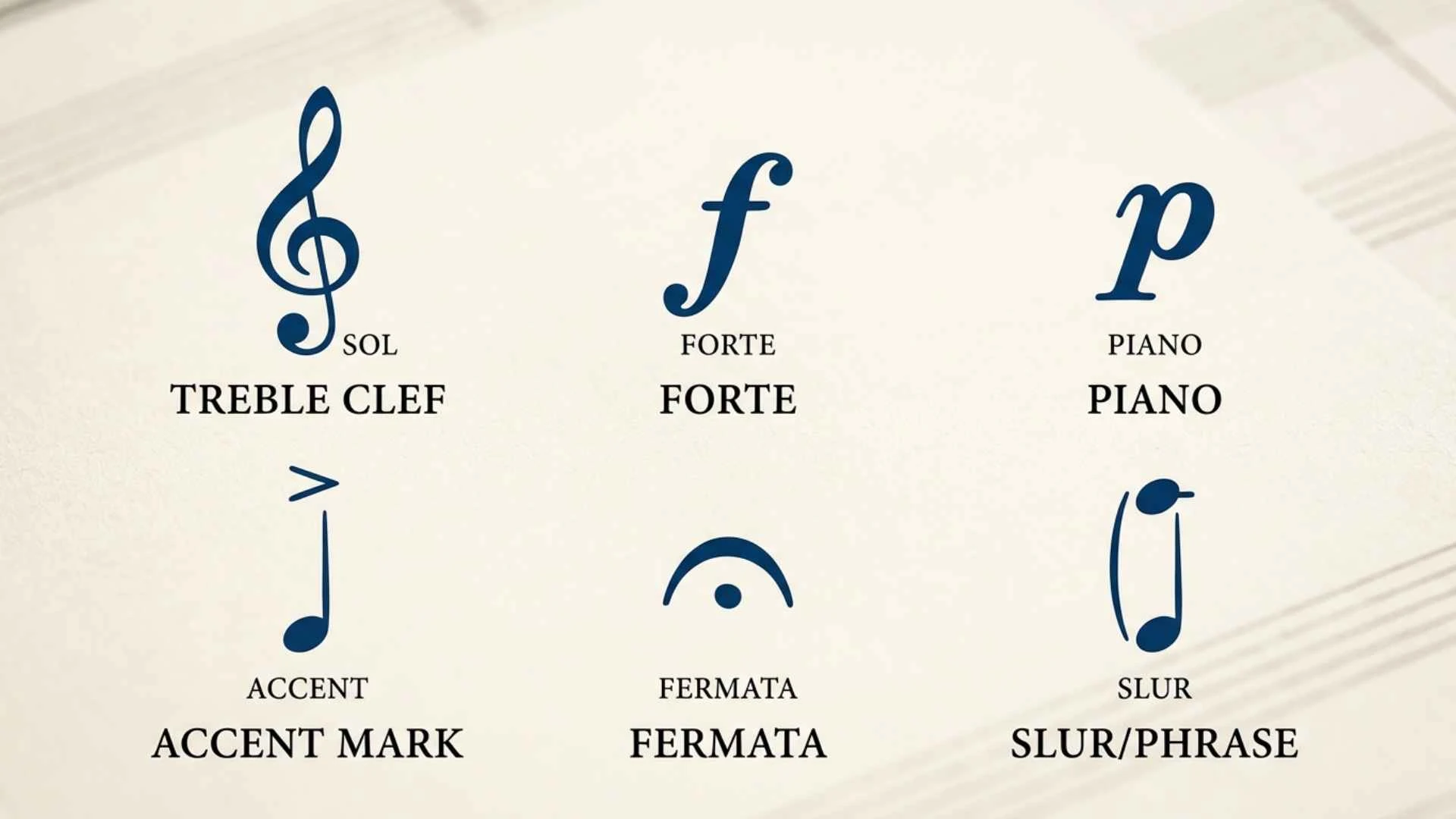
Piano symbols are an essential part of understanding music, reading sheet music, and expressing musical ideas. From familiar musical notes and sharp signs to piano keys, chords, dynamics, and rhythm markings, each symbol communicates specific instructions or meanings. Whether you are a beginner learning to play your first melody or an experienced pianist exploring advanced compositions, understanding piano symbols can make music easier to read, interpret, and perform.
Different piano symbols serve different purposes in musical notation. Notes and rests indicate sounds and silence, while clefs, time signatures, and key signatures help organize musical compositions. Dynamic markings such as piano (p) and forte (f) tell musicians how softly or loudly to play. Other symbols, including pedals, slurs, staccato dots, accidentals, and articulation marks, provide instructions for creating particular sounds and musical expressions. Beyond technical notation, the piano also carries symbolic meanings associated with creativity, emotion, harmony, elegance, and artistic expression.
In this complete guide to piano symbols, you will explore their meanings, historical origins, musical notation, and cultural significance. You will learn how to recognize common symbols on piano sheet music, understand their functions, and identify markings used in beginner and advanced compositions. We will also explore the deeper symbolism associated with piano keys, musical imagery, and the instrument itself. Whether you are studying music theory, learning piano, or simply curious about musical symbols, this guide will help you understand the language behind the instrument.
Quick Answer
Piano symbols are written signs used in sheet music to show pitch, rhythm, tempo, dynamics, articulation, fingering, pedaling, and expression. Common examples include treble and bass clefs, notes, rests, sharps, flats, time signatures, slurs, staccato marks, dynamic signs, and sustain-pedal instructions.
Quick Facts About Piano Symbols
| Aspect | Information |
| Origin | Developed from broader systems of Western musical notation |
| Historical Significance | Allowed composers to preserve and share increasingly complex music |
| Main Meaning | Instructions for pitch, timing, technique, and expression |
| Spiritual Meaning | Harmony, emotional release, inner balance, and connection |
| Cultural Importance | Supports musical education, performance, composition, and preservation |
| Modern Usage | Sheet music, music apps, digital pianos, tattoos, logos, fashion, and social media |
What Are Piano Symbols?
Piano symbols are the marks, signs, letters, numbers, and Italian terms printed in piano sheet music. Together, they tell a pianist what notes to play, when to play them, how long to hold them, how loudly to perform them, and what emotional character the music should express.
Most piano notation is written on the grand staff, which combines the treble staff and bass staff. The treble clef usually guides the right hand, while the bass clef commonly guides the left. Middle C sits between the two staves and acts as a visual bridge.
Modern piano notation did not appear all at once. It evolved from early European systems used to record sacred chant. Medieval manuscripts show the gradual development of staff lines, clefs, and more exact pitch notation. Over time, composers added symbols for rhythm, accidentals, phrasing, ornaments, dynamics, and technique.
The piano itself arrived much later. Bartolomeo Cristofori developed an early form of the instrument around the beginning of the eighteenth century. As keyboard music became more expressive, printed notation had to communicate subtle differences in touch, volume, phrasing, and pedaling.
Essential Piano Symbols and Their Meanings
Treble Clef
The treble clef looks like a curled decorative symbol wrapped around the second line of the staff.
It marks that line as the note G. In piano music, it commonly represents notes played by the right hand. Symbolically, its upward shape is often associated with lightness, melody, imagination, and emotional expression.
Bass Clef
The bass clef resembles a curved mark followed by two dots.
The dots surround the line representing F. It usually guides the pianist’s left hand and lower notes. Because bass tones provide depth and support, the bass clef can symbolize stability, grounding, strength, and the hidden foundation beneath a melody.
Notes
Notes are oval-shaped symbols placed on staff lines or spaces. Their position shows pitch, while their shape and stems show duration.
A whole note lasts longer than a half note, quarter note, eighth note, or sixteenth note. Symbolically, a single note can represent one voice, one moment, or one emotional truth. A series of notes suggests movement, communication, and unfolding experience.
Rests
Rests indicate silence for a measured length of time.
There are whole rests, half rests, quarter rests, eighth rests, and other values. Although they produce no sound, rests are essential. They create breathing space, tension, and structure.
Psychologically, a rest reminds us that silence is not emptiness. It can be preparation, reflection, restraint, or peace.
Sharp, Flat, and Natural Signs
A sharp sign, written as ♯, raises a note by one semitone. A flat sign, written as ♭, lowers it by one semitone. A natural sign, written as ♮, cancels a previous sharp or flat.
These accidentals alter the expected pitch. On a symbolic level, they suggest adjustment, transformation, emotional tension, and return.
The Library of Congress describes sharps, flats, and naturals as core accidental signs that modify or restore a note’s designated pitch.
Time Signatures
A time signature appears near the beginning of a piece as two stacked numbers.
The upper number shows how many beats belong in each measure. The lower number identifies which note value receives one beat. For example, 4/4 time contains four quarter-note beats per measure.
Time signatures symbolize order, cycles, and the way human beings divide continuous time into understandable patterns.
Key Signatures
A key signature is a group of sharps or flats placed after the clef.
It establishes the main tonal framework of the composition. A key signature helps the pianist understand which notes will usually be raised or lowered throughout the piece.
Symbolically, it acts like the emotional environment of a story. Major keys are often heard as bright or open, while minor keys may sound serious, tender, mysterious, or sorrowful. These emotional associations are common, though context can change them.
Dynamic Symbols
Dynamic markings tell the pianist how loudly or softly to play.
Common examples include:
- p, piano, meaning soft
- pp, pianissimo, meaning very soft
- f, forte, meaning loud
- ff, fortissimo, meaning very loud
- mp, mezzo-piano, meaning moderately soft
- mf, mezzo-forte, meaning moderately loud
A crescendo sign gradually increases volume, while a diminuendo or decrescendo gradually reduces it.
These signs represent emotional intensity. They show that expression is not fixed. It rises, falls, grows, retreats, and changes like human feeling.
Articulation Marks
Articulation symbols shape the beginning, length, and character of individual notes.
A dot above or below a note means staccato, so the sound should be short and detached. A horizontal line means tenuto, asking the player to give the note its full value. An accent mark adds emphasis.
A slur connects several notes into a smooth phrase, while a tie joins two notes of the same pitch into one sustained sound.
Pedal Symbols
Pedal markings tell pianists when to press or release the sustain pedal.
Traditional notation may use the word Ped. to indicate pressing the pedal and an asterisk to show release. Modern scores may use horizontal lines with changes marked beneath the staff.
The sustain pedal allows selected notes and chords to continue ringing after the keys are released. Yamaha explains that held notes continue sounding while the sustain pedal remains pressed.
Symbolically, pedaling suggests memory, resonance, and emotional traces that remain after an action has ended.
Fingering Numbers
Numbers from 1 to 5 may appear above or below notes.
For each hand:
- 1 represents the thumb
- 2 represents the index finger
- 3 represents the middle finger
- 4 represents the ring finger
- 5 represents the little finger
Fingering numbers support efficient movement. They represent discipline, planning, coordination, and the quiet technique behind effortless-looking performance.
Repeat Signs
A repeat sign uses a double bar line with two dots. It instructs the pianist to return to an earlier point and play a section again.
Other navigation symbols include D.C., D.S., the coda sign, and the segno sign.
These marks reflect a familiar human pattern: returning to something old, but hearing or experiencing it differently the second time.
Deep Symbolic Meaning of Piano Symbols
Spiritual Meaning
On a spiritual level, piano symbols can represent the movement from silence into creation. A blank staff contains possibility. Notes bring form to that possibility, while rhythm gives it direction.
The treble and bass clefs may be viewed as two complementary energies. One rises toward brightness and melody. The other reaches toward depth and grounding. Together, they create balance.
Chords also carry spiritual symbolism because several separate tones can form one unified sound. This makes harmony a natural metaphor for cooperation, community, and the relationship between individual identity and a greater whole.
These meanings are modern interpretations rather than fixed religious teachings.
Psychological Meaning
Music notation gives visible structure to invisible sound. This appeals to the human need to recognize patterns, predict events, and organize emotional experience.
From a Jungian perspective, the piano can be viewed as an image of integration. High and low notes, major and minor moods, silence and sound, control and freedom all exist within one instrument.
The performer must unite these opposites. Technical discipline controls the hands, but emotional sensitivity gives the piece life.
Cultural Meaning
Piano symbols form a shared language used by musicians across many countries. Italian terms such as allegro, adagio, forte, and piano remain common even when performers do not speak Italian.
This shared vocabulary helps preserve music across generations. A pianist today can read compositions written centuries ago and recover much of the composer’s intended rhythm, phrasing, and expression.
Piano Symbols Across Different Cultures
Strictly speaking, ancient Egyptian, Greek, Roman, and Indigenous civilizations did not use modern piano symbols because the piano had not yet been invented. However, these cultures created musical ideas and notation traditions that help explain humanity’s long desire to preserve sound.
Ancient Egypt
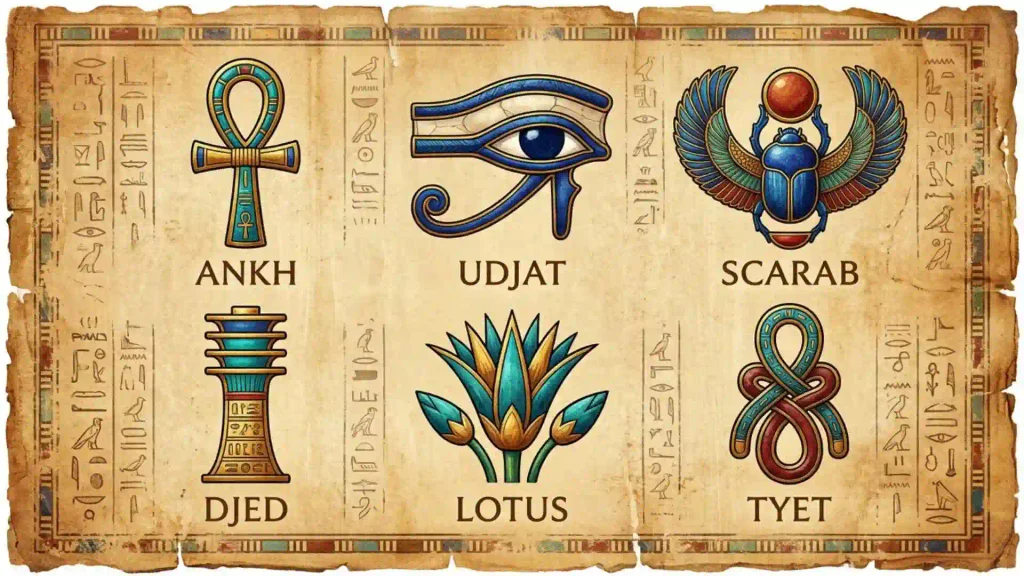
Music played an important role in Egyptian religion, court life, work, and celebration. Harps, flutes, lutes, and percussion instruments appear in tomb paintings.
Modern piano notation did not exist, but Egyptian art used repeated visual patterns to show order, ceremony, and rhythm. Today, these images help scholars study musical performance even when no complete notation system survives.
Ancient Greece
Ancient Greek thinkers connected music with mathematics, ethics, education, and the order of the cosmos. Greek music could be represented through letters and signs placed near poetic text.
The idea that intervals follow numerical relationships influenced later Western music theory. Modern piano scales, modes, and harmonic study still reflect parts of this intellectual heritage.
Roman Culture
Roman musical culture absorbed many Greek ideas. Music accompanied theater, military life, public ceremony, dining, and religious practice.
Although Roman notation was not the direct equivalent of modern piano notation, Roman culture helped transmit Greek musical theory into later European education.
Eastern Traditions
China, Japan, India, Korea, and other Asian cultures developed their own musical systems, instruments, scales, and notation methods.
Chinese gongche notation, Japanese tablature traditions, and Indian systems of raga and tala organize music differently from Western staff notation. Modern musicians sometimes combine these traditions with piano performance, showing that one instrument can carry many cultural voices.
Indigenous Traditions
Many Indigenous musical traditions preserve knowledge through oral teaching, movement, memory, repetition, and community participation rather than through Western notation.
When Indigenous music is arranged for piano, standard symbols may record pitch and rhythm, but they cannot always capture every cultural detail. Context, language, ceremony, and community meaning remain essential.
Modern Global Culture
Today, pianists use standard notation throughout much of the world. Digital platforms also display falling notes, keyboard diagrams, chord letters, MIDI data, and color-coded learning systems.
The Library of Congress records experimental notation systems, including George Antheil’s See-Note method, which used a piano-keyboard image and visual bars to represent notes.
Similar Symbols and Their Meanings
| Symbol | Main Function | Common Symbolic Association |
| Treble clef | Identifies higher pitch range | Creativity, lightness, expression |
| Bass clef | Identifies lower pitch range | Stability, depth, grounding |
| Musical note | Represents pitch and duration | Voice, movement, communication |
| Rest | Represents measured silence | Peace, pause, reflection |
| Sharp | Raises pitch | Growth, intensity, change |
| Flat | Lowers pitch | Softening, descent, melancholy |
| Natural | Restores original pitch | Truth, balance, return |
| Pedal mark | Controls resonance | Memory, continuity, emotional depth |
| Repeat sign | Replays a section | Cycles, memory, second chances |
A common misconception is that the treble clef is specifically a piano symbol. In fact, it belongs to general music notation and appears in music for voices and many instruments.
Likewise, a musical note does not automatically represent a piano. It represents music more broadly unless paired with keys, a keyboard, or another clear piano image.
Piano Symbols in Mythology and Folklore
There are no authentic ancient myths about piano notation because the instrument and its modern written language developed much later.
However, the deeper themes represented by piano symbols appear in mythology. Greek stories linked music with figures such as Apollo, associated with order and artistic harmony, and Orpheus, whose music was said to move animals, trees, stones, and even the powers of the underworld.
The famous concept of the “music of the spheres” imagined the universe as a form of cosmic harmony. Although modern piano signs were not part of this belief, notation now provides a visual metaphor for the same dream: that reality may contain pattern, rhythm, tension, and resolution.
Piano Symbols in Art, Literature, Movies, and Pop Culture
Pianos often appear in visual art as signs of refinement, education, intimacy, or domestic life. Pierre-Auguste Renoir painted several versions of Two Young Girls at the Piano, continuing a European tradition of showing music as part of family and cultural life.
Artists have also borrowed musical language to describe visual works. James McNeill Whistler used titles such as “symphony,” “harmony,” “arrangement,” and “nocturne” to connect painting with musical mood rather than literal storytelling.
In novels and films, the piano may symbolize hidden talent, grief, romance, memory, class, obsession, or freedom. A closed piano can suggest silence or lost opportunity. An abandoned score may represent an unfinished life. A repeated melody can awaken memories that characters have tried to bury.
Piano symbols also appear in tattoos, clothing, jewelry, logos, posters, and social media profiles. In these settings, they often communicate love of music, artistic identity, personal healing, or dedication to practice.
Spiritual and Dream Meaning of Piano Symbols
Dreaming of reading piano symbols may suggest that you are trying to understand a complex emotional situation. You may sense that your life contains a pattern, even if you cannot yet interpret it.
Dreaming of unreadable sheet music can reflect confusion, performance pressure, or fear of disappointing others. Missing notes may symbolize forgotten responsibilities or a feeling that something important is absent.
A beautifully written score may represent order, creative potential, or spiritual harmony. Playing from it with confidence can suggest trust in your abilities.
Dream interpretations are personal and are not scientific predictions. The strongest meaning usually comes from your emotions, memories, and current circumstances.
Positive and Negative Meanings of Piano Symbols
| Positive Meaning | Negative Meaning |
| Harmony | Emotional conflict |
| Creativity | Performance pressure |
| Discipline | Perfectionism |
| Communication | Fear of being misunderstood |
| Memory | Difficulty releasing the past |
| Emotional expression | Emotional overwhelm |
| Balance | Loss of control |
| Practice and growth | Frustration with slow progress |
The same symbol can carry both light and shadow. A repeat sign may represent mastery through practice, or it may suggest being trapped in a cycle. A rest can mean peaceful reflection, or it can represent silence caused by fear.
Context gives the symbol its true emotional meaning.
Why Humans Are Attracted to Piano Symbols
Humans naturally look for patterns. Piano notation turns time, pitch, silence, and emotion into visible shapes that the mind can organize.
The symbols also create a bridge between control and mystery. A score provides exact instructions, yet no two pianists perform it in exactly the same way.
This combination feels deeply human. We all live within limits, routines, and shared rules, but we still search for a personal voice.
Piano symbols therefore attract musicians and nonmusicians alike. They suggest that life can be structured without becoming emotionless and expressive without becoming chaotic.
Modern Uses of Piano Symbols
Today, piano symbols appear in:
- Printed and digital sheet music
- Piano-learning applications
- MIDI and notation software
- Music-school branding
- Concert posters and album artwork
- Tattoos and personalized jewelry
- Clothing and fashion accessories
- Wall art and home decor
- Social media usernames and profile designs
- Memorial designs honoring musicians
- Wedding invitations for musical couples
Braille music also provides a nonvisual notation system for blind musicians. It uses raised-dot combinations to represent notes, octave signs, intervals, accidentals, and other musical information.
Interesting Facts About Piano Symbols
- The word piano is itself a dynamic term. It comes from the Italian word meaning soft.
- The grand staff joins two pitch worlds. Treble and bass notation allow pianists to read a very wide range of notes at once.
- Silence is precisely measured. Musical rests have exact durations, making silence part of the composition rather than an empty gap.
- Many expressive terms are Italian. This reflects Italy’s major role in European music during the development of modern notation and instrumental traditions.
- One symbol may affect many notes. A key signature can change specified pitches throughout an entire section.
- Pedal notation has changed over time. Some scores use words and asterisks, while others use continuous lines.
- Musical notation is accessible through touch. Tactile and braille systems allow musicians to read music without sight.
- Modern notation software can interpret chord names in several systems. These may include English note names, German note names, solfège, and Nashville numbers.
Frequently Asked Questions
What are the most important piano symbols for beginners?
Beginners should first learn the treble clef, bass clef, note values, rests, time signatures, sharps, flats, naturals, dynamics, fingering numbers, and pedal marks.
What do the symbols above piano notes mean?
Symbols above or below notes usually show articulation, fingering, accents, phrasing, ornaments, or technical instructions. Their exact meaning depends on the symbol and musical context.
What does the squiggly line in piano music mean?
A vertical wavy line beside a chord usually means the notes should be played quickly in sequence rather than struck at exactly the same moment. This is called an arpeggiated chord.
What does Ped. mean in piano sheet music?
Ped. tells the pianist to press the sustain pedal. An asterisk or the end of a pedal line usually tells the player when to release or change it.
Are piano symbols universal?
Many standard notation symbols are recognized internationally, but musical cultures may use different notation systems, terminology, tuning methods, and performance traditions.
What does a piano symbol tattoo mean?
A piano or musical-notation tattoo may represent creativity, discipline, emotional healing, memory, love of music, or a connection to a musician. Its personal meaning depends on the wearer.
Conclusion
Piano symbols are far more than technical marks printed on a page.
They preserve sound, guide movement, shape emotion, and connect performers across generations.
Each clef, rest, note, accidental, and dynamic sign contributes to a language built from both order and feeling.
When you learn to read that language, silence begins to reveal rhythm, memory, tension, and possibility.
The deepest lesson of piano notation is that even the smallest symbol can help create something unforgettable.
 John Mercer
 Michael Rivera