
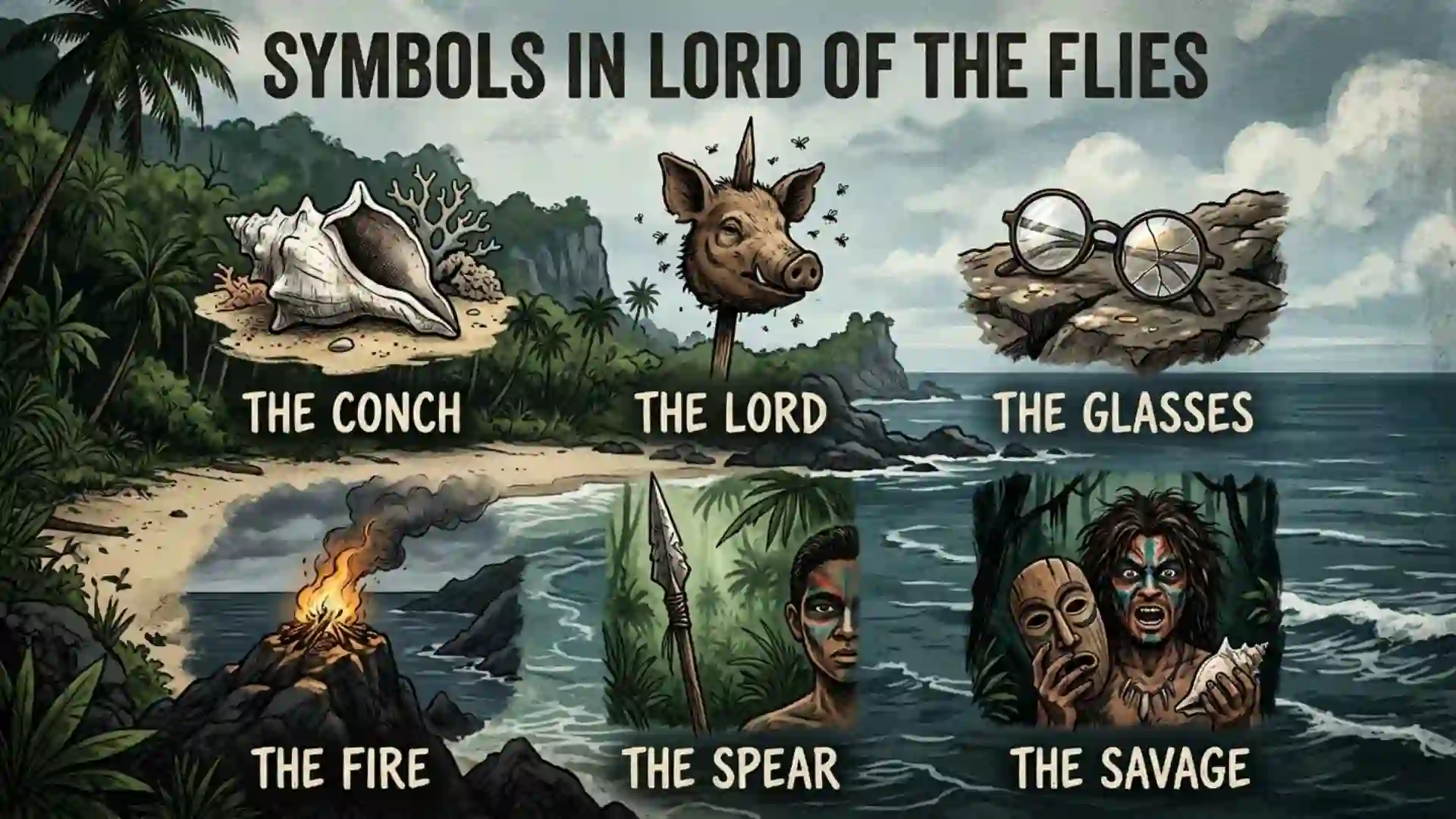
Symbols in Lord of the Flies play an essential role in revealing the novel’s deeper themes of human nature, civilization, savagery, fear, and the loss of innocence. Written by William Golding, this famous novel uses objects, characters, animals, and natural elements to communicate ideas beyond the surface-level story. From the mysterious conch shell to the terrifying Lord of the Flies, each symbol represents an important part of the boys’ psychological and social transformation on the isolated island.
Throughout the novel, Golding uses symbolism to show how quickly order can collapse when people lose rules, authority, and moral responsibility. The conch shell represents democracy and civilized behavior, while Piggy’s glasses symbolize intelligence, knowledge, and the power of science. Similarly, the signal fire represents hope and rescue, whereas the beast reflects the boys’ growing fear and the darkness within human nature. These symbols become increasingly meaningful as Jack and Ralph develop opposing ideas about leadership, survival, and power.
In this complete guide to symbols in Lord of the Flies, you will explore the meanings of the novel’s most important objects, characters, animals, and settings. You will discover how the conch, the beast, the painted faces, the island, the fire, and the Lord of the Flies connect to broader literary themes. Whether you are studying the novel for school, preparing for an exam, or exploring its deeper messages, understanding these symbols will help you appreciate Golding’s powerful commentary on civilization and human behavior.
Quick Answer
The main symbols in Lord of the Flies include the conch shell, signal fire, Piggy’s glasses, the beast, the Lord of the Flies, face paint, and the island itself. Together, they represent democracy, knowledge, rescue, fear, evil, lost identity, and the collapse of civilized behavior.
Quick Facts About Symbols in Lord of the Flies
| Aspect | Information |
| Origin | William Golding’s 1954 novel Lord of the Flies |
| Historical Significance | Influenced by World War II, totalitarianism, and Golding’s wartime experience |
| Main Meaning | The conflict between civilization and human savagery |
| Spiritual Meaning | The struggle between conscience, evil, sacrifice, and inner darkness |
| Cultural Importance | A lasting warning about power, violence, group behavior, and social collapse |
| Modern Usage | Studied in schools, psychology, political discussion, film, television, and popular culture |
What Are Symbols in Lord of the Flies?
Symbols in Lord of the Flies are objects, characters, places, and events that carry meanings beyond their literal role in the story. Golding uses them to examine what happens when society’s laws and institutions disappear.
The novel follows a group of British schoolboys stranded on a tropical island after a plane crash during an unnamed wartime conflict. At first, they attempt to recreate the organized world they know. They hold meetings, elect a leader, assign responsibilities, and create rules.
However, their small society slowly falls apart.
The symbols evolve as this collapse takes place. The conch begins as a respected sign of order, but later loses its authority. The signal fire starts as a symbol of hope, yet becomes neglected as the boys turn toward hunting and violence. Piggy’s glasses represent reason and technology, but they are eventually stolen and used for destructive power.
Golding published the novel in 1954, less than a decade after World War II. His experiences in the Royal Navy influenced his darker view of human behavior. The Holocaust, fascism, global warfare, and the atomic age had challenged the belief that civilized societies were naturally moral.
Through symbolism, Golding asks a disturbing question: Is civilization truly strong, or is it only a thin layer covering humanity’s violent instincts?
Deep Symbolic Meaning of Symbols in Lord of the Flies
Spiritual Level
On a spiritual level, the novel explores the battle between conscience and corruption. The boys arrive on the island wearing school uniforms, carrying the habits of organized society. Yet as rules weaken, their behavior changes.
Simon represents spiritual insight, compassion, and truth. He understands that the beast is not an outside monster. It exists within the boys themselves.
His encounter with the Lord of the Flies resembles a dark spiritual vision. The pig’s head appears to speak to him, revealing that evil cannot simply be hunted or killed because it is part of human nature.
Simon’s later death carries sacrificial and religious meaning. He discovers the truth and tries to share it, but the group kills him during a violent ritual. His death recalls stories of innocent truth-tellers who are rejected by fearful societies.
Psychological Level
Psychologically, the symbols reflect fear, identity, instinct, and group behavior.
The beast represents projected fear. Instead of admitting that they are afraid of one another and of their own impulses, the boys imagine an external creature. This allows them to place their anxiety onto something they believe they can hunt.
The face paint gives the hunters psychological freedom from shame. Once their individual faces are hidden, they feel less responsible for their actions.
This connects to the psychological idea of deindividuation. People in groups may lose self-awareness and behave in ways they would avoid alone, especially when their identities are hidden.
The novel also reflects ideas associated with Carl Jung’s concept of the shadow. The shadow contains the unwanted or hidden parts of the personality. On the island, the boys’ aggression, fear, and hunger for dominance emerge from this hidden psychological space.
Cultural Level
Culturally, the symbols show how communities depend on shared beliefs.
The conch only has power because the boys agree to respect it. Once they stop believing in its authority, it becomes an ordinary shell.
This reflects a wider truth about laws, governments, money, and social customs. Many systems function because people collectively accept their meaning.
Golding suggests that civilization is not maintained by objects or words alone. It survives only when individuals choose responsibility, restraint, and cooperation.
Types and Variations of Symbols in Lord of the Flies
The Conch Shell
Visual Description: A large pink and cream shell discovered near the lagoon.
Meaning: Democracy, order, public speech, and shared authority.
Symbolism: The conch gives each boy the right to speak during assemblies. It creates a system where voices can be heard without interruption.
Cultural Connection: It resembles ceremonial objects used to gather communities or announce public events.
Where It Appears: Ralph and Piggy use it to call the first meeting. Its destruction marks the final collapse of organized society.
The conch’s fading color also reflects its weakening power. When Roger kills Piggy and the conch shatters, law and reason are destroyed at the same moment.
The Signal Fire
Visual Description: A fire built on the mountain to create smoke for passing ships.
Meaning: Hope, rescue, responsibility, and connection to civilization.
Symbolism: As long as the boys maintain the fire, they remain committed to returning home.
Cultural Connection: Fire has long symbolized knowledge, life, communication, and divine power.
Where It Appears: The boys first create it using Piggy’s glasses. Later, they neglect it while hunting.
The signal fire has a double meaning. It can save the boys, but it can also destroy. In the final chapters, Jack’s tribe sets the island on fire to kill Ralph. Ironically, this destructive fire attracts the rescuing naval officer.
Piggy’s Glasses
Visual Description: Thick spectacles worn by Piggy.
Meaning: Intelligence, clear vision, science, and technology.
Symbolism: The glasses allow the boys to create fire. This makes them a source of practical power.
Cultural Connection: Glasses often represent learning and rational thought.
Where It Appears: Ralph’s group initially uses them for the signal fire. Jack later steals them to control fire and strengthen his tribe.
When one lens breaks, reason becomes damaged but not completely lost. When the glasses are stolen, intelligence is separated from morality and used by those seeking control.
The Beast
Visual Description: An imagined creature that changes form in the boys’ minds.
Meaning: Fear, uncertainty, violence, and inner evil.
Symbolism: The beast represents the boys’ inability to understand their own darkness.
Cultural Connection: Monsters in mythology often express social fears and hidden dangers.
Where It Appears: It begins as a “beastie” described by a young child. Later, the boys mistake a dead parachutist for a supernatural creature.
The beast grows more powerful because the boys believe in it. Fear becomes a political tool that Jack uses to gain loyalty.
The Lord of the Flies
Visual Description: A severed pig’s head placed on a sharpened stick and surrounded by flies.
Meaning: Corruption, death, decay, and evil within humanity.
Symbolism: It is the novel’s most direct symbol of inner darkness.
Cultural Connection: The title translates the Hebrew name Beelzebub, traditionally associated with a demonic figure.
Where It Appears: Jack’s hunters leave the pig’s head as an offering to the beast. Simon later experiences a terrifying vision beside it.
The Lord of the Flies tells Simon that the beast is part of everyone. Whether the voice is supernatural or imagined, its message captures Golding’s central idea.
Face Paint and Masks
Visual Description: Clay and charcoal painted across the hunters’ faces.
Meaning: Lost identity, freedom from guilt, tribal belonging, and aggression.
Symbolism: The mask allows Jack and the hunters to separate themselves from their former moral identities.
Cultural Connection: Masks have been used in ritual, warfare, theater, and spiritual ceremonies.
Where It Appears: Jack first paints his face before hunting a pig.
The paint is not evil by itself. Its meaning comes from the way the boys use it to hide personal responsibility.
The Island
Visual Description: A beautiful tropical island with beaches, forests, fruit, mountains, and a lagoon.
Meaning: Isolation, temptation, freedom, and a miniature human world.
Symbolism: The island begins like a paradise but becomes scarred by fear and violence.
Cultural Connection: It recalls the biblical Garden of Eden and adventure stories about untouched islands.
Where It Appears: The entire novel takes place there.
The island acts as a laboratory where Golding removes adult institutions and watches the boys create and destroy their own society.
Symbols in Lord of the Flies Across Different Cultures
Although Golding’s symbols belong to a modern British novel, many connect with older cultural traditions.
Ancient Egypt
Egyptian culture often treated order as a sacred force. The concept of Ma’at represented balance, truth, justice, and social harmony. The conch plays a similar role because it supports order and fair speech.
Ancient Greece
Greek myths often explored the conflict between reason and uncontrolled passion. Piggy’s glasses can be linked with rational knowledge, while Jack’s hunting rituals resemble the surrender to violent instinct.
The beast also recalls mythological monsters that embodied fears society could not easily explain.
Roman Culture
Roman political symbols represented law, authority, and public unity. Like the conch, these symbols depended on collective respect. Once political authority lost legitimacy, conflict often followed.
Eastern Traditions
Buddhist and Hindu traditions frequently examine illusion, attachment, ego, and the inner causes of suffering. The beast can be understood as an illusion strengthened by fear, while Jack’s hunger for power reflects attachment to status and control.
Indigenous Traditions
Many Indigenous traditions view masks, animals, and fire as spiritually meaningful. However, Golding’s hunters should not be treated as accurate representations of Indigenous cultures. Their behavior reflects British fears about “savagery,” not the complexity of real Indigenous societies.
Modern Interpretations
Modern readers often connect the symbols with authoritarian politics, mob behavior, online anonymity, war, and social division. The painted faces can even resemble digital anonymity, where hidden identity sometimes encourages cruelty.
Similar Symbols and Their Meanings
| Symbol | Main Meaning | Related Symbol | Key Difference |
| Conch | Democracy and order | Crown or gavel | The conch depends on shared consent rather than force |
| Signal fire | Hope and rescue | Lighthouse | The fire requires constant human responsibility |
| Piggy’s glasses | Knowledge and technology | Book or lamp | The glasses provide both insight and physical power |
| Beast | Fear and projected evil | Mythological monster | The beast exists mainly within the boys |
| Lord of the Flies | Inner corruption | Devil figure | It represents evil as part of humanity |
| Face paint | Lost identity | Ritual mask | It frees the boys from personal shame |
| Island | Isolated society | Garden of Eden | The paradise is destroyed by human choices |
A common misconception is that each symbol has only one fixed meaning. Golding’s symbols often carry opposing possibilities. Fire can rescue or destroy. Leadership can protect or dominate. Community can offer safety or become a violent mob.
Symbols in Lord of the Flies in Mythology and Folklore
The novel draws on several mythic patterns.
The island resembles a lost paradise. Like Eden, it offers beauty, food, and freedom. Yet innocence does not survive because the danger comes from the people inside the paradise.
The beast follows the ancient pattern of the monster in the wilderness. In folklore, monsters often live beyond the boundaries of the known world. Golding changes this idea by placing the true monster inside the human mind.
The Lord of the Flies also echoes stories of demonic temptation. It does not force Simon to do anything. Instead, it reveals a truth that is difficult to accept: evil is not only an outside enemy.
Simon’s journey up the mountain has the shape of a heroic truth-seeking quest. He discovers the dead parachutist, understands the false beast, and returns to enlighten the others. Like many tragic figures in myth, he is killed before his truth can save the community.
Symbols in Lord of the Flies in Art, Literature, Movies, and Pop Culture
Lord of the Flies has influenced later stories about isolated groups, survival, competition, and social breakdown.
Film adaptations visually emphasize the conch, painted faces, fire, and pig’s head because these objects communicate meaning even without dialogue.
In literature and television, groups trapped away from society often repeat Golding’s central conflict. Characters build rules, form factions, create enemies, and struggle between cooperation and domination.
The phrase “Lord of the Flies” has also entered popular culture as a description of chaos among unsupervised groups.
Visual artists and book-cover designers frequently use broken glasses, flames, flies, masks, and pig imagery to represent the novel’s themes.
Unlike symbols used mainly for decoration, these images remain disturbing because they force audiences to think about how quickly ordinary people may change under pressure.
Spiritual and Dream Meaning of Symbols in Lord of the Flies
Readers sometimes interpret the novel’s symbols through dreams and spiritual reflection.
Dreaming of a conch may suggest a need to speak, listen, or restore fairness. A broken conch may represent ignored truth or lost authority.
A signal fire may symbolize hope, a call for help, or a desire to reconnect with others. An uncontrolled fire may warn of anger or destruction.
Broken glasses may suggest confusion, damaged judgment, or the misuse of knowledge.
A beast in a dream may represent fear that has not yet been understood. Golding’s message encourages the dreamer to look inward rather than blame an imagined outside enemy.
A pig’s head or swarm of flies may symbolize decay, guilt, corruption, or an uncomfortable truth that has been avoided.
These interpretations are symbolic rather than predictive. Their meaning depends on the dreamer’s emotions and personal experiences.
Positive and Negative Meanings of Symbols in Lord of the Flies
| Symbol | Positive Meaning | Negative Meaning |
| Conch | Fairness, order, communication | Fragile authority, ignored rules |
| Fire | Rescue, warmth, hope | Destruction, neglect, violence |
| Glasses | Intelligence, invention, clarity | Power without morality |
| Beast | Awareness of fear | Panic, projection, manipulation |
| Masks | Freedom and group identity | Lost responsibility and cruelty |
| Island | Opportunity and beauty | Isolation and social collapse |
| Lord of the Flies | Recognition of inner darkness | Corruption, death, and evil |
The symbols contain both light and shadow because human tools and institutions are not automatically good or evil. Their meaning depends on how people use them.
Why Humans Are Attracted to Symbols in Lord of the Flies
Humans naturally search for patterns and meaning. A shell is easier to remember than an abstract discussion of democracy. A fire creates a stronger emotional image than a general statement about hope.
Symbols also connect public events with private emotions. Most readers understand what it feels like to be ignored, afraid, excluded, or tempted to follow a powerful group.
Golding’s symbols endure because they reflect collective memory. Fire, masks, monsters, blood, and broken objects have carried emotional meaning across many cultures.
They also invite personal interpretation. One reader may see the conch as democracy. Another may see it as the fragile trust that keeps a family, classroom, or country together.
Modern Uses of Symbols in Lord of the Flies
The novel’s symbols still appear in education, political debate, psychology, and media.
Teachers use the conch to discuss democratic speech and respectful discussion. Psychologists may use the hunters’ behavior to explain conformity, group pressure, aggression, and deindividuation.
Writers and filmmakers borrow the island setting to explore what happens when social rules disappear.
The symbols also appear in tattoos, graphic art, fashion, and online design. A conch may express freedom of speech, while broken glasses may represent lost reason. Pig imagery often communicates corruption or moral decay.
On social media, references to the novel are sometimes used to describe chaotic group behavior. This comparison can be useful, but it may also oversimplify real political or cultural problems.
Interesting Facts About Symbols in Lord of the Flies
- The title “Lord of the Flies” is linked to Beelzebub, a name traditionally associated with demonic evil.
- The conch’s color fades as its political influence weakens.
- Piggy’s real name is never revealed, which shows how completely the group controls his identity.
- The dead parachutist connects the island’s violence with the adult war outside it.
- The naval officer rescues the boys but also serves a military system involved in global conflict.
- The first fire accidentally causes destruction, suggesting that technology without control can become dangerous.
- Simon is the only major character who understands the beast before the final rescue.
- Jack’s painted face changes not only how others see him, but also how he sees himself.
- The destruction of the conch and Piggy’s death happen together, joining the deaths of democracy and reason.
- The fire meant to kill Ralph becomes the signal that saves him, showing how symbols can contain deep irony.
Frequently Asked Questions
What are the most important symbols in Lord of the Flies?
The most important symbols are the conch shell, signal fire, Piggy’s glasses, the beast, the Lord of the Flies, face paint, and the island.
What does the conch symbolize in Lord of the Flies?
The conch symbolizes democracy, organized government, respectful speech, and the shared rules that hold society together.
What does the beast represent?
The beast represents fear and the violent instincts hidden within human beings. It becomes powerful because the boys believe it exists outside themselves.
What do Piggy’s glasses symbolize?
Piggy’s glasses symbolize intelligence, scientific knowledge, clear judgment, and technology. Their theft shows how knowledge can be controlled by violent leaders.
Why is the signal fire important?
The signal fire represents hope of rescue and the boys’ connection to civilization. When they neglect it, they move further toward savagery.
What is the meaning of the Lord of the Flies?
The Lord of the Flies represents decay, corruption, and the evil within human nature. It tells Simon that the true beast cannot be escaped because it exists inside people.
Conclusion
The symbols in Lord of the Flies turn a survival story into a powerful study of civilization, fear, and moral choice.
The conch, fire, glasses, beast, and masks reveal how order can weaken when people stop respecting truth and responsibility.
Golding’s darkest warning is not that monsters live in distant places, but that violence can grow inside ordinary human communities.
Yet the novel also reminds us that recognizing this darkness may be the first step toward resisting it.
Meta Description
Symbols in Lord of the Flies: Hidden Meanings Behind the Island’s Descent Into Darkness
Symbols in Lord of the Flies reveal how quickly civilization can break when fear, power, and violence take control.
William Golding turns ordinary objects, such as a shell, a fire, and a pair of glasses, into powerful signs of human hope and human weakness.
As the boys struggle to survive, each symbol changes with them and exposes something unsettling about society.
By exploring these hidden meanings, you can better understand the novel’s message about morality, leadership, fear, and the darkness within human nature.
Quick Answer
The main symbols in Lord of the Flies include the conch shell, signal fire, Piggy’s glasses, the beast, the Lord of the Flies, face paint, and the island itself. Together, they represent democracy, knowledge, rescue, fear, evil, lost identity, and the collapse of civilized behavior.
Quick Facts About Symbols in Lord of the Flies
| Aspect | Information |
| Origin | William Golding’s 1954 novel Lord of the Flies |
| Historical Significance | Influenced by World War II, totalitarianism, and Golding’s wartime experience |
| Main Meaning | The conflict between civilization and human savagery |
| Spiritual Meaning | The struggle between conscience, evil, sacrifice, and inner darkness |
| Cultural Importance | A lasting warning about power, violence, group behavior, and social collapse |
| Modern Usage | Studied in schools, psychology, political discussion, film, television, and popular culture |
What Are Symbols in Lord of the Flies?
Symbols in Lord of the Flies are objects, characters, places, and events that carry meanings beyond their literal role in the story. Golding uses them to examine what happens when society’s laws and institutions disappear.
The novel follows a group of British schoolboys stranded on a tropical island after a plane crash during an unnamed wartime conflict. At first, they attempt to recreate the organized world they know. They hold meetings, elect a leader, assign responsibilities, and create rules.
However, their small society slowly falls apart.
The symbols evolve as this collapse takes place. The conch begins as a respected sign of order, but later loses its authority. The signal fire starts as a symbol of hope, yet becomes neglected as the boys turn toward hunting and violence. Piggy’s glasses represent reason and technology, but they are eventually stolen and used for destructive power.
Golding published the novel in 1954, less than a decade after World War II. His experiences in the Royal Navy influenced his darker view of human behavior. The Holocaust, fascism, global warfare, and the atomic age had challenged the belief that civilized societies were naturally moral.
Through symbolism, Golding asks a disturbing question: Is civilization truly strong, or is it only a thin layer covering humanity’s violent instincts?
Deep Symbolic Meaning of Symbols in Lord of the Flies
Spiritual Level
On a spiritual level, the novel explores the battle between conscience and corruption. The boys arrive on the island wearing school uniforms, carrying the habits of organized society. Yet as rules weaken, their behavior changes.
Simon represents spiritual insight, compassion, and truth. He understands that the beast is not an outside monster. It exists within the boys themselves.
His encounter with the Lord of the Flies resembles a dark spiritual vision. The pig’s head appears to speak to him, revealing that evil cannot simply be hunted or killed because it is part of human nature.
Simon’s later death carries sacrificial and religious meaning. He discovers the truth and tries to share it, but the group kills him during a violent ritual. His death recalls stories of innocent truth-tellers who are rejected by fearful societies.
Psychological Level
Psychologically, the symbols reflect fear, identity, instinct, and group behavior.
The beast represents projected fear. Instead of admitting that they are afraid of one another and of their own impulses, the boys imagine an external creature. This allows them to place their anxiety onto something they believe they can hunt.
The face paint gives the hunters psychological freedom from shame. Once their individual faces are hidden, they feel less responsible for their actions.
This connects to the psychological idea of deindividuation. People in groups may lose self-awareness and behave in ways they would avoid alone, especially when their identities are hidden.
The novel also reflects ideas associated with Carl Jung’s concept of the shadow. The shadow contains the unwanted or hidden parts of the personality. On the island, the boys’ aggression, fear, and hunger for dominance emerge from this hidden psychological space.
Cultural Level
Culturally, the symbols show how communities depend on shared beliefs.
The conch only has power because the boys agree to respect it. Once they stop believing in its authority, it becomes an ordinary shell.
This reflects a wider truth about laws, governments, money, and social customs. Many systems function because people collectively accept their meaning.
Golding suggests that civilization is not maintained by objects or words alone. It survives only when individuals choose responsibility, restraint, and cooperation.
Types and Variations of Symbols in Lord of the Flies
The Conch Shell
Visual Description: A large pink and cream shell discovered near the lagoon.
Meaning: Democracy, order, public speech, and shared authority.
Symbolism: The conch gives each boy the right to speak during assemblies. It creates a system where voices can be heard without interruption.
Cultural Connection: It resembles ceremonial objects used to gather communities or announce public events.
Where It Appears: Ralph and Piggy use it to call the first meeting. Its destruction marks the final collapse of organized society.
The conch’s fading color also reflects its weakening power. When Roger kills Piggy and the conch shatters, law and reason are destroyed at the same moment.
The Signal Fire
Visual Description: A fire built on the mountain to create smoke for passing ships.
Meaning: Hope, rescue, responsibility, and connection to civilization.
Symbolism: As long as the boys maintain the fire, they remain committed to returning home.
Cultural Connection: Fire has long symbolized knowledge, life, communication, and divine power.
Where It Appears: The boys first create it using Piggy’s glasses. Later, they neglect it while hunting.
The signal fire has a double meaning. It can save the boys, but it can also destroy. In the final chapters, Jack’s tribe sets the island on fire to kill Ralph. Ironically, this destructive fire attracts the rescuing naval officer.
Piggy’s Glasses
Visual Description: Thick spectacles worn by Piggy.
Meaning: Intelligence, clear vision, science, and technology.
Symbolism: The glasses allow the boys to create fire. This makes them a source of practical power.
Cultural Connection: Glasses often represent learning and rational thought.
Where It Appears: Ralph’s group initially uses them for the signal fire. Jack later steals them to control fire and strengthen his tribe.
When one lens breaks, reason becomes damaged but not completely lost. When the glasses are stolen, intelligence is separated from morality and used by those seeking control.
The Beast
Visual Description: An imagined creature that changes form in the boys’ minds.
Meaning: Fear, uncertainty, violence, and inner evil.
Symbolism: The beast represents the boys’ inability to understand their own darkness.
Cultural Connection: Monsters in mythology often express social fears and hidden dangers.
Where It Appears: It begins as a “beastie” described by a young child. Later, the boys mistake a dead parachutist for a supernatural creature.
The beast grows more powerful because the boys believe in it. Fear becomes a political tool that Jack uses to gain loyalty.
The Lord of the Flies
Visual Description: A severed pig’s head placed on a sharpened stick and surrounded by flies.
Meaning: Corruption, death, decay, and evil within humanity.
Symbolism: It is the novel’s most direct symbol of inner darkness.
Cultural Connection: The title translates the Hebrew name Beelzebub, traditionally associated with a demonic figure.
Where It Appears: Jack’s hunters leave the pig’s head as an offering to the beast. Simon later experiences a terrifying vision beside it.
The Lord of the Flies tells Simon that the beast is part of everyone. Whether the voice is supernatural or imagined, its message captures Golding’s central idea.
Face Paint and Masks
Visual Description: Clay and charcoal painted across the hunters’ faces.
Meaning: Lost identity, freedom from guilt, tribal belonging, and aggression.
Symbolism: The mask allows Jack and the hunters to separate themselves from their former moral identities.
Cultural Connection: Masks have been used in ritual, warfare, theater, and spiritual ceremonies.
Where It Appears: Jack first paints his face before hunting a pig.
The paint is not evil by itself. Its meaning comes from the way the boys use it to hide personal responsibility.
The Island
Visual Description: A beautiful tropical island with beaches, forests, fruit, mountains, and a lagoon.
Meaning: Isolation, temptation, freedom, and a miniature human world.
Symbolism: The island begins like a paradise but becomes scarred by fear and violence.
Cultural Connection: It recalls the biblical Garden of Eden and adventure stories about untouched islands.
Where It Appears: The entire novel takes place there.
The island acts as a laboratory where Golding removes adult institutions and watches the boys create and destroy their own society.
Symbols in Lord of the Flies Across Different Cultures
Although Golding’s symbols belong to a modern British novel, many connect with older cultural traditions.
Ancient Egypt
Egyptian culture often treated order as a sacred force. The concept of Ma’at represented balance, truth, justice, and social harmony. The conch plays a similar role because it supports order and fair speech.
Ancient Greece
Greek myths often explored the conflict between reason and uncontrolled passion. Piggy’s glasses can be linked with rational knowledge, while Jack’s hunting rituals resemble the surrender to violent instinct.
The beast also recalls mythological monsters that embodied fears society could not easily explain.
Roman Culture
Roman political symbols represented law, authority, and public unity. Like the conch, these symbols depended on collective respect. Once political authority lost legitimacy, conflict often followed.
Eastern Traditions
Buddhist and Hindu traditions frequently examine illusion, attachment, ego, and the inner causes of suffering. The beast can be understood as an illusion strengthened by fear, while Jack’s hunger for power reflects attachment to status and control.
Indigenous Traditions
Many Indigenous traditions view masks, animals, and fire as spiritually meaningful. However, Golding’s hunters should not be treated as accurate representations of Indigenous cultures. Their behavior reflects British fears about “savagery,” not the complexity of real Indigenous societies.
Modern Interpretations
Modern readers often connect the symbols with authoritarian politics, mob behavior, online anonymity, war, and social division. The painted faces can even resemble digital anonymity, where hidden identity sometimes encourages cruelty.
Similar Symbols and Their Meanings
| Symbol | Main Meaning | Related Symbol | Key Difference |
| Conch | Democracy and order | Crown or gavel | The conch depends on shared consent rather than force |
| Signal fire | Hope and rescue | Lighthouse | The fire requires constant human responsibility |
| Piggy’s glasses | Knowledge and technology | Book or lamp | The glasses provide both insight and physical power |
| Beast | Fear and projected evil | Mythological monster | The beast exists mainly within the boys |
| Lord of the Flies | Inner corruption | Devil figure | It represents evil as part of humanity |
| Face paint | Lost identity | Ritual mask | It frees the boys from personal shame |
| Island | Isolated society | Garden of Eden | The paradise is destroyed by human choices |
A common misconception is that each symbol has only one fixed meaning. Golding’s symbols often carry opposing possibilities. Fire can rescue or destroy. Leadership can protect or dominate. Community can offer safety or become a violent mob.
Symbols in Lord of the Flies in Mythology and Folklore
The novel draws on several mythic patterns.
The island resembles a lost paradise. Like Eden, it offers beauty, food, and freedom. Yet innocence does not survive because the danger comes from the people inside the paradise.
The beast follows the ancient pattern of the monster in the wilderness. In folklore, monsters often live beyond the boundaries of the known world. Golding changes this idea by placing the true monster inside the human mind.
The Lord of the Flies also echoes stories of demonic temptation. It does not force Simon to do anything. Instead, it reveals a truth that is difficult to accept: evil is not only an outside enemy.
Simon’s journey up the mountain has the shape of a heroic truth-seeking quest. He discovers the dead parachutist, understands the false beast, and returns to enlighten the others. Like many tragic figures in myth, he is killed before his truth can save the community.
Symbols in Lord of the Flies in Art, Literature, Movies, and Pop Culture
Lord of the Flies has influenced later stories about isolated groups, survival, competition, and social breakdown.
Film adaptations visually emphasize the conch, painted faces, fire, and pig’s head because these objects communicate meaning even without dialogue.
In literature and television, groups trapped away from society often repeat Golding’s central conflict. Characters build rules, form factions, create enemies, and struggle between cooperation and domination.
The phrase “Lord of the Flies” has also entered popular culture as a description of chaos among unsupervised groups.
Visual artists and book-cover designers frequently use broken glasses, flames, flies, masks, and pig imagery to represent the novel’s themes.
Unlike symbols used mainly for decoration, these images remain disturbing because they force audiences to think about how quickly ordinary people may change under pressure.
Spiritual and Dream Meaning of Symbols in Lord of the Flies
Readers sometimes interpret the novel’s symbols through dreams and spiritual reflection.
Dreaming of a conch may suggest a need to speak, listen, or restore fairness. A broken conch may represent ignored truth or lost authority.
A signal fire may symbolize hope, a call for help, or a desire to reconnect with others. An uncontrolled fire may warn of anger or destruction.
Broken glasses may suggest confusion, damaged judgment, or the misuse of knowledge.
A beast in a dream may represent fear that has not yet been understood. Golding’s message encourages the dreamer to look inward rather than blame an imagined outside enemy.
A pig’s head or swarm of flies may symbolize decay, guilt, corruption, or an uncomfortable truth that has been avoided.
These interpretations are symbolic rather than predictive. Their meaning depends on the dreamer’s emotions and personal experiences.
Positive and Negative Meanings of Symbols in Lord of the Flies
| Symbol | Positive Meaning | Negative Meaning |
| Conch | Fairness, order, communication | Fragile authority, ignored rules |
| Fire | Rescue, warmth, hope | Destruction, neglect, violence |
| Glasses | Intelligence, invention, clarity | Power without morality |
| Beast | Awareness of fear | Panic, projection, manipulation |
| Masks | Freedom and group identity | Lost responsibility and cruelty |
| Island | Opportunity and beauty | Isolation and social collapse |
| Lord of the Flies | Recognition of inner darkness | Corruption, death, and evil |
The symbols contain both light and shadow because human tools and institutions are not automatically good or evil. Their meaning depends on how people use them.
Why Humans Are Attracted to Symbols in Lord of the Flies
Humans naturally search for patterns and meaning. A shell is easier to remember than an abstract discussion of democracy. A fire creates a stronger emotional image than a general statement about hope.
Symbols also connect public events with private emotions. Most readers understand what it feels like to be ignored, afraid, excluded, or tempted to follow a powerful group.
Golding’s symbols endure because they reflect collective memory. Fire, masks, monsters, blood, and broken objects have carried emotional meaning across many cultures.
They also invite personal interpretation. One reader may see the conch as democracy. Another may see it as the fragile trust that keeps a family, classroom, or country together.
Modern Uses of Symbols in Lord of the Flies
The novel’s symbols still appear in education, political debate, psychology, and media.
Teachers use the conch to discuss democratic speech and respectful discussion. Psychologists may use the hunters’ behavior to explain conformity, group pressure, aggression, and deindividuation.
Writers and filmmakers borrow the island setting to explore what happens when social rules disappear.
The symbols also appear in tattoos, graphic art, fashion, and online design. A conch may express freedom of speech, while broken glasses may represent lost reason. Pig imagery often communicates corruption or moral decay.
On social media, references to the novel are sometimes used to describe chaotic group behavior. This comparison can be useful, but it may also oversimplify real political or cultural problems.
Interesting Facts About Symbols in Lord of the Flies
- The title “Lord of the Flies” is linked to Beelzebub, a name traditionally associated with demonic evil.
- The conch’s color fades as its political influence weakens.
- Piggy’s real name is never revealed, which shows how completely the group controls his identity.
- The dead parachutist connects the island’s violence with the adult war outside it.
- The naval officer rescues the boys but also serves a military system involved in global conflict.
- The first fire accidentally causes destruction, suggesting that technology without control can become dangerous.
- Simon is the only major character who understands the beast before the final rescue.
- Jack’s painted face changes not only how others see him, but also how he sees himself.
- The destruction of the conch and Piggy’s death happen together, joining the deaths of democracy and reason.
- The fire meant to kill Ralph becomes the signal that saves him, showing how symbols can contain deep irony.
Frequently Asked Questions
What are the most important symbols in Lord of the Flies?
The most important symbols are the conch shell, signal fire, Piggy’s glasses, the beast, the Lord of the Flies, face paint, and the island.
What does the conch symbolize in Lord of the Flies?
The conch symbolizes democracy, organized government, respectful speech, and the shared rules that hold society together.
What does the beast represent?
The beast represents fear and the violent instincts hidden within human beings. It becomes powerful because the boys believe it exists outside themselves.
What do Piggy’s glasses symbolize?
Piggy’s glasses symbolize intelligence, scientific knowledge, clear judgment, and technology. Their theft shows how knowledge can be controlled by violent leaders.
Why is the signal fire important?
The signal fire represents hope of rescue and the boys’ connection to civilization. When they neglect it, they move further toward savagery.
What is the meaning of the Lord of the Flies?
The Lord of the Flies represents decay, corruption, and the evil within human nature. It tells Simon that the true beast cannot be escaped because it exists inside people.
Conclusion
The symbols in Lord of the Flies turn a survival story into a powerful study of civilization, fear, and moral choice.
The conch, fire, glasses, beast, and masks reveal how order can weaken when people stop respecting truth and responsibility.
Golding’s darkest warning is not that monsters live in distant places, but that violence can grow inside ordinary human communities.
Yet the novel also reminds us that recognizing this darkness may be the first step toward resisting it.
 John Mercer