
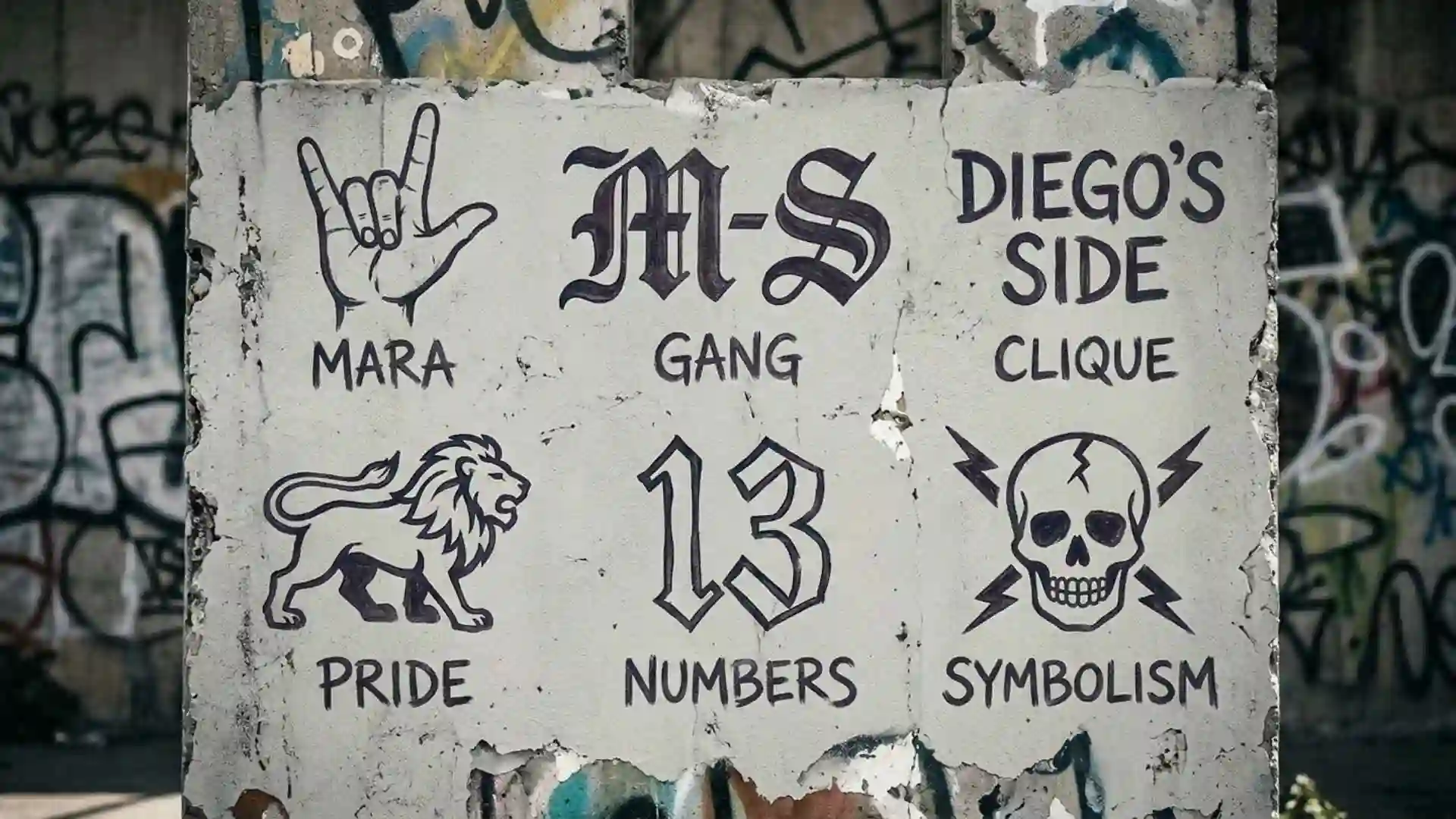
MS-13 symbols have attracted widespread attention because of their connections to gang identity, history, territorial affiliation, and popular culture. MS-13, also known as Mara Salvatrucha, is a transnational criminal gang that originated in Los Angeles during the 1980s. Its name, numbers, lettering, tattoos, and other visual markings have appeared in media reports, law enforcement discussions, documentaries, and crime-related research. Understanding these symbols requires historical and cultural context rather than relying on appearances alone.
Some commonly discussed MS-13 symbols include the number 13, the letters MS, the abbreviation MS-13, and certain tattoo designs. These markings have been associated with gang identification, group affiliation, and personal identity among some members. However, not every number 13 tattoo, hand gesture, letter combination, or similar graphic indicates gang membership. Many symbols have different meanings in other communities, cultures, and everyday situations. Context, usage, and reliable evidence are essential when interpreting them.
In this complete guide to MS-13 symbols and meanings, you will explore the gang’s origins, historical background, commonly reported markings, tattoo associations, and cultural significance. You will also learn about common misconceptions, the difference between gang-related imagery and ordinary symbols, and why visual markings should not be used alone to identify someone. Whether you are researching gang history, studying criminal symbolism, or trying to understand references in news and popular culture, this guide provides a clearer and more balanced explanation.
Quick Answer
MS13 symbols are visual identifiers associated with Mara Salvatrucha, a transnational criminal gang that began in Los Angeles during the 1980s. Common examples include “MS,” “MS13,” “13,” devil-horn imagery, clique initials, and territorial graffiti. Their meanings can involve loyalty, identity, intimidation, neighborhood control, or affiliation, but context is essential.
Quick Facts About MS13 Symbols
| Aspect | Information |
| Origin | Developed within Mara Salvatrucha culture after the gang emerged in 1980s Los Angeles |
| Historical significance | Used to express identity, loyalty, territorial claims, and separation from rival gangs |
| Main meaning | Affiliation with MS13, a local clique, or the wider gang identity |
| Spiritual meaning | No universal spiritual meaning; religious or death-related images may be adopted for fear, identity, or personal belief |
| Cultural importance | Part of modern street-gang culture, not an ancient Salvadoran or Indigenous tradition |
| Modern usage | Tattoos, graffiti, clothing, drawings, online posts, hand signs, and stylized initials |
What Are MS13 Symbols?
MS13 symbols are letters, numbers, images, hand signs, and graffiti associated with Mara Salvatrucha, commonly called MS13. The gang originated among Salvadoran immigrant communities in Los Angeles during the 1980s, a period shaped by civil war, migration, poverty, exclusion, and conflict with established street gangs.
The exact origin of the organization’s name remains debated. “Mara” is widely used as a Central American term for a gang. “Salva” is commonly connected with El Salvador, while “trucha” can suggest being alert, sharp, or streetwise. The number 13 later became part of the gang’s public identity, although explanations for its adoption vary across sources and local histories.
As MS13 expanded, its symbols became more than personal decoration. Graffiti could mark territory, communicate the presence of a clique, warn rivals, or reinforce the idea of “el barrio,” meaning the neighborhood or close social world claimed by the group. Researchers have described the letters M and S as central to the gang’s collective identity, sometimes called “las letras.”
These symbols also changed over time. Large, visible facial and body tattoos were once strongly associated with Central American gang imagery. However, highly visible tattoos attracted police attention and became useful evidence. A federal indictment states that MS13 leaders later restricted some gang tattoos because law enforcement was using them during investigations and trials.
Deep Symbolic Meaning of MS13 Symbols
Social and Group Meaning
The strongest meaning behind MS13 imagery is group belonging. Letters, numbers, and local clique names can communicate that the gang comes before the individual. Symbols may serve as reminders of loyalty, shared enemies, rules, and obligations.
In this setting, a mark is not simply art. It can represent a social contract. To a member, it may suggest belonging to a protective group or substitute family. To residents, rivals, or victims, the same image may communicate surveillance, threat, or control.
Researchers studying MS13 have noted that the idea of “el barrio” can be both physical and psychological. The neighborhood is treated as territory, but also as a place of identity, support, discipline, and fear. Graffiti and public markings help turn that abstract idea into something visible.
Psychological Meaning
Psychologically, gang symbols can meet several human needs: identity, recognition, safety, status, and belonging. Young people who feel excluded may be especially drawn to a group that offers a clear name, visual language, and role.
From a Jungian perspective, such imagery can resemble the shadow archetype, the part of human identity connected with fear, aggression, rebellion, and forbidden power. This does not mean MS13 symbols possess a universal mystical meaning. It means people may use dark or threatening images to project strength and hide vulnerability.
A frightening tattoo may say, “I cannot be harmed,” even when the person carrying it has experienced fear, displacement, poverty, trauma, or coercion.
Spiritual Meaning
MS13 symbols do not have a single recognized spiritual meaning. MS13 is a modern criminal organization, not a spiritual tradition, religion, or ancient symbolic system.
Some individuals connected with gangs may use crosses, praying figures, skulls, demons, the Grim Reaper, or images of Jesus. These may express personal faith, ideas about death, guilt, protection, suffering, or power. However, the same religious image may also be worn by millions of people who have no connection to gangs.
Spiritual imagery must therefore be interpreted carefully. A cross is not an MS13 symbol by itself. A skull is not proof of membership. Meaning depends on the complete design, lettering, location, personal history, and surrounding evidence.
Types and Variations of MS13 Symbols
MS, MS13, and Mara Salvatrucha Lettering
The most direct identifiers are the letters “MS,” the term “MS13,” or the full name “Mara Salvatrucha.” They may appear in block lettering, Gothic script, graffiti-style writing, or highly decorative tattoo designs.
Their basic meaning is identification with the larger gang. In some settings, the letters may also symbolize loyalty to “las letras,” a phrase connected with the collective authority of the M and S identity.
The Number 13
The number 13 is commonly incorporated into tattoos, drawings, clothing, and graffiti connected with MS13. It may appear as “13,” “XIII,” or blended into lettering.
However, 13 is used in many unrelated settings. It appears in popular culture, sports, superstition, music, birth dates, and other gang traditions. The number alone cannot establish affiliation.
Devil Horns and Horned Imagery
Federal court documents have identified devil-horn imagery among symbols associated with MS13. Horns may appear in tattoos, hand gestures, stylized letters, or demonic designs.
Within threatening visual culture, horns can communicate aggression, rebellion, danger, or power. Yet horned imagery also appears in heavy-metal music, fantasy art, religious art, costume design, and ordinary entertainment.
Clique Names and Initials
MS13 is made up of local groups often described as cliques or “clicas.” A tattoo or graffiti tag may therefore include initials, abbreviations, neighborhood names, or geographic references associated with a particular clique.
These local markings can be more specific than the general MS13 name. Their meaning may differ by city, country, prison, or generation, which is one reason symbols should be examined by trained specialists rather than interpreted through online lists alone.
Territorial Graffiti
Graffiti can display the letters MS, the number 13, local clique initials, crossed-out rival symbols, or neighborhood references. Its purpose may include claiming space, intimidating residents, memorializing members, challenging rivals, or advertising presence.
Public markings are especially powerful because they transform a wall, bridge, school route, or street corner into a message about control.
Skulls, Demons, and Death Imagery
Skulls, skeletons, demons, and Grim Reaper figures sometimes appear with gang-associated lettering. They can symbolize mortality, fearlessness, violence, death, or the expectation of a dangerous life.
These designs are not exclusive to MS13. They are common in tattoo culture, biker art, military imagery, music, fashion, and religious traditions.
MS13 Symbols Across Different Cultures
MS13 symbols should not be presented as part of Ancient Egyptian, Greek, Roman, Eastern, or Indigenous symbolic traditions. The gang’s imagery is modern and grew from specific social conditions in Los Angeles and Central America.
Ancient Egypt used skulls, animals, and sacred signs within religious systems about kingship, protection, death, and rebirth. Ancient Greece and Rome used horns, underworld figures, and warrior imagery in mythology. Eastern traditions developed complex meanings for numbers, demons, guardians, and death. Indigenous cultures created symbols tied to land, ancestry, ceremony, and community.
Although MS13 tattoos may borrow general images such as skulls, crosses, or horned figures, visual similarity does not prove historical continuity. Treating gang imagery as an ancient Salvadoran or Indigenous tradition would be inaccurate and could unfairly stigmatize legitimate cultural art.
Modern MS13 symbolism is better understood through migration, urban exclusion, street identity, prison culture, territorial conflict, and group psychology.
Similar Symbols and Their Meanings
| Symbol | Possible MS13 connection | Common non-gang meanings |
| MS or MS13 | Direct gang identifier when used in a clear gang context | Initials, business names, medical abbreviations |
| 13 or XIII | Frequently used in MS13 imagery | Birth date, lucky number, sports number, popular culture |
| Devil horns | May appear in gang gestures or artwork | Rock music, fantasy, humor, religious art |
| Skull | Death, intimidation, danger | Memorial art, fashion, anatomy, military imagery |
| Cross | May be combined with gang lettering | Christian faith, remembrance, family devotion |
| Grim Reaper | Threat, mortality, violent reputation | Tattoo art, film, gaming, literature |
| Graffiti initials | Clique or territorial marking | Artist tag, nickname, school initials |
The main misconception is that one isolated image provides certainty. It does not. The FBI’s Tattoo and Graffiti team compares images with large reference collections and treats symbol analysis as a source of investigative leads, not automatic proof for criminal prosecution.
MS13 Symbols in Mythology and Folklore
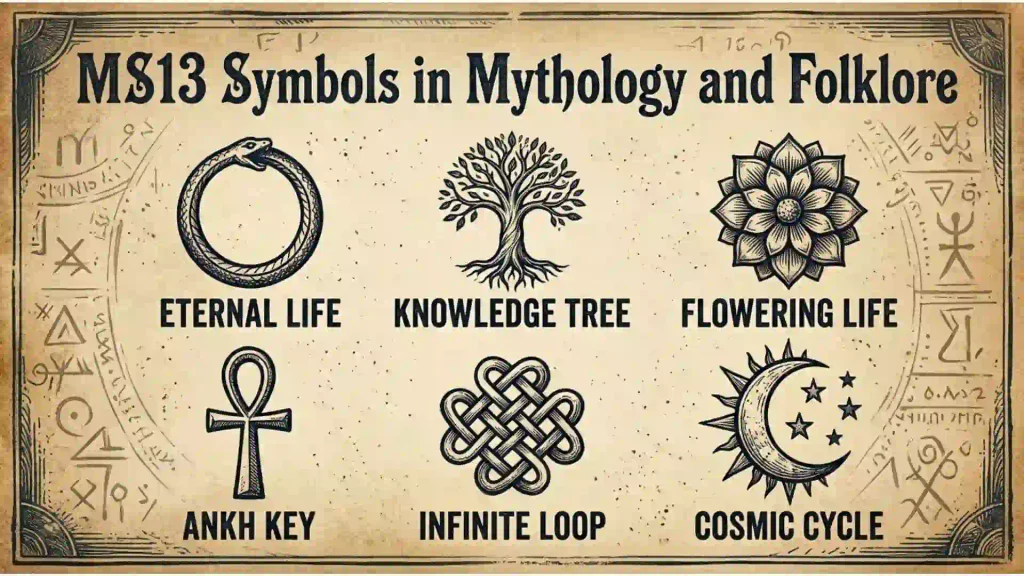
MS13 has no authentic foundation in ancient mythology or folklore. Still, members may borrow familiar images from stories about death, demons, warriors, rebellion, or supernatural power.
The Grim Reaper, for example, comes from European personifications of death. Horned figures appear in many mythologies, but they do not share one universal meaning. Skulls have represented mortality, ancestors, danger, remembrance, and rebirth in different cultures.
When these images enter gang symbolism, their older meanings are often simplified. They become visual tools for intimidation, fearlessness, fatalism, or identity rather than expressions of the original tradition.
MS13 Symbols in Art, Movies, Tattoos, and Pop Culture
News reports, documentaries, films, television dramas, and social media often focus on dramatic facial tattoos and frightening graffiti. This creates an instantly recognizable image, but it can also distort reality.
Not every member has visible tattoos, especially as criminal groups adapt to law-enforcement attention. Likewise, not everyone with a skull, number 13, Gothic lettering, or religious tattoo is connected with MS13. Court records indicate that gang leadership recognized the risks of identifiable tattoos and placed restrictions on them.
In visual storytelling, MS13 imagery often acts as shorthand for violence or urban danger. Responsible media should avoid turning real suffering into spectacle or portraying Central American communities as naturally linked to gang crime.
Spiritual and Dream Meaning of MS13 Symbols
Dreaming about MS13 symbols does not predict gang involvement or future violence. Dreams often use frightening images to represent fear, pressure, vulnerability, conflict, or loss of control.
Seeing threatening graffiti in a dream may reflect anxiety about personal boundaries. A tattoo may symbolize an identity that feels permanent. Being surrounded by symbols could represent social pressure or fear of rejection.
The most useful interpretation begins with the dreamer’s emotions and life situation, not a fixed supernatural dictionary.
Positive and Negative Meanings of MS13 Symbols
| Perceived positive meaning inside a group | Negative meaning in community context |
| Belonging | Coercion |
| Protection | Intimidation |
| Loyalty | Loss of individual freedom |
| Identity | Criminal affiliation |
| Brotherhood | Violent group pressure |
| Recognition | Territorial threat |
A symbol can feel protective to an insider while creating terror for a shopkeeper, student, parent, or neighborhood resident. This contrast shows why symbols cannot be separated from power and consequences.
Why Humans Are Attracted to MS13 Symbols
Humans naturally respond to repeated patterns, shared colors, letters, signs, and stories. Symbols make invisible ideas visible. They can turn loneliness into belonging, fear into a display of strength, and uncertainty into a clear identity.
Gang imagery can be especially attractive when a person lacks safety, respect, family support, or opportunity. The symbol promises recognition, but that promise may come with control, violence, trauma, and severe legal or personal consequences.
Understanding this attraction does not excuse crime. It helps explain why prevention must offer more than punishment. Young people also need safety, education, trusted adults, meaningful work, mental-health support, and a community identity that does not demand violence.
Modern Uses of MS13 Symbols
Today, MS13-related imagery may appear in tattoos, graffiti, handwritten notes, prison drawings, photographs, videos, clothing, and social-media posts.
Its use is less predictable than popular media suggests. Some members avoid obvious markings. Some symbols may be historical rather than evidence of present activity. Others may have been forced onto a person. A Justice Department resource has documented allegations of youths being forcibly tattooed with gang symbols, showing why appearance alone can produce serious injustice.
Anyone concerned about possible gang activity should avoid confronting people, photographing them secretly at close range, or making public accusations. Immediate threats should be reported through appropriate local emergency or law-enforcement channels.
Interesting Facts About MS13 Symbols
- The letters M and S may be described within the gang as “las letras,” emphasizing collective identity.
- Graffiti can mark psychological ownership as well as physical territory.
- Some leaders reportedly restricted visible tattoos after they became useful evidence.
- MS13 imagery is not an ancient Salvadoran symbolic tradition.
- Religious tattoos may reflect faith, fear, identity, or artistic choice and are not proof of gang membership.
- Local clique initials can change the meaning of a larger MS13 design.
- A symbol may be forced onto a victim rather than chosen freely.
- Professional analysts study combinations, context, location, and visual details instead of relying on one image.
- Media portrayals often exaggerate the idea that all members have facial tattoos.
- Common symbols such as 13, skulls, crosses, and horns have many innocent meanings.
Frequently Asked Questions
What are the most common MS13 symbols?
Commonly reported forms include MS, MS13, the number 13, clique initials, devil-horn imagery, hand signs, and territorial graffiti.
Does the number 13 always mean MS13?
No. The number 13 has many personal, artistic, religious, sporting, and cultural meanings. Context and supporting evidence are necessary.
What does MS stand for in MS13?
MS refers to Mara Salvatrucha. The exact historical roots of the complete name are debated, though it is strongly connected with Salvadoran identity and Central American street language.
Are skull tattoos MS13 symbols?
A skull may appear within MS13-related designs, but skull tattoos are extremely common outside gang culture. A skull alone does not indicate gang membership.
Do MS13 symbols have a spiritual meaning?
There is no official universal spiritual meaning. Religious, demonic, or death imagery may reflect personal beliefs, intimidation, identity, guilt, mortality, or artistic preference.
Can a tattoo prove someone belongs to MS13?
No. A tattoo may provide context or an investigative lead, but it should not be treated as conclusive proof without additional reliable evidence.
Conclusion
MS13 symbols are modern signs of identity, loyalty, territory, intimidation, and group power, not ancient or universally spiritual symbols.
Their meaning depends on combinations, local context, personal history, and supporting evidence.
Learning about them can help communities recognize risk while avoiding harmful stereotypes and false accusations.
The most important lesson is simple: symbols can reveal part of a story, but they should never replace careful facts, human judgment, and compassion.
 Michael Rivera