
Logic symbols are special signs used to represent ideas, relationships, statements, and logical operations in a clear and concise way. They appear in mathematics, computer science, philosophy, programming, electronics, and everyday problem-solving. Symbols such as ¬, ∧, ∨, →, ↔, ∀, and ∃ can express complex ideas in just a few characters.
Understanding logic symbols makes it easier to read and create logical statements. Each symbol has a specific meaning, and its interpretation can change depending on the context in which it is used. For example, ∧ commonly represents “and,” while ∨ represents “or,” and → is often used to show implication or a logical “if…then” relationship.
This guide explores the meanings, history, types, examples, and significance of logic symbols in an easy-to-understand way. Whether you are a student learning formal logic, a programmer working with Boolean expressions, or simply curious about the symbols behind logical reasoning, this guide will help you understand what these signs mean and how they are used.
Quick Answer
Logic symbols are special characters used to represent logical concepts such as truth, falsehood, connection, comparison, and reasoning. Common examples include AND (∧), OR (∨), NOT (¬), implication (→), and equivalence (↔). They help philosophers, mathematicians, scientists, and programmers express ideas accurately.
Quick Facts About Logic Symbols
| Aspect | Information |
| Origin | Developed from ancient philosophical reasoning and formalized through modern symbolic logic |
| Historical Significance | Helped transform philosophy and mathematics into precise scientific disciplines |
| Main Meaning | Representation of logical relationships, truth values, and reasoning processes |
| Spiritual Meaning | Symbolic connection to balance, order, truth, and the search for knowledge |
| Cultural Importance | Represents humanity’s desire to understand patterns and discover universal truths |
| Modern Usage | Used in mathematics, programming, artificial intelligence, electronics, and academic research |
What Are Logic Symbols?
Definition of Logic Symbols
Logic symbols are visual signs that represent ideas used in logical reasoning. Instead of writing long sentences, people use symbols to show relationships between statements.
For example:
- “It is raining and it is cold” can be represented using the AND symbol (∧).
- “If it rains, then the ground becomes wet” can be represented using implication (→).
These symbols create a universal system where complex arguments can be analyzed quickly and accurately.
Origin and Historical Background
The roots of logic symbols go back to ancient civilizations and philosophers who studied reasoning. Ancient Greek thinkers, especially Aristotle, created early systems for analyzing arguments. Aristotle’s work on syllogisms became one of the foundations of formal logic.
However, the modern symbolic system developed much later. During the 19th century, mathematicians and philosophers such as George Boole and Gottlob Frege introduced methods that replaced lengthy logical statements with mathematical symbols.
George Boole’s Boolean algebra became especially important because it created the foundation for digital computers. Today, every smartphone, website, and artificial intelligence system depends on logical operations based on these ideas.
Evolution Over Time
Logic symbols evolved from philosophical tools into essential elements of modern technology.
Their journey includes:
- Ancient philosophy and argument analysis
- Mathematical logic in the 1800s
- Computer science and programming in the 1900s
- Artificial intelligence and machine reasoning today
What began as a way to study human thought became a language that helps machines process information.
Deep Symbolic Meaning of Logic Symbols
Spiritual Level
Although logic symbols are mainly scientific tools, they also carry deeper symbolic meanings. They represent humanity’s search for truth, order, and understanding.
Many spiritual traditions value concepts connected to logic:
- Balance between opposing forces
- Harmony between chaos and structure
- The journey from confusion to clarity
- The discovery of hidden patterns in existence
A logical statement often represents the human desire to separate truth from illusion. In this sense, logic symbols symbolize enlightenment through knowledge.
Psychological Level
From a psychological perspective, logic symbols reflect the human need for organization and certainty.
Psychologist Carl Jung explored how symbols influence the human mind. While logic symbols are not traditional archetypal images, they connect with the universal human pattern of seeking meaning and structure.
They appeal to people because they:
- Reduce mental confusion
- Create clear connections between ideas
- Help solve problems
- Provide a sense of control and understanding
The human brain naturally looks for patterns. Logic symbols provide a visual system for recognizing relationships.
Cultural Level
Across cultures, logic represents wisdom and intellectual progress. Societies have always created systems for recording knowledge, from Egyptian writing to Chinese mathematics and Greek philosophy.
Logic symbols became a modern expression of this ancient human tradition. They show how different cultures share one common goal: understanding reality through reason.
Types and Variations of Logic Symbols
Conjunction Symbol (AND, ∧)
Visual Description: A symbol that looks like an upside-down V.
Meaning: Represents that two statements are true together.
Symbolism: Connection, unity, and cooperation.
Cultural Connection: It reflects the human idea that separate parts can combine to create a greater whole.
Where It Appears:
- Mathematics
- Programming languages
- Philosophy
- Digital electronics
Example:
A ∧ B means both A and B must be true.
Disjunction Symbol (OR, ∨)
Visual Description: A symbol shaped like a V.
Meaning: Represents alternatives or choices.
Symbolism: Possibility, freedom, and multiple paths.
Where It Appears:
- Computer programming
- Decision systems
- Mathematical reasoning
Example:
A ∨ B means either A, B, or both can be true.
Negation Symbol (NOT, ¬)
Visual Description: A small angled line placed before a statement.
Meaning: Reverses the truth value of a statement.
Symbolism: Opposition, contrast, and transformation.
Example:
¬A means “not A.”
Implication Symbol (→)
Visual Description: A right-facing arrow.
Meaning: Shows a relationship where one statement leads to another.
Symbolism: Direction, cause, and consequence.
Example:
A → B means if A happens, B follows.
Equivalence Symbol (↔)
Visual Description: Two arrows pointing in opposite directions.
Meaning: Shows that two statements have the same logical value.
Symbolism: Balance, equality, and mutual connection.
Logic Symbols Across Different Cultures
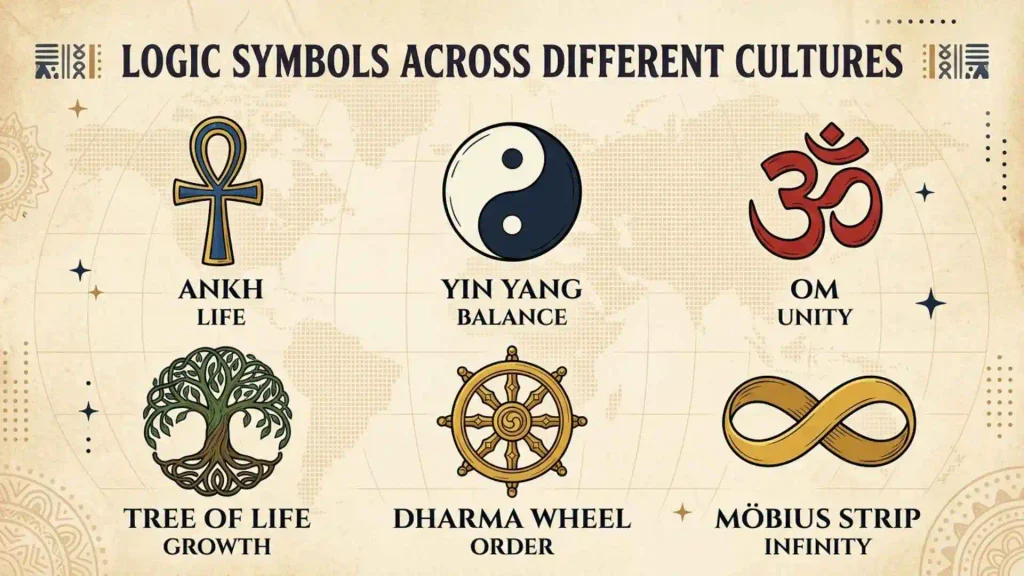
Ancient Egypt
Ancient Egyptians did not use modern logic symbols, but they valued mathematical order and universal balance. The concept of Ma’at represented truth, harmony, and cosmic balance.
Logic symbols share a similar idea by representing order within complex systems.
Ancient Greece
Greek philosophers created the foundation of formal reasoning. Aristotle developed methods for evaluating arguments, which later influenced symbolic logic.
Greek culture connected logic with wisdom and the pursuit of truth.
Roman Culture
Roman thinkers adopted Greek philosophy and spread logical education throughout the Roman Empire. Logic became an important part of rhetoric, law, and political discussion.
Eastern Traditions
Indian and Chinese philosophical traditions developed sophisticated systems of reasoning.
Ancient Indian philosophers explored debate methods and logical classification, while Chinese thinkers examined relationships between ideas and reality.
Indigenous Traditions
Many Indigenous cultures use symbolic systems to represent relationships between humans, nature, and the universe. While different from mathematical logic symbols, these traditions also show humanity’s desire to understand patterns and connections.
Modern Interpretations
Today, logic symbols represent scientific thinking, technology, and global communication. They appear in programming languages, artificial intelligence models, engineering, and academic research.
Similar Symbols and Their Meanings
| Symbol | Meaning | Main Difference |
| ∧ | AND | Requires multiple conditions together |
| ∨ | OR | Allows different possibilities |
| ¬ | NOT | Changes truth value |
| → | Implication | Shows conditional relationships |
| = | Equality | Shows two values are the same |
A common misconception is that all symbols represent mathematical calculations. Many logic symbols describe relationships between ideas rather than numbers.
Logic Symbols in Mythology and Folklore
Ancient myths often explored ideas connected to logic, such as order versus chaos, truth versus deception, and wisdom versus ignorance.
Greek mythology featured figures such as Athena, who represented wisdom and strategic thinking. Stories about divine knowledge often reflected humanity’s desire to understand hidden rules behind existence.
Logic symbols represent a modern version of this ancient search. Instead of mythical explanations, they provide structured methods for discovering truth.
Logic Symbols in Art, Literature, Movies and Pop Culture
Logic symbols appear throughout modern culture because they represent intelligence, mystery, and technology.
Literature
Writers often use logical ideas to explore:
- Human decision-making
- Moral choices
- Cause and effect
- The nature of truth
Movies and Television
Science fiction frequently uses logic concepts when discussing artificial intelligence, robots, and futuristic societies.
Films involving computers often show symbols and mathematical patterns as representations of machine thinking.
Tattoos and Fashion
Some people choose logic symbols as tattoos because they represent:
- Intelligence
- Curiosity
- Rational thinking
- Love of mathematics
- Problem-solving ability
Technology Design
Modern technology companies often use abstract symbols because they communicate innovation and complexity.
Spiritual and Dream Meaning of Logic Symbols
Dreams involving symbols can have personal meanings depending on the dreamer’s experiences.
Possible interpretations include:
| Dream Symbol | Possible Meaning |
| Seeing equations or symbols | Searching for answers |
| Solving logical problems | Finding clarity in life |
| Confusing symbols | Feeling uncertain or overwhelmed |
| Perfect patterns | Desire for balance and order |
Spiritually, logic symbols may represent the journey from uncertainty toward understanding.
Positive and Negative Meanings of Logic Symbols
| Positive Meaning | Negative Meaning |
| Wisdom | Overthinking |
| Clarity | Emotional distance |
| Truth | Lack of flexibility |
| Organization | Excessive control |
| Understanding | Ignoring intuition |
A symbol itself is neutral. Its meaning depends on how humans use and interpret it.
Why Humans Are Attracted to Logic Symbols
Humans naturally search for patterns. Logic symbols satisfy this need by turning invisible thoughts into visible structures.
They attract people because they create a feeling of discovery. A simple symbol can represent an entire idea, argument, or system.
Throughout history, humans have created symbols to store knowledge. Logic symbols continue this tradition by becoming a language of reasoning.
Modern Uses of Logic Symbols
Education
Students learn logic symbols in mathematics, philosophy, computer science, and critical thinking courses.
Programming
Programming languages depend heavily on logical operators such as AND, OR, and NOT.
Artificial Intelligence
AI systems use logical concepts to process information, make decisions, and analyze relationships.
Engineering
Electronic circuits rely on logic gates that use the same principles represented by logic symbols.
Personal Expression
People use logic symbols in artwork, jewelry, and designs to represent intelligence and curiosity.
Interesting Facts About Logic Symbols
- Boolean logic created the foundation for modern computer systems.
- Logic symbols allow ideas to be communicated without relying on spoken language.
- The symbol ∧ is often called the logical conjunction operator.
- Ancient philosophy influenced the development of modern symbolic logic.
- Logic is considered one of the foundations of mathematics and computer science.
- Artificial intelligence systems use logical principles when analyzing information.
- Logic symbols appear in programming, electronics, mathematics, and philosophy.
Frequently Asked Questions
What are the most common logic symbols?
The most common logic symbols are AND (∧), OR (∨), NOT (¬), implication (→), and equivalence (↔).
Why are logic symbols important?
Logic symbols make complex ideas easier to express, analyze, and communicate. They are essential in mathematics, science, and technology.
Who invented logic symbols?
No single person invented all logic symbols. They developed over centuries through the work of philosophers and mathematicians, including Aristotle, Boole, and Frege.
Are logic symbols used in programming?
Yes. Programming languages use logical operators to create decisions, conditions, and automated processes.
Do logic symbols have spiritual meanings?
Logic symbols are mainly scientific tools, but they can symbolize truth, balance, knowledge, and humanity’s search for understanding.
Conclusion
Logic symbols are more than simple marks on a page. They represent humanity’s endless search for truth, order, and knowledge. From ancient philosophy to artificial intelligence, these symbols have shaped how humans think and communicate. They connect ideas, reveal patterns, and transform complex reasoning into clear expressions. Behind every symbol is a story of curiosity, discovery, and the human desire to understand the world.
 Sarah Thompson
 John Mercer