

SF Symbols are a collection of thousands of icons designed by Apple for use in apps and digital interfaces. They provide developers and designers with a consistent way to represent common actions, objects, concepts, and system functions. From simple icons for search and settings to symbols for communication, transportation, accessibility, and media, SF Symbols are now an important part of Apple’s visual design language.
Understanding SF Symbols meanings can help you recognize what different icons communicate and why they appear in specific places. Each symbol is designed with Apple’s interface guidelines in mind, so its shape, weight, scale, and visual style can work naturally alongside text and other interface elements. Some symbols have straightforward meanings, while others can carry broader visual or symbolic associations depending on how they are used.
In this complete guide, you’ll learn about the history of SF Symbols, their meanings, categories, common uses, design principles, and hidden symbolism. We’ll also look at how these icons are used across Apple platforms and why consistent symbols can make digital experiences easier to understand. Whether you are an Apple user, designer, developer, or simply curious about the icons you see every day, this guide will help you understand SF Symbols more clearly.
Quick Answer: What Are SF Symbols?
SF Symbols are a collection of over 5,000 customizable icons created by Apple for use in apps, websites, and digital interfaces. They provide consistent symbols for actions, objects, and concepts while supporting different weights, sizes, colors, and accessibility features across Apple platforms.
Quick Facts About SF Symbols
| Aspect | Information |
| Origin | Created by Apple and introduced in 2019 with iOS 13 |
| Historical Significance | Changed digital icon design by creating a unified symbol system |
| Main Meaning | Visual communication through simple, recognizable icons |
| Spiritual Meaning | Represents connection, clarity, and universal human understanding |
| Cultural Importance | Shows how symbols create shared digital languages |
| Modern Usage | Used in iOS, macOS, watchOS, and app design |
What Are SF Symbols?
Definition of SF Symbols
SF Symbols are a library of icons developed by Apple to help designers and developers create clear and consistent user interfaces. The “SF” name comes from Apple’s San Francisco typeface, which is the foundation of Apple’s modern design system.
Unlike traditional icons that are separate images, SF Symbols are designed like a font. They can adjust naturally with text, changing size and weight while maintaining visual balance.
For example, a simple heart symbol, location pin, camera icon, or message bubble can appear in different styles without losing its original meaning.
Origin and Historical Background
Apple introduced SF Symbols at the Worldwide Developers Conference (WWDC) in 2019. The goal was to solve a common problem in interface design: inconsistency.
Before SF Symbols, designers often created custom icons for every application. This created different visual languages across apps. Users had to learn new symbols repeatedly.
Apple created SF Symbols to establish a universal system where symbols would feel familiar across devices.
The system was inspired by several historical ideas:
- Typography and letter design
- Ancient symbolic communication
- Wayfinding systems
- Modern graphic design principles
Just as road signs help drivers understand information quickly, digital symbols help users navigate technology.
Evolution of SF Symbols
Since their introduction, SF Symbols have expanded significantly. New versions have added thousands of icons representing:
- Technology
- Nature
- Transportation
- Communication
- Health
- Education
- Finance
- Entertainment
- Accessibility
Apple continues improving SF Symbols by adding more expressive designs and supporting new technologies.
Deep Symbolic Meaning of SF Symbols
Spiritual Level: Symbols as Universal Language
Although SF Symbols are technological creations, their deeper meaning connects with an ancient human tradition: using symbols to communicate beyond words.
Throughout history, humans have used symbols to represent ideas that are difficult to explain verbally.
Examples include:
- Ancient Egyptian hieroglyphs
- Religious symbols
- Tribal markings
- Navigation symbols
- Mathematical signs
SF Symbols continue this tradition in the digital age.
A simple icon can represent:
- Connection through a network symbol
- Protection through a shield icon
- Knowledge through a book symbol
- Communication through a message icon
These designs transform complex ideas into understandable visual experiences.
Psychological Level: Why Humans Understand Symbols
Psychologists have studied how humans naturally recognize patterns and images.
Carl Jung, a famous Swiss psychiatrist, explored the idea of archetypes. He believed certain symbols appear repeatedly across human cultures because they connect with shared psychological experiences.
SF Symbols work because they use familiar visual patterns.
For example:
- A magnifying glass represents searching
- A trash can represents deletion
- A house represents home
- A bell represents notifications
People understand these symbols quickly because the brain connects images with previous experiences.
Cultural Level: Digital Symbols and Society
Symbols create shared understanding between people from different backgrounds.
A person in Japan, Brazil, Germany, or the United States can often understand the meaning of a play button, Wi-Fi symbol, or camera icon without reading text.
SF Symbols contribute to a global digital culture where visual communication crosses language barriers.
Types and Variations of SF Symbols
Interface and Navigation Symbols
Visual Description
These symbols represent common actions inside applications.
Examples include:
- Home icons
- Back arrows
- Search symbols
- Menu icons
- Navigation indicators
Meaning and Symbolism
Navigation symbols represent movement, direction, and control.
A simple arrow suggests progress or change. A home symbol represents safety and familiarity.
Cultural Connection
Navigation symbols connect with ancient human needs for exploration and orientation.
They appear in:
- Maps
- Architecture
- Transportation systems
- Digital interfaces
Communication Symbols
Visual Description
These include icons related to human interaction.
Examples:
- Messages
- Phone calls
- Video communication
Meaning and Symbolism
Communication symbols represent connection between individuals.
A message bubble is not just an icon. It represents conversation, relationships, and social interaction.
Where They Appear
Communication symbols appear in:
- Social media platforms
- Mobile applications
- Messaging services
- Collaboration tools
Nature and Environmental Symbols
Visual Description
SF Symbols include icons representing:
- Trees
- Weather
- Animals
- Plants
- Natural elements
Symbolic Meaning
Nature symbols represent life, growth, balance, and environmental awareness.
They connect modern technology with the natural world.
Object-Based Symbols
These symbols represent physical items:
- Cameras
- Cars
- Books
- Computers
- Tools
They help users understand digital functions by connecting them with real-world objects.
SF Symbols Across Different Cultures
Ancient Egypt
Ancient Egyptians created one of history’s most famous symbolic systems through hieroglyphs.
Symbols represented:
- Life
- Protection
- Power
- Spiritual beliefs
The ankh symbol represented life, while the eye of Horus represented protection.
Like SF Symbols, Egyptian symbols transformed complex concepts into simple visual forms.
Ancient Greece
Greek culture used symbols extensively in mythology, philosophy, and mathematics.
Examples include:
- The owl representing wisdom
- The laurel representing victory
- Greek letters representing scientific ideas
Greek symbols influenced modern communication systems.
Roman Culture
Romans used symbols for:
- Authority
- Military identity
- Public communication
Roman numerals, legal symbols, and architectural signs continue influencing modern design.
Eastern Traditions
Eastern cultures have rich symbolic traditions.
Examples include:
- Yin-yang representing balance
- Lotus representing spiritual growth
- Mandalas representing harmony
These traditions show how symbols can communicate philosophical ideas.
Indigenous Traditions
Many Indigenous cultures use symbols to preserve stories, identity, and spiritual knowledge.
Symbols appear in:
- Artwork
- Clothing
- Ceremonial objects
- Storytelling traditions
Like digital icons, these symbols communicate meaning quickly.
Modern Interpretations
Modern society has created a new symbolic language through technology.
SF Symbols represent this modern evolution where digital icons become everyday communication tools.
Similar Symbols and Their Meanings
| Symbol Type | Meaning | Difference from SF Symbols |
| Emojis | Emotional expression | More personal and informal |
| Logos | Brand identity | Represent companies or organizations |
| Road Signs | Public instructions | Used mainly in physical spaces |
| SF Symbols | Digital interaction | Designed for user interfaces |
SF Symbols are often confused with emojis, but their purposes are different.
Emojis express feelings and ideas, while SF Symbols guide actions and improve usability.
SF Symbols in Mythology and Folklore
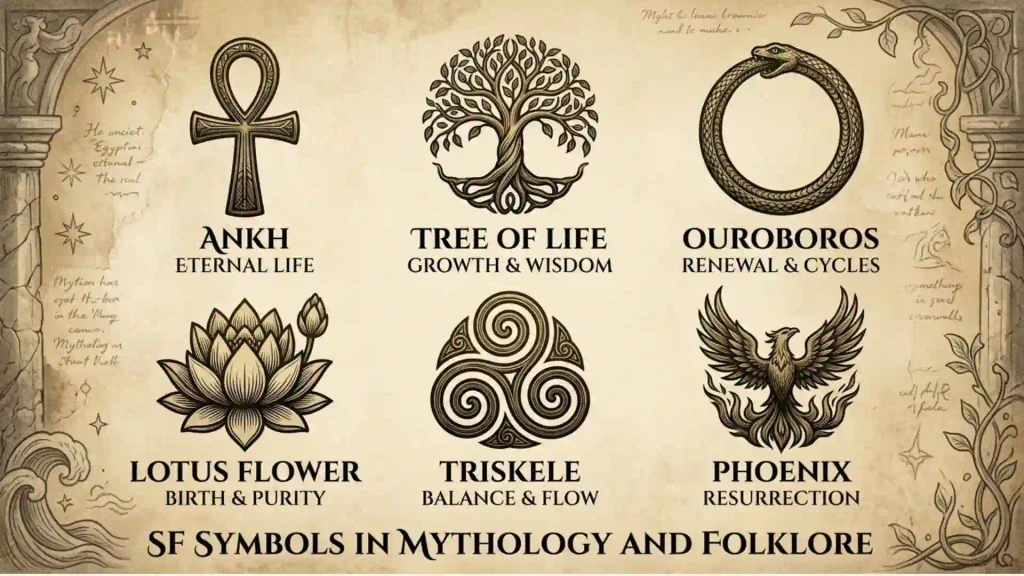
Although SF Symbols are modern creations, they follow the same principles found in ancient myths.
Human societies have always created visual shortcuts for important ideas.
A shield icon today has a similar symbolic purpose to protective symbols found in ancient cultures.
A star symbol connects with ancient beliefs about:
- Guidance
- Hope
- The universe
- Dreams
Technology has not removed symbolism. It has simply created a new environment for it.
SF Symbols in Art, Literature, Movies, and Pop Culture
Digital Design
SF Symbols have become important tools for modern interface designers.
They appear in:
- Mobile applications
- Software interfaces
- Websites
- Smart devices
Literature and Visual Storytelling
Symbols have always helped writers communicate deeper meanings.
A key may represent opportunity. A door may represent change. A light may represent knowledge.
Digital symbols follow the same storytelling tradition.
Movies and Entertainment
Modern films often use symbolic imagery:
- Warning icons
- Technology symbols
- Interface graphics
These symbols help audiences understand futuristic worlds.
Tattoos and Personal Expression
Some people choose digital-inspired symbols as tattoos because they represent:
- Technology
- Creativity
- Modern identity
- Connection
Spiritual and Dream Meaning of SF Symbols
Because SF Symbols are digital rather than ancient spiritual symbols, dream interpretations depend on personal experience.
Seeing digital symbols in dreams may represent:
- Communication needs
- Desire for clarity
- Searching for answers
- Connection with others
A symbol appearing repeatedly in dreams may reflect something the mind considers important.
Positive and Negative Meanings of SF Symbols
| Positive Meaning | Negative Meaning |
| Communication | Information overload |
| Connection | Digital dependence |
| Clarity | Oversimplification |
| Innovation | Loss of personal expression |
| Accessibility | Technology dependence |
A symbol itself is neutral. Its meaning depends on how humans use and interpret it.
Why Humans Are Attracted to SF Symbols
Humans naturally prefer simple patterns that provide quick understanding.
SF Symbols attract people because they offer:
- Instant recognition
- Visual simplicity
- Emotional familiarity
- Universal communication
A well-designed symbol reduces confusion and creates confidence.
In a world filled with information, symbols provide moments of clarity.
Modern Uses of SF Symbols
App Development
Developers use SF Symbols to create consistent Apple applications.
They help improve:
- User experience
- Accessibility
- Visual design
Branding
Although SF Symbols are not brand logos, companies use similar symbolic principles when creating identities.
Strong brands often rely on memorable visual elements.
Social Media
Modern platforms depend heavily on symbols:
- Like icons
- Share buttons
- Notification symbols
- Profile indicators
Home and Personal Design
Digital symbols influence modern aesthetics through:
- Wallpapers
- Digital artwork
- Product design
Interesting Facts About SF Symbols
- Apple introduced SF Symbols in 2019 alongside iOS 13.
- SF Symbols are designed to work alongside Apple’s San Francisco font.
- The symbols can change weight and size while maintaining alignment.
- Designers use SF Symbols to improve accessibility.
- SF Symbols are available in thousands of variations.
- They represent a modern evolution of ancient symbolic communication.
- Many symbols are inspired by objects people already recognize.
- SF Symbols help reduce language barriers in digital experiences.
Frequently Asked Questions
What are SF Symbols used for?
SF Symbols are used to create consistent icons in Apple applications, improving navigation, accessibility, and user experience.
Are SF Symbols free to use?
SF Symbols are available from Apple for use in apps designed for Apple platforms, following Apple’s licensing guidelines.
Are SF Symbols the same as emojis?
No. Emojis express emotions and ideas, while SF Symbols mainly represent actions, objects, and interface functions.
Who created SF Symbols?
SF Symbols were created by Apple as part of its design system for iOS and other Apple platforms.
Why are symbols important in technology?
Symbols help people understand digital actions quickly without depending on written language.
Conclusion
SF Symbols show how ancient human communication methods have evolved into modern digital languages. These small icons combine design, psychology, history, and technology to make complex ideas easier to understand.
From ancient hieroglyphs to smartphone interfaces, symbols continue shaping how humans connect with the world. SF Symbols represent the future of visual communication, where simplicity creates powerful meaning.
 Sarah Thompson
 John Mercer