
Star symbols have fascinated people for thousands of years. Across ancient civilizations, religions, cultures, and modern societies, stars have been used to represent hope, guidance, protection, wisdom, destiny, and the mysteries of the universe. A simple star can carry very different meanings depending on its shape, number of points, cultural setting, and the way it is used.
In ancient history, people looked to the night sky for more than beauty. Stars helped communities track seasons, navigate long journeys, understand celestial events, and connect earthly life with the heavens. Over time, star symbols appeared in religious traditions, mythology, art, architecture, flags, jewelry, tattoos, literature, and spiritual practices, giving them layers of historical and cultural meaning.
Today, star symbolism remains just as powerful. A star may represent new beginnings, personal growth, ambition, divine guidance, remembrance, or a desire to reach something greater. In this guide, we’ll explore the history and meanings behind star symbols, including their spiritual significance, cultural interpretations, different star shapes, and why these timeless symbols continue to capture human imagination.
Quick Answer
Star symbols are visual representations of stars that symbolize guidance, hope, protection, spirituality, achievement, and connection with the universe. Across cultures, star symbols have appeared in religion, mythology, navigation, art, and personal expression, often representing light in darkness, dreams, and higher knowledge.
Quick Facts About Star Symbols
| Aspect | Information |
| Origin | Ancient civilizations observed stars in the night sky and created symbolic representations of them |
| Historical Significance | Used in astronomy, religion, navigation, royalty, and cultural traditions |
| Main Meaning | Guidance, hope, achievement, protection, and inspiration |
| Spiritual Meaning | Connection with higher consciousness, divine energy, and inner wisdom |
| Cultural Importance | Found in Egyptian, Greek, Roman, Islamic, Indigenous, and modern cultures |
| Modern Usage | Used in logos, tattoos, jewelry, flags, fashion, art, and digital communication |
What Are Star Symbols?
Star symbols are artistic representations of stars used to communicate ideas, beliefs, and emotions. While a star can simply represent a celestial object, humans have always given stars deeper meanings because of their beauty, distance, and mysterious nature.
Since ancient times, people have looked at the night sky and searched for meaning among the stars. Before modern technology, stars helped civilizations understand seasons, travel across oceans, and create calendars. Over time, these practical uses developed into rich symbolic traditions.
Ancient Egyptians connected stars with the afterlife and divine beings. The Greeks associated stars with gods, heroes, and legendary stories. Many cultures viewed stars as signs from the heavens, believing they carried messages from spiritual forces.
The evolution of star symbols continued through history. A simple five-pointed star, known as a pentagram, became connected with different religious and philosophical ideas. A six-pointed star became strongly associated with Jewish identity through the Star of David. Crescent and star combinations became important symbols in several cultures.
Today, star symbols continue to represent ambition, dreams, success, and personal identity.
Deep Symbolic Meaning of Star Symbols
Spiritual Meaning of Star Symbols
On a spiritual level, star symbols often represent divine guidance, enlightenment, and connection with something greater than ourselves.
Many spiritual traditions view stars as reminders that light exists even during darkness. A person looking at a star-filled sky may feel a sense of peace, wonder, and connection with the universe.
Stars are commonly linked with:
- Higher wisdom
- Spiritual awakening
- Hope during difficult times
- Protection from negative energy
- Inner transformation
In many beliefs, stars represent the journey of the soul. They symbolize the idea that humans are always searching for knowledge, purpose, and meaning.
Psychological Meaning of Star Symbols
Psychologically, star symbols connect with powerful human emotions and universal patterns.
Swiss psychiatrist Carl Jung explored the idea of archetypes, suggesting that certain symbols appear repeatedly across human cultures because they reflect shared experiences of the human mind.
Stars can represent:
- Dreams and ambitions
- Personal growth
- Recognition and success
- A desire to stand out
- Hope for the future
People are naturally attracted to stars because they combine beauty with mystery. A star is small when viewed from Earth, yet it represents something enormous in the universe. This contrast reflects the human desire to achieve greatness despite feeling small.
Cultural Meaning of Star Symbols
Across societies, star symbols have represented identity, beliefs, and collective values.
For example:
- A star on a flag may represent unity or national pride.
- A star in religious art may represent divine presence.
- A star in jewelry may represent personal dreams.
- A star in literature may symbolize destiny.
The meaning of a star depends greatly on the culture and context where it appears.
Types and Variations of Star Symbols
Five-Pointed Star
Visual Description: A star with five points, commonly called a five-point star.
Meaning: The five-pointed star is one of the most recognized symbols worldwide.
Symbolism:
- Balance
- Protection
- Human potential
- Achievement
Cultural Connection:
The five-pointed star has appeared in ancient Mesopotamian writings, European traditions, military symbols, and national flags.
Where It Appears:
- Flags
- Military badges
- Religious artwork
- Jewelry
- Tattoos
Pentagram
Visual Description: A five-pointed star drawn with five connected lines.
Meaning: The pentagram has carried different meanings throughout history.
Symbolism:
- Harmony
- The elements of nature
- Spiritual balance
Cultural Connection:
Ancient Greek philosophers, including followers of Pythagoras, viewed the pentagram as a symbol of mathematical perfection.
Where It Appears:
- Ancient philosophy
- Modern spiritual practices
- Art and design
Six-Pointed Star
Visual Description: Two overlapping triangles forming a six-pointed star.
Meaning: Often recognized as the Star of David.
Symbolism:
- Faith
- Unity
- Protection
- Relationship between heaven and earth
Cultural Connection:
The symbol became strongly associated with Jewish identity and appears on the flag of Israel.
Where It Appears:
- Synagogues
- Religious artwork
- Cultural symbols
Eight-Pointed Star
Visual Description: A star with eight points.
Meaning: Often represents balance, renewal, and cosmic order.
Symbolism:
- Harmony
- Regeneration
- Infinity
Cultural Connection:
Eight-pointed stars appear in Islamic art, architecture, and decorative patterns.
Where It Appears:
- Mosques
- Traditional artwork
- Geometric designs
Shooting Star
Visual Description: A star with a trail showing movement across the sky.
Meaning: Represents wishes, dreams, and sudden opportunities.
Symbolism:
- Change
- Hope
- New beginnings
Cultural Connection:
Many cultures believe seeing a shooting star is a special moment connected with wishes or good fortune.
Where It Appears:
- Stories
- Children’s literature
- Jewelry
- Popular culture
Star Symbols Across Different Cultures
Ancient Egypt
Ancient Egyptians had a deep relationship with stars. They believed certain stars were connected with gods and the journey after death.
The goddess Nut, often shown covering the sky, was associated with the heavens and stars. Egyptians also believed stars represented eternal life because they appeared to disappear and return every night.
Stars were included in temple ceilings and tomb decorations as symbols of divine connection and immortality.
Ancient Greece
Greek mythology connected stars with gods, heroes, and legendary stories.
Many constellations were created from Greek myths. Stories about heroes such as Orion and figures like the Pleiades became permanently connected with the stars.
For Greeks, stars represented:
- Divine stories
- Heroic achievements
- Destiny
Roman Culture
Romans adopted many Greek ideas about stars and astronomy. Stars were associated with gods, emperors, and victory.
Roman leaders sometimes used celestial imagery to show power and connection with divine forces.
A star could represent:
- Glory
- Authority
- Success
Eastern Traditions
In many Eastern cultures, stars have been connected with spiritual balance and cosmic order.
Chinese traditions used stars in astrology and believed celestial patterns influenced human experiences.
Indian traditions also placed importance on stars through Vedic astrology, where celestial bodies were connected with personality, destiny, and spiritual understanding.
Indigenous Traditions
Many Indigenous cultures viewed stars as important guides and storytellers.
For example, Native American traditions often connected stars with ancestors, creation stories, and navigation.
The night sky was not only a scientific subject but also a spiritual map filled with meaning.
Modern Interpretations
Today, star symbols represent:
- Personal dreams
- Achievement
- Creativity
- Identity
- Hope
They appear everywhere from technology brands to tattoos and social media designs.
Similar Symbols and Their Meanings
| Symbol | Similarity to Star Symbols | Main Difference |
| Sun Symbol | Represents light and energy | Connected more with power and life force |
| Moon Symbol | Represents the sky and mystery | Often linked with emotions and cycles |
| Compass Symbol | Represents guidance | Focuses on direction rather than inspiration |
| Angel Symbol | Represents spiritual connection | More directly connected with divine beings |
Star symbols are often confused with sun symbols because both represent light. However, stars usually represent guidance, dreams, and distant possibilities, while the sun often represents strength, energy, and life.
Star Symbols in Mythology and Folklore
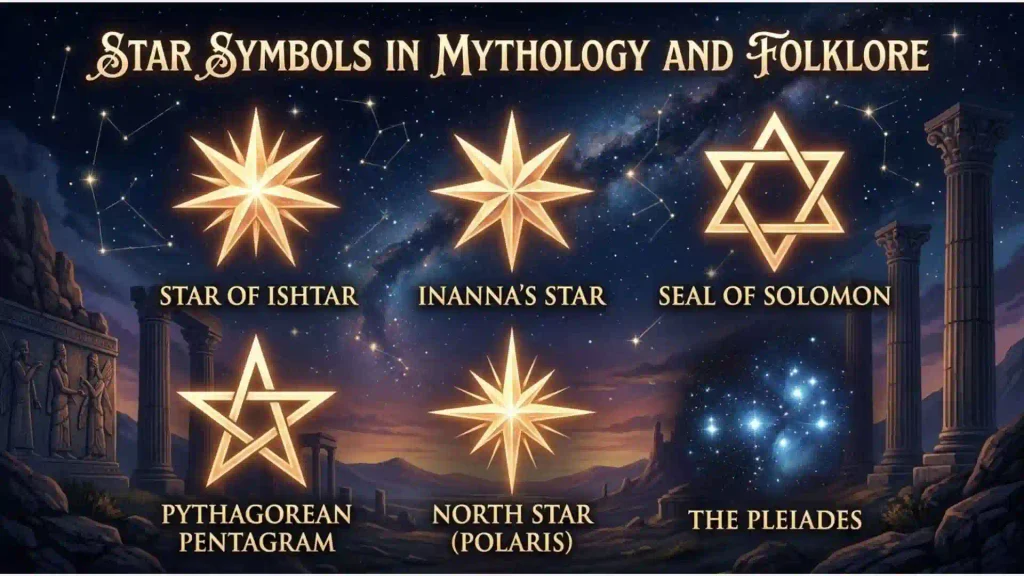
Stars appear in countless myths around the world.
In Greek mythology, many constellations were created from stories of gods and heroes. The stars became permanent reminders of these legends.
In Aboriginal Australian traditions, the stars form important parts of Dreamtime stories. The night sky preserves cultural knowledge, history, and spiritual teachings.
In many folk traditions, stars are believed to influence human destiny. The idea of someone being a “rising star” comes from the ancient connection between stars and greatness.
Stars have also been used as symbols of wishes. The phrase “wish upon a star” became popular because people associated rare celestial events with magical possibilities.
Star Symbols in Art, Literature, Movies, and Pop Culture
Artists have used stars to express imagination, emotion, and spiritual ideas.
In paintings, stars often represent:
- Hope
- Mystery
- Divine inspiration
The famous painting The Starry Night uses swirling stars to express emotion, movement, and the connection between humanity and the universe.
In literature, stars often symbolize dreams and destiny. Writers frequently use stars as metaphors for guidance and unreachable goals.
In movies and television, stars appear in:
- Fantasy worlds
- Space stories
- Hero journeys
- Magical themes
In modern fashion and tattoos, star symbols often represent personal achievements, memories, or life goals.
Spiritual and Dream Meaning of Star Symbols
Dreaming about star symbols is often interpreted as a sign of hope, inspiration, or personal growth.
Common interpretations include:
Seeing Bright Stars
May symbolize:
- Success
- Positive changes
- New opportunities
Reaching for Stars
Often represents:
- Ambition
- Big dreams
- Desire for improvement
Falling Stars
May represent:
- Change
- Unexpected events
- New beginnings
Spiritual interpretations vary, but many people see star dreams as reminders to follow their inner purpose.
Positive and Negative Meanings of Star Symbols
| Positive Meaning | Negative Meaning |
| Hope | Unrealistic expectations |
| Guidance | Feeling distant or unreachable |
| Achievement | Desire for attention |
| Inspiration | Pride or ego |
| Spiritual connection | Confusion about direction |
A symbol does not have one fixed meaning. Its interpretation depends on personal experiences, cultural background, and the situation where it appears.
Why Humans Are Attracted to Star Symbols
Humans have always looked upward for answers. Stars represent something beyond ordinary life.
Their attraction comes from several psychological reasons:
- They remind people of dreams and possibilities.
- They create feelings of wonder and curiosity.
- They connect individuals with ancient human experiences.
- They represent light during difficult moments.
A star is both familiar and mysterious. Everyone can see one, yet no one can fully touch it. This combination makes star symbols emotionally powerful.
Modern Uses of Star Symbols
Tattoos
Star tattoos are popular because they allow people to express:
- Personal journeys
- Goals
- Memories
- Spiritual beliefs
Jewelry
Star necklaces, rings, and bracelets often symbolize protection, beauty, and dreams.
Fashion
Designers use stars to create feelings of confidence, creativity, and uniqueness.
Branding
Companies use star symbols to communicate:
- Quality
- Excellence
- Trust
- Success
Home Decor
Star patterns are often used to create peaceful and inspiring environments.
Social Media
Stars are commonly used as emojis and digital symbols to show excitement, admiration, or achievement.
Interesting Facts About Star Symbols
- Ancient sailors used stars for navigation before modern technology existed.
- The word “disaster” comes from a Latin phrase meaning “bad star,” showing the historical connection between stars and fate.
- The five-pointed star is one of the most common symbols on national flags.
- Many ancient civilizations built structures aligned with stars.
- The Star of David became widely recognized as a Jewish symbol during the modern era.
- Shooting stars are not actually stars but pieces of space material burning in Earth’s atmosphere.
- Stars have inspired countless myths, poems, songs, and artworks throughout history.
- Many cultures viewed stars as ancestors watching over humanity.
Frequently Asked Questions
What do star symbols represent?
Star symbols commonly represent hope, guidance, success, dreams, spirituality, and connection with the universe.
What is the spiritual meaning of star symbols?
Spiritually, star symbols often represent enlightenment, divine guidance, inner wisdom, and personal transformation.
Why are star symbols used in tattoos?
People choose star tattoos to represent goals, achievements, protection, memories, and important life experiences.
Are all star symbols positive?
Not always. While stars usually have positive meanings, some interpretations connect them with pride, unrealistic dreams, or confusion depending on context.
What is the most famous star symbol?
The five-pointed star is one of the most recognized star symbols worldwide, while the Star of David is among the most culturally significant.
Conclusion
Star symbols are more than simple shapes. They are powerful reminders of human dreams, beliefs, and curiosity about the universe. From ancient temples and myths to modern tattoos and designs, stars continue to guide and inspire people. Their timeless meaning comes from the human desire to find light, purpose, and connection in a vast world. Every star symbol carries a story waiting to be discovered.
 John Mercer
 Michael Rivera