
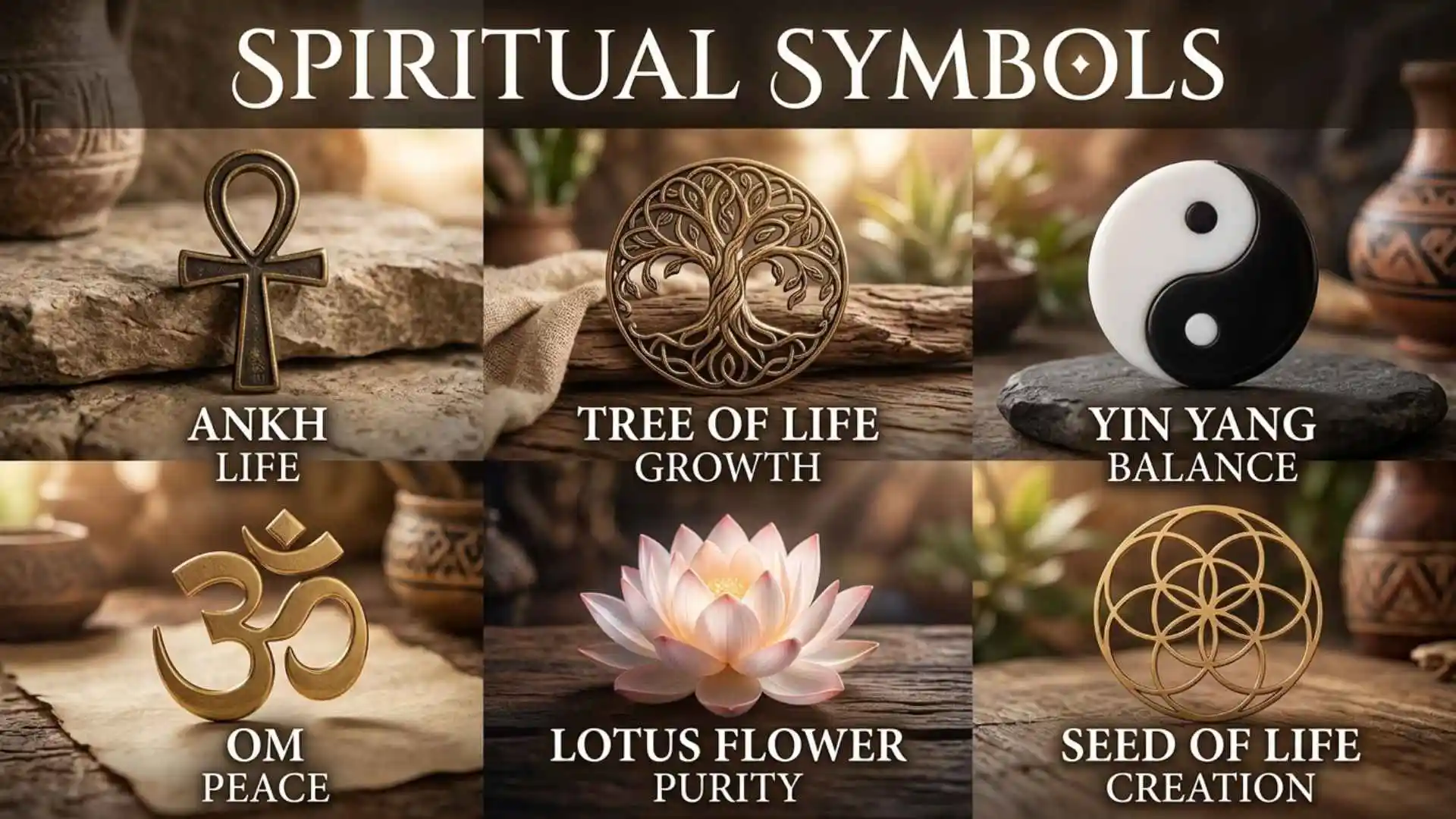
Spiritual symbols have been used for thousands of years to express ideas that words sometimes cannot fully explain. From the lotus flower and Om symbol to the cross, mandala, crescent moon, and ancient geometric patterns, these signs can represent faith, protection, transformation, wisdom, balance, and connection to something greater. Their meanings often come from religious traditions, mythology, nature, and cultural practices passed down through generations.
What makes spiritual symbols fascinating is that the same shape or image can carry different meanings across cultures and belief systems. A circle, for example, may represent eternity, unity, wholeness, or the cycle of life, while a tree can symbolize growth, connection, strength, and spiritual grounding. Understanding these meanings requires looking at the history and cultural context behind each symbol rather than assuming that every symbol has one universal interpretation.
In this guide, we’ll explore the most meaningful spiritual symbols, their ancient origins, traditional interpretations, and the ideas they represent in human life. Whether you are researching symbolism for personal reflection, art, tattoos, meditation, literature, or cultural study, these symbols can offer a deeper way to understand concepts such as peace, protection, love, healing, transformation, spirituality, and inner strength.
Quick Answer
Spiritual symbols are meaningful signs, shapes, objects, or images that represent deeper spiritual ideas such as connection, protection, enlightenment, healing, transformation, and divine energy. They have been used across religions, cultures, mythology, and personal practices to express beliefs, emotions, and the relationship between humans and the universe.
Quick Facts About Spiritual Symbols
| Aspect | Information |
| Origin | Ancient civilizations used symbols to represent spiritual beliefs, natural forces, and divine concepts. |
| Historical Significance | Spiritual symbols appeared in Egyptian temples, Greek mythology, Eastern philosophies, and indigenous traditions. |
| Main Meaning | They represent ideas such as life, death, rebirth, protection, wisdom, and spiritual connection. |
| Spiritual Meaning | They often symbolize inner growth, consciousness, enlightenment, and the search for higher understanding. |
| Cultural Importance | Different societies created unique symbols to preserve traditions, stories, and sacred knowledge. |
| Modern Usage | Today, they appear in tattoos, jewelry, meditation practices, artwork, branding, and personal expression. |
What Are Spiritual Symbols?
Definition of Spiritual Symbols
Spiritual symbols are visual representations that carry meanings beyond their physical appearance. A simple shape, animal, object, or pattern can communicate complex ideas about spirituality, faith, nature, and human existence.
For example, a circle may represent eternity and the endless cycle of life, while a lotus flower may symbolize purity and spiritual awakening. These meanings are not always universal, but many cultures share similar interpretations because humans often use symbols to understand invisible concepts.
Origin and Historical Background
The history of spiritual symbols reaches back to prehistoric times. Early humans painted animals, geometric patterns, and mysterious signs on cave walls, suggesting a desire to connect with nature, ancestors, and spiritual forces.
Ancient civilizations developed more complex symbolic systems. Egyptians used symbols such as the Ankh to represent life, while Hindu and Buddhist traditions developed sacred symbols connected to consciousness, balance, and enlightenment.
Over centuries, spiritual symbols evolved through religion, philosophy, mythology, and cultural exchange. Although their meanings changed in different societies, their purpose remained similar: helping humans communicate ideas that words alone could not fully express.
Why Spiritual Symbols Became Important
Symbols became important because they provided a bridge between the physical world and spiritual beliefs. Many cultures believed that symbols could offer protection, represent divine power, or guide individuals through personal transformation.
A symbol could carry the memory of an entire tradition. A single image could tell stories about creation, morality, human struggles, and the search for wisdom.
Deep Symbolic Meaning of Spiritual Symbols
Spiritual Level
On a spiritual level, symbols represent the connection between human consciousness and something greater than ourselves. They often appear in meditation, prayer, rituals, and sacred ceremonies.
Many spiritual traditions use symbols as tools for reflection. Looking at a meaningful symbol can help people focus their thoughts, develop awareness, and explore their inner world.
For example, the mandala in Hinduism and Buddhism represents the universe and spiritual harmony. Meditating on a mandala can encourage balance, mindfulness, and a deeper understanding of existence.
Spiritual symbols often represent:
- Inner transformation
- Divine connection
- Protection from negative energy
- Personal growth
- Enlightenment
- Balance between physical and spiritual life
Psychological Level
Psychologist Carl Jung explored the importance of symbols through his theory of archetypes and the collective unconscious. Jung believed that certain symbols appear repeatedly across cultures because they represent shared patterns of human experience.
For example:
- The tree often represents growth, knowledge, and connection between earth and sky.
- The circle represents wholeness and completion.
- The journey symbol represents personal development and transformation.
Humans are naturally attracted to symbols because the brain searches for patterns and meanings. A symbol can create emotional responses because it connects with memories, beliefs, and personal experiences.
Cultural Level
Every culture develops spiritual symbols that reflect its history and worldview. These symbols help communities preserve traditions and communicate shared values.
A symbol can represent:
- Religious beliefs
- Ancestral wisdom
- Cultural identity
- Moral teachings
- Historical experiences
For many indigenous communities, symbols are not simply decorations. They are living expressions of connection between humans, nature, ancestors, and the spiritual world.
Types and Variations of Spiritual Symbols
The Ankh
Visual Description: A cross-like symbol with a loop at the top.
Meaning: Life, immortality, and eternal existence.
Symbolism: The Ankh represents the balance between male and female energies and the continuation of life beyond physical existence.
Cultural Connection: Ancient Egyptians used the Ankh in temples, artwork, and royal ceremonies.
Where It Appears:
- Egyptian mythology
- Ancient artwork
- Jewelry
- Modern spiritual designs
The Lotus Flower
Visual Description: A flower rising from muddy water.
Meaning: Purity, awakening, and spiritual growth.
Symbolism: The lotus represents the ability to overcome challenges and become spiritually stronger.
Cultural Connection: It is deeply connected with Hinduism and Buddhism.
Where It Appears:
- Meditation practices
- Religious artwork
- Sacred texts
- Tattoos
The Yin Yang Symbol
Visual Description: A circle divided into two flowing halves, one dark and one light.
Meaning: Balance and harmony.
Symbolism: It represents the relationship between opposite forces such as light and darkness, masculine and feminine, and activity and rest.
Cultural Connection: It comes from Chinese philosophy, especially Taoism.
Where It Appears:
- Philosophy
- Martial arts
- Meditation
- Modern design
The Tree of Life
Visual Description: A tree with spreading branches and deep roots.
Meaning: Growth, wisdom, connection, and eternal life.
Symbolism: The tree represents the connection between heaven, earth, and the underworld.
Cultural Connection: Similar concepts appear in Norse mythology, Celtic traditions, Judaism, and many indigenous cultures.
Where It Appears:
- Mythology
- Religious traditions
- Jewelry
- Home decoration
The Mandala
Visual Description: A circular geometric pattern.
Meaning: Unity, balance, and the structure of the universe.
Symbolism: Mandalas represent spiritual journeys and inner harmony.
Cultural Connection: Common in Hindu and Buddhist practices.
Where It Appears:
- Meditation
- Temple artwork
- Psychology
- Modern coloring practices
Spiritual Symbols Across Different Cultures
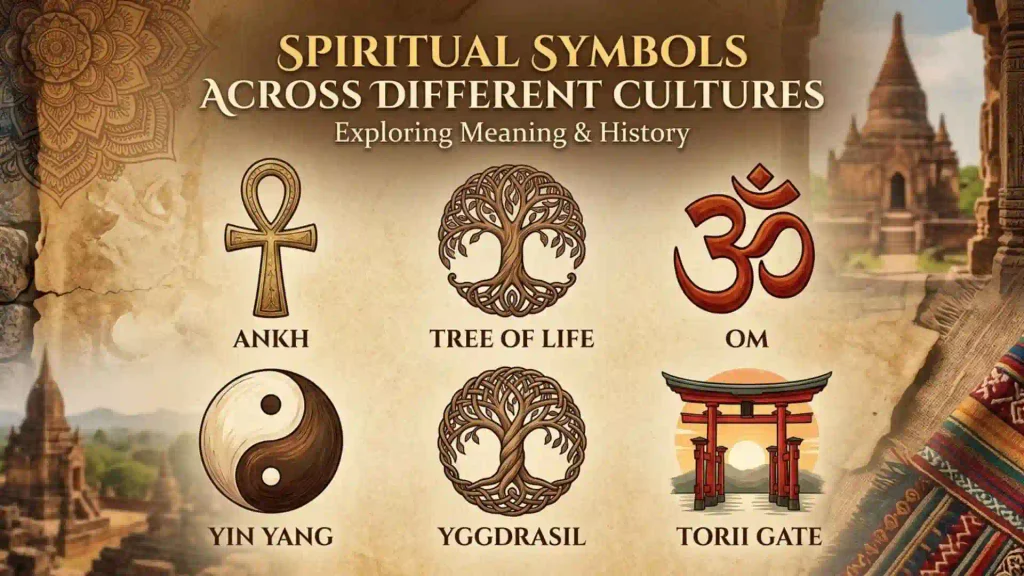
Ancient Egypt
Ancient Egyptians created some of the world’s most recognizable spiritual symbols. Their symbols reflected beliefs about life, death, and the afterlife.
The Ankh represented eternal life, while the Eye of Horus symbolized protection, healing, and restoration. Egyptian symbols were often placed in temples and burial sites because they were believed to carry spiritual power.
Ancient Greece
Greek culture connected symbols with gods, myths, and human virtues.
The owl represented wisdom through its association with Athena, the goddess of wisdom. The laurel wreath symbolized victory and honor, while the serpent represented healing and transformation.
Greek mythology influenced later Western interpretations of symbolism, literature, and art.
Roman Culture
Romans adopted and transformed many Greek symbols while adding their own meanings.
Symbols such as the eagle represented power and authority, while the laurel wreath became a sign of achievement and leadership.
Roman spiritual symbolism often connected with ideas of strength, destiny, and divine approval.
Eastern Traditions
Eastern philosophies contain some of the richest spiritual symbolism in history.
Hinduism uses symbols such as Om, the lotus flower, and mandalas to represent consciousness and universal energy. Buddhism uses symbols like the Dharma wheel to represent spiritual teachings and the path toward enlightenment.
Taoism emphasizes balance through the Yin Yang symbol, showing harmony between opposing forces.
Indigenous Traditions
Many indigenous cultures view symbols as connections between humans, nature, and ancestors.
Animals, natural elements, and geometric patterns often represent spiritual guidance. The eagle, for example, is considered sacred in many Native American traditions and symbolizes vision, strength, and connection with the spiritual world.
Modern Interpretations
Today, spiritual symbols continue to evolve. People use them for meditation, personal identity, emotional healing, and artistic expression.
Modern interpretations often combine ancient meanings with personal experiences.
Similar Symbols and Their Meanings
| Symbol | Similar Meaning | Main Difference |
| Circle | Unity, eternity, completeness | Focuses mainly on wholeness and cycles |
| Lotus | Growth and transformation | Specifically represents rising above difficulties |
| Tree of Life | Connection and wisdom | Emphasizes growth and relationships |
| Mandala | Balance and harmony | Represents spiritual structure and meditation |
| Yin Yang | Balance | Focuses on opposing forces working together |
Many spiritual symbols share similar themes because humans across cultures often explore the same questions about life, purpose, and existence.
Spiritual Symbols in Mythology and Folklore
Mythology is filled with symbolic meanings. Ancient stories used symbols to explain creation, human nature, and the relationship between people and the divine.
The Phoenix, for example, represents rebirth because ancient legends describe a bird that rises again from its ashes. This symbol continues to represent renewal and overcoming hardship.
The serpent appears in many traditions. It can represent healing, wisdom, transformation, or danger depending on cultural context.
The world tree appears in Norse mythology as Yggdrasil, a cosmic tree connecting different realms of existence. Similar concepts appear in many cultures, showing humanity’s shared fascination with life, connection, and the universe.
Spiritual Symbols in Art, Literature, Movies and Pop Culture
Spiritual symbols have influenced creativity for centuries.
Paintings and Art
Artists use spiritual symbols to express emotions, beliefs, and philosophical ideas. Religious paintings often include symbolic colors, animals, and objects to communicate deeper meanings.
Literature and Poetry
Writers use symbols to explore themes such as identity, death, love, transformation, and hope.
A journey in literature often symbolizes personal growth, while darkness and light frequently represent struggles between fear and understanding.
Movies and Television
Modern films often use spiritual symbolism to create deeper stories.
Common examples include:
- Circles representing cycles of time
- Birds representing freedom
- Water representing emotional transformation
- Light representing knowledge or hope
Tattoos and Fashion
Many people choose spiritual symbols as tattoos because they represent personal beliefs, life experiences, or emotional connections.
Jewelry featuring symbols such as the lotus, tree of life, or mandala allows people to carry meaningful reminders with them.
Spiritual and Dream Meaning of Spiritual Symbols
Dreams involving spiritual symbols are often interpreted as reflections of personal emotions, beliefs, and unconscious thoughts.
Common interpretations include:
- Seeing a circle may represent completion or a new beginning.
- Seeing a tree may represent growth and stability.
- Seeing light may symbolize hope, awareness, or spiritual discovery.
- Seeing wings may represent freedom and personal transformation.
However, dream meanings are personal. The same symbol can have different meanings depending on someone’s experiences and cultural background.
Positive and Negative Meanings of Spiritual Symbols
| Positive Meaning | Negative Meaning |
| Protection | Fear or misunderstanding |
| Wisdom | Misinterpretation |
| Growth | Resistance to change |
| Healing | Emotional struggles |
| Transformation | Loss of old identity |
A spiritual symbol does not always represent only positive or negative ideas. Like life itself, symbols often contain both light and shadow.
Why Humans Are Attracted to Spiritual Symbols
Humans are naturally drawn to symbols because they help explain experiences that are difficult to describe.
Symbols create emotional connections because they:
- Connect people with traditions
- Provide personal meaning
- Represent hopes and fears
- Create a sense of belonging
- Help people understand life changes
A person may choose a symbol because it reminds them of healing after hardship, a spiritual journey, or an important personal belief.
Symbols become powerful because humans give them meaning.
Modern Uses of Spiritual Symbols
Tattoos
Spiritual tattoos allow people to express identity, beliefs, memories, and personal transformation.
Jewelry
Necklaces, rings, and bracelets featuring spiritual symbols are often worn as reminders of protection, strength, or inner peace.
Fashion and Design
Modern designers use spiritual patterns because they combine beauty with deeper meanings.
Branding
Some companies use symbolic imagery to communicate ideas such as trust, harmony, nature, or creativity.
Social Media
People share spiritual symbols online as expressions of mindfulness, personal growth, and inspiration.
Home Decor
Symbols such as mandalas and the tree of life are popular in home spaces because they create feelings of balance and connection.
Interesting Facts About Spiritual Symbols
- The Ankh was one of the most important symbols in ancient Egypt and appeared thousands of years ago.
- The lotus flower grows in muddy water, which is why many cultures connect it with overcoming challenges.
- The Yin Yang symbol does not represent good versus evil but rather balance between different forces.
- Mandalas have been used for centuries as meditation tools.
- The Tree of Life appears in many unrelated cultures, showing similar human ideas about connection and existence.
- Carl Jung studied symbols because he believed they revealed deep patterns in the human mind.
- Many modern tattoos are inspired by ancient spiritual symbols.
- Symbols can change meaning depending on culture, history, and personal interpretation.
Frequently Asked Questions
What are the most common spiritual symbols?
Some common spiritual symbols include the Ankh, lotus flower, mandala, Yin Yang, Tree of Life, Om symbol, and Eye of Horus.
Why are spiritual symbols important?
Spiritual symbols help people express beliefs, connect with traditions, explore emotions, and understand deeper aspects of life.
Do spiritual symbols have the same meaning everywhere?
No. A symbol can have different meanings depending on cultural background, religion, history, and personal experiences.
Are spiritual symbols connected to psychology?
Yes. Psychologists such as Carl Jung studied symbols because they often represent universal human experiences and unconscious patterns.
Can spiritual symbols appear in dreams?
Yes. Many people interpret spiritual symbols in dreams as reflections of emotions, personal growth, and inner thoughts.
Conclusion
Spiritual symbols are powerful reminders of humanity’s search for meaning, connection, and understanding. From ancient temples to modern tattoos, these symbols continue to inspire people across cultures. They represent deep ideas about life, transformation, balance, and consciousness. Every symbol carries a story, and every person may discover a unique meaning within it.
 Sarah Thompson
 John Mercer