
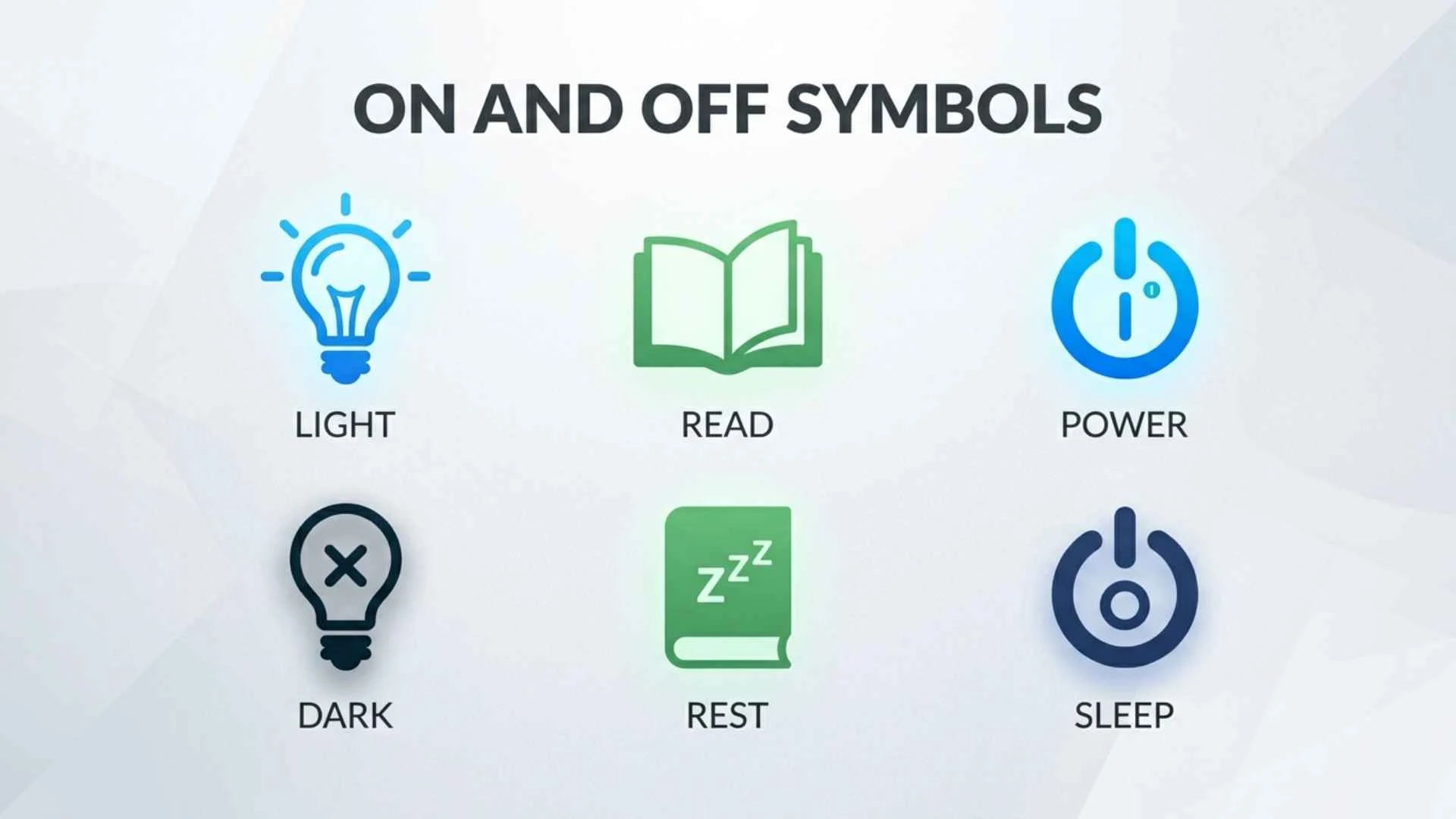
On and off symbols are among the most familiar signs in modern life. You can find them on phones, computers, appliances, vehicles, power buttons, apps, and electronic devices. Although these simple symbols often look like nothing more than controls for turning something on or off, they also have an interesting history and meaning that connects technology, design, psychology, and human communication.
The most recognizable power symbol combines a circle with a vertical line, while related on and off symbols may appear as separate lines, circles, switches, or icons. Their designs developed from older electrical and engineering markings and later became standardized for use across different devices. Because symbols can communicate an action without words, these signs have become a universal part of modern visual language.
Beyond their practical purpose, on and off symbols can also carry symbolic and psychological meanings. “On” may suggest activity, energy, connection, awareness, or readiness, while “off” can represent rest, silence, disconnection, or pause. Understanding these meanings helps explain why such simple symbols are so powerful and why they continue to appear in technology, art, design, culture, and everyday communication.
Quick Answer: What Are On and Off Symbols?
On and off symbols are universal icons used to show whether a device, system, or function is active or inactive. The most common power symbol combines a broken circle and vertical line, representing the connection and interruption of electrical flow. These symbols help people quickly understand control, energy, and operation.
Quick Facts About On and Off Symbols
| Aspect | Information |
| Origin | Developed from electrical engineering symbols and binary concepts |
| Historical Significance | Became widely used with the growth of electronic devices in the 20th century |
| Main Meaning | Represents activation, deactivation, connection, and separation |
| Spiritual Meaning | Can symbolize balance between action and stillness, energy and rest |
| Cultural Importance | Recognized globally as a universal language of technology |
| Modern Usage | Found on computers, phones, appliances, vehicles, websites, and digital interfaces |
What Are On and Off Symbols?
Definition of On and Off Symbols
On and off symbols are visual signs that communicate whether something is functioning, powered, connected, or stopped. They are examples of universal symbols, meaning people can understand their purpose regardless of language.
The most recognizable on and off symbol is the power button icon:
- A circle represents a complete cycle or continuous state.
- A vertical line represents interruption, activation, or a connection point.
- Together, they show the ability to switch between two states.
These symbols are based on the idea of binary states, where something exists as either active or inactive.
Origin and Historical Background
The history of on and off symbols is closely connected to the development of electricity and electronic technology. Early electrical equipment used simple written labels such as “ON” and “OFF.” However, as technology expanded globally, designers needed symbols that could be understood without translation.
During the 20th century, engineers developed standardized icons to simplify machine controls. Organizations such as the International Electrotechnical Commission (IEC) helped establish internationally recognized symbols for electrical equipment.
The power symbol became popular because it visually explained the idea of a circuit being connected or disconnected.
Evolution Over Time
Originally, these symbols appeared on industrial machines and laboratory equipment. Later, they moved into everyday life through:
- Televisions
- Radios
- Computers
- Smartphones
- Gaming consoles
- Smart home devices
- Vehicles
Today, the on and off symbols have become part of the global visual language of technology.
Deep Symbolic Meaning of On and Off Symbols
Spiritual Level of On and Off Symbols
Symbolism of Energy and Balance
On and off symbols can represent the natural rhythm of existence. Many spiritual traditions describe life as a balance between opposite forces:
- Activity and rest
- Light and darkness
- Creation and silence
- Movement and stillness
The “on” state may represent energy, awareness, and action, while the “off” state can represent reflection, peace, and renewal.
Connection With Inner Transformation
Spiritually, switching something on can symbolize awakening or gaining awareness. Turning something off may represent releasing distractions and returning to inner calm.
Many meditation practices focus on moving between external activity and internal silence. In this sense, the symbol becomes a reminder that humans need both action and rest.
Psychological Level of On and Off Symbols
Human Attraction to Simple Patterns
Psychologically, people naturally respond to simple and recognizable patterns. The human brain prefers symbols that communicate quickly without requiring explanation.
On and off symbols work because they create immediate understanding. A person does not need to read instructions to know that a button controls power.
Jungian Symbolism and Opposite Forces
Psychologist Carl Jung explored the importance of symbols and opposites in the human unconscious. The idea of on and off reflects a common human experience of duality.
Examples include:
- Consciousness and unconsciousness
- Awareness and ignorance
- Action and inactivity
- Order and chaos
The symbol represents the human desire to control transitions between different states.
Cultural Level of On and Off Symbols
Universal Meaning Across Societies
Unlike many cultural symbols, on and off symbols have a relatively consistent global meaning. A person in Japan, Brazil, Egypt, or the United States can usually understand the symbol without translation.
This makes it one of the strongest examples of modern universal communication.
Symbolism in Daily Life
People interact with these symbols when they:
- Start a computer
- Turn on lights
- Activate appliances
- Control vehicles
- Manage digital accounts
Although they appear ordinary, these symbols represent human control over technology.
Types and Variations of On and Off Symbols
Power Button Symbol
Visual Description:
A circle with a vertical line extending from the top.
Meaning:
Represents turning a device on or off.
Symbolism:
Shows control, energy flow, and connection.
Cultural Connection:
Used globally in electronics and digital technology.
Where It Appears:
- Computers
- Phones
- Televisions
- Appliances
- Gaming systems
Standby Symbol
Visual Description:
A circle with a small vertical line that does not fully interrupt the circle.
Meaning:
Represents a device being ready but not fully active.
Symbolism:
Shows a middle state between operation and shutdown.
Where It Appears:
- Remote controls
- Electronic devices
- Energy-saving systems
Toggle Switch Symbol
Visual Description:
A switch showing two positions.
Meaning:
Represents choosing between two options.
Symbolism:
Shows decision-making and control.
Where It Appears:
- Software settings
- Mobile applications
- Websites
Digital Binary Symbols
Visual Description:
Usually represented as 1 and 0.
Meaning:
- 1 = on
- 0 = off
Symbolism:
Represents the foundation of modern computing.
Where It Appears:
- Programming
- Computer science
- Digital electronics
On and Off Symbols Across Different Cultures
Ancient Egypt
Ancient Egyptian culture often focused on concepts of balance, cycles, and transformation. Although Egyptians did not use modern electronic symbols, their beliefs included ideas similar to the meaning behind on and off states.
The concept of life and death, darkness and light, was central in Egyptian mythology. The daily journey of the sun god Ra represented cycles of renewal and movement between different states.
Ancient Greece
Greek philosophy explored opposites such as:
- Being and non-being
- Order and chaos
- Activity and rest
Philosophers such as Heraclitus discussed constant change and transformation. The idea behind on and off symbols connects with this ancient understanding of shifting states.
Roman Culture
Romans used symbols and signs extensively for communication, administration, and engineering. Their approach to organized systems influenced modern ideas of standardized symbols.
While they did not have electrical icons, their use of visual communication helped shape later symbolic traditions.
Eastern Traditions
Many Eastern philosophies emphasize balance between opposing forces.
Examples include:
- Yin and yang in Chinese philosophy
- Meditation and awareness practices
- Cycles of energy and rest
The relationship between active and inactive states closely reflects these ideas.
Indigenous Traditions
Many Indigenous cultures view nature as a cycle of movement and stillness. Seasons, day and night, and natural rhythms demonstrate similar concepts of switching between states.
The modern interpretation of on and off symbols connects with this universal human understanding of change.
Modern Interpretations
Today, on and off symbols represent:
- Digital control
- Human interaction with machines
- Personal boundaries
- Energy management
- Technological progress
They have become symbols of modern life itself.
Similar Symbols and Their Meanings
| Symbol | Meaning | Difference |
| On and Off Symbol | Control between active and inactive states | Mainly related to technology |
| Yin Yang Symbol | Balance between opposite forces | Represents harmony rather than control |
| Circle Symbol | Completion and unity | Does not always indicate power |
| Lightning Symbol | Energy and electricity | Represents power rather than switching |
| Pause Symbol | Temporary stopping | Does not mean complete shutdown |
Common Misconceptions About On and Off Symbols
Some people believe the power symbol only means “off.” However, it actually represents the ability to switch between two states.
Another misunderstanding is that all power-related symbols are identical. Different industries may use variations depending on their purpose.
On and Off Symbols in Mythology and Folklore
Although modern on and off symbols are technological creations, their meaning connects with ancient stories about transformation.
Many myths describe characters moving between different states:
- Heroes becoming enlightened
- Gods controlling natural forces
- Humans experiencing rebirth
- Darkness changing into light
These stories reflect the same human fascination with transitions and transformation.
The symbolic idea of turning something on resembles awakening, while turning something off resembles rest, disappearance, or entering another state.
On and Off Symbols in Art, Literature, Movies, and Pop Culture
In Art
Artists often explore themes of contrast:
- Light versus darkness
- Movement versus stillness
- Presence versus absence
The concept behind on and off symbols fits naturally into these artistic ideas.
In Literature
Writers frequently use transformation as a theme. Characters may experience moments where they “switch on” their awareness or “switch off” emotions.
In Movies and Television
Technology-based stories often use these symbols to represent:
- Artificial intelligence activation
- Machines waking up
- Systems shutting down
- Control over powerful technology
In Tattoos and Fashion
Some people use power symbols as tattoos because they represent:
- Strength
- Personal control
- New beginnings
- Digital identity
Spiritual and Dream Meaning of On and Off Symbols
Dream Interpretation
Seeing an on and off symbol in dreams may represent personal choices or changes.
Possible meanings include:
Turning something on:
- New opportunities
- Increased awareness
- Creativity
- Personal growth
Turning something off:
- Need for rest
- Ending a chapter
- Removing distractions
- Emotional protection
Meditation and Spiritual Experiences
During meditation, people often explore states of awareness and silence. The symbolism of on and off reflects the movement between active thinking and peaceful consciousness.
Positive and Negative Meanings of On and Off Symbols
| Positive Meaning | Negative Meaning |
| Control | Loss of connection |
| Awareness | Isolation |
| New beginnings | Ending something important |
| Energy | Exhaustion |
| Transformation | Resistance to change |
| Balance | Lack of action |
A symbol does not have a single meaning. Its interpretation depends on context, culture, and personal experience.
Why Humans Are Attracted to On and Off Symbols
Humans have always searched for ways to understand complex ideas quickly. Symbols help transform complicated concepts into simple visual messages.
The attraction comes from several psychological factors:
Human Need for Control
People feel safer when they can influence their environment. A power button represents the ability to control technology.
Pattern Recognition
The human brain is designed to recognize patterns quickly. Simple symbols communicate faster than written instructions.
Cultural Memory
Symbols become powerful because generations of people learn and share their meanings.
Personal Connection
For some people, these symbols represent independence, technology, creativity, or personal transformation.
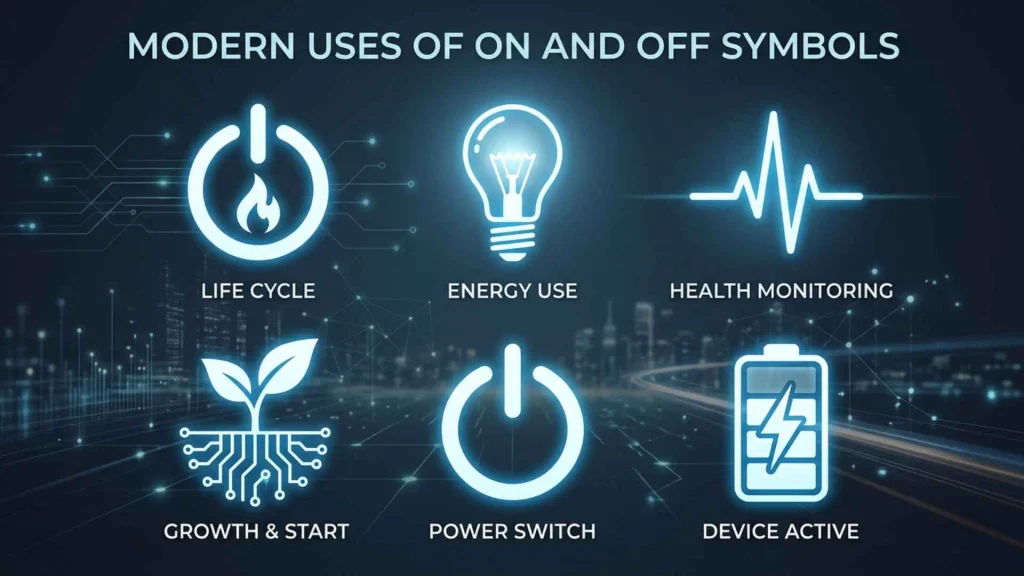
Modern Uses of On and Off Symbols
Technology
The most common use remains electronic devices:
- Computers
- Smartphones
- Smart watches
- Appliances
Branding
Technology companies often use power-related imagery because it suggests innovation and connection.
Social Media
Digital platforms use similar concepts through:
- Online status indicators
- Active and inactive modes
- Availability settings
Home Design
Modern interior designs sometimes include technology-inspired symbols because they represent futuristic lifestyles.
Personal Expression
People use these symbols to express:
- Love of technology
- Personal growth
- Control over life choices
Interesting Facts About On and Off Symbols
- The modern power symbol became widely recognized because global technology needed universal instructions.
- The symbol combines ideas from electrical engineering and binary computing.
- The circle and line design represents connection and interruption.
- The symbol appears on billions of devices worldwide.
- Many people recognize the power icon faster than written words.
- The symbol has become part of modern visual culture.
- Similar ideas of switching between states appear in ancient philosophies.
- The power symbol is considered one of the most successful examples of universal design.
Frequently Asked Questions
What do on and off symbols mean?
On and off symbols show whether a device, system, or function is active or inactive. They represent control, energy, and transition between states.
Why is the power symbol a circle and line?
The circle represents a continuous cycle, while the line represents a break or connection point in an electrical system.
Are on and off symbols universal?
Yes, the power symbol is widely recognized worldwide because it was designed for international understanding.
What do on and off symbols represent spiritually?
Spiritually, they can represent balance between action and rest, awareness and silence, or transformation and renewal.
Why are symbols important in human communication?
Symbols allow people to understand ideas quickly without relying on language, making communication faster and more universal.
Conclusion
On and off symbols are more than simple buttons on electronic devices. They represent humanity’s relationship with energy, technology, control, and transformation. From ancient ideas of balance to modern digital systems, these symbols reflect the universal human experience of change. Their simplicity hides a deeper message: every action has a moment of beginning, and every movement requires a moment of rest.
Meta Description
On and Off Symbols: Hidden Meanings, History, Psychology, and Modern Uses Explained
On and off symbols are simple signs that appear everywhere, yet they carry powerful meanings about connection, control, energy, and human interaction. From ancient ideas of opening and closing to modern digital technology, these symbols represent the relationship between action and rest. You see them daily on devices, machines, apps, and systems, often without thinking about their deeper meaning. This guide explores the history, symbolism, psychology, and cultural importance behind these familiar signs.
Quick Answer: What Are On and Off Symbols?
On and off symbols are universal icons used to show whether a device, system, or function is active or inactive. The most common power symbol combines a broken circle and vertical line, representing the connection and interruption of electrical flow. These symbols help people quickly understand control, energy, and operation.
Quick Facts About On and Off Symbols
| Aspect | Information |
| Origin | Developed from electrical engineering symbols and binary concepts |
| Historical Significance | Became widely used with the growth of electronic devices in the 20th century |
| Main Meaning | Represents activation, deactivation, connection, and separation |
| Spiritual Meaning | Can symbolize balance between action and stillness, energy and rest |
| Cultural Importance | Recognized globally as a universal language of technology |
| Modern Usage | Found on computers, phones, appliances, vehicles, websites, and digital interfaces |
What Are On and Off Symbols?
Definition of On and Off Symbols
On and off symbols are visual signs that communicate whether something is functioning, powered, connected, or stopped. They are examples of universal symbols, meaning people can understand their purpose regardless of language.
The most recognizable on and off symbol is the power button icon:
- A circle represents a complete cycle or continuous state.
- A vertical line represents interruption, activation, or a connection point.
- Together, they show the ability to switch between two states.
These symbols are based on the idea of binary states, where something exists as either active or inactive.
Origin and Historical Background
The history of on and off symbols is closely connected to the development of electricity and electronic technology. Early electrical equipment used simple written labels such as “ON” and “OFF.” However, as technology expanded globally, designers needed symbols that could be understood without translation.
During the 20th century, engineers developed standardized icons to simplify machine controls. Organizations such as the International Electrotechnical Commission (IEC) helped establish internationally recognized symbols for electrical equipment.
The power symbol became popular because it visually explained the idea of a circuit being connected or disconnected.
Evolution Over Time
Originally, these symbols appeared on industrial machines and laboratory equipment. Later, they moved into everyday life through:
- Televisions
- Radios
- Computers
- Smartphones
- Gaming consoles
- Smart home devices
- Vehicles
Today, the on and off symbols have become part of the global visual language of technology.
Deep Symbolic Meaning of On and Off Symbols
Spiritual Level of On and Off Symbols
Symbolism of Energy and Balance
On and off symbols can represent the natural rhythm of existence. Many spiritual traditions describe life as a balance between opposite forces:
- Activity and rest
- Light and darkness
- Creation and silence
- Movement and stillness
The “on” state may represent energy, awareness, and action, while the “off” state can represent reflection, peace, and renewal.
Connection With Inner Transformation
Spiritually, switching something on can symbolize awakening or gaining awareness. Turning something off may represent releasing distractions and returning to inner calm.
Many meditation practices focus on moving between external activity and internal silence. In this sense, the symbol becomes a reminder that humans need both action and rest.
Psychological Level of On and Off Symbols
Human Attraction to Simple Patterns
Psychologically, people naturally respond to simple and recognizable patterns. The human brain prefers symbols that communicate quickly without requiring explanation.
On and off symbols work because they create immediate understanding. A person does not need to read instructions to know that a button controls power.
Jungian Symbolism and Opposite Forces
Psychologist Carl Jung explored the importance of symbols and opposites in the human unconscious. The idea of on and off reflects a common human experience of duality.
Examples include:
- Consciousness and unconsciousness
- Awareness and ignorance
- Action and inactivity
- Order and chaos
The symbol represents the human desire to control transitions between different states.
Cultural Level of On and Off Symbols
Universal Meaning Across Societies
Unlike many cultural symbols, on and off symbols have a relatively consistent global meaning. A person in Japan, Brazil, Egypt, or the United States can usually understand the symbol without translation.
This makes it one of the strongest examples of modern universal communication.
Symbolism in Daily Life
People interact with these symbols when they:
- Start a computer
- Turn on lights
- Activate appliances
- Control vehicles
- Manage digital accounts
Although they appear ordinary, these symbols represent human control over technology.
Types and Variations of On and Off Symbols
Power Button Symbol
Visual Description:
A circle with a vertical line extending from the top.
Meaning:
Represents turning a device on or off.
Symbolism:
Shows control, energy flow, and connection.
Cultural Connection:
Used globally in electronics and digital technology.
Where It Appears:
- Computers
- Phones
- Televisions
- Appliances
- Gaming systems
Standby Symbol
Visual Description:
A circle with a small vertical line that does not fully interrupt the circle.
Meaning:
Represents a device being ready but not fully active.
Symbolism:
Shows a middle state between operation and shutdown.
Where It Appears:
- Remote controls
- Electronic devices
- Energy-saving systems
Toggle Switch Symbol
Visual Description:
A switch showing two positions.
Meaning:
Represents choosing between two options.
Symbolism:
Shows decision-making and control.
Where It Appears:
- Software settings
- Mobile applications
- Websites
Digital Binary Symbols
Visual Description:
Usually represented as 1 and 0.
Meaning:
- 1 = on
- 0 = off
Symbolism:
Represents the foundation of modern computing.
Where It Appears:
- Programming
- Computer science
- Digital electronics
On and Off Symbols Across Different Cultures
Ancient Egypt
Ancient Egyptian culture often focused on concepts of balance, cycles, and transformation. Although Egyptians did not use modern electronic symbols, their beliefs included ideas similar to the meaning behind on and off states.
The concept of life and death, darkness and light, was central in Egyptian mythology. The daily journey of the sun god Ra represented cycles of renewal and movement between different states.
Ancient Greece
Greek philosophy explored opposites such as:
- Being and non-being
- Order and chaos
- Activity and rest
Philosophers such as Heraclitus discussed constant change and transformation. The idea behind on and off symbols connects with this ancient understanding of shifting states.
Roman Culture
Romans used symbols and signs extensively for communication, administration, and engineering. Their approach to organized systems influenced modern ideas of standardized symbols.
While they did not have electrical icons, their use of visual communication helped shape later symbolic traditions.
Eastern Traditions
Many Eastern philosophies emphasize balance between opposing forces.
Examples include:
- Yin and yang in Chinese philosophy
- Meditation and awareness practices
- Cycles of energy and rest
The relationship between active and inactive states closely reflects these ideas.
Indigenous Traditions
Many Indigenous cultures view nature as a cycle of movement and stillness. Seasons, day and night, and natural rhythms demonstrate similar concepts of switching between states.
The modern interpretation of on and off symbols connects with this universal human understanding of change.
Modern Interpretations
Today, on and off symbols represent:
- Digital control
- Human interaction with machines
- Personal boundaries
- Energy management
- Technological progress
They have become symbols of modern life itself.
Similar Symbols and Their Meanings
| Symbol | Meaning | Difference |
| On and Off Symbol | Control between active and inactive states | Mainly related to technology |
| Yin Yang Symbol | Balance between opposite forces | Represents harmony rather than control |
| Circle Symbol | Completion and unity | Does not always indicate power |
| Lightning Symbol | Energy and electricity | Represents power rather than switching |
| Pause Symbol | Temporary stopping | Does not mean complete shutdown |
Common Misconceptions About On and Off Symbols
Some people believe the power symbol only means “off.” However, it actually represents the ability to switch between two states.
Another misunderstanding is that all power-related symbols are identical. Different industries may use variations depending on their purpose.
On and Off Symbols in Mythology and Folklore
Although modern on and off symbols are technological creations, their meaning connects with ancient stories about transformation.
Many myths describe characters moving between different states:
- Heroes becoming enlightened
- Gods controlling natural forces
- Humans experiencing rebirth
- Darkness changing into light
These stories reflect the same human fascination with transitions and transformation.
The symbolic idea of turning something on resembles awakening, while turning something off resembles rest, disappearance, or entering another state.
On and Off Symbols in Art, Literature, Movies, and Pop Culture
In Art
Artists often explore themes of contrast:
- Light versus darkness
- Movement versus stillness
- Presence versus absence
The concept behind on and off symbols fits naturally into these artistic ideas.
In Literature
Writers frequently use transformation as a theme. Characters may experience moments where they “switch on” their awareness or “switch off” emotions.
In Movies and Television
Technology-based stories often use these symbols to represent:
- Artificial intelligence activation
- Machines waking up
- Systems shutting down
- Control over powerful technology
In Tattoos and Fashion
Some people use power symbols as tattoos because they represent:
- Strength
- Personal control
- New beginnings
- Digital identity
Spiritual and Dream Meaning of On and Off Symbols
Dream Interpretation
Seeing an on and off symbol in dreams may represent personal choices or changes.
Possible meanings include:
Turning something on:
- New opportunities
- Increased awareness
- Creativity
- Personal growth
Turning something off:
- Need for rest
- Ending a chapter
- Removing distractions
- Emotional protection
Meditation and Spiritual Experiences
During meditation, people often explore states of awareness and silence. The symbolism of on and off reflects the movement between active thinking and peaceful consciousness.
Positive and Negative Meanings of On and Off Symbols
| Positive Meaning | Negative Meaning |
| Control | Loss of connection |
| Awareness | Isolation |
| New beginnings | Ending something important |
| Energy | Exhaustion |
| Transformation | Resistance to change |
| Balance | Lack of action |
A symbol does not have a single meaning. Its interpretation depends on context, culture, and personal experience.
Why Humans Are Attracted to On and Off Symbols
Humans have always searched for ways to understand complex ideas quickly. Symbols help transform complicated concepts into simple visual messages.
The attraction comes from several psychological factors:
Human Need for Control
People feel safer when they can influence their environment. A power button represents the ability to control technology.
Pattern Recognition
The human brain is designed to recognize patterns quickly. Simple symbols communicate faster than written instructions.
Cultural Memory
Symbols become powerful because generations of people learn and share their meanings.
Personal Connection
For some people, these symbols represent independence, technology, creativity, or personal transformation.
Modern Uses of On and Off Symbols
Technology
The most common use remains electronic devices:
- Computers
- Smartphones
- Smart watches
- Appliances
Branding
Technology companies often use power-related imagery because it suggests innovation and connection.
Social Media
Digital platforms use similar concepts through:
- Online status indicators
- Active and inactive modes
- Availability settings
Home Design
Modern interior designs sometimes include technology-inspired symbols because they represent futuristic lifestyles.
Personal Expression
People use these symbols to express:
- Love of technology
- Personal growth
- Control over life choices
Interesting Facts About On and Off Symbols
- The modern power symbol became widely recognized because global technology needed universal instructions.
- The symbol combines ideas from electrical engineering and binary computing.
- The circle and line design represents connection and interruption.
- The symbol appears on billions of devices worldwide.
- Many people recognize the power icon faster than written words.
- The symbol has become part of modern visual culture.
- Similar ideas of switching between states appear in ancient philosophies.
- The power symbol is considered one of the most successful examples of universal design.
Frequently Asked Questions
What do on and off symbols mean?
On and off symbols show whether a device, system, or function is active or inactive. They represent control, energy, and transition between states.
Why is the power symbol a circle and line?
The circle represents a continuous cycle, while the line represents a break or connection point in an electrical system.
Are on and off symbols universal?
Yes, the power symbol is widely recognized worldwide because it was designed for international understanding.
What do on and off symbols represent spiritually?
Spiritually, they can represent balance between action and rest, awareness and silence, or transformation and renewal.
Why are symbols important in human communication?
Symbols allow people to understand ideas quickly without relying on language, making communication faster and more universal.
Conclusion
On and off symbols are more than simple buttons on electronic devices. They represent humanity’s relationship with energy, technology, control, and transformation. From ancient ideas of balance to modern digital systems, these symbols reflect the universal human experience of change. Their simplicity hides a deeper message: every action has a moment of beginning, and every movement requires a moment of rest.
 Sarah Thompson
 Michael Rivera