
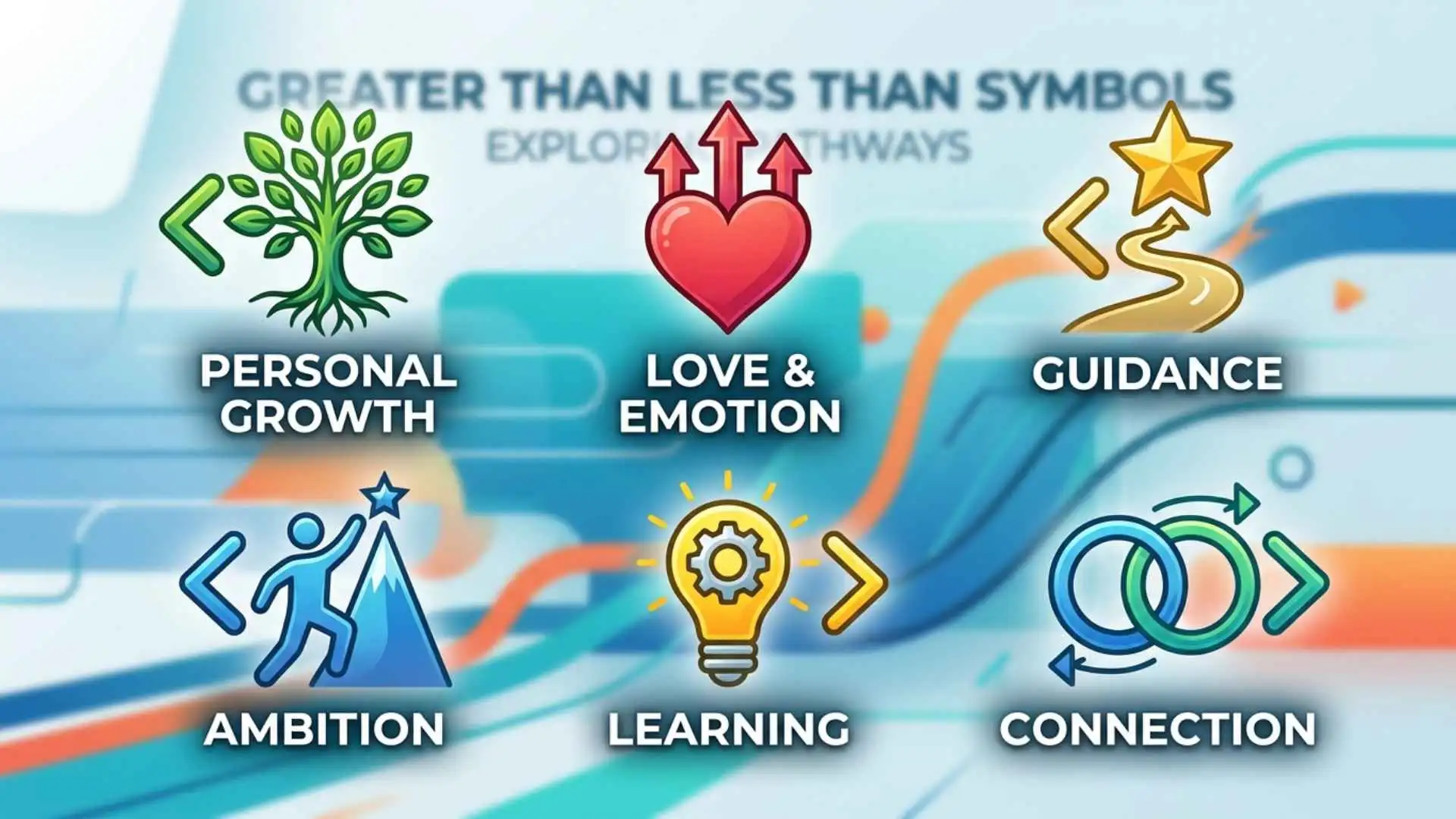
Greater than and less than symbols are some of the most familiar signs in mathematics. The greater than symbol (>) and less than symbol (<) help us compare two numbers, values, quantities, or expressions quickly. You may see them in basic arithmetic, algebra, statistics, computer programming, equations, and everyday comparisons. Although these symbols look simple, understanding their direction and meaning is essential for solving mathematical problems correctly.
The basic rule is easy to remember: > means “greater than,” while < means “less than.” For example, 8 > 5 means that 8 is greater than 5, while 3 < 7 means that 3 is less than 7. The wider, open side of the symbol faces the larger value, while the pointed side faces the smaller value. This simple visual rule makes the symbols easier to recognize and use.
But where did these mathematical signs come from, and why do they look the way they do? The history of greater than and less than symbols connects modern mathematics with centuries of efforts to make numerical comparisons shorter and clearer. In this guide, we’ll explore their meaning, history, hidden logic, common uses, examples, mistakes to avoid, and how these symbols work in more advanced mathematics and related fields.
Quick Answer
Greater than less than symbols are mathematical signs used to compare two values. The symbol > means “greater than,” showing that the value on the left is larger. The symbol < means “less than,” showing that the value on the left is smaller. They help express numerical relationships clearly and quickly.
Quick Facts About Greater Than Less Than Symbols
| Aspect | Information |
| Origin | Introduced in mathematics during the 17th century |
| Historical Significance | Created to simplify comparisons between quantities |
| Main Meaning | Shows whether one value is larger or smaller than another |
| Mathematical Meaning | Represents inequality relationships |
| Cultural Importance | Became a universal language for logic and measurement |
| Modern Usage | Used in math, coding, science, statistics, and technology |
What Are Greater Than Less Than Symbols?
Definition of Greater Than Less Than Symbols
Greater than less than symbols are mathematical comparison symbols used to show the relationship between two quantities. They are known as inequality symbols because they do not show that two values are equal. Instead, they explain whether one value is larger or smaller.
The two primary symbols are:
- > means greater than
- < means less than
For example:
- 8 > 3 means 8 is greater than 3.
- 2 < 7 means 2 is less than 7.
The wider opening side of the symbol always faces the larger number, while the pointed side faces the smaller number.
Origin and Historical Background
The greater than and less than symbols were introduced by English mathematician Thomas Harriot in the early 17th century. They appeared in mathematical writings as a way to make comparisons easier and more consistent.
Before these symbols existed, mathematicians had to write comparisons using longer phrases. Instead of writing:
“Five is greater than three”
they could use:
5 > 3
This innovation made mathematical communication faster and more precise.
Evolution Over Time
Over centuries, the symbols expanded beyond basic arithmetic. Today, they appear in:
- Algebra
- Geometry
- Computer programming
- Data science
- Economics
- Engineering
- Statistics
Modern technology has given these symbols new meanings. In programming languages, they can control decisions, comparisons, and logical operations.
For example:
if score > 90
means a program should check whether the score is higher than 90.
Deep Symbolic Meaning of Greater Than Less Than Symbols
Spiritual Level
Although greater than less than symbols are mathematical tools, they can also represent deeper human ideas about balance, growth, and comparison.
The greater than symbol can represent:
- Progress
- Achievement
- Expansion
- Personal growth
The less than symbol can represent:
- Humility
- Learning
- Beginning stages
- The need for improvement
In a symbolic sense, these signs remind people that life is full of relationships between different levels, experiences, and stages.
A person may be “greater than” their past struggles because they have grown through challenges. At the same time, they may be “less than” future possibilities because learning never ends.
Psychological Level
From a psychological perspective, comparison is a natural part of human thinking. People constantly evaluate differences in size, value, success, and progress.
Greater than less than symbols represent this mental process in a simple visual form.
They connect with:
- Pattern recognition
- Logical thinking
- Decision-making
- Problem-solving
Psychologist Carl Jung explored how humans understand symbols and patterns. While mathematical signs are not archetypes in the same way as myths or dreams, they demonstrate humanity’s ability to create visual shortcuts for complex ideas.
Cultural Level
Across societies, humans have always searched for ways to compare and measure.
Ancient civilizations compared:
- Land sizes
- Wealth
- Time
- Distance
- Resources
Greater than less than symbols became a modern expression of this ancient human need to organize information.
They represent order, measurement, and the desire to understand relationships.
Types and Variations of Greater Than Less Than Symbols
Basic Greater Than Symbol (>)
Visual Description:
A symbol shaped like an open angle facing left.
Meaning:
The number or value on the left is larger than the number on the right.
Example:
10 > 4
Symbolism:
- Higher value
- Increased amount
- Larger quantity
Where It Appears:
- Mathematics textbooks
- Statistics
- Scientific formulas
- Programming
Basic Less Than Symbol (<)
Visual Description:
A symbol shaped like an open angle facing right.
Meaning:
The number or value on the left is smaller than the number on the right.
Example:
3 < 9
Symbolism:
- Smaller quantity
- Lower value
- Limited amount
Where It Appears:
- Arithmetic
- Measurement systems
- Data analysis
Greater Than or Equal To Symbol (≥)
Visual Description:
A greater than symbol combined with a horizontal line underneath.
Meaning:
The first value is larger than or equal to the second value.
Example:
x ≥ 5
This means x can be 5 or any number greater than 5.
Less Than or Equal To Symbol (≤)
Visual Description:
A less than symbol combined with a horizontal line.
Meaning:
The first value is smaller than or equal to the second value.
Example:
x ≤ 10
This means x can be 10 or any number below it.
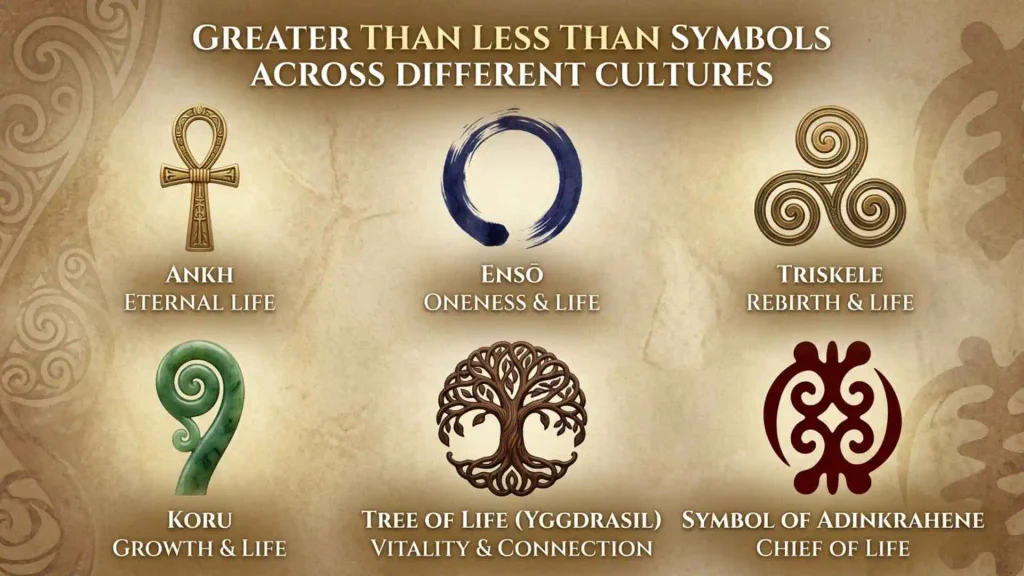
Greater Than Less Than Symbols Across Different Cultures
Ancient Egypt
Ancient Egyptians developed advanced mathematical systems for building, farming, and trade. Although they did not use modern inequality symbols, they regularly compared quantities in practical situations.
Their measurements of land, grain, and resources show an early human interest in numerical relationships.
Ancient Greece
Greek mathematicians created many foundations of modern mathematics. Thinkers such as Euclid developed ideas about measurement, geometry, and logical comparison.
Their mathematical methods influenced later systems where comparison symbols became essential.
Roman Culture
Romans used mathematics mainly for engineering, architecture, taxation, and trade. They relied on numerical comparisons when managing their empire.
Although they did not use modern symbols, their practical calculations helped shape the need for clearer mathematical communication.
Eastern Traditions
Ancient Indian and Chinese mathematicians made major contributions to numbers, algebra, and calculation methods.
The development of advanced mathematical ideas in these cultures helped create the environment where comparison systems could grow.
Indigenous Traditions
Many Indigenous cultures used practical measurement systems to compare seasons, resources, distances, and natural patterns.
Their knowledge shows that comparison is not only a mathematical concept but also a fundamental human skill.
Modern Interpretations
Today, greater than less than symbols are recognized worldwide. A student in Japan, Brazil, Egypt, or Canada can understand the same mathematical message.
They have become a universal language of logic.
Similar Symbols and Their Meanings
| Symbol | Meaning | Example |
| > | Greater than | 9 > 5 |
| < | Less than | 4 < 8 |
| ≥ | Greater than or equal to | x ≥ 3 |
| ≤ | Less than or equal to | x ≤ 7 |
| = | Equal to | 5 = 5 |
Common Misconceptions
Many learners confuse the direction of these symbols because they look similar.
A helpful memory trick is:
The wide opening always points toward the bigger number.
Example:
12 > 6
The symbol opens toward 12 because 12 is larger.
Greater Than Less Than Symbols in Mythology and Folklore
Unlike ancient religious symbols such as circles, animals, or sacred shapes, mathematical symbols do not have traditional myths surrounding them. However, the ideas behind them have existed in human stories for thousands of years.
Many myths involve comparisons:
- Heroes overcoming challenges
- Gods competing for power
- Humans seeking wisdom
- Nature balancing opposing forces
The concept of “greater” and “lesser” appears throughout folklore because humans naturally organize experiences through comparison.
Greater Than Less Than Symbols in Art, Literature, Movies and Pop Culture
Art and Design
Modern designers often use mathematical symbols because they represent intelligence, technology, and logic.
They appear in:
- Educational graphics
- Technology branding
- Digital artwork
- Science illustrations
Literature
Writers use comparison as a storytelling tool. Characters are often shown as greater or lesser in terms of courage, knowledge, power, or morality.
Movies and Television
Science fiction and technology-based stories frequently use mathematical symbols to represent:
- Computer systems
- Data analysis
- Artificial intelligence
- Scientific discovery
Tattoos and Fashion
Some people choose mathematical symbols as tattoos because they represent:
- Personal growth
- Continuous learning
- Balance
- Logical thinking
A greater than symbol may represent overcoming a difficult past, while a less than symbol may symbolize staying humble and open to learning.
Spiritual and Dream Meaning of Greater Than Less Than Symbols
Dreams involving comparison symbols may represent personal evaluation and decision-making.
Possible interpretations include:
Positive Meanings
- Personal improvement
- Setting goals
- Recognizing achievements
- Finding balance
Cautionary Meanings
- Comparing yourself too much with others
- Feeling inferior
- Seeking approval
- Focusing only on success
In meditation or personal reflection, these symbols can represent the idea that growth is a journey rather than a competition.
Positive and Negative Meanings of Greater Than Less Than Symbols
| Positive Meaning | Negative Meaning |
| Growth | Unhealthy comparison |
| Progress | Feeling inadequate |
| Achievement | Pride or superiority |
| Learning | Fear of failure |
| Understanding | Judgment |
A symbol itself is neutral. Its meaning depends on how people interpret and use it.
Why Humans Are Attracted to Greater Than Less Than Symbols
Humans naturally search for patterns and relationships. These symbols are powerful because they transform complicated ideas into simple visual messages.
They appeal to people because they provide:
- Clarity
- Order
- Fast understanding
- Logical structure
A small symbol can communicate an entire idea without needing a sentence.
This ability to compress information is one reason mathematics has become a universal language.
Modern Uses of Greater Than Less Than Symbols
Education
Teachers use these symbols to help students understand:
- Number relationships
- Algebra
- Equations
- Logical thinking
Programming
Developers use comparison operators to create decisions in software.
Examples include:
- Checking passwords
- Evaluating scores
- Managing data
Science and Statistics
Researchers use these symbols when describing:
- Measurements
- Probability
- Research results
- Scientific limits
Everyday Life
People use comparison concepts daily when deciding:
- Prices
- Sizes
- Quantities
- Performance levels
Interesting Facts About Greater Than Less Than Symbols
- Greater than and less than symbols were created over 400 years ago.
- They are among the most recognized mathematical symbols worldwide.
- Computer programmers use these symbols as logical operators.
- The symbol direction confuses many students because both signs look almost identical.
- Inequality symbols are essential in advanced mathematics, including calculus and statistics.
- They help computers make decisions by comparing values.
- The symbols represent one of humanity’s oldest ideas: understanding relationships between things.
Frequently Asked Questions
What do greater than less than symbols mean?
Greater than less than symbols compare two values. The > symbol means greater than, and the < symbol means less than.
How do I remember which way the symbol goes?
The open side always faces the larger number. The pointed side faces the smaller number.
Who invented the greater than less than symbols?
English mathematician Thomas Harriot introduced these symbols in the early 1600s.
Are greater than and less than symbols used outside mathematics?
Yes. They are widely used in programming, science, statistics, and technology.
What is the difference between > and ≥?
The symbol > means only greater than, while ≥ means greater than or equal to.
Conclusion
Greater than less than symbols are small mathematical marks with a powerful role in human communication. They help people compare values, understand relationships, and organize complex information. From ancient measurement systems to modern computer programming, comparison has always shaped human knowledge. These symbols remind us that meaning often comes from understanding relationships, balance, and change.
 John Mercer
 Michael Rivera