
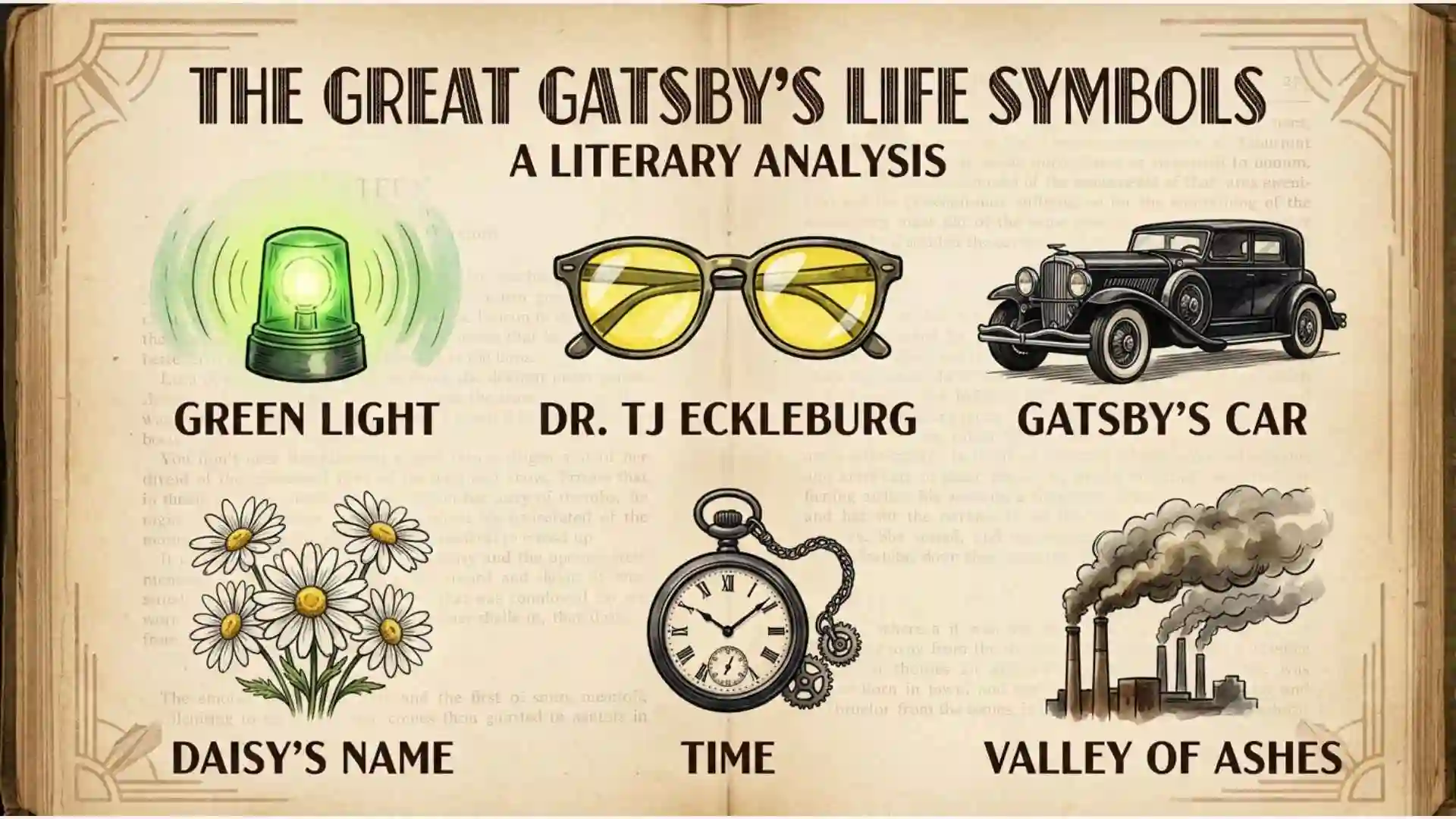
F. Scott Fitzgerald’s The Great Gatsby is filled with powerful symbols that reveal deeper ideas about love, wealth, dreams, identity, and the American Dream. Many objects, places, and images in the novel represent more than what they appear to be. From the famous green light to the mysterious eyes of Doctor T. J. Eckleburg, each symbol adds another layer of meaning to the story.
Some of the most important symbols in The Great Gatsby are connected to the characters’ hopes and struggles. The green light represents Gatsby’s longing for Daisy and the future he believes he can achieve, while the Valley of Ashes reflects poverty, emptiness, and the darker side of wealth. Other symbols, such as Gatsby’s extravagant parties, cars, and the eyes of Doctor Eckleburg, help Fitzgerald explore social class, materialism, morality, and the loss of meaningful dreams.
Understanding these symbols makes The Great Gatsby much easier to analyze and appreciate. They help explain why the characters make certain choices and how Fitzgerald presents the gap between appearance and reality. In this guide, we’ll explore the major symbols in The Great Gatsby, their meanings, and how they connect to the novel’s central themes.
Quick Answer
Symbols in The Great Gatsby are objects, places, colors, and images that represent deeper ideas such as dreams, wealth, social class, illusion, and the search for happiness. Major symbols include the green light, the eyes of Doctor T. J. Eckleburg, the Valley of Ashes, cars, colors, and Gatsby’s mansion.
Quick Facts About Symbols in The Great Gatsby
| Aspect | Information |
| Origin | The symbols come from F. Scott Fitzgerald’s 1925 novel The Great Gatsby |
| Historical Significance | They reflect the 1920s Jazz Age, wealth culture, social inequality, and changing American values |
| Main Meaning | Symbols represent dreams, identity, love, ambition, and moral decline |
| Spiritual Meaning | Many symbols explore hope, longing, temptation, and the search for meaning |
| Cultural Importance | They represent important ideas about the American Dream and human desires |
| Modern Usage | The symbols are studied in literature, education, films, art, and cultural discussions |
What Are Symbols in The Great Gatsby?
Definition and Purpose of Symbolism
Symbolism is a literary technique where an object, image, place, or action represents a deeper meaning beyond its literal purpose. In The Great Gatsby, Fitzgerald uses symbolism to transform ordinary things into powerful reflections of human emotions and social realities.
For example, a simple green light at the end of a dock becomes a representation of Gatsby’s greatest hopes and impossible dreams. A damaged road filled with industrial waste becomes a symbol of forgotten people and broken promises.
Fitzgerald did not create symbols only to make the story more interesting. He used them to question important ideas about society, morality, and human nature.
Historical Background of The Great Gatsby
Published in 1925, The Great Gatsby takes place during the Roaring Twenties, a period known for economic growth, jazz music, changing lifestyles, and increased consumerism in the United States.
The decade also contained serious contradictions. Many people became wealthy, but social inequality remained strong. Traditional values were challenged by materialism, and many individuals searched for success through money and status.
Fitzgerald captured these conflicts through symbols that show both the beauty and emptiness of the Jazz Age.
Deep Symbolic Meaning of Symbols in The Great Gatsby
Spiritual Level: Dreams, Hope, and Human Desire
Many symbols in The Great Gatsby represent the human search for something greater. Gatsby’s dream of reconnecting with Daisy is not only about romance. It represents humanity’s desire to return to an ideal moment and create a perfect future.
The green light symbolizes hope, faith, and the belief that something better is always within reach. However, Fitzgerald also shows that chasing an impossible dream can create suffering.
The novel suggests that people often create their own symbols of happiness. These symbols can inspire them, but they can also become illusions.
Psychological Level: Memory, Identity, and Illusion
From a psychological perspective, Fitzgerald’s symbols explore how people create meaning through their emotions and memories.
Gatsby is deeply connected to an imagined version of Daisy. He does not only love Daisy as she truly is. He loves the dream and identity he has built around her.
The symbols in the novel reflect ideas connected to Carl Jung’s concept of archetypes. Certain images, such as light, darkness, and empty landscapes, appear across cultures because they represent universal human experiences.
Light often represents hope and awareness, while darkness may represent uncertainty, fear, or hidden truths.
Cultural Level: The American Dream and Social Class
The symbols in The Great Gatsby also represent larger cultural issues. The novel questions whether wealth truly leads to happiness and whether anyone can achieve success through determination alone.
Gatsby’s mansion, expensive parties, and luxurious lifestyle represent the promise of success. However, they also reveal the loneliness and insecurity hidden behind material wealth.
Fitzgerald shows that social status and money cannot always overcome family background, history, or cultural barriers.
Types and Variations of Symbols in The Great Gatsby
The Green Light
Visual Description: A small green light shining across the water from Daisy Buchanan’s dock.
Meaning: Hope, dreams, desire, and the future.
Symbolism: The green light represents Gatsby’s longing for Daisy and his belief that he can recreate the past.
Cultural Connection: Green has often been associated with growth, renewal, and ambition.
Where It Appears: Literature, discussions of the American Dream, and modern interpretations of ambition.
Gatsby looks at the green light as a symbol of everything he wants but cannot fully possess. It represents the human tendency to chase distant dreams.
The Eyes of Doctor T. J. Eckleburg
Visual Description: A giant faded billboard showing the eyes of an advertisement doctor overlooking the Valley of Ashes.
Meaning: Observation, judgment, and the loss of moral values.
Symbolism: The eyes may represent society watching itself or the absence of spiritual guidance in a materialistic world.
Cultural Connection: Many readers interpret the eyes as a symbol of God, conscience, or moral awareness.
Where It Appears: Literary criticism, religious discussions, and cultural analysis.
The mysterious eyes remind readers that actions have consequences, even when people believe they are invisible.
The Valley of Ashes
Visual Description: A gray industrial wasteland located between West Egg and New York City.
Meaning: Poverty, hopelessness, and social inequality.
Symbolism: The Valley of Ashes represents the forgotten people left behind by wealth and progress.
Cultural Connection: It reflects the economic divisions of the 1920s.
Where It Appears: Social criticism, literature studies, and discussions about class inequality.
While wealthy characters enjoy luxury, the Valley of Ashes shows the hidden cost of their lifestyle.
Gatsby’s Mansion
Visual Description: A large, impressive house filled with luxury and entertainment.
Meaning: Wealth, ambition, and the desire for acceptance.
Symbolism: The mansion represents Gatsby’s attempt to create a new identity.
Cultural Connection: It reflects the American belief that success can be achieved through money.
Where It Appears: Film adaptations, literary discussions, and cultural interpretations.
Despite its beauty, the mansion becomes a symbol of Gatsby’s isolation.
Cars
Visual Description: Expensive automobiles used by wealthy characters.
Meaning: Freedom, status, speed, and danger.
Symbolism: Cars represent modern technology and the careless lifestyle of the wealthy.
Cultural Connection: The automobile became a major symbol of American progress during the 1920s.
Where It Appears: The novel’s most tragic moments and discussions of responsibility.
The automobile symbolizes both opportunity and destruction.
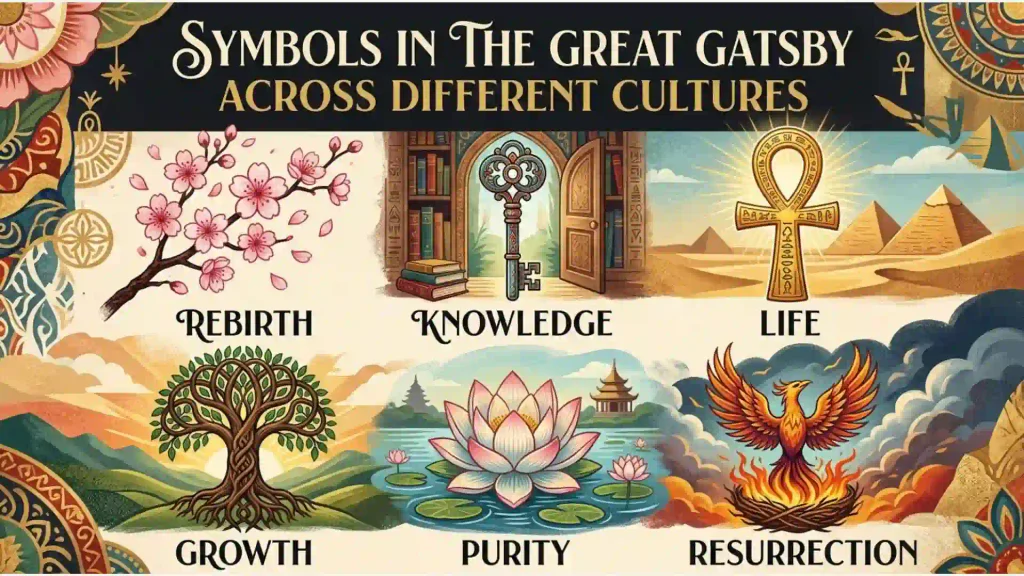
Symbols in The Great Gatsby Across Different Cultures
Ancient Egypt
Ancient Egyptian culture used symbols such as the scarab beetle, the ankh, and the eye to represent life, protection, and spiritual knowledge.
Similar to the eyes of Doctor T. J. Eckleburg, Egyptian eye symbolism connects vision with awareness and judgment.
Ancient Greece
Greek mythology often used symbols to explore human weaknesses, ambition, and fate.
Like Greek tragedies, The Great Gatsby uses symbols to show how personal desires can lead to downfall.
Roman Culture
Roman society valued wealth, power, and social reputation. Symbols of status were important in Roman life.
The luxurious homes and parties in Fitzgerald’s novel reflect similar ideas about wealth as a sign of importance.
Eastern Traditions
Many Eastern philosophies explore illusion, desire, and attachment. The idea that excessive desire can create suffering appears in several spiritual traditions.
Gatsby’s obsession with recreating the past connects with these ideas about attachment.
Indigenous Traditions
Many Indigenous cultures use nature symbols to represent balance, community, and spiritual connection.
The contrast between natural spaces and industrial destruction in the novel connects with broader themes about humanity’s relationship with the environment.
Modern Interpretations
Today, symbols from The Great Gatsby represent modern struggles with success, identity, social media image creation, and the pursuit of perfection.
Similar Symbols and Their Meanings
| Symbol | Similar Symbol | Similarities | Differences |
| Green Light | Star | Represents hope and dreams | Green light focuses on personal desire |
| Eyes of Eckleburg | All-seeing eye | Represents observation | Eckleburg also represents moral emptiness |
| Valley of Ashes | Wasteland | Represents destruction | It specifically reflects social inequality |
| Mansion | Castle | Represents status and power | Gatsby’s mansion hides loneliness |
| Cars | Horses in mythology | Represent movement and freedom | Cars also symbolize modern danger |
Symbols in The Great Gatsby in Mythology and Folklore
Many symbols in the novel connect with ancient storytelling traditions.
The idea of chasing an unreachable dream appears in myths around the world. Stories of heroes searching for impossible goals often explore ambition, sacrifice, and human limitations.
Gatsby’s dream resembles mythological quests where characters seek something extraordinary. However, Fitzgerald changes the traditional hero story by showing that success and wealth do not guarantee fulfillment.
The green light functions almost like a mythical object, representing a desired future that always remains just beyond reach.
Symbols in The Great Gatsby in Art, Literature, Movies, and Pop Culture
Literature
The symbols in The Great Gatsby have influenced generations of writers who explore themes of ambition, identity, and social criticism.
The novel’s imagery continues to appear in discussions about the American Dream.
Movies
Film adaptations use visual symbols to strengthen the story. The green light, luxurious parties, and dramatic settings help audiences understand Gatsby’s emotional world.
Fashion and Design
The style of the Jazz Age, including glamorous clothing and Art Deco designs, remains connected with Gatsby symbolism.
Modern fashion often uses Gatsby-inspired themes to represent elegance, luxury, and nostalgia.
Tattoos and Personal Expression
Some people choose Gatsby symbols, especially the green light, as personal reminders of hope, ambition, or dreams.
Spiritual and Dream Meaning of Symbols in The Great Gatsby
Dream interpretations often connect Gatsby symbols with personal emotions.
A green light in a dream may represent a goal, hope, or a new opportunity.
A mansion may symbolize personal ambition, success, or the desire to prove oneself.
A broken or empty place like the Valley of Ashes may represent feelings of neglect, disappointment, or emotional exhaustion.
These interpretations depend on personal experiences, but they show why symbols remain meaningful across generations.
Positive and Negative Meanings of Symbols in The Great Gatsby
| Positive Meaning | Negative Meaning |
| Hope and ambition | Unrealistic expectations |
| Love and devotion | Obsession |
| Success and achievement | Materialism |
| Beauty and creativity | Illusion and deception |
| Progress and change | Loss of morality |
A symbol can represent both light and shadow. The same dream that motivates someone can also trap them if it becomes impossible to achieve.
Why Humans Are Attracted to Symbols in The Great Gatsby
Humans naturally search for meaning. Symbols allow people to connect personal emotions with larger ideas.
A simple object can hold memories, dreams, and beliefs. This is why symbols appear in religions, cultures, stories, and personal identities.
Fitzgerald’s symbols remain powerful because they reflect experiences almost everyone understands: wanting something, remembering the past, seeking acceptance, and searching for happiness.
Modern Uses of Symbols in The Great Gatsby
Today, Gatsby symbols appear in:
- Literature classrooms and academic discussions
- Movie designs and theater productions
- Art inspired by the Jazz Age
- Fashion themes based on the 1920s
- Social media discussions about success and identity
- Home decor inspired by vintage luxury
These symbols continue because their meanings connect with modern questions about wealth, dreams, and personal identity.
Interesting Facts About Symbols in The Great Gatsby
- The green light is one of the most recognized literary symbols in American literature.
- Fitzgerald wrote The Great Gatsby while America was experiencing major cultural changes during the Jazz Age.
- The Valley of Ashes represents real concerns about industrial growth and inequality.
- Gatsby’s parties symbolize both excitement and emotional emptiness.
- The eyes of Doctor T. J. Eckleburg have inspired many different interpretations, including religious and psychological meanings.
- Color symbolism is one of Fitzgerald’s strongest storytelling techniques.
- Many symbols in the novel have become common references in discussions about the American Dream.
Frequently Asked Questions
What is the most important symbol in The Great Gatsby?
The green light is often considered the most important symbol because it represents Gatsby’s dreams, hope, and desire for a future with Daisy.
What does the Valley of Ashes symbolize?
The Valley of Ashes symbolizes poverty, social inequality, and the negative consequences hidden behind wealth and industrial progress.
What do the eyes of Doctor T. J. Eckleburg represent?
The eyes represent judgment, moral awareness, and the feeling that society is being watched.
Why does Fitzgerald use colors as symbols?
Fitzgerald uses colors to express emotions, social meanings, and deeper themes such as wealth, danger, purity, and desire.
How do Gatsby symbols connect to the American Dream?
They show both the hope of achieving success and the problems caused by chasing wealth without genuine happiness.
Conclusion
Symbols in The Great Gatsby transform a simple story about love and wealth into a deeper exploration of human dreams and struggles. Fitzgerald’s symbols reveal the beauty, hope, and danger hidden inside the American Dream. From the green light to the Valley of Ashes, each symbol invites readers to examine their own desires and beliefs. These timeless images continue to remind us that true fulfillment comes from more than money or status.
 Sarah Thompson
 John Mercer