
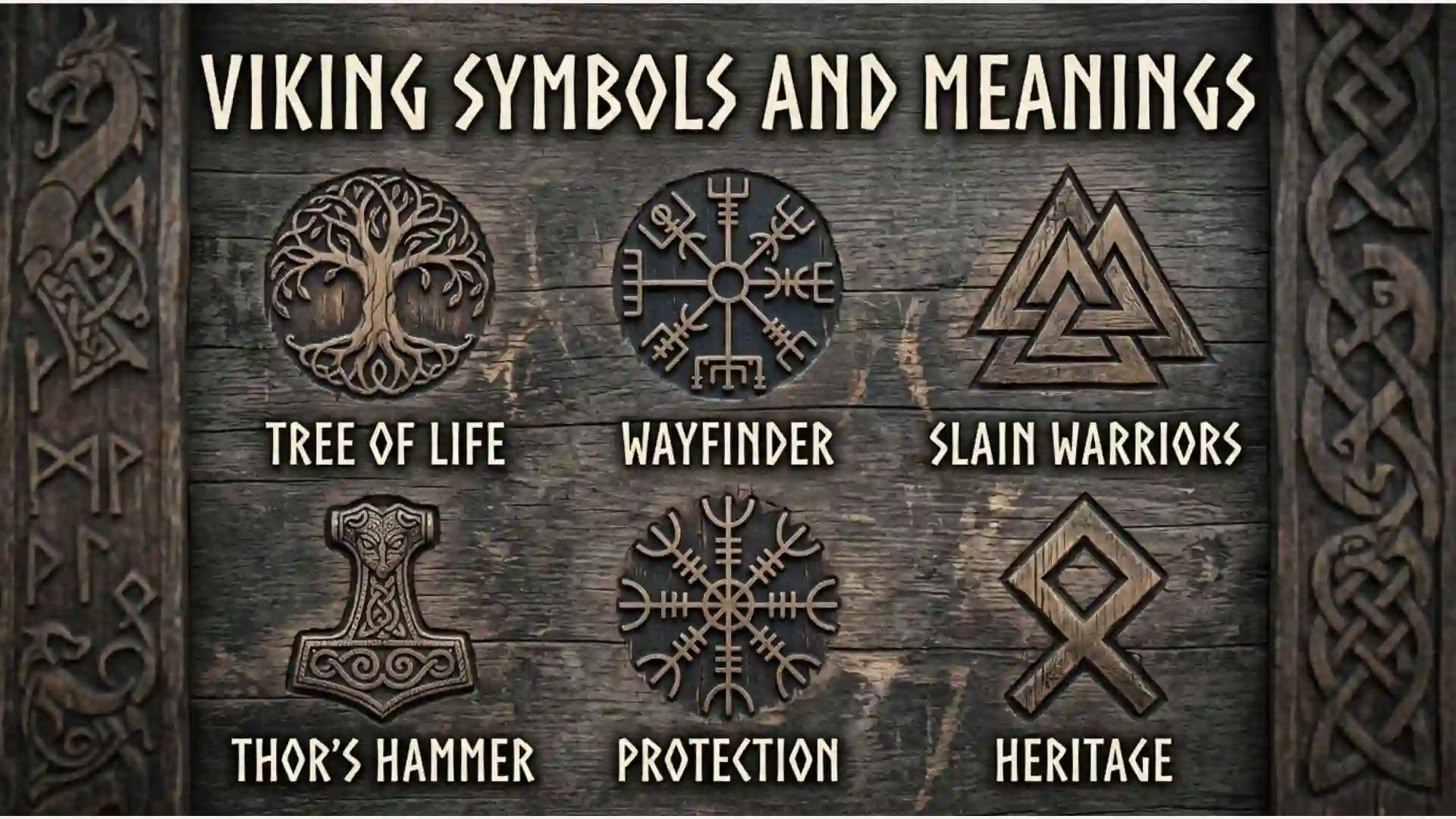
Viking symbols carry the stories, beliefs, and spiritual ideas of the ancient Norse world. From powerful runes and protective signs to symbols connected with gods, warriors, fate, and nature, these markings had meanings that went far beyond simple decoration. Many were closely connected to Norse mythology, religion, protection, strength, and destiny.
Some of the best-known Viking and Norse symbols include Mjölnir (Thor’s hammer), Valknut, Ægishjálmur, Vegvísir, Yggdrasil, and the runes. However, their histories and meanings are not always as simple as modern tattoos, jewelry, and popular culture suggest. Some symbols are well supported by archaeological or historical evidence, while others come from later Icelandic magical traditions.
Today, Viking symbols continue to attract people who are interested in strength, courage, protection, wisdom, loyalty, and spiritual meaning. Understanding where these signs came from and what they represented can help you appreciate them beyond their modern appearance. In this guide, we’ll explore the most important Viking symbols, their meanings, historical roots, and how their ancient messages are interpreted today.
Quick Answer
Viking symbols and meanings refer to the signs, marks, and images used by the Norse people to represent beliefs, protection, power, spirituality, and connections with gods and nature. Popular symbols include the Valknut, Mjölnir, Yggdrasil, Vegvísir, and runes, each carrying unique historical and cultural significance.
Quick Facts About Viking Symbols and Meanings
| Aspect | Information |
| Origin | Ancient Norse and Scandinavian cultures, especially during the Viking Age (approximately 793 to 1066 CE) |
| Historical Significance | Used in religion, art, weapons, jewelry, stones, and everyday objects |
| Main Meaning | Protection, strength, destiny, wisdom, courage, and connection with the divine |
| Spiritual Meaning | Represented relationships between humans, gods, nature, and the unseen world |
| Cultural Importance | Preserved Norse mythology, traditions, and beliefs about life and death |
| Modern Usage | Found in tattoos, jewelry, artwork, games, films, fashion, and spiritual practices |
What Are Viking Symbols and Meanings?
Viking symbols were visual expressions of the beliefs and values of the Norse people. Before Christianity became dominant in Scandinavia, Vikings followed a rich mythology centered around gods such as Odin, Thor, Freyja, and Tyr. Symbols helped them communicate ideas that words could not fully express.
The Viking Age began in the late eighth century when Scandinavian explorers, traders, and warriors traveled across Europe and beyond. They carried their traditions with them, leaving behind carvings, artifacts, weapons, and inscriptions that reveal their symbolic world.
Many Viking symbols appeared on rune stones, ships, amulets, helmets, shields, and household items. They were not simply decorations. A symbol could represent a prayer for protection, a connection to a god, a reminder of courage, or a belief about fate.
The importance of these symbols came from the Norse understanding that the universe was filled with powerful forces. Humans, gods, animals, and nature were connected through a complex spiritual system.
Over time, Viking symbols evolved. Some remained connected to ancient Norse religion, while others gained new meanings through modern interpretations in literature, entertainment, and personal expression.
Deep Symbolic Meaning of Viking Symbols
Spiritual Meaning of Viking Symbols
For the Vikings, symbols created a bridge between the physical world and spiritual forces. They believed gods influenced human lives, and certain signs could represent divine protection or guidance.
The Valknut, associated with Odin, symbolized the mysteries of life, death, and the warrior’s journey. It was often connected with fallen warriors who were believed to enter Valhalla, Odin’s great hall.
Yggdrasil, the cosmic tree of Norse mythology, represented the connection between different realms of existence. It showed that everything in the universe was connected through a greater spiritual order.
Runes also held spiritual importance. They were not only letters but were believed to contain deeper meanings and hidden powers. Some Vikings used runic inscriptions for blessings, protection, or magical purposes.
Psychological Meaning of Viking Symbols
From a psychological perspective, Viking symbols represent universal human desires. They connect with ideas such as bravery, survival, identity, and the search for meaning.
Carl Jung’s concept of archetypes helps explain why these ancient symbols still attract people today. The warrior, the wise seeker, the protector, and the journey into the unknown are powerful human patterns found across cultures.
For example, Mjölnir, Thor’s hammer, represents protection and strength. Psychologically, it reflects the human desire to overcome challenges and defend what matters.
These symbols continue to appeal because they represent emotions that remain relevant: courage during difficult times, hope in uncertainty, and the desire to belong to something greater.
Cultural Meaning of Viking Symbols
Viking symbols were deeply connected to community identity. They reflected shared stories, religious beliefs, and traditions passed from one generation to another.
A symbol carved into a stone or worn as jewelry could communicate a person’s values, family connections, or spiritual beliefs.
Today, these symbols continue to represent Scandinavian heritage, Norse mythology, and historical curiosity. They appear in museums, books, movies, and popular culture around the world.
Types and Variations of Viking Symbols
Valknut
Visual Description: Three interlocking triangles forming a complex geometric shape.
Meaning: The Valknut is one of the most recognized Norse symbols. It is strongly associated with Odin and themes of death, warriors, and the afterlife.
Symbolism: It represents the transition between life and death, fate, and the power of Odin.
Cultural Connection: Found on archaeological artifacts, including the Tängelgårda stone from Sweden.
Where It Appears: Ancient carvings, modern tattoos, jewelry, artwork, and fantasy media.
Mjölnir, Thor’s Hammer
Visual Description: A short-handled hammer representing the weapon of Thor, the thunder god.
Meaning: Protection, strength, courage, and divine power.
Symbolism: Thor used Mjölnir to protect gods and humans from destructive forces.
Cultural Connection: Many Vikings wore hammer-shaped pendants as protective amulets.
Where It Appears: Jewelry, historical artifacts, movies, tattoos, and modern Norse-inspired designs.
Yggdrasil, The World Tree
Visual Description: A giant mythical tree connecting different worlds.
Meaning: Life, wisdom, balance, and cosmic connection.
Symbolism: Yggdrasil represents the structure of the Norse universe, linking realms such as Asgard, Midgard, and the underworld.
Cultural Connection: Central to Norse mythology recorded in sources like the Poetic Edda and Prose Edda.
Where It Appears: Literature, art, spiritual designs, and modern mythology studies.
Vegvísir
Visual Description: A compass-like symbol made from eight branches.
Meaning: Guidance and finding one’s way through difficult journeys.
Symbolism: It is often interpreted as a magical navigation symbol.
Cultural Connection: The symbol appears in the Icelandic magical manuscript known as the Huld Manuscript from the 19th century. Its direct connection to Viking Age culture is debated.
Where It Appears: Tattoos, jewelry, and modern Norse-inspired spirituality.
Runes
Visual Description: Angular letters from ancient Germanic alphabets.
Meaning: Communication, wisdom, mystery, and knowledge.
Symbolism: Runes were used for writing but also carried symbolic meanings.
Cultural Connection: Found throughout Scandinavia on stones, weapons, and objects.
Where It Appears: Historical inscriptions, books, games, and modern designs.
Viking Symbols Across Different Cultures
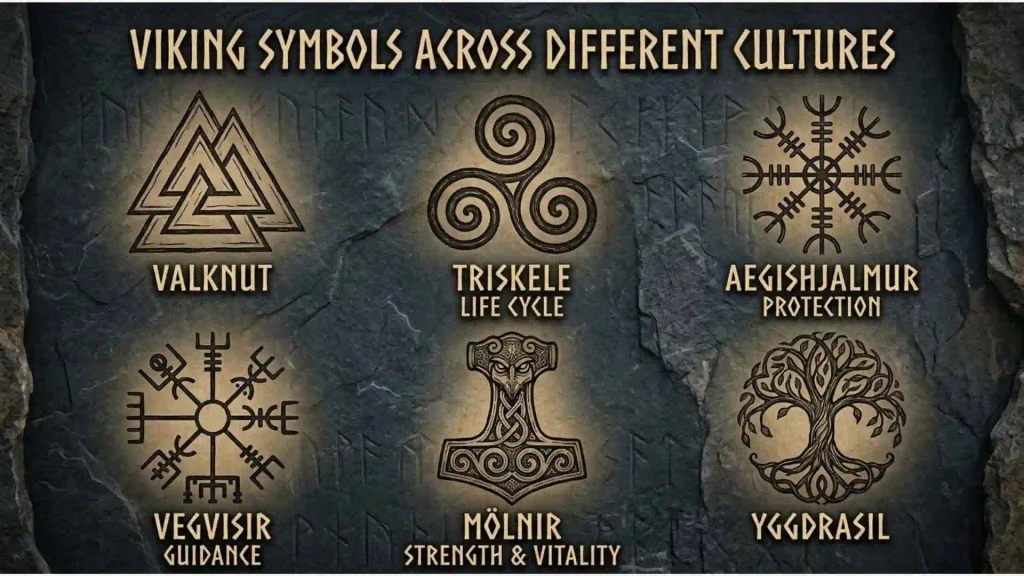
Ancient Egypt
Ancient Egyptian culture developed independently from Viking traditions, but both civilizations used symbols to express ideas about life, death, and the divine.
Egyptian symbols such as the Ankh represented eternal life, while Viking symbols like the Valknut focused more on warrior identity and the journey after death.
Both cultures used visual signs to explain mysteries beyond everyday human experience.
Ancient Greece
Greek mythology shared similarities with Norse beliefs. Greek gods such as Zeus and Athena had roles comparable to Norse gods like Thor and Odin.
Symbols from both cultures represented power, wisdom, protection, and the relationship between humans and gods.
Roman Culture
Romans interacted with Germanic and Scandinavian groups and recorded information about their beliefs. Roman influence also affected later interpretations of Norse traditions.
Symbols of weapons, animals, and divine figures were important in both Roman and Norse societies.
Eastern Traditions
Eastern cultures such as Hindu and Buddhist traditions also use symbols to represent spiritual ideas, balance, transformation, and cosmic order.
Although the meanings differ, the human desire to express invisible spiritual concepts through visual signs is shared worldwide.
Indigenous Traditions
Many Indigenous cultures use animal symbols, natural elements, and sacred designs to represent identity and spiritual relationships.
Similar to Norse traditions, nature played an important role in understanding human existence.
Modern Interpretations
Today, Viking symbols are used globally in entertainment, fashion, tattoos, and historical research. Their meanings often combine ancient traditions with personal interpretations.
Similar Symbols and Their Meanings
| Symbol | Meaning | Difference |
| Valknut | Death, destiny, Odin, warriors | Focuses on the afterlife and fate |
| Mjölnir | Protection and strength | Connected specifically with Thor |
| Yggdrasil | Life and cosmic connection | Represents the structure of the universe |
| Runes | Knowledge and communication | Functions as both writing and symbolism |
| Vegvísir | Guidance and direction | More connected to later Icelandic tradition |
A common misconception is that every popular Norse symbol was used widely during the Viking Age. Some symbols became famous through modern interpretations rather than direct Viking-era evidence.
Viking Symbols in Mythology and Folklore
Norse mythology is filled with stories that explain the meaning behind these symbols.
Odin, the Allfather, was associated with wisdom, sacrifice, and knowledge. According to mythology, Odin sacrificed himself on Yggdrasil to gain knowledge of the runes.
Thor’s hammer Mjölnir represented protection against chaos. Stories describe Thor using the hammer to defend both gods and humans.
The Valknut connects to stories about warriors chosen by Odin after death. These legends shaped the Viking understanding of bravery and honor.
These myths continue to influence modern fantasy novels, video games, movies, and popular storytelling.
Viking Symbols in Art, Literature, Movies and Pop Culture
Viking symbols have become powerful images in modern creativity.
In literature, authors use Norse symbols to explore themes of destiny, heroism, and adventure. Modern fantasy often borrows ideas from Norse mythology.
Movies and television series featuring Vikings frequently use symbols such as axes, runes, and Thor’s hammer to create historical atmosphere.
Tattoos featuring Viking symbols are popular because people connect them with personal strength, heritage, courage, and resilience.
Fashion designers and artists also use Norse patterns because of their bold shapes and mysterious appearance.
Spiritual and Dream Meaning of Viking Symbols
Many people interpret Viking symbols through a personal spiritual lens today.
Dreaming about a hammer may symbolize protection, inner strength, or overcoming challenges. Seeing a tree symbol may represent growth, balance, and personal transformation.
Runes in dreams are sometimes interpreted as messages about wisdom, choices, or hidden knowledge.
However, dream meanings are personal and depend on individual experiences. Ancient Norse interpretations provide cultural context, but personal emotions often shape modern meanings.
Positive and Negative Meanings of Viking Symbols
| Positive Meaning | Negative Meaning |
| Courage | Violence |
| Protection | Conflict |
| Wisdom | Obsession with power |
| Strength | Aggression |
| Spiritual connection | Misinterpretation |
A symbol can represent both positive and negative ideas depending on how it is used. Like many ancient signs, Viking symbols contain layers of meaning.
Why Humans Are Attracted to Viking Symbols
Humans have always used symbols to understand life’s biggest questions. Viking symbols attract people because they represent universal themes: courage, mystery, survival, and connection.
They also create a feeling of belonging. Someone wearing a Viking symbol may feel connected to history, ancestry, mythology, or personal values.
The human mind naturally searches for patterns and meaning. Ancient symbols provide a visual language that connects past experiences with modern emotions.
Modern Uses of Viking Symbols
Tattoos
Viking tattoos often represent strength, personal journeys, courage, or interest in Norse history.
Jewelry
Mjölnir necklaces and rune bracelets are popular choices for people interested in Norse-inspired designs.
Branding
Some companies use Viking imagery to communicate toughness, adventure, and determination.
Social Media and Entertainment
Games, movies, and online communities frequently use Viking symbols to represent fantasy, exploration, and warrior themes.
Home Decor
Norse artwork and rune-inspired designs are used in modern interior decoration.
Interesting Facts About Viking Symbols and Meanings
- The Vikings used the Younger Futhark rune system during much of the Viking Age.
- Mjölnir pendants were worn as protective symbols during the Viking period.
- Yggdrasil is considered the center of Norse cosmology.
- The Valknut appears on several archaeological discoveries but its exact meaning remains debated.
- Not all modern Norse symbols were used during the Viking Age.
- Runes were both practical writing tools and symbolic objects.
- Viking symbols often combined religion, art, and daily life.
- Norse mythology influenced many modern fantasy stories.
Frequently Asked Questions
What is the most powerful Viking symbol?
Mjölnir, Thor’s hammer, is often considered one of the most powerful Viking symbols because it represents protection, strength, and divine power.
What do Viking symbols represent?
Viking symbols represent ideas such as courage, protection, wisdom, fate, spirituality, and connection with Norse mythology.
Are Viking symbols religious?
Many Viking symbols were connected to Norse religion, but modern uses may focus on history, personal meaning, or artistic expression.
What does the Valknut symbolize?
The Valknut is associated with Odin, warriors, death, and the transition between life and the afterlife.
Did Vikings really use Vegvísir?
Vegvísir appears in later Icelandic magical traditions. Its direct use during the Viking Age is uncertain.
Conclusion
Viking symbols and meanings open a window into a world where mythology, nature, and human emotions were deeply connected. These ancient signs represented courage, protection, wisdom, and the mysteries of existence. From Thor’s hammer to Yggdrasil, each symbol carries stories that continue to inspire people today. Their lasting power comes from their ability to connect ancient wisdom with modern human experiences.
 Sarah Thompson
 Michael Rivera