
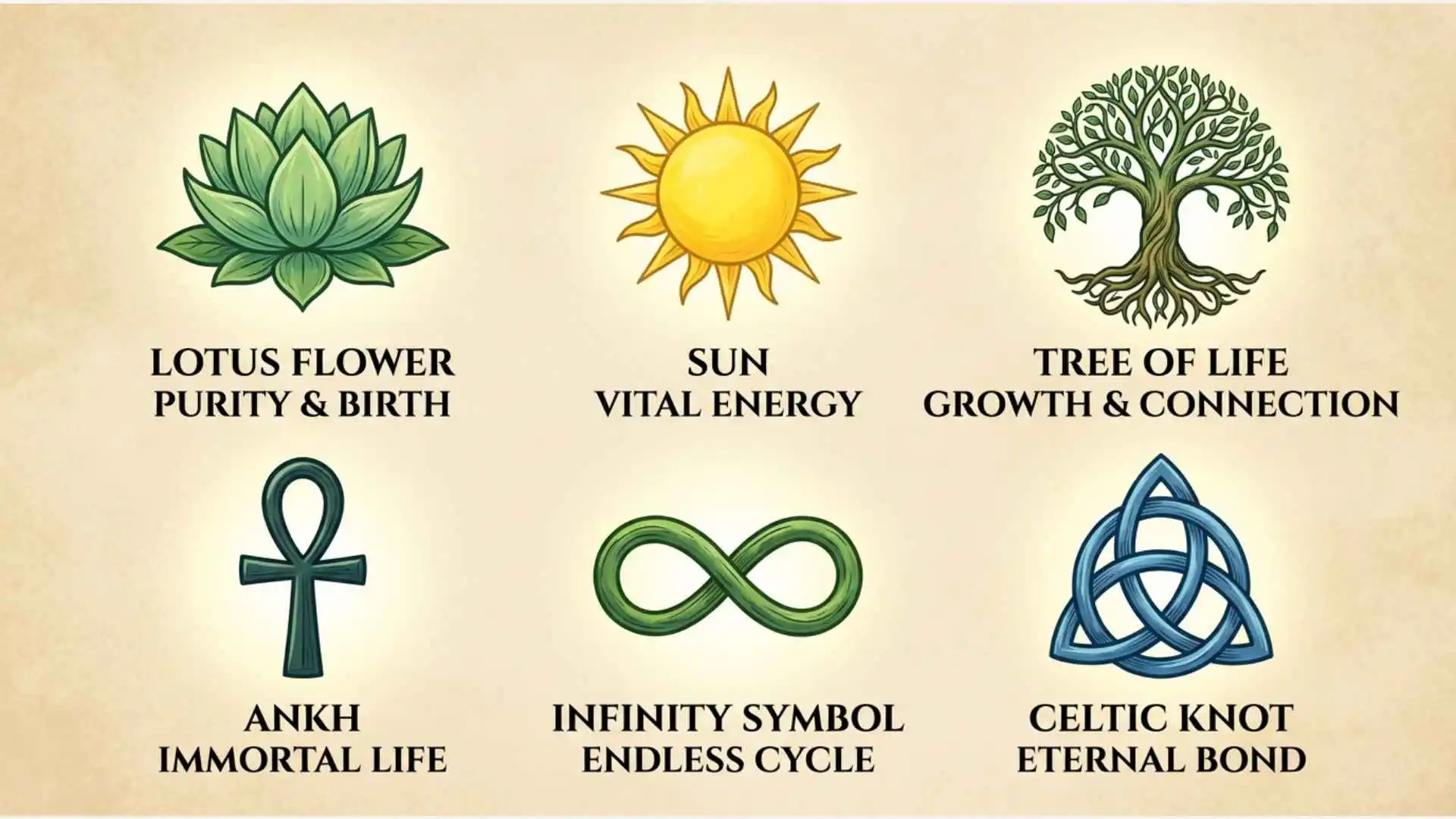
Signs and symbols are part of everyday life, helping people communicate ideas, warnings, emotions, beliefs, and information without using many words. From road signs and mathematical symbols to religious icons and cultural marks, each symbol can carry a meaning that depends on its context. Understanding these different signs and symbols can make it easier to recognize the messages they are designed to convey.
The Testbook significance of different signs and symbols is especially useful for students preparing for competitive exams and general knowledge questions. Testbook-style questions often ask learners to identify symbols, understand their meanings, match signs with their uses, or recognize the field in which a particular symbol is commonly used. Learning the basic categories and meanings can make these questions much easier to answer.
In this guide, we will explore the meaning, history, types, and significance of different signs and symbols, along with the hidden messages they may communicate. Whether you are studying for an exam, improving your general knowledge, or simply curious about the symbols you see around you, this overview will help you understand why signs and symbols matter and how their meanings have developed over time.
Quick Answer
Different signs and symbols testbook significance refers to the importance of learning various visual signs and symbols used in communication, culture, science, religion, and daily life. These symbols represent ideas, instructions, emotions, and traditions, helping people understand information quickly across languages and societies.
Quick Facts About Different Signs and Symbols Testbook Significance
| Aspect | Information |
| Origin | Symbols began with early human communication through cave drawings, markings, and ancient scripts |
| Historical Significance | They helped civilizations record knowledge, express beliefs, and communicate important messages |
| Main Meaning | Signs and symbols represent ideas, objects, actions, warnings, and concepts |
| Spiritual Meaning | Many symbols represent faith, protection, transformation, and connection with the unseen world |
| Cultural Importance | Symbols preserve traditions, values, and shared identities among communities |
| Modern Usage | Used in education, technology, transportation, branding, science, and digital communication |
What Are Different Signs and Symbols Testbook Significance?
Definition of Signs and Symbols
Signs and symbols are visual representations that communicate meanings beyond their physical appearance. A sign usually provides direct information, while a symbol often carries deeper meanings connected to culture, emotions, or beliefs.
For example, a red traffic light is a sign that tells drivers to stop. However, a dove is a symbol representing peace, hope, and harmony in many cultures.
The study of different signs and symbols testbook significance focuses on understanding how these visual elements influence communication and knowledge. Educational resources, including test preparation materials, often include questions about symbols because they appear in reasoning, general knowledge, history, geography, and cultural studies.
Historical Background of Symbols
The history of symbols goes back thousands of years. Early humans painted animals, hunting scenes, and mysterious marks on cave walls. These images were not only artwork but also methods of sharing information.
Ancient civilizations developed complex symbolic systems. The Egyptians used hieroglyphs to record stories, religious beliefs, and royal events. The Greeks used symbols in mathematics, philosophy, and mythology. Ancient Indian traditions used symbols such as the lotus, Om, and Swastika to represent spiritual ideas.
Over time, symbols evolved from religious and cultural expressions into tools used in science, technology, business, and global communication.
Deep Symbolic Meaning of Different Signs and Symbols
Spiritual Level
Symbols often connect humans with spiritual ideas that are difficult to express through ordinary language. Many religious traditions use symbols to represent divine forces, spiritual growth, and the journey of the soul.
The lotus flower, common in Hinduism and Buddhism, represents purity and spiritual awakening because it grows from muddy water but blooms beautifully above the surface. The cross in Christianity represents sacrifice, faith, and salvation.
Symbols allow people to express their relationship with higher meanings, inner peace, and personal transformation.
Psychological Level
Psychologist Carl Jung explained that symbols are powerful because they connect with universal human experiences. He believed certain symbols appear across cultures because they represent shared patterns of human thought, known as archetypes.
People are naturally attracted to symbols because the human brain recognizes shapes, patterns, and images quickly. A heart shape immediately connects with love. A shield suggests protection. A broken chain suggests freedom.
Symbols create emotional connections because they combine visual simplicity with deeper personal meanings.
Cultural Level
Every culture develops symbols that reflect its history, values, and traditions. A symbol may represent unity in one society while having a different meaning elsewhere.
For example, the Swastika is an ancient symbol of prosperity and good fortune in Hinduism, Buddhism, and Jain traditions. However, its misuse by Nazi Germany created a negative association in many Western societies.
This shows that symbols must always be understood within their cultural and historical context.
Types and Variations of Different Signs and Symbols
Religious and Spiritual Symbols
Visual Description: Images connected with faith, worship, and spiritual beliefs.
Meaning: They represent devotion, sacred ideas, and religious teachings.
Symbolism: Religious symbols often express hope, protection, morality, and connection with the divine.
Cultural Connection: Christianity, Hinduism, Buddhism, Islam, Judaism, and other traditions use powerful symbols.
Where They Appear: Temples, churches, books, jewelry, art, and religious ceremonies.
Examples include:
- Om symbol in Hindu traditions representing universal consciousness
- Cross symbol representing Christianity
- Crescent and star associated with Islamic culture
- Dharma wheel representing Buddhist teachings
Warning and Safety Symbols
Visual Description: Simple shapes, colors, and images designed for quick recognition.
Meaning: They communicate danger, instructions, or required actions.
Symbolism: These symbols protect people by providing immediate information.
Cultural Connection: International safety standards use many universal signs.
Where They Appear: Roads, workplaces, airports, factories, and public buildings.
Examples include:
- Radiation warning symbol
- Fire exit sign
- Biohazard symbol
- Poison warning symbol
Mathematical and Scientific Symbols
Visual Description: Special marks representing scientific concepts.
Meaning: They simplify complex information.
Symbolism: These symbols represent discovery, logic, and knowledge.
Cultural Connection: Scientists worldwide use shared symbolic languages.
Where They Appear: Textbooks, laboratories, engineering documents, and technology.
Examples include:
- Pi symbol representing mathematical constant
- Chemical symbols from the periodic table
- Infinity symbol representing endlessness
National and Cultural Symbols
Visual Description: Images representing nations, communities, and identities.
Meaning: They create a sense of belonging and shared history.
Symbolism: They represent pride, unity, and collective memory.
Where They Appear: Flags, monuments, clothing, ceremonies, and artwork.
Examples include:
- National flags
- Eagles representing strength and freedom
- Lions representing courage and leadership
Different Signs and Symbols Across Different Cultures
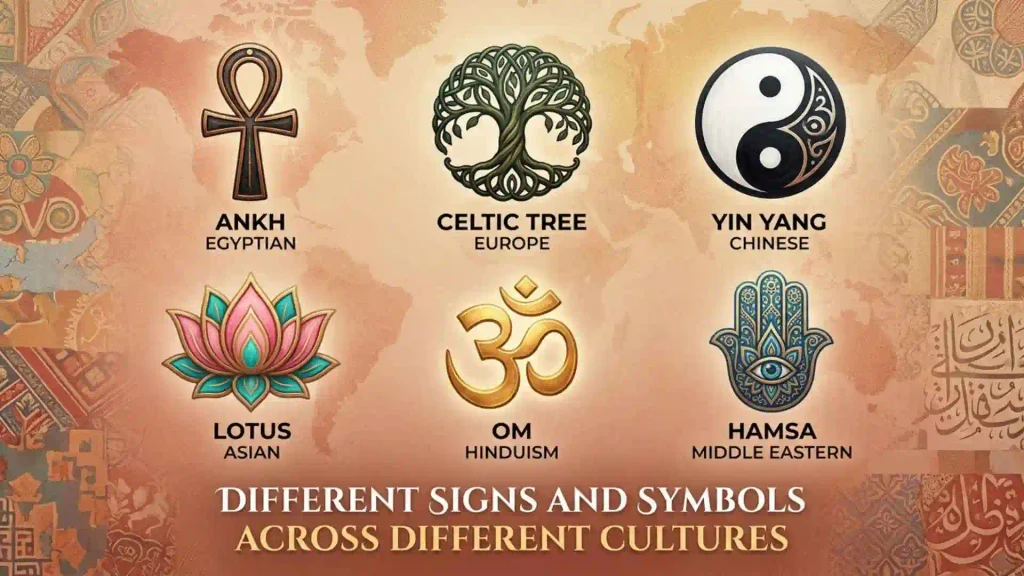
Ancient Egypt
Ancient Egyptians created one of the richest symbolic systems in history. Their symbols appeared in temples, tombs, and religious texts.
The Ankh symbol represented life and immortality. The Eye of Horus represented protection, healing, and royal power. Egyptian symbols connected daily life with spiritual beliefs about death and the afterlife.
Ancient Greece
Greek civilization used symbols extensively in mythology and philosophy. The owl represented wisdom because it was connected with Athena, the goddess of wisdom.
The laurel wreath symbolized victory and honor. Greek symbols influenced literature, art, science, and modern education.
Roman Culture
Romans adopted and transformed many Greek symbols while creating their own visual language.
The eagle represented power and military strength. The fasces symbolized authority and government leadership. Roman symbols influenced modern legal and political imagery.
Eastern Traditions
Eastern cultures often use symbols for spiritual balance and personal growth.
In Hinduism, symbols like Om and the lotus represent consciousness and purity. In Buddhism, the Dharma wheel represents the path toward enlightenment. Chinese traditions use symbols such as the dragon to represent strength and good fortune.
Indigenous Traditions
Indigenous communities around the world use symbols to preserve stories, nature connections, and ancestral knowledge.
Animal symbols often represent spiritual guides. Patterns, colors, and designs in traditional artwork communicate history, identity, and relationships with the natural world.
Modern Interpretations
Today, symbols appear everywhere, from smartphone icons to company logos. Modern society depends on symbols because they allow fast communication in a global world.
Similar Symbols and Their Meanings
| Symbol | Similar Meaning | Difference |
| Heart and Dove | Love and peace | Heart focuses on emotion, dove focuses on harmony |
| Shield and Lock | Protection and security | Shield represents defense, lock represents privacy |
| Lotus and Tree of Life | Growth and transformation | Lotus emphasizes spiritual purity, tree emphasizes connection and continuity |
| Sun and Fire | Energy and power | Sun represents life and creation, fire represents change and transformation |
Different Signs and Symbols in Mythology and Folklore
Myths and folklore are filled with symbolic meanings. Ancient stories often used symbols to explain human struggles, natural events, and moral lessons.
The phoenix, a legendary bird found in various mythological traditions, symbolizes rebirth because it rises again after destruction. The serpent appears in many cultures with different meanings, including wisdom, transformation, danger, and healing.
These stories helped symbols survive across generations. Even today, people recognize mythical symbols because they represent universal human experiences.
Different Signs and Symbols in Art, Literature, Movies, and Pop Culture
Artists and writers use symbols to communicate deeper messages. A rose in literature may represent love, beauty, or loss. A storm may represent emotional conflict or change.
Movies often use symbols to strengthen storytelling. Colors, objects, and characters can represent hidden themes. Tattoos and fashion also use symbols as personal expressions of identity, memories, beliefs, or personal journeys.
Modern brands use symbols to create recognition. Logos such as the Apple symbol or Nike swoosh show how simple designs can become powerful cultural images.
Spiritual and Dream Meaning of Different Signs and Symbols
Dreams often contain symbolic images that reflect emotions, memories, and personal experiences.
Common interpretations include:
- Flying symbols may represent freedom or ambition.
- Water symbols may represent emotions and change.
- Doors may represent opportunities or new beginnings.
- Light may represent hope, knowledge, or spiritual awareness.
However, dream meanings are personal. The same symbol can have different meanings depending on a person’s experiences and beliefs.
Positive and Negative Meanings of Different Signs and Symbols
| Positive Meaning | Negative Meaning |
| Hope | Fear |
| Protection | Control |
| Unity | Division |
| Transformation | Loss |
| Knowledge | Confusion |
A symbol does not always have only one meaning. Its interpretation depends on history, culture, situation, and personal understanding.
Why Humans Are Attracted to Different Signs and Symbols
Humans have always searched for meaning in the world around them. Symbols help people organize thoughts, remember important ideas, and communicate emotions.
The attraction to symbols comes from several factors:
- The brain naturally recognizes patterns.
- Symbols create emotional connections.
- Cultural memories pass through generations.
- Personal experiences give symbols unique meanings.
A simple image can hold thousands of years of history and personal stories.
Modern Uses of Different Signs and Symbols
Tattoos and Jewelry
People use symbols on their bodies and accessories to represent beliefs, relationships, memories, and personal values.
Branding
Companies use symbols to create emotional connections with customers. A strong logo can communicate trust and identity instantly.
Social Media
Emojis, icons, and digital symbols have become a modern language. They help people express emotions quickly.
Home Decor
Many people use symbolic artwork and objects to create spaces connected with peace, spirituality, or cultural identity.
Interesting Facts About Different Signs and Symbols
- Ancient Egyptian hieroglyphs combined pictures and sounds to create a complex writing system.
- The peace symbol became internationally recognized during the nuclear disarmament movement.
- Many modern emojis are based on older symbolic communication methods.
- The lotus flower appears in several Asian spiritual traditions.
- Road symbols are designed to overcome language barriers.
- Symbols can change meaning over time because of historical events.
- Ancient coins often contained symbols representing rulers and beliefs.
- Company logos are modern examples of powerful symbolic communication.
Frequently Asked Questions
What is the significance of different signs and symbols?
Different signs and symbols are significant because they help humans communicate ideas, emotions, beliefs, and information across cultures and languages.
Why are symbols important in history?
Symbols preserve historical knowledge, religious beliefs, cultural traditions, and social values from past civilizations.
What is the difference between a sign and a symbol?
A sign usually gives direct information, while a symbol carries deeper meanings connected with culture, emotions, or ideas.
Why do cultures use different symbols?
Cultures use symbols to express identity, explain beliefs, preserve traditions, and create connections among people.
Can symbols have different meanings?
Yes. A symbol’s meaning can change depending on cultural background, historical events, and personal interpretation.
Conclusion
Different signs and symbols testbook significance shows how visual communication has shaped human civilization from ancient times to the modern world. Symbols are more than simple images because they carry history, emotions, beliefs, and shared memories. Understanding their meanings helps us appreciate cultures, psychology, and human creativity. Every symbol tells a story, and every story reveals something about humanity.
 John Mercer
 Michael Rivera