
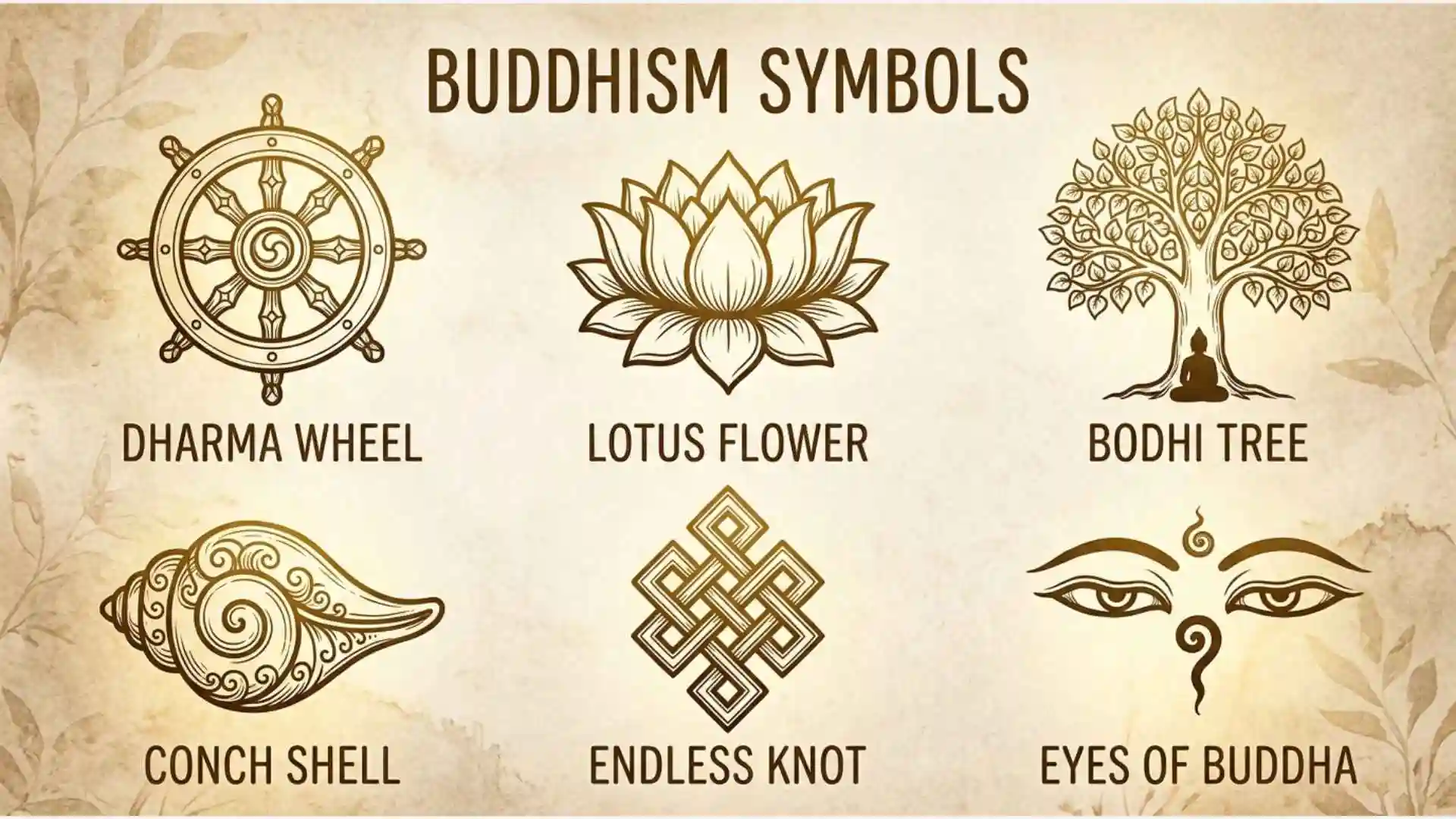
Buddhism is rich with symbols that express ideas about peace, wisdom, compassion, enlightenment, and the path to awakening. From the famous lotus flower and Dharma wheel to the Bodhi tree and endless knot, these sacred signs carry meanings that have developed across centuries of Buddhist teachings and traditions. They are found in temples, statues, artwork, manuscripts, meditation spaces, and religious ceremonies.
Each Buddhist symbol can tell a deeper story about the human journey. Some represent the Buddha’s teachings, while others reflect important qualities that practitioners seek to develop, such as mindfulness, inner peace, compassion, and freedom from suffering. Although symbols can vary in meaning across traditions such as Theravada, Mahayana, and Vajrayana Buddhism, many share a common connection to the journey toward enlightenment.
In this guide, you’ll discover the most important Buddhism symbols, their meanings, ancient origins, and spiritual significance. Whether you are studying Buddhist culture, exploring symbolism, or simply curious about the signs you see in Buddhist art and temples, understanding these symbols can offer a meaningful look into the philosophy and wisdom at the heart of Buddhism.
Quick Answer
Buddhism symbols are sacred images, objects, and signs that represent Buddhist teachings, spiritual values, and the path toward enlightenment. They express ideas such as wisdom, compassion, protection, balance, and freedom from suffering. Common Buddhist symbols include the Dharma wheel, lotus flower, endless knot, Buddha eyes, and the eight auspicious symbols.
Quick Facts About Buddhism Symbols
| Aspect | Information |
| Origin | Ancient India, developing from Buddhist teachings around the 5th century BCE |
| Historical Significance | Used to communicate Buddhist philosophy, stories, and spiritual principles |
| Main Meaning | Wisdom, enlightenment, compassion, balance, and liberation |
| Spiritual Meaning | Represents the journey from ignorance to awareness |
| Cultural Importance | Central in Buddhist art, temples, rituals, and traditions across Asia |
| Modern Usage | Found in meditation spaces, jewelry, tattoos, architecture, and spiritual artwork |
What Are Buddhism Symbols?
Buddhism symbols are visual representations of Buddhist teachings, beliefs, and spiritual experiences. Before written texts became widely available, symbols helped followers understand complex ideas through simple images.
Buddhism began in ancient India with the teachings of Siddhartha Gautama, who later became known as the Buddha. After reaching enlightenment under the Bodhi tree, Buddha shared teachings about suffering, compassion, mindfulness, and liberation.
Early Buddhist communities did not always represent Buddha in human form. Instead, they used symbolic images such as footprints, empty thrones, the Bodhi tree, and the Dharma wheel to represent his presence and teachings.
Over centuries, Buddhist symbols evolved as Buddhism spread across countries including Sri Lanka, China, Japan, Tibet, Korea, Thailand, and Nepal. Each culture added unique artistic styles while preserving the deeper spiritual meanings.
These symbols became more than decorations. They became visual reminders of important Buddhist principles, helping people reflect on personal growth, ethical living, and the nature of existence.
Deep Symbolic Meaning of Buddhism Symbols
Spiritual Level
On a spiritual level, Buddhism symbols represent the journey toward enlightenment. They remind practitioners that the mind can overcome confusion, attachment, and suffering.
The lotus flower, for example, grows from muddy water but blossoms into a beautiful flower. Buddhists see this as a symbol of human potential. A person can rise above difficulties and develop wisdom and compassion.
The Dharma wheel represents the Buddha’s teachings and the movement of spiritual truth. Its eight spokes connect with the Noble Eightfold Path, which teaches right understanding, right action, and right mindfulness.
Many Buddhist symbols encourage self-reflection. They are not only objects of worship but also tools for meditation and awareness.
Psychological Level
Buddhism symbols have powerful psychological meanings because humans naturally connect with images and patterns.
Swiss psychologist Carl Jung studied the importance of symbols and believed they could represent deep aspects of the human unconscious. Buddhist symbols often connect with universal human experiences such as transformation, peace, balance, and renewal.
For example:
- The lotus represents personal growth after hardship.
- The endless knot represents the connection between all things.
- The Buddha eyes represent awareness and inner vision.
These images appeal to people because they reflect emotional journeys that many humans experience.
Cultural Level
Across Buddhist cultures, symbols create shared identity and preserve ancient traditions. They appear in temples, paintings, statues, ceremonies, and everyday objects.
For communities, Buddhist symbols represent values passed from generation to generation. They connect modern followers with ancient teachings and cultural heritage.
Types and Variations of Buddhism Symbols
The Dharma Wheel (Dharmachakra)
Visual Description: A circular wheel with eight spokes, often shown in gold or carved into temple walls.
Meaning: The Dharma wheel represents Buddha’s teachings and the path toward enlightenment.
Symbolism:
- The wheel represents spiritual progress.
- The eight spokes represent the Noble Eightfold Path.
- The circular shape represents the continuous nature of learning and practice.
Cultural Connection: The Dharma wheel is one of the oldest Buddhist symbols and appears throughout Buddhist countries.
Where It Appears:
- Buddhist temples
- Religious artwork
- Flags
- Meditation spaces
The Lotus Flower
Visual Description: A lotus blossom rising above water.
Meaning: The lotus represents purity, awakening, and spiritual transformation.
Symbolism:
The flower grows from muddy water but remains clean, representing how people can overcome suffering and develop wisdom.
Cultural Connection: The lotus is important in many Asian traditions, including Buddhism and Hinduism.
Where It Appears:
- Buddhist statues
- Paintings
- Meditation imagery
- Jewelry designs
The Endless Knot
Visual Description: A complex woven design without a beginning or end.
Meaning: It represents interconnectedness, wisdom, and the relationship between cause and effect.
Symbolism:
The endless pattern reminds people that all actions, thoughts, and events are connected.
Cultural Connection: It is especially important in Tibetan Buddhism.
Where It Appears:
- Tibetan artwork
- Prayer objects
- Decorative designs
Buddha Eyes
Visual Description: Large peaceful eyes often painted on Buddhist stupas.
Meaning: Buddha eyes represent awareness, compassion, and spiritual vision.
Symbolism:
The eyes suggest that true understanding comes from seeing beyond ordinary appearances.
Cultural Connection: Common in Nepalese Buddhist architecture, especially around stupas.
Where It Appears:
- Temples
- Stupas
- Sacred paintings
The Bodhi Tree
Visual Description: A sacred fig tree associated with Buddha’s enlightenment.
Meaning: It represents awakening, knowledge, and spiritual realization.
Symbolism:
Buddha achieved enlightenment while meditating beneath a Bodhi tree in Bodh Gaya, India.
Where It Appears:
- Buddhist pilgrimage sites
- Religious artwork
- Temple gardens
Buddhism Symbols Across Different Cultures
Ancient Indian Tradition
Buddhist symbols originated in ancient India, where the teachings of Buddha developed. Early symbols focused on enlightenment, meditation, and liberation from suffering.
The Dharma wheel became especially important because it represented the Buddha setting his teachings into motion.
Chinese Buddhist Tradition
When Buddhism reached China, symbols blended with Chinese artistic traditions. The lotus became widely used in temples, paintings, and sculptures.
Chinese Buddhism also emphasized harmony, balance, and compassion, influencing how symbols were interpreted.
Japanese Buddhist Tradition
Japanese Buddhism developed unique artistic expressions through Zen Buddhism and other schools.
Symbols such as the lotus, Buddha statues, and meditation imagery became connected with simplicity, mindfulness, and inner peace.
Tibetan Buddhist Tradition
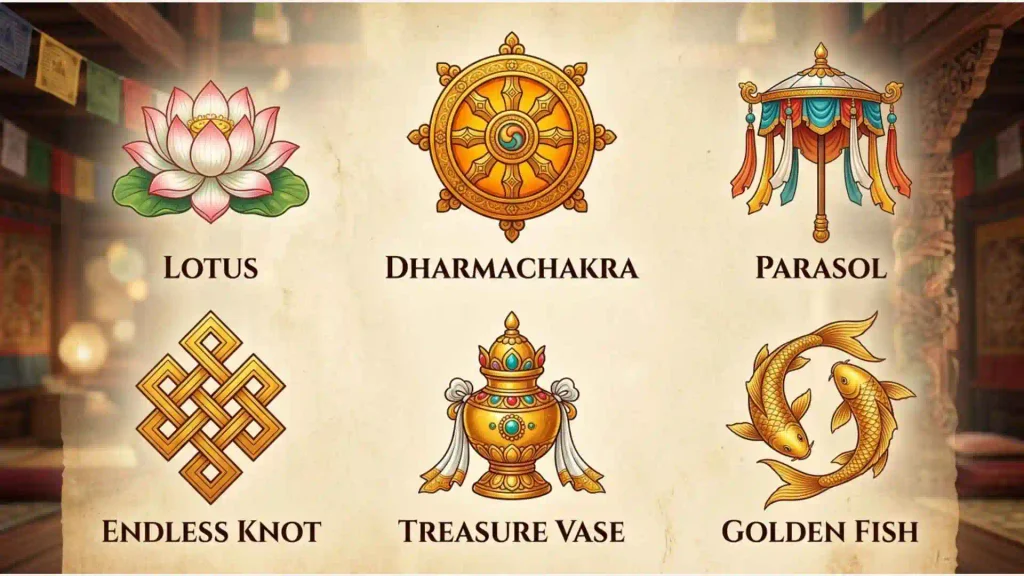
Tibetan Buddhism uses many symbolic images, including the endless knot, mandala, vajra, and the eight auspicious symbols.
These symbols are often used during meditation practices and spiritual ceremonies.
Modern Global Culture
Today, Buddhist symbols appear worldwide. Many people use them as reminders of mindfulness, peace, and personal growth, even outside traditional Buddhist communities.
Similar Symbols and Their Meanings
| Symbol | Similarity | Difference |
| Lotus Flower | Represents purity and transformation | Buddhist lotus specifically connects with enlightenment |
| Dharma Wheel | Similar to other wheel symbols of movement | Represents Buddha’s teachings and spiritual path |
| Yin Yang Symbol | Represents balance | Comes from Taoist philosophy, not Buddhism |
| Mandala | Represents harmony and wholeness | Often used as a meditation tool in Buddhism |
A common misunderstanding is that all Asian spiritual symbols have the same meaning. While some ideas overlap, each tradition has its own history and interpretation.
Buddhism Symbols in Mythology and Folklore
Buddhist symbols are deeply connected with legends and sacred stories.
The lotus flower appears in many Buddhist stories connected with purity and divine awakening. Some traditions describe Buddha’s birth as being associated with lotus imagery, symbolizing his extraordinary spiritual nature.
The Bodhi tree became sacred because of the story of Buddha’s enlightenment. According to tradition, Siddhartha Gautama meditated beneath the tree until he discovered the path beyond suffering.
The Dharma wheel is connected with the story of Buddha’s first sermon at Sarnath, where he began teaching the Four Noble Truths and the Eightfold Path.
These stories transformed symbols into living reminders of spiritual discovery.
Buddhism Symbols in Art, Literature, Movies and Pop Culture
Buddhist symbols have influenced art for centuries.
Paintings and Sculpture
Artists across Asia have used Buddhist symbols in temple murals, statues, and sacred paintings. The lotus throne beneath Buddha statues is one of the most recognized examples.
Literature
Buddhist ideas appear in many books and poems exploring mindfulness, suffering, compassion, and human existence.
Movies and Television
Films often use Buddhist imagery to represent peace, wisdom, or personal transformation. Meditation scenes, temples, and lotus imagery frequently appear when characters seek deeper understanding.
Tattoos and Fashion
Many people choose Buddhist symbols as tattoos or jewelry because they represent personal values such as:
- Inner peace
- Strength through challenges
- Spiritual growth
- Awareness
However, cultural respect is important because these symbols have deep religious meanings.
Spiritual and Dream Meaning of Buddhism Symbols
Seeing Buddhism symbols in dreams or meditation experiences is often interpreted as a sign of reflection, transformation, or seeking balance.
Common interpretations include:
| Symbol | Possible Meaning |
| Lotus | Personal growth and overcoming difficulties |
| Dharma Wheel | A new spiritual direction or learning journey |
| Buddha Statue | Wisdom, calmness, and self-awareness |
| Endless Knot | Relationships and interconnected experiences |
Dream interpretations vary by personal beliefs and cultural background. They should be viewed as opportunities for reflection rather than fixed predictions.
Positive and Negative Meanings of Buddhism Symbols
| Positive Meaning | Negative Meaning |
| Wisdom | Misunderstanding spiritual teachings |
| Peace | Using symbols only as decoration without respect |
| Compassion | Cultural appropriation |
| Transformation | Attachment to external symbols instead of inner practice |
| Balance | Confusion about meanings |
A symbol itself is not positive or negative. Its meaning depends on how people understand and use it.
Why Humans Are Attracted to Buddhism Symbols
Humans have always used symbols to express ideas that words cannot fully explain.
Buddhist symbols attract people because they represent universal experiences:
- The desire for peace
- The search for meaning
- The hope for personal transformation
- The need for connection
They also help people remember important values. A small lotus image can remind someone to remain calm during difficult times. A Dharma wheel can inspire someone to continue learning and growing.
Symbols become powerful because humans attach memories, emotions, and personal stories to them.
Modern Uses of Buddhism Symbols
Tattoos
Buddhist symbols are popular tattoo designs because they represent personal journeys and spiritual beliefs.
Jewelry
Lotus pendants, Dharma wheel necklaces, and endless knot bracelets are often worn as reminders of mindfulness and peace.
Home Decor
Many people use Buddhist artwork, statues, and meditation designs to create peaceful environments.
Branding and Design
Some modern wellness brands use Buddhist-inspired imagery to communicate calmness, balance, and natural living.
Social Media
Buddhist symbols frequently appear in online spaces related to meditation, mindfulness, and personal development.
Interesting Facts About Buddhism Symbols
- The Dharma wheel is featured on the national flag of India because it represents movement, progress, and justice.
- The lotus flower is one of the most important symbols in both Buddhism and Hinduism.
- The eight-spoked Dharma wheel represents the Eightfold Path taught by Buddha.
- The Bodhi tree in Bodh Gaya, India, is believed to descend from the original tree under which Buddha reached enlightenment.
- Tibetan Buddhist art often uses complex mandalas as tools for meditation.
- Buddha was not commonly represented in human form during the earliest period of Buddhist art.
- Many Buddhist symbols combine artistic beauty with philosophical teachings.
Frequently Asked Questions
What are the most important Buddhism symbols?
The most important Buddhism symbols include the Dharma wheel, lotus flower, endless knot, Buddha eyes, Bodhi tree, and eight auspicious symbols.
What does the lotus mean in Buddhism?
The lotus represents purity, spiritual growth, and enlightenment because it rises from muddy water while remaining beautiful and clean.
What does the Dharma wheel symbolize?
The Dharma wheel represents Buddha’s teachings and the journey toward enlightenment through the Noble Eightfold Path.
Are Buddhist symbols only religious symbols?
No. While they have deep religious meanings, many people also appreciate them as symbols of peace, mindfulness, and personal growth.
What does the endless knot mean in Buddhism?
The endless knot symbolizes interconnectedness, wisdom, and the connection between causes and effects.
Conclusion
Buddhism symbols are more than beautiful images. They are timeless reminders of wisdom, compassion, and the human journey toward inner peace. From the lotus flower to the Dharma wheel, each symbol carries centuries of history and spiritual meaning. These sacred signs continue to inspire people around the world to seek awareness, balance, and deeper understanding.
 Sarah Thompson
 Michael Rivera