
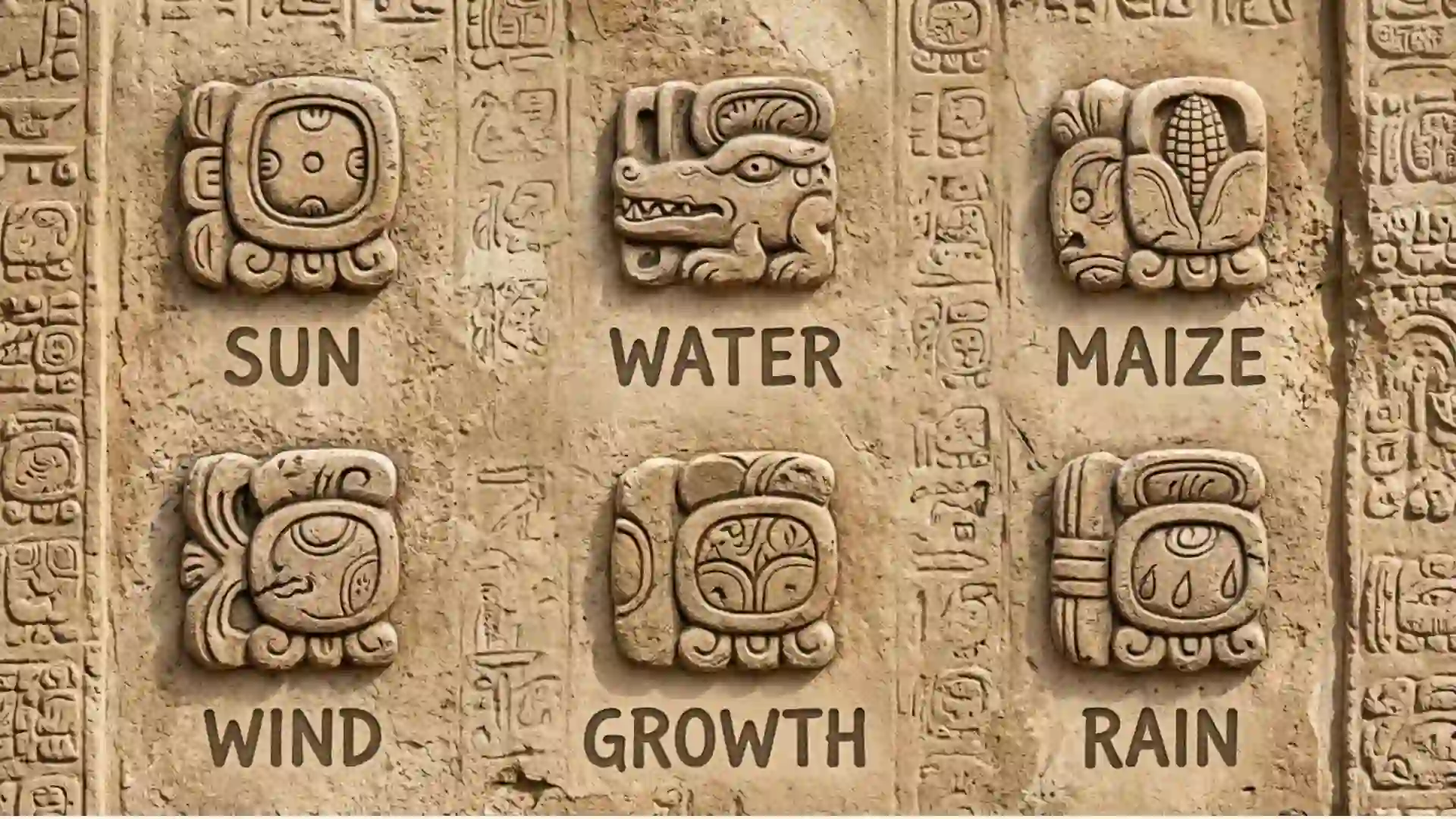
Mayan symbols offer a fascinating look into the beliefs, traditions, and worldview of the ancient Maya civilization. These symbols appeared in temples, monuments, pottery, manuscripts, jewelry, and other forms of Maya art. Many were connected to nature, gods, astronomy, time, death, rebirth, power, and the relationship between humans and the spiritual world.
The ancient Maya used a complex system of signs and images to communicate ideas that went far beyond simple decoration. Animals such as the jaguar and serpent, along with the sun, moon, maize, rain, and sacred trees, held deep cultural and spiritual meanings. Some symbols were also closely connected to Maya calendars, religious ceremonies, royal authority, and stories about the creation of the world.
In this guide, you’ll discover the meanings behind important Mayan symbols, where they came from, and why they mattered to Maya society. You’ll also learn about their spiritual significance, connections to Maya mythology and astronomy, and how these ancient symbols continue to influence modern art, culture, jewelry, tattoos, and popular interpretations today.
Quick Answer
Mayan symbols are ancient signs and glyphs created by the Maya civilization of Mesoamerica to represent ideas, sounds, numbers, gods, natural forces, and spiritual concepts. They appeared in temples, manuscripts, calendars, pottery, and artwork, reflecting Maya knowledge of astronomy, mythology, and sacred traditions.
Quick Facts About Mayan Symbols
| Aspect | Information |
| Origin | Developed by the Maya civilization in Mesoamerica, especially in present-day Mexico, Guatemala, Belize, Honduras, and El Salvador |
| Historical Significance | Used for writing, religious ceremonies, astronomy, calendars, and recording historical events |
| Main Meaning | Represented gods, nature, time cycles, animals, human experiences, and cosmic ideas |
| Spiritual Meaning | Connected humans with creation, ancestors, the universe, and divine forces |
| Cultural Importance | Preserved Maya history, mythology, scientific knowledge, and religious beliefs |
| Modern Usage | Found in art, tattoos, jewelry, cultural studies, architecture, and spiritual symbolism |
What Are Mayan Symbols?
Mayan symbols are visual signs created by the ancient Maya people to communicate complex ideas. These symbols were not simple decorations. They formed part of a sophisticated writing system known as Maya hieroglyphics or Maya glyphs.
The Maya civilization flourished between approximately 2000 BCE and the 16th century CE, reaching its peak during the Classic Period from around 250 to 900 CE. Their cities, including Tikal, Palenque, and Chichén Itzá, contained thousands of carved symbols that recorded royal histories, religious beliefs, astronomical observations, and important ceremonies.
Maya writing was one of the most advanced writing systems developed in the ancient Americas. Unlike simple picture symbols, Maya glyphs could represent sounds, words, and concepts.
The symbols appeared on:
- Temple walls
- Stone monuments called stelae
- Pottery
- Jewelry
- Books made from bark paper called codices
- Ritual objects
Many Mayan symbols were connected to the Maya understanding of time. The Maya believed time was not simply a straight line but a series of repeating cycles connected to cosmic events.
Deep Symbolic Meaning of Mayan Symbols
Spiritual Meaning of Mayan Symbols
For the Maya, symbols were a bridge between the physical world and the spiritual realm. They represented communication between humans, gods, ancestors, and natural forces.
Many symbols were connected with:
- Creation stories
- The movement of celestial bodies
- Life and death cycles
- Spiritual transformation
- Divine protection
The Maya believed that the universe had different layers, including the heavens, the earthly world, and the underworld known as Xibalba. Symbols helped people understand and interact with these spiritual dimensions.
For example, the ceiba tree symbol represented the connection between different worlds. Its roots reached the underworld, its trunk represented the human world, and its branches reached the heavens.
Psychological Meaning of Mayan Symbols
From a psychological perspective, Mayan symbols represent universal human themes. Swiss psychologist Carl Jung suggested that certain symbols appear across cultures because they connect with shared human experiences called archetypes.
Mayan symbols often represent archetypal ideas such as:
- The journey of life
- Death and rebirth
- The search for wisdom
- Balance between opposing forces
- Connection with nature
Humans are naturally attracted to these symbols because they provide meaning and help explain experiences that feel larger than everyday life.
A symbol of the sun, for example, is not only an image of a star. It can represent hope, energy, growth, and renewal.
Cultural Meaning of Mayan Symbols
Mayan symbols preserved the identity of an entire civilization. They helped rulers record victories, religious ceremonies, and family histories.
Symbols were also used to honor:
- Gods
- Kings and queens
- Ancestors
- Natural elements
- Sacred animals
For Maya communities, these symbols were living expressions of their relationship with the universe.
Types and Variations of Mayan Symbols
Maya Sun Symbol
Visual Description: Often represented through circular shapes, rays, and solar imagery.
Meaning: The sun symbol represented life, energy, creation, and divine power.
Symbolism: The sun was connected with warmth, agriculture, and the movement of time.
Cultural Connection: The Maya carefully studied the sun’s movement to create accurate calendars.
Where It Appears:
- Temples
- Calendar systems
- Religious artwork
- Modern Maya-inspired designs
Maya Calendar Symbols
Visual Description: Complex combinations of numbers and glyphs.
Meaning: Represented cycles of time and important dates.
Symbolism: Time was viewed as sacred and connected with cosmic forces.
Cultural Connection: The Maya created advanced calendars, including the Tzolk’in sacred calendar and Haab’ solar calendar.
Where It Appears:
- Codices
- Stone carvings
- Archaeological sites
Maya Jaguar Symbol
Visual Description: Images of jaguars or jaguar features.
Meaning: Power, strength, protection, and connection with the spiritual world.
Symbolism: The jaguar was considered a powerful animal that could move between the human world and supernatural realms.
Cultural Connection: Maya rulers often associated themselves with jaguar power.
Where It Appears:
- Royal artwork
- Religious ceremonies
- Mythological stories
Maya Serpent Symbol
Visual Description: A decorated snake figure, often connected with feathers.
Meaning: Wisdom, transformation, and divine communication.
Symbolism: Serpents represented movement between different worlds.
Cultural Connection: The feathered serpent was an important symbol throughout Mesoamerican cultures.
Where It Appears:
- Temple carvings
- Mythology
- Religious art
Maya Water Symbol
Visual Description: Flowing patterns and wave-like designs.
Meaning: Life, fertility, cleansing, and renewal.
Symbolism: Water represented the source of creation and agricultural success.
Cultural Connection: Rain and water were deeply connected with Chaac, the Maya rain god.
Where It Appears:
- Ceremonial objects
- Architecture
- Artwork
Mayan Symbols Across Different Cultures
Ancient Egypt
Ancient Egyptian symbols and Mayan symbols developed independently but shared similar themes.
Both cultures used symbols to represent:
- Gods
- Afterlife beliefs
- Cosmic order
- Royal power
The Egyptian ankh represented life, while Maya symbols often represented cycles of life, death, and rebirth.
Ancient Greece
Greek culture valued symbols connected with mythology and philosophy.
Similarities include:
- Sacred animals
- Divine signs
- Stories about gods and creation
However, Greek symbols were often connected with mythology and philosophy, while Maya symbols were strongly connected with calendars, astronomy, and writing.
Roman Culture
Romans adopted many symbolic traditions from earlier civilizations.
Like the Maya, Romans used symbols to represent:
- Political authority
- Religious beliefs
- Social identity
However, Maya symbols focused more heavily on cosmic cycles and spiritual connections.
Eastern Traditions
Eastern cultures, including Hindu and Buddhist traditions, also developed symbolic systems.
Shared themes include:
- Balance
- Spiritual awakening
- Connection between humans and the universe
For example, the Maya concept of cosmic balance shares similarities with ideas found in Eastern philosophies.
Indigenous Traditions
Many Indigenous cultures of the Americas use symbols connected with:
- Nature
- Animals
- Ancestors
- Spiritual relationships
Mayan symbols remain an important part of Indigenous heritage and cultural identity.
Similar Symbols and Their Meanings
| Symbol | Similar Meaning | Difference |
| Maya Jaguar | Strength and protection | Maya jaguar symbolism connects strongly with rulers and spiritual worlds |
| Egyptian Scarab | Renewal and transformation | Scarab focuses on rebirth and solar cycles |
| Celtic Tree Symbol | Connection between worlds | Maya ceiba tree connects specifically with Maya cosmology |
| Yin Yang Symbol | Balance | Maya symbols express balance through cosmic cycles and nature |
Mayan Symbols in Mythology and Folklore
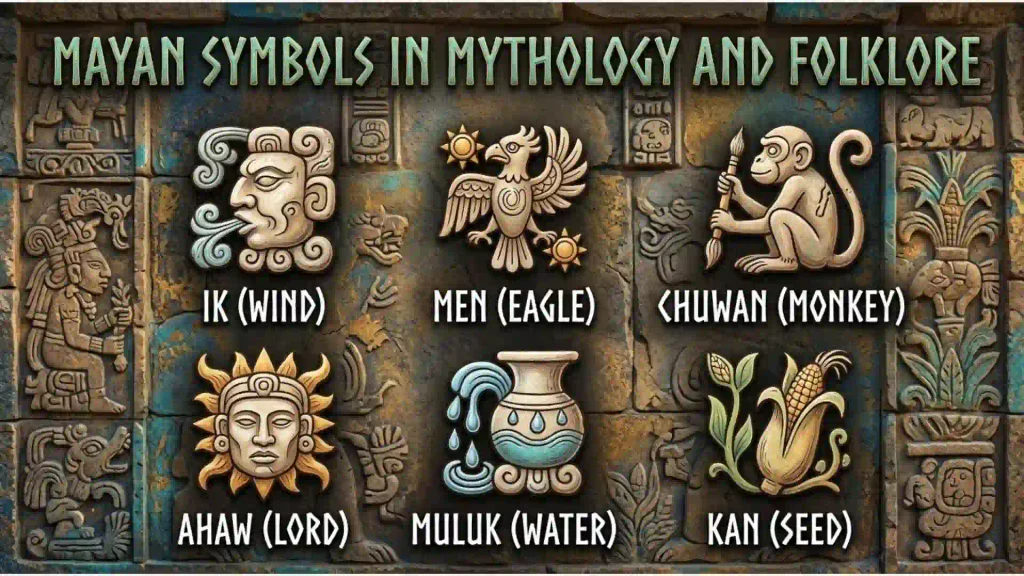
Mayan mythology is filled with symbolic stories about creation, gods, heroes, and the natural world.
The Popol Vuh, the sacred creation story of the K’iche’ Maya, describes the creation of humans, the actions of gods, and the relationship between humans and the universe.
Important symbolic figures include:
Kukulkan, the Feathered Serpent
Kukulkan represented wisdom, creation, and communication between heaven and earth.
Chaac, the Rain God
Chaac symbolized water, fertility, and agricultural survival.
The Hero Twins
The Hero Twins from the Popol Vuh represented courage, intelligence, and overcoming challenges.
These stories helped shape how Maya communities understood their symbols.
Mayan Symbols in Art, Literature, Movies, and Pop Culture
Mayan symbols continue to influence modern creativity.
Art and Architecture
Artists use Maya-inspired patterns to celebrate:
- Ancient knowledge
- Cultural identity
- Connection with nature
Literature
Writers often use Mayan symbols to explore themes such as:
- Mystery
- Lost civilizations
- Human discovery
- Spiritual journeys
Movies and Television
Mayan imagery frequently appears in stories about archaeology, ancient mysteries, and adventure.
Although some popular portrayals are inaccurate, they have increased global interest in Maya history.
Tattoos and Fashion
Many people choose Mayan symbols for tattoos because they represent:
- Strength
- Wisdom
- Protection
- Spiritual growth
However, understanding the cultural meaning behind a symbol is important before using it.
Spiritual and Dream Meaning of Mayan Symbols
Dream interpretations involving Mayan symbols often focus on personal transformation and hidden knowledge.
Common interpretations include:
| Symbol | Possible Dream Meaning |
| Jaguar | Inner strength and courage |
| Sun | New beginnings and energy |
| Serpent | Transformation and wisdom |
| Tree | Growth and connection |
| Calendar | Personal cycles and life changes |
In meditation and spiritual practices, Mayan symbols may inspire reflection on nature, time, and personal purpose.
These meanings are modern interpretations and may differ from traditional Maya beliefs.
Positive and Negative Meanings of Mayan Symbols
| Positive Meaning | Negative Meaning |
| Wisdom | Fear of the unknown |
| Spiritual connection | Misinterpretation of ancient beliefs |
| Strength | Desire for power |
| Transformation | Resistance to change |
| Balance | Loss of harmony |
A symbol can represent both positive and challenging ideas depending on its context.
Why Humans Are Attracted to Mayan Symbols
Humans have always searched for meaning through symbols. Ancient signs create a connection between visible images and invisible ideas.
People are attracted to Mayan symbols because they represent:
- Mystery
- Ancient wisdom
- Human creativity
- Connection with nature
- The search for deeper meaning
These symbols remind people that past civilizations also asked important questions about life, existence, and the universe.
Modern Uses of Mayan Symbols
Today, Mayan symbols appear in many areas:
Tattoos
Used as personal expressions of identity, strength, and spirituality.
Jewelry
Maya-inspired designs are worn as reminders of wisdom and cultural appreciation.
Fashion
Patterns inspired by Maya artwork appear in clothing and accessories.
Branding
Some businesses use ancient symbols to suggest heritage, authenticity, and mystery.
Home Decor
Maya-inspired artwork adds cultural and historical themes to living spaces.
Contemporary Spirituality
Some people use Mayan symbols for meditation, reflection, and personal growth.
Interesting Facts About Mayan Symbols
- The Maya developed one of the most advanced writing systems in ancient America.
- Maya glyphs could represent both sounds and complete ideas.
- The Maya created highly accurate astronomical calculations.
- The famous Maya calendar did not predict the end of the world. It marked the completion of a major time cycle.
- The Maya used over 800 known glyphs in their writing system.
- The Popol Vuh preserves important Maya creation stories and mythology.
- Many Maya symbols remain meaningful to modern Maya communities.
- Maya temples often contain symbols connected with astronomy and sacred time.
Frequently Asked Questions
What do Mayan symbols represent?
Mayan symbols represent ideas related to gods, nature, time, astronomy, spirituality, animals, and human experiences.
What is the most famous Mayan symbol?
The Maya calendar symbols are among the most famous because of global interest in Maya timekeeping systems.
Are Mayan symbols spiritual?
Yes. Many Mayan symbols had spiritual meanings connected with creation, gods, ancestors, and the universe.
What does the Mayan jaguar symbol mean?
The jaguar symbol represents strength, protection, power, and spiritual connection.
Are Mayan symbols still used today?
Yes. Modern Maya communities, artists, researchers, and designers continue to use and study these symbols.
Conclusion
Mayan symbols are more than ancient markings carved into stone. They are powerful reflections of a civilization that studied time, nature, spirituality, and human existence. Each symbol carries stories of creation, transformation, and connection with the universe. By understanding Mayan symbols, we gain a deeper appreciation for Maya wisdom and the universal human desire to find meaning in life.
 Sarah Thompson
 John Mercer