
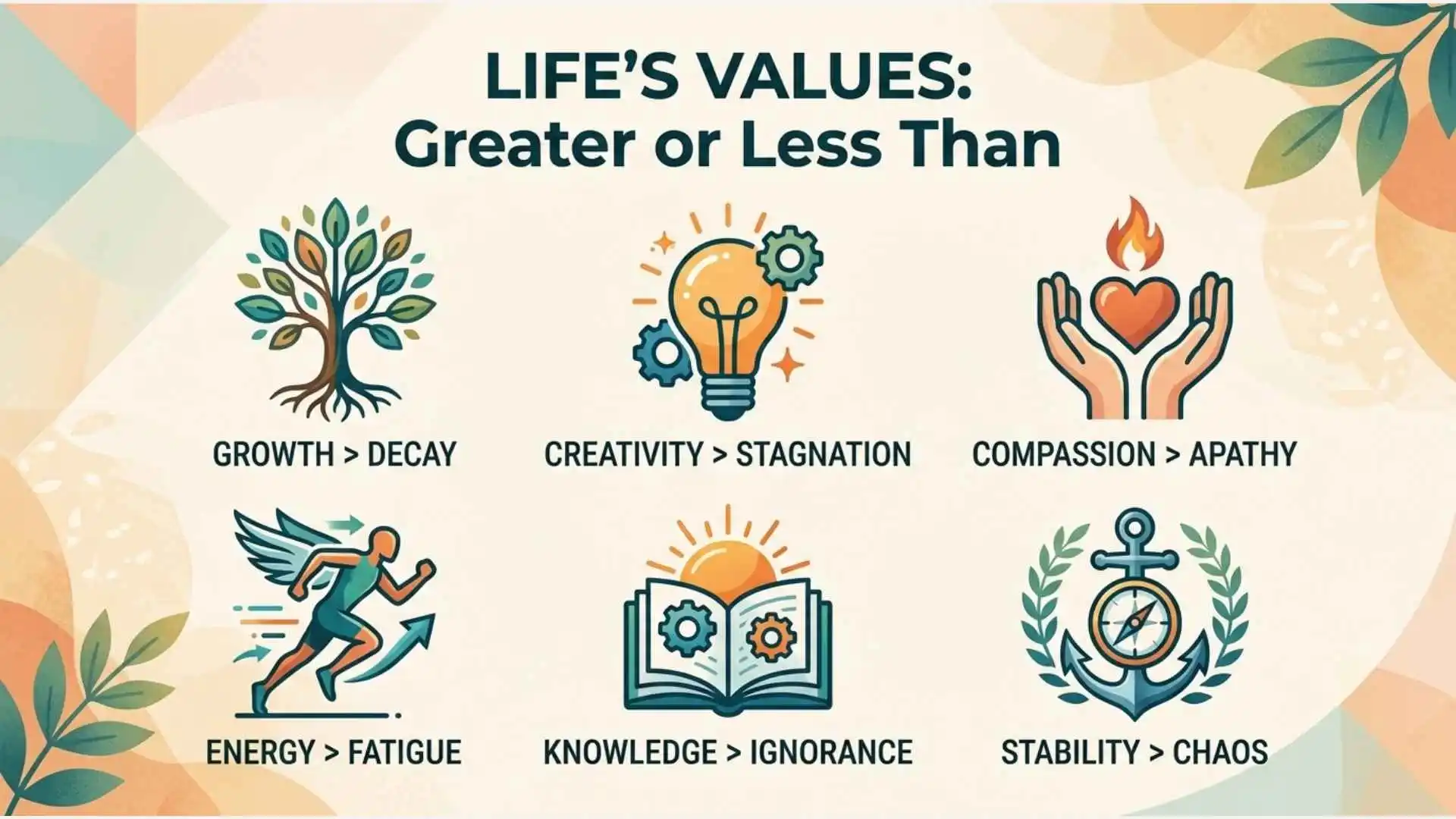
The greater than (>) and less than (<) symbols are two of the most common signs used in mathematics to compare numbers, values, quantities, and expressions. They quickly show whether one value is larger or smaller than another. For example, 8 > 5 means 8 is greater than 5, while 3 < 7 means 3 is less than 7.
These inequality signs are useful far beyond basic arithmetic. You will find them in algebra, statistics, programming, science, economics, measurements, and everyday comparisons. Related symbols such as greater than or equal to (≥) and less than or equal to (≤) also help describe situations where two values may be equal as well as greater or smaller.
Understanding which direction the symbol should face can sometimes be confusing, especially when working with negative numbers, algebraic expressions, or unfamiliar notation. This guide explains the meaning, history, rules, uses, examples, and differences between greater than and less than symbols so you can recognize and use inequality signs with confidence.
Quick Answer
The greater than symbol (>) means that the value on the left is larger than the value on the right, while the less than symbol (<) means the value on the left is smaller than the value on the right. These symbols are called inequality signs and are used in mathematics, programming, science, and data comparison.
Quick Facts About Greater Than or Less Than Symbols
| Aspect | Information |
| Origin | Introduced by English mathematician Thomas Harriot in the early 1600s |
| Historical Significance | Simplified mathematical comparison and inequality expressions |
| Main Meaning | Shows whether one value is larger or smaller than another |
| Mathematical Symbolism | Represents relationships between quantities |
| Cultural Importance | Became a universal language of numbers and logic |
| Modern Usage | Used in mathematics, coding, statistics, science, and technology |
What Are Greater Than or Less Than Symbols?
Definition of Greater Than and Less Than Symbols
Greater than or less than symbols are mathematical symbols used to compare two values. They show the relationship between numbers, expressions, or quantities.
The two main symbols are:
- Greater than symbol: >
- Less than symbol: <
The greater than symbol means the number or expression on the left side is larger.
Example:
8 > 3
This statement means “8 is greater than 3.”
The less than symbol means the number or expression on the left side is smaller.
Example:
2 < 7
This statement means “2 is less than 7.”
These symbols are known as inequality symbols because they show that two values are not equal.
Origin and Historical Background
Before these symbols existed, mathematicians used written words to describe comparisons. Expressions such as “5 is greater than 3” were common but took more time and space.
The symbols were introduced around 1631 by English mathematician and astronomer Thomas Harriot. His work helped create a shorter way to express relationships between numbers.
Over time, mathematicians adopted these symbols because they improved clarity and reduced lengthy explanations. They became a standard part of mathematical notation used worldwide.
Evolution Over Time
The use of comparison symbols expanded beyond basic arithmetic. Today, they appear in:
- Algebra
- Calculus
- Statistics
- Computer programming
- Artificial intelligence
- Data science
- Engineering
A symbol created hundreds of years ago now helps computers make decisions and process information.
Deep Symbolic Meaning of Greater Than or Less Than Symbols
Although these symbols were created for mathematics, they also represent deeper human ideas about comparison, balance, and relationships.
Spiritual Level
Mathematical symbols are often viewed as reflections of human attempts to understand order in the universe. Greater than and less than symbols represent balance, difference, and the relationship between opposing forces.
In symbolic interpretations:
- Greater than can represent growth, expansion, progress, or abundance.
- Less than can represent humility, simplicity, limitation, or the need for improvement.
Many spiritual traditions explore the idea that everything exists in relationship with something else. These symbols visually express that concept.
The opening side of the symbol creates a sense of direction, showing how one thing relates to another. This idea connects with broader spiritual themes of harmony and balance.
Psychological Level
From a psychological perspective, humans naturally compare things. Comparison helps people understand their environment, make decisions, and organize information.
The greater than and less than symbols appeal to the human mind because they create immediate visual meaning. The brain quickly recognizes direction and difference.
Swiss psychologist Carl Jung discussed the importance of symbols in human thinking. While mathematical symbols are not traditional archetypes, they reflect a universal human desire to categorize, measure, and understand relationships.
These symbols represent:
- Decision-making
- Ranking
- Progress
- Evaluation
- Logical thinking
Cultural Level
Across cultures, humans have created systems for measuring value and difference. Mathematical symbols became a shared language that crosses borders.
A student in Japan, a scientist in Egypt, and a programmer in Brazil can all understand the meaning of:
10 > 5
This universal quality makes mathematical symbols an important part of global communication.
Types and Variations of Greater Than or Less Than Symbols
Greater than and less than symbols have several variations depending on their purpose.
Greater Than Symbol (>)
Visual Description: A symbol shaped like an open angle pointing toward the larger value.
Meaning: The left value is larger than the right value.
Example:
15 > 9
Symbolism:
- Growth
- Higher quantity
- Larger measurement
- Increased value
Where It Appears:
- Mathematics textbooks
- Scientific formulas
- Computer programming
- Data analysis
Less Than Symbol (<)
Visual Description: A symbol shaped like an open angle pointing away from the smaller value.
Meaning: The left value is smaller than the right value.
Example:
4 < 12
Symbolism:
- Lower quantity
- Smaller measurement
- Reduced amount
- Limited value
Where It Appears:
- Arithmetic
- Statistics
- Engineering calculations
- Programming conditions
Greater Than or Equal To Symbol (≥)
Visual Description: A greater than symbol combined with a horizontal line.
Meaning: The first value is larger than or equal to the second value.
Example:
10 ≥ 10
This means 10 is greater than or equal to 10.
Less Than or Equal To Symbol (≤)
Visual Description: A less than symbol combined with a horizontal line.
Meaning: The first value is smaller than or equal to the second value.
Example:
5 ≤ 8
This means 5 is less than or equal to 8.
Greater Than or Less Than Symbols Across Different Fields
Mathematics
Mathematics is the primary field where these symbols are used. They help students and professionals compare numbers and solve equations.
Examples include:
- 20 > 15
- x < 100
- a ≥ b
In algebra, inequalities help describe possible solutions rather than a single answer.
Science
Scientists use inequality symbols to describe measurements, limits, and conditions.
Examples:
- Temperature requirements
- Chemical ranges
- Physical measurements
- Experimental boundaries
A scientist may write:
Temperature < 50°C
meaning the temperature must remain below 50 degrees Celsius.
Computer Programming
In programming, greater than and less than symbols allow computers to make decisions.
Example:
if age >= 18:
allow access
The computer checks whether a condition is true or false.
Programming languages use these symbols in:
- Python
- JavaScript
- Java
- C++
- SQL
Data Science and Statistics
Researchers use inequality symbols to analyze information and identify patterns.
Examples:
- Finding values greater than an average
- Filtering data sets
- Setting measurement limits
Modern technology depends heavily on these comparison systems.
Similar Symbols and Their Meanings
| Symbol | Meaning | Example |
| > | Greater than | 9 > 4 |
| < | Less than | 3 < 8 |
| ≥ | Greater than or equal to | 7 ≥ 7 |
| ≤ | Less than or equal to | 5 ≤ 6 |
| = | Equal to | 4 = 4 |
| ≠ | Not equal to | 5 ≠ 2 |
Common Misconceptions
Many students confuse the direction of these symbols. A useful trick is to remember that the wide opening always faces the larger number.
Example:
9 > 2
The symbol opens toward 9 because 9 is bigger.
The pointed side always faces the smaller number.
Greater Than or Less Than Symbols in Mythology and Human Thought
Although these symbols are not ancient religious symbols, their meaning connects with an old human theme: understanding differences.
Ancient civilizations created systems to compare:
- Wealth
- Social status
- Time
- Land
- Resources
Ancient Egyptians used measurement systems to organize agriculture and construction. Greek mathematicians developed logical methods for understanding quantity and relationships. Roman engineers used mathematical concepts for architecture and planning.
The modern inequality symbols continue this ancient human tradition of creating order from complexity.
Greater Than or Less Than Symbols in Art, Literature, Movies, and Pop Culture
Mathematical symbols have entered modern culture beyond classrooms.
Digital Design
Designers use comparison symbols in:
- Infographics
- Data visualization
- Technology branding
- Educational graphics
Social Media
Symbols are often used creatively online.
Examples:
- “Coffee > Sleep” to show preference
- “Summer < Winter” to express opinions
Here, the symbol becomes a casual language tool rather than a mathematical expression.
Technology and Gaming
In gaming communities, comparison symbols are used to rank:
- Characters
- Skills
- Equipment
- Performance levels
They communicate ideas quickly in digital conversations.
Spiritual and Dream Meaning of Greater Than or Less Than Symbols
Dream interpretations are subjective, but symbols involving comparison may represent personal evaluation.
Possible meanings include:
Positive Interpretations
- Personal growth
- Improvement
- Achievement
- Understanding priorities
Cautionary Interpretations
- Feeling inferior
- Comparing yourself with others
- Fear of not being enough
Seeing comparison symbols in dreams may reflect how someone views success, progress, or personal value.
Positive and Negative Meanings of Greater Than or Less Than Symbols
| Positive Meaning | Negative Meaning |
| Growth and progress | Unhealthy comparison |
| Logical thinking | Judgment |
| Understanding differences | Feeling inferior |
| Organization and clarity | Competition |
A symbol itself is neutral. Its meaning depends on how people use and interpret it.
Why Humans Are Attracted to Greater Than or Less Than Symbols
Humans naturally search for patterns and relationships. Comparison helps people understand the world around them.
These symbols are powerful because they transform complicated ideas into simple visual messages.
They represent:
- Curiosity
- Discovery
- Logic
- Measurement
- Understanding
From a child’s first math lesson to advanced artificial intelligence systems, these symbols help humans and machines interpret information.
Modern Uses of Greater Than or Less Than Symbols
Education
Teachers use these symbols to introduce children to comparison and logical reasoning.
Technology
Software developers use them to create decision-making systems.
Branding and Marketing
Companies sometimes use comparison symbols to communicate ideas like:
- Better performance
- Higher quality
- Faster results
Personal Expression
People use these symbols online to express preferences.
Examples:
- “Books > Movies”
- “Health > Wealth”
The symbols have become part of modern digital communication.
Interesting Facts About Greater Than or Less Than Symbols
- The symbols were introduced in the 1600s by Thomas Harriot.
- They are understood worldwide regardless of spoken language.
- Computer programming relies heavily on comparison operators.
- The opening side always faces the larger value.
- Inequality symbols help artificial intelligence systems compare data.
- These symbols are among the most commonly used mathematical marks.
- They appear in science, economics, engineering, and statistics.
- Social media users often use them as opinion symbols rather than mathematical signs.
Frequently Asked Questions
What do greater than and less than symbols mean?
The greater than symbol (>) means the value on the left is larger. The less than symbol (<) means the value on the left is smaller.
How do you remember which way the symbol faces?
Remember that the open side faces the bigger number, while the pointed side faces the smaller number.
Who invented the greater than and less than symbols?
English mathematician Thomas Harriot introduced these symbols in the early 1600s.
Are greater than and less than symbols used outside mathematics?
Yes. They are used in programming, science, statistics, technology, and online communication.
What is the difference between ≥ and >?
The symbol > means strictly greater, while ≥ means greater than or equal to.
Conclusion
Greater than or less than symbols are more than simple mathematical marks. They represent humanity’s desire to understand relationships, patterns, and differences. From ancient measurement systems to modern technology, these symbols continue to connect ideas across cultures and disciplines. Their simple shape carries a powerful message: every value exists in relation to something else.
 Sarah Thompson
 Michael Rivera