
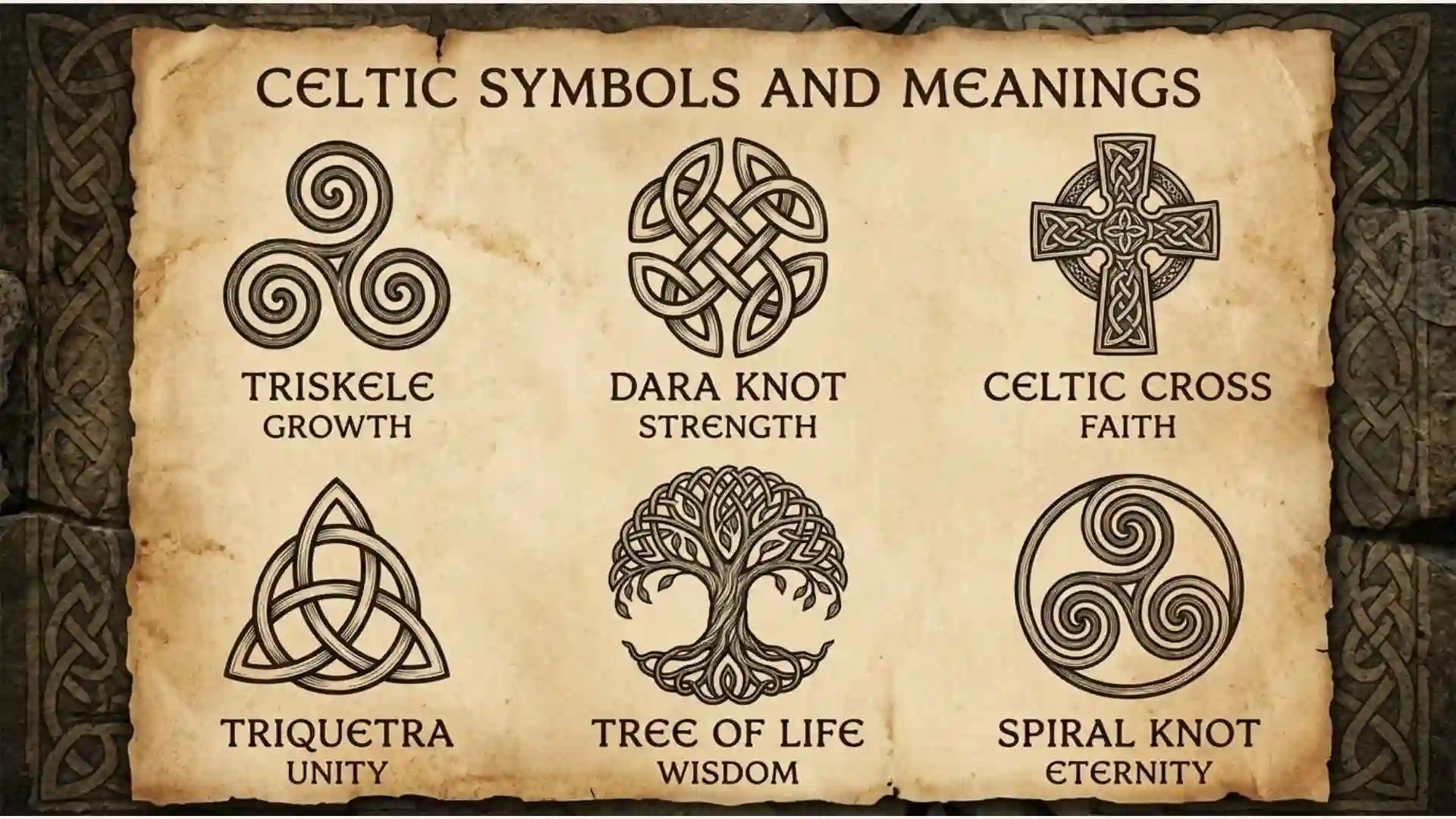
Celtic symbols are more than beautiful patterns found in jewelry, artwork, tattoos, and traditional designs. They are connected to the history, beliefs, nature, and cultural traditions of Celtic peoples. Symbols such as the Trinity Knot, Celtic Cross, Spiral, Dara Knot, and Claddagh have become widely recognized, with each carrying meanings that can relate to life, faith, strength, love, eternity, or spiritual connection.
Many Celtic designs are closely connected with nature and the cycles of life. Spirals may represent growth and movement, while interwoven knots are often associated with connection, continuity, and eternity. However, it is important to remember that not every modern interpretation of a Celtic symbol can be traced directly to ancient Celtic beliefs. Some meanings developed through later Irish, Scottish, Welsh, Christian, and modern cultural traditions.
Today, Celtic symbols continue to attract people because they combine history, spirituality, identity, and visual beauty. Whether you are researching Celtic heritage, choosing a meaningful tattoo, exploring ancient symbolism, or simply curious about these mysterious designs, understanding their historical context can make their meanings much deeper.
Quick Answer: What Are Celtic Symbols and Meanings?
Celtic symbols and meanings refer to the traditional signs, patterns, and designs created by Celtic cultures to represent spiritual beliefs, nature, protection, eternity, and connections between humans and the universe. These symbols appeared in ancient manuscripts, stone carvings, jewelry, weapons, and artwork across Celtic regions.
Quick Facts About Celtic Symbols and Meanings
| Aspect | Information |
| Origin | Ancient Celtic cultures of Ireland, Scotland, Wales, Britain, and parts of Western Europe |
| Historical Significance | Used in art, religious traditions, monuments, manuscripts, and personal objects |
| Main Meaning | Connection, eternity, nature, protection, strength, and spiritual wisdom |
| Spiritual Meaning | Represents cycles of life, transformation, balance, and connection with the divine |
| Cultural Importance | A major part of Celtic identity, mythology, and heritage |
| Modern Usage | Found in tattoos, jewelry, fashion, artwork, meditation, and personal symbolism |
What Are Celtic Symbols and Meanings?
Celtic symbols are artistic designs created by ancient Celtic communities to communicate ideas that were often difficult to express through words. These symbols represented everything from the endless cycle of life to the relationship between humans, animals, and nature.
The Celtic people were not a single nation but a collection of tribes and cultures that lived across regions including Ireland, Scotland, Wales, Brittany, and parts of mainland Europe. Their traditions developed over centuries, especially during the Iron Age and later medieval periods.
Many Celtic symbols became widely known through ancient Irish and British artwork. Manuscripts such as the Book of Kells preserved some of the most famous Celtic designs, including complex interwoven patterns and spiritual imagery.
Celtic artwork often avoided simple decoration. Instead, patterns were created with deeper meanings. Spirals represented movement and growth, knots symbolized eternity, and animals reflected qualities admired by Celtic societies.
Over time, these symbols evolved from religious and cultural expressions into modern representations of heritage, spirituality, personal strength, and connection to ancient wisdom.
Deep Symbolic Meaning of Celtic Symbols and Meanings
Spiritual Meaning of Celtic Symbols
Celtic symbols often reflect the belief that all things in nature are connected. Ancient Celtic spirituality viewed forests, rivers, animals, and celestial bodies as meaningful parts of existence.
The endless patterns found in Celtic art often represent the idea that life has no true beginning or end. Birth, death, and rebirth were viewed as parts of a continuous cycle.
Many symbols were also connected with protection and spiritual guidance. Warriors, families, and communities used symbolic designs on shields, jewelry, and monuments as reminders of strength and divine support.
The Celtic worldview emphasized harmony between the physical world and the spiritual realm. Symbols became a bridge between everyday life and unseen forces.
Psychological Meaning of Celtic Symbols
From a psychological perspective, Celtic symbols appeal to humans because they represent universal ideas such as connection, safety, transformation, and identity.
The famous psychologist Carl Jung explored the concept of archetypes, suggesting that certain images appear repeatedly across human cultures because they reflect shared experiences and emotions.
Celtic spirals, circles, and natural symbols connect with these universal patterns. They remind people of growth, balance, and the search for meaning.
People are naturally attracted to repeating patterns because the human brain recognizes order and harmony. This may explain why Celtic knot designs remain popular thousands of years after their creation.
Cultural Meaning of Celtic Symbols
Celtic symbols represent heritage, community, and ancestral connections. For many people today, these designs are more than decorations. They are reminders of family roots, cultural identity, and historical traditions.
In Ireland and Scotland, Celtic artwork continues to appear in festivals, monuments, crafts, and national expressions of heritage.
These symbols also help preserve stories that were passed from generation to generation before written records became common.
Types and Variations of Celtic Symbols and Meanings
Celtic Knot
Visual Description:
Celtic knots are intricate patterns made of connected lines that weave over and under each other without a clear beginning or ending.
Meaning:
They represent eternity, endless love, friendship, loyalty, and the continuous journey of life.
Symbolism:
The unbroken pattern suggests that relationships and spiritual connections can continue forever.
Cultural Connection:
Celtic knots appeared in medieval Irish manuscripts, stone crosses, and decorative artwork.
Where It Appears:
- Religious manuscripts
- Jewelry
- Tattoos
- Wedding designs
- Modern artwork
Celtic Spiral
Visual Description:
A spiral design with curved lines moving outward or inward.
Meaning:
Represents growth, transformation, energy, and personal development.
Symbolism:
The spiral reflects natural movements found in waves, galaxies, plants, and human evolution.
Cultural Connection:
One of the oldest Celtic-inspired designs, appearing in prehistoric monuments such as Newgrange.
Where It Appears:
- Ancient carvings
- Meditation artwork
- Jewelry
- Spiritual designs
Triquetra (Celtic Trinity Knot)
Visual Description:
A three-pointed knot consisting of three connected loops.
Meaning:
Often associated with unity, balance, and the connection of three important elements.
Symbolism:
It may represent concepts such as mind, body, and spirit; earth, sea, and sky; or life, death, and rebirth.
Cultural Connection:
The symbol appears in Christian Celtic art, especially in medieval Ireland.
Where It Appears:
- Cross designs
- Manuscripts
- Religious artwork
- Tattoos
Celtic Tree of Life
Visual Description:
A tree with branches reaching upward and roots extending downward.
Meaning:
Represents connection between heaven, earth, and the underworld.
Symbolism:
The tree symbolizes wisdom, strength, growth, and family connections.
Cultural Connection:
Trees were sacred in Celtic traditions, especially oak trees, which represented knowledge and power.
Where It Appears:
- Jewelry
- Home decorations
- Spiritual artwork
- Family symbols
Celtic Animals
Celtic culture gave great importance to animals because they represented powerful qualities.
Common Celtic animal symbols include:
| Animal | Meaning |
| Wolf | Loyalty, instinct, protection |
| Deer | Spiritual guidance, gentleness, connection with nature |
| Horse | Freedom, power, movement |
| Raven | Wisdom, mystery, transformation |
| Snake | Renewal and rebirth |
Celtic Symbols Across Different Cultures
Ancient Egypt
Ancient Egyptian culture developed independently from Celtic traditions, but both civilizations used symbols to represent life, eternity, and spiritual transformation.
For example, the Egyptian ankh represented eternal life, while Celtic knots expressed endless existence. Both cultures used visual language to explore humanity’s relationship with the unseen world.
Ancient Greece
Ancient Greek culture valued symbols connected with mythology, nature, and divine forces. Similar to Celtic traditions, Greek symbols often represented qualities such as wisdom, strength, and protection.
The Greek laurel symbolized victory, while Celtic animal symbols often represented personal power and spiritual qualities.
Roman Culture
Roman expansion influenced Celtic societies throughout Europe. Romans recorded aspects of Celtic religion and traditions, although they often interpreted Celtic beliefs through their own cultural perspective.
Some Celtic symbols survived through Roman periods and later became part of medieval European artwork.
Eastern Traditions
Eastern traditions, including Hindu and Buddhist symbolism, also use circles, spirals, and repeating patterns to represent balance, consciousness, and spiritual journeys.
Although Celtic and Eastern symbols developed separately, they share similar themes of harmony and transformation.
Indigenous Traditions
Many Indigenous cultures worldwide use animals, nature patterns, and sacred designs to express relationships between humans and the natural world.
Celtic symbolism shares this respect for nature, especially through animal symbols and sacred trees.
Modern Interpretations
Today, Celtic symbols are used globally by people interested in spirituality, ancestry, art, and personal expression.
Many modern interpretations focus on universal themes such as love, protection, personal growth, and connection.
Similar Symbols and Their Meanings
| Symbol | Similarity | Difference |
| Celtic Knot | Represents eternity and connection | More focused on endless patterns and relationships |
| Yin Yang | Represents balance | Focuses on opposing forces working together |
| Mandala | Represents harmony and spiritual focus | Usually organized around circular symmetry |
| Ankh | Represents eternal life | Originates from Ancient Egypt |
A common misconception is that all Celtic symbols had one fixed meaning. In reality, meanings changed depending on location, historical period, and cultural context.
Celtic Symbols in Mythology and Folklore
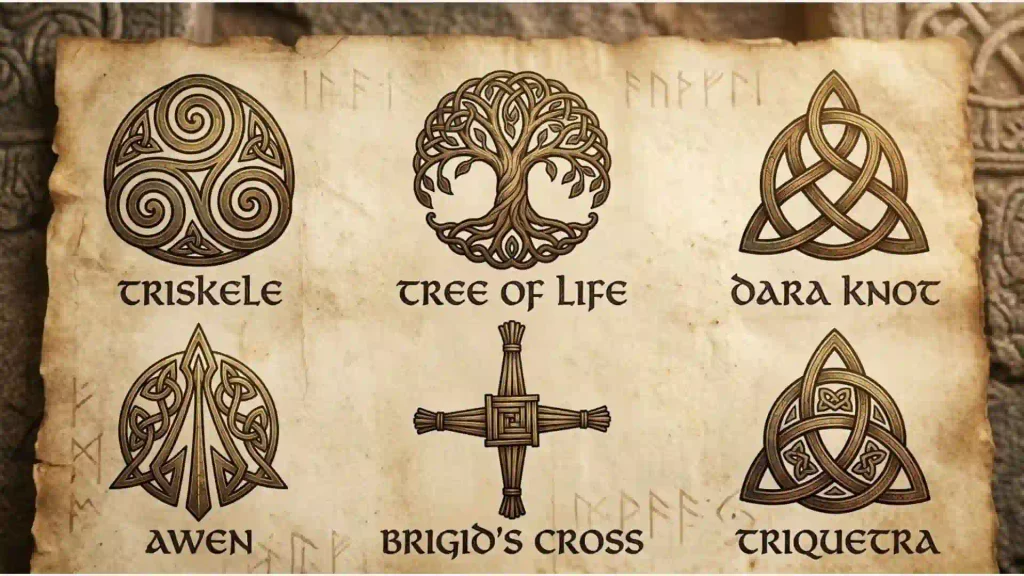
Celtic mythology is filled with stories of gods, heroes, magical creatures, and connections between humans and nature.
Animals played an important role in Celtic legends. The raven was associated with prophecy and wisdom, while deer were often connected with spiritual journeys and magical encounters.
The Celtic Otherworld, a mysterious spiritual realm in Irish mythology, influenced many symbolic ideas about transformation and the relationship between life and death.
Stories about heroes such as Cú Chulainn often included symbolic themes of courage, destiny, and supernatural power.
These myths helped preserve the emotional meaning behind Celtic symbols.
Celtic Symbols in Art, Literature, Movies and Pop Culture
Celtic designs continue to influence modern creativity.
Art and Paintings
Artists use Celtic patterns to create works inspired by history, spirituality, and nature. The detailed designs provide endless possibilities for visual storytelling.
Literature and Poetry
Celtic symbolism appears frequently in fantasy literature because themes of magic, nature, and ancient wisdom connect strongly with imaginative storytelling.
Movies and Television
Fantasy films and television series often use Celtic-inspired imagery to represent ancient worlds, mystical cultures, and magical traditions.
Tattoos and Fashion
Celtic tattoos are popular because people often choose them to represent:
- Family connections
- Personal strength
- Spiritual growth
- Heritage
- Protection
Jewelry featuring Celtic knots and trinity symbols is also widely worn as meaningful personal decoration.
Spiritual and Dream Meaning of Celtic Symbols
Dreaming of Celtic symbols is often interpreted as a sign of connection, transformation, or personal discovery.
Common interpretations include:
| Symbol | Dream Meaning |
| Celtic Knot | Strong relationships or lifelong connections |
| Spiral | Personal growth and change |
| Tree of Life | Healing, wisdom, and family roots |
| Animal Symbols | Inner strength or guidance |
In meditation and spiritual practices, Celtic designs may be used as reminders of balance, patience, and awareness.
However, dream meanings are personal. A symbol may represent different emotions depending on an individual’s experiences.
Positive and Negative Meanings of Celtic Symbols
| Positive Meaning | Negative Meaning |
| Connection | Feeling trapped in cycles |
| Protection | Fear of change |
| Wisdom | Misinterpretation of tradition |
| Transformation | Emotional confusion |
| Strength | Attachment to the past |
A symbol itself is not automatically positive or negative. Its meaning depends on personal beliefs, cultural background, and context.
Why Humans Are Attracted to Celtic Symbols
Humans have always used symbols to express ideas that words cannot fully capture.
Celtic symbols attract people because they combine beauty with meaning. A simple design can represent love, ancestry, protection, or spiritual discovery.
The repeating patterns create a feeling of balance and order. They remind people that life is connected and constantly changing.
For many individuals, wearing a Celtic symbol feels like carrying a personal story, a family connection, or a reminder of inner strength.
Modern Uses of Celtic Symbols
Tattoos
Celtic tattoos remain popular because they allow people to express identity, heritage, and personal beliefs.
Jewelry
Rings, necklaces, bracelets, and pendants featuring Celtic knots and crosses are often chosen as meaningful gifts.
Fashion and Design
Celtic patterns appear in clothing, artwork, logos, and decorative items because of their timeless visual appeal.
Branding
Some companies use Celtic-inspired designs to communicate tradition, craftsmanship, authenticity, or connection to heritage.
Home Decor
Celtic artwork is used in homes to create a feeling of history, nature, and spiritual warmth.
Interesting Facts About Celtic Symbols and Meanings
- Celtic knots are designed without a visible beginning or ending, representing eternity.
- The spiral is one of the oldest symbols found in Celtic-related archaeological sites.
- Trees were considered sacred in many Celtic traditions.
- The Book of Kells contains some of the most famous examples of Celtic artwork.
- Many modern Celtic tattoos combine ancient designs with personal meanings.
- Celtic symbolism influenced medieval European art and manuscripts.
- Animals were viewed as powerful spiritual symbols in Celtic mythology.
- Celtic designs continue to inspire artists worldwide.
Frequently Asked Questions
What is the most famous Celtic symbol?
The Celtic knot and the triquetra are among the most recognized Celtic symbols because they represent eternity, connection, and balance.
What do Celtic symbols usually mean?
Celtic symbols commonly represent themes such as nature, spirituality, protection, family, transformation, and eternal connections.
Are Celtic symbols religious?
Some Celtic symbols became connected with Christianity, while others came from older Celtic beliefs involving nature and spirituality.
What does the Celtic knot symbolize?
The Celtic knot symbolizes endless cycles, eternal relationships, loyalty, and the interconnected nature of life.
Are Celtic symbols still used today?
Yes, Celtic symbols are widely used in tattoos, jewelry, art, fashion, and spiritual practices around the world.
Conclusion
Celtic symbols and meanings offer a powerful connection between ancient wisdom and modern life. These designs remind us of timeless ideas such as love, balance, transformation, and our relationship with nature. From Celtic knots to sacred trees, each symbol carries stories shaped by generations of human experience. Their lasting popularity shows that meaningful symbols continue to inspire, guide, and connect people across cultures.
 John Mercer
 Michael Rivera