
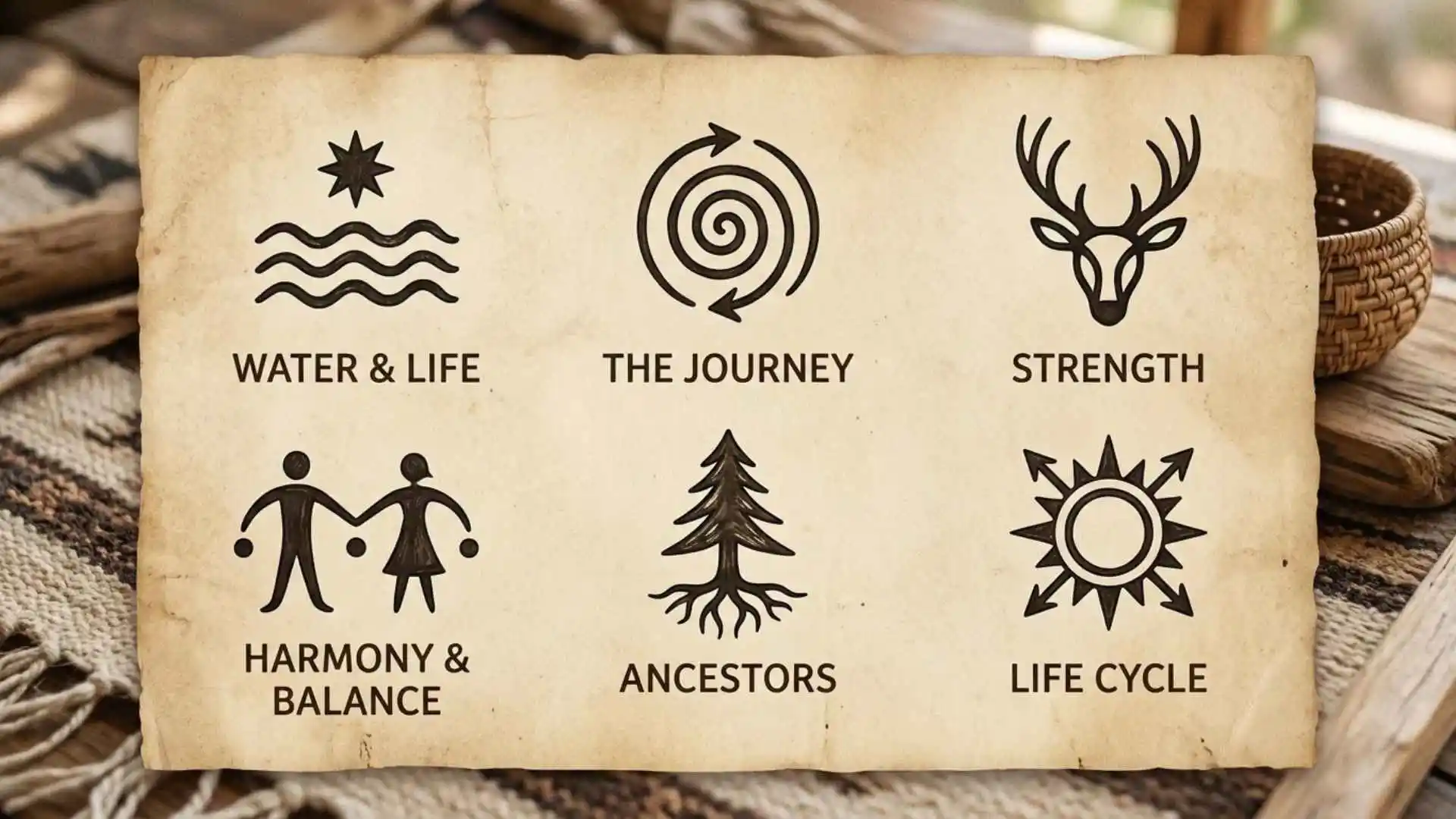
Cherokee symbols reflect the rich history, spiritual beliefs, traditions, and cultural identity of the Cherokee people, an Indigenous nation originally rooted in the southeastern United States. These symbols can be connected to nature, animals, plants, sacred traditions, and the relationship between humans and the world around them. Understanding their meanings offers valuable insight into Cherokee heritage and the cultural values passed down through generations.
Throughout Cherokee history, stories, oral traditions, and artistic expressions have helped preserve important cultural knowledge. Animals such as the bear, eagle, and owl appear in various Indigenous traditions, although their meanings can differ between communities and stories. Cherokee cultural heritage also includes sacred places, traditional ceremonies, and the Cherokee syllabary, a writing system developed by Sequoyah in the early nineteenth century. These elements help explain the diversity and significance of Cherokee cultural expression.
Today, Cherokee symbols and traditions continue to attract interest from people researching Indigenous history, spirituality, art, and mythology. However, it is important to recognize that not every symbol commonly described online as Cherokee has a verified Cherokee origin or a universally accepted meaning. Exploring these symbols through reliable historical sources and Cherokee-authored materials helps readers appreciate their significance respectfully while avoiding misconceptions and cultural stereotypes.
Quick Answer
Cherokee symbols include meaningful images, patterns, animals, natural elements, national emblems, and characters from the Cherokee syllabary. They may represent the seven clans, spiritual balance, sacred fire, creation stories, protection, community, language, and cultural survival. Their exact meanings depend on the symbol, artist, family, ceremony, and historical context.
Quick Facts About Cherokee Symbols
| Aspect | Information |
| Origin | Cherokee communities of the southeastern United States |
| Historical Significance | Preserved identity, teachings, language, clan relationships, and national unity |
| Main Meaning | Community, balance, endurance, responsibility, and connection to the natural world |
| Spiritual Meaning | Renewal, sacred relationships, protection, transformation, and harmony |
| Cultural Importance | Links Cherokee people with ancestors, language, stories, land, and sovereignty |
| Modern Usage | Tribal seals, flags, jewelry, baskets, clothing, public art, tattoos, education, and digital media |
What Are Cherokee Symbols?
Cherokee symbols are visual forms connected with Cherokee history, beliefs, social structures, stories, art, and political identity. They can appear as animals, stars, plants, woven designs, colors, ceremonial objects, written characters, or official emblems.
However, the term should be used carefully. Not every geometric image sold online as a “Cherokee symbol” has a documented Cherokee origin. Some designs are borrowed from other Native nations, modern spiritual movements, or commercial art.
Cherokee culture is represented today by three federally recognized governments: the Cherokee Nation, the Eastern Band of Cherokee Indians, and the United Keetoowah Band of Cherokee Indians. Individual communities, artists, families, and ceremonial traditions may interpret images differently.
Historically, Cherokee knowledge was carried through oral storytelling, songs, dances, community practices, pottery, carving, basketry, beadwork, and relationships with the land. Visual meaning was usually connected to a larger story rather than treated as a fixed code.
A major change came through Sequoyah’s creation of the Cherokee syllabary. Completed in 1821, it used characters to represent spoken Cherokee syllables. The writing system spread rapidly and helped make Cherokee-language newspapers, records, letters, and education possible.
Deep Symbolic Meaning of Cherokee Symbols
Spiritual Level
Many Cherokee traditions emphasize relationships rather than isolated objects. A fire, river, animal, plant, or direction may have meaning because of its role within creation, ceremony, healing, or community life.
Fire can suggest renewal, continuity, purification, and the presence of communal life. Water may represent cleansing, movement, healing, and the boundary between ordinary and sacred experience. Plants such as cedar can carry associations with medicine, protection, and endurance.
These meanings should not be reduced to simple formulas. Sacred knowledge may belong to particular communities or ceremonial settings and may not be intended for public explanation.
Psychological Level
Cherokee symbols can also be understood through human psychology. People naturally connect with images that make identity visible.
A star can express belonging. A circle can suggest continuity. An animal can represent a quality people admire or fear. Fire may awaken feelings of warmth, danger, memory, and transformation.
From a Jungian perspective, such images may resemble archetypes found in many societies. Yet Cherokee meanings should not be replaced by universal psychological theories. Cultural context comes first.
Cultural Level
On the cultural level, Cherokee symbols often express community responsibility. The Cherokee clan system has traditionally organized kinship, social duties, relationships, and identity.
Cherokee society is historically matrilineal, meaning clan identity is passed through the mother. The seven-clan structure continues to hold cultural importance, even though particular customs have changed over time.
Symbols can therefore function like visual memory. They remind people that identity is not only personal. It is connected to relatives, ancestors, language, government, land, and future generations.
Types and Variations of Cherokee Symbols
The Seven-Pointed Star
Visual description: A star with seven evenly arranged points.
Meaning: The seven points represent the seven traditional Cherokee clans.
Symbolism: Unity, shared identity, balance, national continuity, and collective strength.
Cultural connection: The star appears at the center of the Great Seal of the Cherokee Nation. The official seal was created under an 1869 executive act and places the star within a wreath of oak leaves. The oak leaves symbolize the eternal flame and endurance of the Cherokee people.
Where it appears: Tribal seals, flags, public buildings, jewelry, clothing, official documents, and contemporary artwork.
The Cherokee Syllabary
Visual description: A set of written characters representing syllables in the Cherokee language.
Meaning: Language, knowledge, literacy, communication, and cultural survival.
Symbolism: The power to preserve Cherokee thought in Cherokee words.
Cultural connection: Sequoyah developed the system after years of work. It was used in the bilingual Cherokee Phoenix, first published in 1828 at New Echota.
Where it appears: Books, signs, classrooms, newspapers, tattoos, public art, digital keyboards, and language revitalization projects.
The characters are not magical pictographs. Each generally represents a spoken syllable. Using a character without understanding its sound may create an incorrect word.
Sacred Fire
Visual description: Flames, a central fire, or a circular gathering around fire.
Meaning: Renewal, continuity, purification, community, and spiritual responsibility.
Symbolism: The living connection between present generations and ancestral tradition.
Cultural connection: Fire has an important place in ceremonial and community life. In the Cherokee Nation seal, the surrounding oak leaves refer to the eternal fire of the Cherokee people.
Where it appears: Ceremonial grounds, national imagery, storytelling, paintings, jewelry, and cultural education.
The Water Spider
Visual description: A spider shown on water or carrying a small coal.
Meaning: Resourcefulness, courage, intelligence, and service to the community.
Symbolism: Great change can begin through a small being willing to act.
Cultural connection: In a well-known Cherokee story, animals seek fire after discovering it on an island. The water spider succeeds by carrying a coal in a small container on her back.
Where it appears: Storytelling, jewelry, children’s books, carvings, paintings, and educational art.
Cherokee jewelry commonly draws on traditional stories involving spiders, ravens, water beetles, wolves, cougars, feathers, corn, bows, and arrows.
The Circle
Visual description: A complete ring without a visible beginning or end.
Meaning: Continuity, community, natural cycles, and interconnected life.
Symbolism: Every person and living being exists within a network of relationships.
Cultural connection: Circular arrangements appear in dances, gatherings, designs, and contemporary interpretations of balance.
Where it appears: Basket patterns, public art, dance formations, jewelry, and modern graphic design.
Rivercane Basket Patterns
Visual description: Repeated diamonds, steps, lines, crosses, or interlocking geometric forms woven into baskets.
Meaning: Skill, memory, family teaching, balance, and adaptation.
Symbolism: Separate strands become strong when woven together.
Cultural connection: Cherokee basket makers have long used rivercane and plant dyes. Historic Eastern Band of Cherokee baskets in the National Museum of the American Indian show twill-plaiting, double weaving, and complex geometric design.
Where it appears: Baskets, textiles, paintings, jewelry, prints, and modern design.
A pattern’s meaning may depend on the maker. It is safer to ask the artist than to assume every diamond or zigzag has one universal definition.
Corn
Visual description: An ear of corn, kernels, leaves, or growing stalks.
Meaning: Nourishment, life, gratitude, fertility, and community survival.
Symbolism: Human life depends on respectful relationships with the earth.
Cultural connection: Corn became central to Cherokee agriculture, foodways, seasonal life, and storytelling.
Where it appears: Jewelry, pottery, carvings, paintings, festivals, and cultural demonstrations.
Feathers and Birds
Visual description: A single feather, wing, bird, or group of birds.
Meaning: Communication, movement, alertness, responsibility, and relationships with the upper world.
Symbolism: Perspective, freedom, prayer, or spiritual attention, depending on context.
Cultural connection: Birds appear in Cherokee stories and art, but meanings vary by species and tradition.
Where it appears: Dance clothing, art, jewelry, storytelling, and modern design.
Cherokee Symbols Across Different Cultures
Cherokee symbols should not be presented as if they came from Egypt, Greece, Rome, or Asia. Still, comparing related human themes can reveal both similarities and important differences.
Ancient Egypt
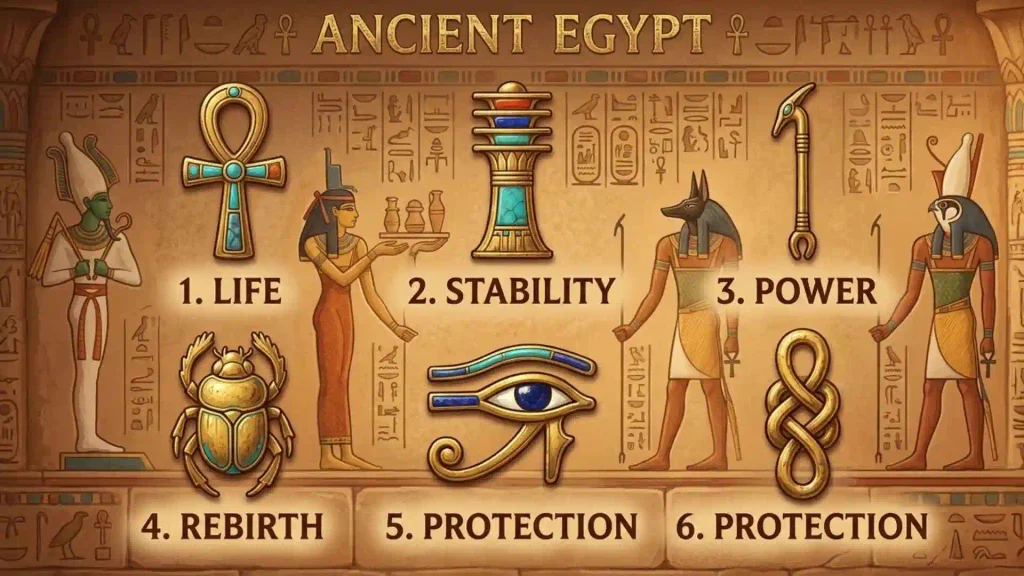
Egyptian culture used written hieroglyphs, sacred animals, solar imagery, and symbols of kingship. The Cherokee syllabary is different because its characters record syllables rather than acting as hieroglyphic pictures.
Ancient Greece
Greek myths frequently used animals and natural forces to express the actions of gods. Cherokee stories also include animals with intelligence and agency, but they arise from Cherokee lands, language, values, and community teachings.
Roman Culture
Roman standards and seals displayed political authority. The Cherokee Nation seal also communicates governmental identity, but it represents a sovereign Indigenous nation with its own constitutional and historical experience.
Eastern Traditions
Circles, directional systems, balance, and natural cycles appear in several Asian traditions. Similar-looking forms do not prove a shared origin. Meanings must be studied within their own cultural histories.
Other Indigenous Traditions
Many Indigenous nations use clan animals, sacred directions, stars, fires, and woven patterns. Their teachings are not interchangeable. A symbol belonging to the Diné, Lakota, Anishinaabe, Muscogee, or Haudenosaunee should not automatically be labeled Cherokee.
Modern Interpretations
Modern artists may combine traditional forms with photography, street art, fashion, graphic design, or digital media. These works can express sovereignty, language renewal, family memory, survival, and contemporary Native life.
Similar Symbols and Their Meanings
| Cherokee-Connected Symbol | Similar Symbol | Main Similarity | Important Difference |
| Seven-pointed star | Seven-pointed stars in other traditions | Sevenfold order or completeness | The Cherokee Nation star specifically represents the seven clans |
| Cherokee syllabary | Alphabetic writing | Records spoken language | Its characters represent syllables, not single alphabetic letters |
| Sacred fire | Ceremonial fires worldwide | Renewal and transformation | Cherokee meaning comes from Cherokee ceremonial and national contexts |
| Water spider | Trickster or helper animals | Intelligence and problem-solving | Her role belongs to a particular Cherokee fire-bringing story |
| Basket pattern | Global geometric weaving | Repetition, rhythm, craftsmanship | Meaning depends on Cherokee materials, makers, techniques, and community knowledge |
Cherokee Symbols in Mythology and Folklore
Cherokee storytelling is filled with animals, plants, natural powers, extraordinary beings, and moral choices. These stories often explain why the world has certain features or how people should behave within it.
The water spider story honors intelligence and courage rather than physical size. Other stories involving birds, wolves, ravens, cougars, insects, or plants may explore pride, cooperation, danger, balance, and responsibility.
Such stories are not merely old entertainment. They can teach listeners how to live, how to observe nature, and how individual actions affect the whole community.
Cherokee Symbols in Art, Literature, Movies, and Pop Culture
Cherokee symbols appear in baskets, pottery, beadwork, carving, painting, jewelry, textiles, murals, books, films, museum exhibitions, and public monuments.
In literature, the Cherokee syllabary can represent language survival and intellectual independence. In visual art, the seven-pointed star may express sovereignty or connection to the seven clans. In jewelry, animals and plants may connect a modern object with an older story.
Tattoos and fashion require special care. A design should not be chosen only because it looks “tribal.” Sacred imagery, clan identity, ceremonial objects, and Cherokee words deserve research and respect.
Pop culture often mixes Native nations together or invents meanings. Tribal museums, Cherokee cultural organizations, language teachers, and named Cherokee artists are more trustworthy sources than anonymous symbol charts.
Spiritual and Dream Meaning of Cherokee Symbols
Dreams are personal experiences, so there is no universal Cherokee dream dictionary.
A fire in a dream might suggest renewal, danger, memory, or the need for change. Water may point toward emotion, cleansing, uncertainty, or movement. A spider may suggest patience, creativity, intelligence, or fear. A star may symbolize guidance or belonging.
These are modern reflective interpretations, not official Cherokee teachings. A symbol seen during meditation or in a dream should not automatically be treated as a message from Cherokee spirituality.
The most respectful approach is to examine your own emotions while avoiding claims to sacred knowledge that has not been shared with you.
Positive and Negative Meanings of Cherokee Symbols
| Positive Meaning | Negative or Cautionary Meaning |
| Fire as renewal and community | Fire as danger or destructive imbalance |
| Spider as intelligence and persistence | Spider as fear, manipulation, or entrapment |
| Star as unity and guidance | Misuse of the star as a decorative stereotype |
| Syllabary as language survival | Incorrect characters creating meaningless words |
| Animal imagery as respect for nature | Treating animals as shallow personality labels |
| Basket patterns as skill and continuity | Copying designs without crediting Cherokee makers |
A symbol can carry both light and shadow. Meaning changes according to the story, setting, intention, and relationship of the person using it.
Why Humans Are Attracted to Cherokee Symbols
People are drawn to symbols because images can hold complex ideas in a small space. A single star can evoke clan identity, history, government, and endurance. A woven basket can reveal patience, family teaching, land-based knowledge, and artistic skill.
Pattern recognition also shapes human attraction. Repeated lines and balanced forms create order that the mind finds memorable.
Yet the strongest attraction often comes from cultural memory. Cherokee symbols survived war, removal, forced assimilation, land loss, and efforts to suppress Native languages. The Trail of Tears of 1838 and 1839 remains central to understanding this endurance.
Their beauty is therefore inseparable from survival.
Modern Uses of Cherokee Symbols
Today, Cherokee symbols appear in:
- Tribal government seals and flags
- Language classes and digital keyboards
- Jewelry created by Cherokee artists
- Rivercane baskets and contemporary textiles
- Museum exhibitions and educational materials
- Murals, sculpture, and public monuments
- Clothing and fashion
- Social media graphics
- Tattoos and personal memorial designs
- Cultural tourism and community events
Responsible use begins with attribution. Buyers should look for Cherokee artists, learn the story behind the work, and avoid mass-produced products that falsely claim tribal authenticity.
Interesting Facts About Cherokee Symbols
- The seven-pointed star on the Cherokee Nation seal represents the seven traditional clans.
- The official seal connects the star with oak leaves symbolizing the eternal Cherokee fire.
- Sequoyah created a syllabary, not an alphabet in the strict linguistic sense.
- The Cherokee Phoenix used Cherokee and English when it began publication in 1828.
- Cherokee syllabary characters represent sounds, so copying one for its appearance can produce an unintended word.
- Cherokee basketry often uses rivercane, natural dyes, and demanding twill-plaiting techniques.
- Clan membership is traditionally inherited through the mother.
- Many popular internet “Cherokee symbols” cannot be verified through Cherokee cultural sources.
- Cherokee culture is living and modern, not limited to historical imagery.
- The meaning of an artwork may belong partly to the individual artist, family, or community that created it.
Frequently Asked Questions
What is the most recognized Cherokee symbol?
The seven-pointed star is among the most recognized Cherokee symbols. On the Cherokee Nation seal, its seven points represent the seven traditional clans.
What does the Cherokee syllabary symbolize?
It symbolizes language, literacy, intellectual achievement, cultural preservation, and the survival of Cherokee identity across generations.
Is the Cherokee syllabary a collection of spiritual symbols?
No. It is a functional writing system in which characters represent spoken Cherokee syllables, although it can also carry strong cultural and emotional meaning.
What animals are important in Cherokee symbolism?
Spiders, wolves, birds, ravens, cougars, water beetles, and other animals appear in Cherokee stories and art. Their meanings depend on the particular narrative and context.
Can anyone get a Cherokee symbol tattoo?
Anyone can physically choose such a tattoo, but respectful use requires accurate research. Avoid sacred imagery, false clan claims, invented translations, and designs copied without permission.
How can I tell whether a Cherokee symbol is authentic?
Consult official tribal resources, Cherokee museums, language programs, cultural educators, and identified Cherokee artists. Be cautious with anonymous websites and commercial symbol charts.
Conclusion
Cherokee symbols are living expressions of language, kinship, sovereignty, memory, and relationships with the natural world.
Their meanings cannot be separated from Cherokee people, history, artists, stories, and communities.
Learning about them requires more than recognizing an attractive shape. It requires attention, humility, and reliable cultural sources.
When approached respectfully, each star, character, animal, flame, and woven pattern reveals a story of connection and endurance.
The deepest lesson is that a symbol gains power not from mystery alone, but from the people who continue to carry its meaning.
 Sarah Thompson
 John Mercer