
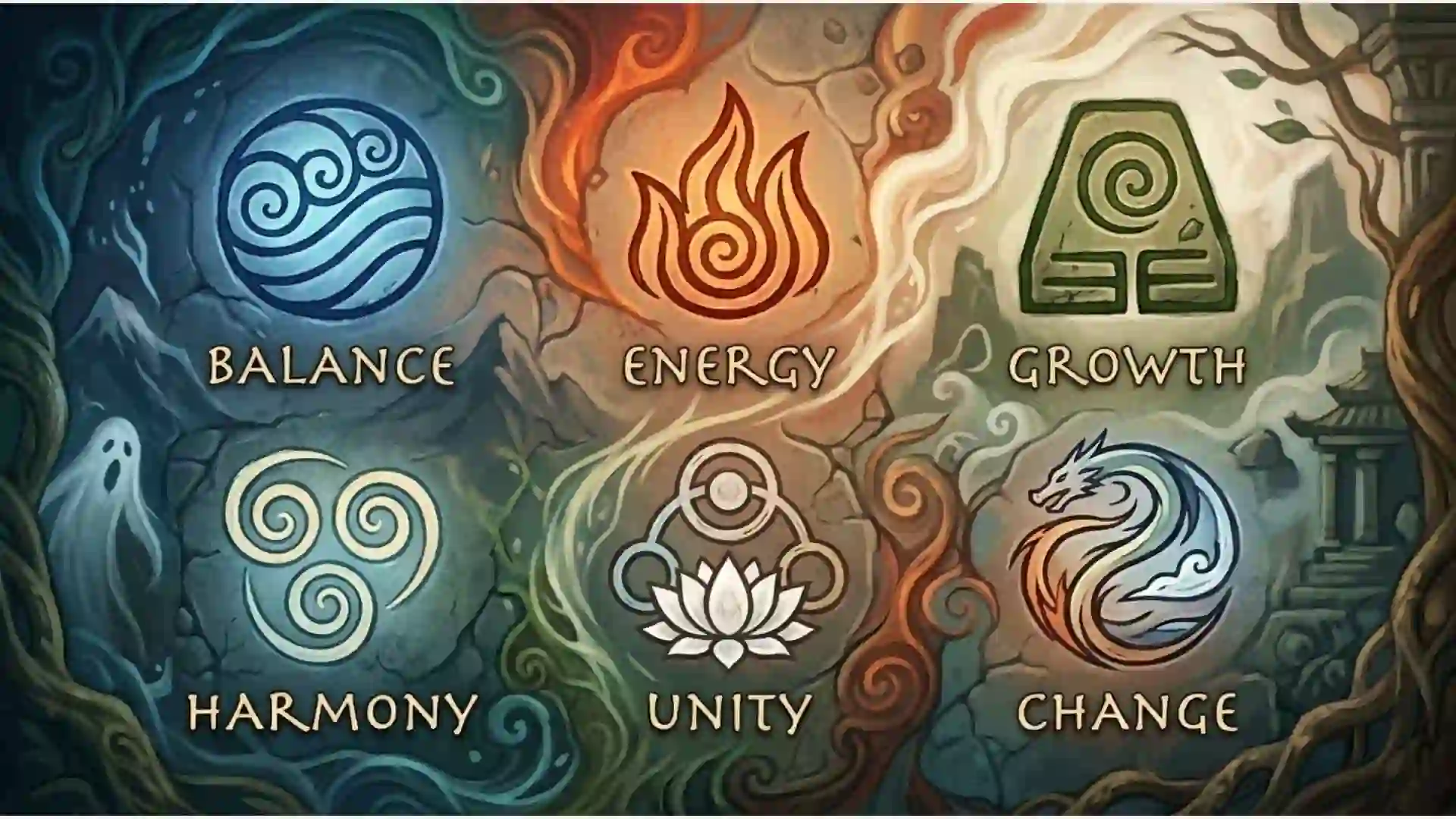
Avatar: The Last Airbender is a popular animated series that combines adventure, spirituality, philosophy, and the power of nature. One of its most fascinating features is the symbolism behind the four nations: the Water Tribes, Earth Kingdom, Fire Nation, and Air Nomads. Each nation represents a unique element, cultural identity, and way of understanding the world. These symbols help viewers recognize the connection between the characters, their abilities, and the natural forces that shape their lives.
The four elements in Avatar represent more than bending abilities. Water symbolizes adaptability, healing, and change, while Earth represents stability, strength, and determination. Fire is associated with energy, passion, destruction, and transformation, whereas Air represents freedom, peace, and spiritual balance. Together, these elements reflect different aspects of human nature and demonstrate how opposing forces can exist in harmony. Their meanings also help explain the beliefs, traditions, and conflicts that influence the story.
Understanding Avatar: The Last Airbender symbols reveals deeper messages hidden throughout the series. From the distinctive emblems of the four nations to the philosophical ideas connected with each element, these symbols contribute to the show’s rich world-building. They also reflect important themes such as balance, responsibility, identity, and personal growth. Exploring these meanings provides a better understanding of how the creators use symbolism to connect the fictional world of Avatar with real-life values and experiences.
Quick Answer
Avatar the Last Airbender symbols are visual emblems representing water, earth, fire, air, the Avatar cycle, and important spiritual ideas within the series. Each symbol expresses the personality of its element, the values of its nation, and the larger theme of balance between opposing forces.
Quick Facts About Avatar the Last Airbender Symbols
| Aspect | Information |
| Origin | Created for the animated fantasy world developed by Michael Dante DiMartino and Bryan Konietzko |
| Historical Significance | Represent the Four Nations, their bending traditions, political identities, and role in the Hundred Year War |
| Main Meaning | Balance between water, earth, fire, and air |
| Spiritual Meaning | Harmony, transformation, interconnectedness, discipline, and renewal |
| Cultural Importance | Combine visual and philosophical influences from Asian, Arctic Indigenous, and other world traditions |
| Modern Usage | Tattoos, clothing, jewelry, fan art, home decor, social media icons, and franchise merchandise |
What Are Avatar the Last Airbender Symbols?
Avatar the Last Airbender symbols are emblems used to identify the cultures, elements, spiritual traditions, and political groups within the Avatar universe. The most recognizable are the Water Tribe, Earth Kingdom, Fire Nation, and Air Nomad symbols.
The Four Nations form the foundation of the fictional world. Each nation is associated with one element and one bending discipline. According to the official Avatar Studios material, the world is built around fire, earth, water, and air, while the Avatar can master all four.
These emblems appear on flags, gates, uniforms, temples, architecture, weapons, coins, documents, and ceremonial objects. They help viewers recognize where a character comes from before a single word is spoken.
Their importance also grows with the story. At first, the symbols seem to divide people into separate nations. Over time, they reveal that difference does not have to create conflict. True peace comes when different strengths support one another.
Deep Symbolic Meaning of Avatar the Last Airbender Symbols
Spiritual Meaning
The central spiritual message behind Avatar the Last Airbender symbols is balance.
Water, earth, fire, and air are not presented as isolated powers. They are parts of one living system. Water nourishes the earth. Earth provides fuel and structure. Fire creates warmth and energy. Air carries breath, weather, and movement.
The Avatar symbolically joins these forces. The Avatar is not meant to erase cultural differences but to protect harmony among them. This reflects the series’ repeated focus on interconnectedness, ethical responsibility, compassion, and spiritual awareness.
Each element can also represent a stage of inner transformation:
- Water teaches acceptance and change.
- Earth teaches stability and courage.
- Fire teaches purpose and self-control.
- Air teaches freedom and detachment.
A balanced person needs all four qualities.
Psychological Meaning
From a psychological view, the four elements resemble human personality patterns or archetypes.
Water reflects emotional intelligence and adaptability. Earth represents patience, boundaries, and resilience. Fire symbolizes desire, anger, ambition, and vitality. Air represents imagination, humor, freedom, and intellectual distance.
Carl Jung used the idea of archetypes to explain recurring images and personality patterns found across stories and cultures. The Avatar elements work in a similar way. Viewers recognize parts of themselves in Katara’s compassion, Toph’s strength, Zuko’s inner fire, and Aang’s desire for freedom.
The Avatar State can be interpreted as contact with the collective self. It joins personal identity with ancestral knowledge, inherited responsibility, and spiritual memory.
Cultural Meaning
Within the story, each symbol creates social belonging. It appears in clothing, architecture, government, family traditions, and public ceremonies.
However, symbols can also become tools of division. Fire Nation banners, for example, sometimes represent patriotism and cultural pride. During imperial expansion, the same emblem becomes associated with conquest, propaganda, and fear.
This contrast shows that a symbol’s meaning depends on how people use it. An emblem can unite a community, but it can also be used to justify control.
Types and Variations of Avatar the Last Airbender Symbols
Water Tribe Symbol
Visual description: Three flowing, wave-like forms arranged inside a circular shape.
Meaning: Change, healing, community, intuition, and emotional strength.
Symbolism: The flowing design reflects water’s ability to move around obstacles rather than attack them directly. Water can be gentle, but it can also become ice, mist, rain, or a destructive wave.
Cultural connection: The Water Tribes draw important visual inspiration from Arctic and circumpolar Indigenous cultures, although they remain fictional societies rather than copies of one real community.
Where it appears: Water Tribe clothing, gates, ships, healing spaces, official designs, and fan artwork.
Earth Kingdom Symbol
Visual description: A square or geometric form surrounding a central opening.
Meaning: Stability, endurance, order, material strength, and grounded identity.
Symbolism: The square shape suggests firmness and structure. The central space may also remind viewers of Earth Kingdom coins, walls, architecture, and the idea of protected territory.
Cultural connection: Earth Kingdom design includes strong Chinese artistic, architectural, and political influences. The kingdom is the largest and most populated of the Four Nations.
Where it appears: Coins, uniforms, military equipment, city gates, maps, official seals, and buildings.
Fire Nation Symbol
Visual description: A rising flame made from sharp, upward-moving curves.
Meaning: Energy, ambition, passion, life, power, destruction, and renewal.
Symbolism: Fire naturally rises, making the emblem feel active and forceful. It captures both the creative and dangerous sides of flame.
The series makes an important distinction between fire and aggression. The Sun Warriors teach Aang and Zuko that fire is not only anger. It is life, breath, warmth, and energy.
Cultural connection: Fire Nation clothing, military organization, architecture, and royal traditions combine several East Asian and Southeast Asian influences within a fictional imperial culture.
Where it appears: Warships, banners, armor, royal buildings, schools, weapons, and government documents.
Air Nomad Symbol
Visual description: A triple spiral resembling moving wind.
Meaning: Freedom, spirituality, peace, movement, joy, and nonattachment.
Symbolism: The spiral has no harsh boundary or fixed direction. It suggests breath, circular motion, and the invisible presence of air.
Cultural connection: Air Nomad philosophy and temple life are strongly inspired by Buddhist monastic traditions, especially ideas of compassion, meditation, detachment, and respect for life.
Where it appears: Air temples, monk clothing, ceremonial objects, gliders, statues, and tattoos.
Airbender Arrow Tattoos
The blue arrows worn by Aang and other airbending masters follow the body’s pathways. They represent mastery, spiritual discipline, and the flow of energy through movement.
Unlike ordinary decoration, the arrows mark an achievement. They show that the wearer has reached a high level of airbending skill and has become part of a living spiritual tradition.
The White Lotus Symbol
The Order of the White Lotus uses a white lotus tile as its sign.
The lotus commonly symbolizes wisdom, purity, awakening, and growth from difficult conditions. In the series, the White Lotus represents knowledge that rises above national loyalty. Its members value philosophy, truth, beauty, and balance more than political borders.
The Avatar Cycle
The Avatar cycle follows the repeating order of water, earth, fire, and air.
It represents death and rebirth, continuity, inherited duty, and the connection between past and future. Official franchise history traces this cycle back to Avatar Wan, the first Avatar.
Avatar the Last Airbender Symbols Across Different Cultures
Avatar is a transcultural fantasy. Its symbols should not be treated as direct copies of any single religion or civilization. Instead, they combine broad artistic and philosophical ideas from many traditions. Scholars have described the franchise as a fantasy world built through mixed cultural and ethnographic influences.
Ancient Egypt
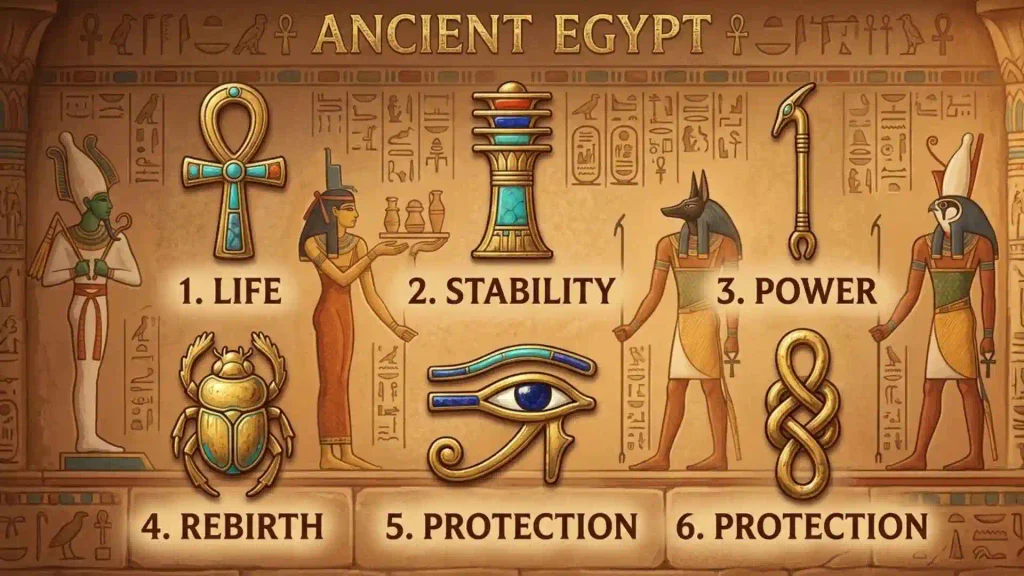
Ancient Egyptians connected water with fertility, rebirth, and the life-giving Nile. This resembles the Water Tribe symbol’s association with healing, survival, and renewal.
The Egyptian sun also represented divine power and life. This creates a loose comparison with the Fire Nation’s solar energy, although the Fire Nation emblem is not an Egyptian symbol.
Ancient Greece
Greek thinkers often described nature through classical elements, especially earth, water, air, and fire. These elements were believed to combine in different ways to form the material world.
Avatar transforms a similar elemental framework into cultures, martial arts, personalities, and spiritual disciplines.
Roman Culture
Roman society valued political identity, military emblems, imperial authority, and public symbols. Fire Nation banners function in a comparable narrative way. They mark territory, communicate state power, and create loyalty to an empire.
This is a thematic comparison, not proof that the Fire Nation was directly based on Rome.
Eastern Traditions
Avatar’s strongest influences come from Asian cultures, philosophies, martial arts, clothing, calligraphy, architecture, and spiritual traditions.
Ideas resembling Buddhism, Taoism, Hindu philosophy, Chinese cosmology, and traditional martial arts appear throughout the franchise. Balance, energy flow, reincarnation, meditation, and harmony with nature shape the meaning of its symbols.
Indigenous Traditions
The Water Tribes reflect influences from Arctic Indigenous clothing, transportation, environmental knowledge, and community life.
The series also presents nature as spiritually alive. Animals, spirits, landscapes, ancestors, and people exist in relationships rather than as completely separate beings.
Modern Interpretations
Today, fans often use the four elemental symbols as personality signs. Someone may choose water because they value empathy, earth because they are dependable, fire because they are ambitious, or air because they seek freedom.
The symbols have therefore moved beyond fictional geography and become tools of personal identity.
Similar Symbols and Their Meanings
| Avatar Symbol | Similar Symbol or Idea | Shared Meaning | Key Difference |
| Water Tribe emblem | Wave or moon symbol | Change, intuition, emotion | Represents a specific fictional culture |
| Earth Kingdom emblem | Square, coin, mountain | Stability, wealth, endurance | Also represents government and territory |
| Fire Nation emblem | Flame or sun | Energy, passion, transformation | Can also represent imperial aggression |
| Air Nomad emblem | Spiral or wind motif | Freedom, breath, spirituality | Connected to airbending mastery |
| White Lotus | Sacred lotus | Wisdom, purity, awakening | Also marks a secret international order |
| Avatar cycle | Wheel of rebirth | Continuity and reincarnation | Follows a fixed elemental order |
A common misconception is that each emblem has only one meaning. In reality, every symbol has a light side and a shadow side. Fire may create life or destroy it. Earth may provide security or become stubbornness. Water may heal or overwhelm. Air may bring freedom or encourage avoidance.
Avatar the Last Airbender Symbols in Mythology and Folklore
Elemental powers appear in myths across the world. Sea gods command waves, storm spirits rule the sky, divine smiths control flame, and earth deities protect harvests and mountains.
Avatar reshapes these ancient patterns through bending. Instead of receiving power from a single god, benders develop skill through discipline, movement, cultural knowledge, and connection to nature.
The original bending teachers deepen this mythic structure. The moon influences waterbending, badgermoles teach earthbending, dragons reveal the true nature of fire, and sky bison guide the Air Nomads.
These relationships suggest that humans do not own the elements. They learn from the natural world.
Avatar the Last Airbender Symbols in Art, Literature, Movies, and Pop Culture
In visual art, the elemental emblems help artists communicate personality instantly. A blue wave may suggest Katara, while a red flame often points to Zuko, Azula, or the Fire Nation.
In literature and comics, symbols preserve cultural identity as the Avatar world expands beyond the original television series. They appear on covers, uniforms, maps, buildings, and political seals.
In television, repeated symbols make the world easier to understand. Viewers can identify a nation through shape, color, architecture, and clothing before the story explains the setting.
Tattoos often combine an elemental emblem with characters, animals, the lotus, the koi fish, or Aang’s arrows. Fashion and jewelry use the same symbols as signs of belonging, nostalgia, and personality.
Spiritual and Dream Meaning of Avatar the Last Airbender Symbols
Dreaming about an Avatar symbol does not have one fixed supernatural meaning. Dreams are influenced by memory, emotion, stress, and personal experience.
Still, the symbols can provide useful themes for reflection:
- Water: You may be processing emotions or adapting to change.
- Earth: You may need stability, patience, or stronger boundaries.
- Fire: You may be feeling ambition, anger, creativity, or desire.
- Air: You may want freedom, peace, or distance from pressure.
- Avatar State: You may feel overwhelmed by responsibility or connected to a stronger version of yourself.
- White Lotus: You may be searching for wisdom, trusted guidance, or truth beyond social divisions.
During meditation, fans sometimes use the four elements as prompts for self-examination. The goal is not to predict the future but to understand which inner quality needs attention.
Positive and Negative Meanings of Avatar the Last Airbender Symbols
| Symbol | Positive Meaning | Negative Meaning |
| Water | Healing, empathy, flexibility | Emotional overwhelm, passivity |
| Earth | Strength, loyalty, patience | Rigidity, resistance to change |
| Fire | Courage, energy, purpose | Anger, domination, destruction |
| Air | Freedom, peace, imagination | Avoidance, detachment, instability |
| Avatar | Unity, service, balance | Pressure, isolation, loss of personal choice |
| White Lotus | Wisdom, cooperation, truth | Secrecy or elitism when misunderstood |
The series repeatedly shows that no element is naturally good or evil. Character determines how power is used.
Why Humans Are Attracted to Avatar the Last Airbender Symbols
People are naturally drawn to clear patterns. A simple wave, flame, square, or spiral can carry a large amount of emotional information.
The four symbols also invite self-discovery. Viewers ask, “Which element feels like me?” That question turns world-building into personal storytelling.
Fans may identify with more than one element. A person can have the emotional depth of water, the determination of earth, the passion of fire, and the curiosity of air. This makes the Avatar’s search for balance feel deeply human.
The symbols also awaken cultural memory. Elemental images have appeared in religion, mythology, philosophy, and art for thousands of years. Avatar gives those ancient patterns a modern emotional language.
Modern Uses of Avatar the Last Airbender Symbols
Avatar the Last Airbender symbols now appear in:
- Tattoos representing identity or personal growth
- Necklaces, rings, bracelets, and earrings
- Shirts, hoodies, shoes, and costumes
- Posters, wall art, and home decor
- Fan club logos and social media profiles
- Video game designs and collectibles
- Journals, stickers, phone cases, and laptop decals
- Meditation spaces and elemental personality content
Official Avatar branding continues to display maps and imagery connected with the Four Nations, showing how central these emblems remain to the franchise.
Interesting Facts About Avatar the Last Airbender Symbols
- The opening sequence presents the elements in the order water, earth, fire, and air.
- The Avatar reincarnation cycle follows the same repeating elemental order.
- Each nation’s emblem uses movement and geometry that fit the behavior of its element.
- The Fire Nation symbol represents life-giving energy as well as destructive power.
- Airbender arrows are signs of mastery, not ordinary childhood markings.
- The White Lotus symbol connects members from different nations.
- Earth Kingdom coins echo the kingdom’s circular and square visual language.
- Waterbending symbolism is closely connected to the moon, tides, healing, and change.
- The four emblems represent cultural identities as well as bending abilities.
- Balance among the nations is a political, psychological, and spiritual idea, not merely an elemental one.
Frequently Asked Questions
What do the four Avatar symbols mean?
They represent the Water Tribe, Earth Kingdom, Fire Nation, and Air Nomads. Together, they symbolize the balance of water, earth, fire, and air.
What is the most spiritual Avatar symbol?
The Air Nomad emblem is strongly connected with meditation and spirituality, while the Avatar cycle represents reincarnation, responsibility, and universal balance.
What does the Fire Nation symbol mean?
It represents fire, energy, ambition, power, life, and transformation. Its darker meanings include anger, conquest, and destructive pride.
What does Aang’s arrow symbol mean?
Aang’s arrows identify him as an airbending master. They also symbolize movement, spiritual energy, discipline, and the Air Nomad tradition.
Is the White Lotus an elemental symbol?
No. The White Lotus represents a secret order devoted to wisdom, philosophy, beauty, cooperation, and truth beyond national divisions.
Which Avatar symbol should I choose for a tattoo?
Choose the symbol whose values match your experience. Water suits adaptability, earth suits resilience, fire suits passion, and air suits freedom. Consider the symbol’s cultural and story context before making it permanent.
Conclusion
Avatar the Last Airbender symbols reveal that every form of power carries both wisdom and danger.
Water, earth, fire, and air become mirrors for emotion, personality, culture, and spiritual growth.
Their deepest lesson is not that one element is stronger than another, but that strength becomes meaningful through balance.
Like the Avatar, each person must learn when to flow, stand firm, act with passion, and finally let go.
 Michael Rivera
 John Mercer