
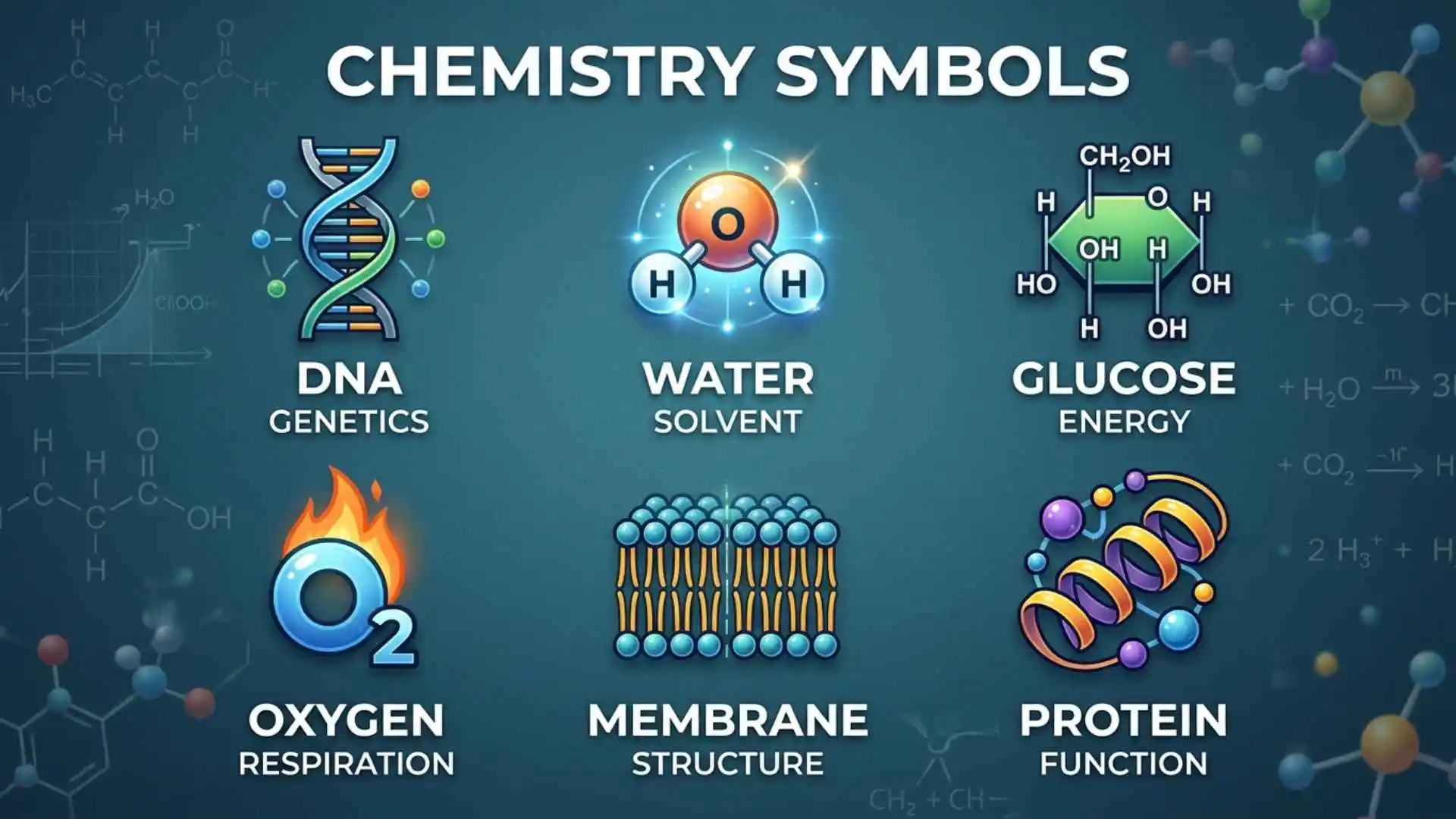
Chemistry symbols are the universal language scientists use to describe elements, compounds, chemical reactions, and the building blocks of matter. From the familiar symbol H for hydrogen to Au for gold and O for oxygen, these small letters carry important scientific information. Whether you are a student learning the periodic table, a teacher explaining chemical reactions, or simply curious about how the world works, understanding chemistry symbols makes complex scientific ideas easier to explore.
Each chemistry symbol has a specific meaning and purpose. Element symbols identify individual elements, while chemical formulas such as H₂O and CO₂ show which atoms make up a compound. Reaction symbols, arrows, state symbols, and mathematical signs help explain how substances interact and change. Some symbols also have fascinating historical roots, often originating from Latin names, ancient alchemical traditions, or the discoveries of pioneering scientists. Learning these details can reveal how chemistry developed into the modern science we know today.
In this complete guide to chemistry symbols, you will discover their meanings, history, different types, and practical uses in scientific communication. You will explore periodic table symbols, chemical formulas, reaction notation, laboratory signs, and traditional alchemical symbols. You will also learn how to read common chemistry equations and understand why these symbols matter in education, research, medicine, industry, and everyday life. By the end, you will have a clearer understanding of chemistry’s visual language and the fascinating stories behind its most recognizable signs.
Quick Answer
Chemistry symbols are standardized letters, numbers, and signs used to represent chemical elements, atoms, ions, reactions, quantities, and physical states. An element symbol usually contains one or two letters, such as H for hydrogen, O for oxygen, and Na for sodium. Together, these symbols form the universal written language of chemistry.
Quick Facts About Chemistry Symbols
| Aspect | Information |
| Origin | Developed from ancient alchemical marks and later standardized scientific abbreviations |
| Historical Significance | Made chemical knowledge easier to record, compare, and share internationally |
| Main Meaning | Represents elements, compounds, reactions, charges, states, and quantities |
| Spiritual Meaning | Historically connected with alchemy, transformation, purification, and the search for hidden knowledge |
| Cultural Importance | Creates a common scientific language across countries and educational systems |
| Modern Usage | Used in laboratories, medicine, engineering, agriculture, manufacturing, and environmental science |
What Are Chemistry Symbols?
Chemistry symbols are visual signs used to communicate chemical information quickly and accurately. The best-known examples are element symbols found on the periodic table.
Each chemical element has a unique symbol. Most consist of one or two letters:
- H represents hydrogen.
- C represents carbon.
- O represents oxygen.
- Cl represents chlorine.
- Ca represents calcium.
The first letter is always capitalized. When a second letter appears, it is lowercase. This distinction matters because Co represents cobalt, while CO represents carbon monoxide.
Chemistry also uses numbers, arrows, brackets, state symbols, mathematical signs, and Greek letters. Together, they explain what substances are present, how much of each substance exists, and what happens during a chemical reaction.
The Historical Origin of Chemistry Symbols
Early chemistry symbols did not look like modern element abbreviations. Ancient metalworkers, physicians, and alchemists used images connected with planets, gods, and natural forces.
Gold, for example, was associated with the Sun. Silver was connected with the Moon. Iron was linked with Mars because both iron and the Roman god Mars were associated with weapons and war.
During the early nineteenth century, Swedish chemist Jöns Jacob Berzelius introduced a simpler system based on letters. Instead of drawing complex pictures, chemists could use abbreviations based on element names.
This system became the foundation of modern chemical notation.
Why Some Symbols Do Not Match English Names
Several element symbols come from Latin or older names rather than modern English:
| Element | Symbol | Name Origin |
| Sodium | Na | Natrium |
| Potassium | K | Kalium |
| Iron | Fe | Ferrum |
| Copper | Cu | Cuprum |
| Silver | Ag | Argentum |
| Gold | Au | Aurum |
| Lead | Pb | Plumbum |
| Tin | Sn | Stannum |
These historical symbols remind us that chemistry developed through many cultures, languages, and generations of scientific work.
Deep Symbolic Meaning of Chemistry Symbols
Chemistry symbols are practical scientific tools, but they also carry broader meanings connected with knowledge, transformation, and human understanding.
Spiritual Level
Modern chemistry does not assign spiritual power to element symbols. However, earlier alchemical traditions often treated substances as symbols of inner transformation.
Gold represented perfection, purity, and spiritual completion. Lead represented heaviness, limitation, or an undeveloped state. Turning lead into gold was sometimes understood as more than a physical experiment. It could also symbolize personal growth, wisdom, and moral purification.
In this historical sense, chemical transformation became a metaphor for changing the self.
Psychological Level
Chemistry symbols reduce complex substances into clear visual patterns. The human mind naturally looks for patterns because they make information easier to understand and remember.
A formula such as H₂O transforms an invisible molecular structure into a recognizable sign. Once learned, the formula immediately brings water to mind.
From a psychological viewpoint, symbols act as bridges between abstract ideas and mental images. Carl Jung also studied alchemical imagery as a reflection of unconscious psychological processes. He did not treat alchemy as modern science, but he believed its images could represent conflict, integration, and personal transformation.
Cultural Level
Chemistry symbols create a shared international language. A scientist in Japan, Brazil, Pakistan, or Germany recognizes the same element symbols.
This shared notation supports education, medicine, environmental research, engineering, and international scientific cooperation. The pronunciation of an element may change between languages, but its official symbol remains recognizable.
Types and Variations of Chemistry Symbols
Chemistry uses several symbol systems, each serving a different purpose.
Element Symbols
Element symbols identify individual chemical elements.
Visual description: One capital letter or a capital letter followed by a lowercase letter.
Examples: H, He, Li, C, N, O, Na, Mg, Fe, and Au.
Meaning: Each symbol represents one type of atom.
Where they appear: Periodic tables, chemical formulas, laboratory reports, textbooks, medicine labels, and industrial documents.
Chemical Formulas
Chemical formulas show which elements make up a substance and how their atoms are combined.
- H₂O represents water.
- CO₂ represents carbon dioxide.
- NaCl represents sodium chloride.
- C₆H₁₂O₆ represents glucose.
Subscript numbers show the number of atoms of each element in one molecule or formula unit.
Coefficients
A coefficient is a number placed before a formula:
2H₂O
The number 2 means two molecules, or two moles depending on the context. It multiplies the entire formula.
Reaction Arrows
An arrow shows the direction of a chemical reaction:
Reactants → Products
The substances on the left change into the substances on the right.
A double arrow, ⇌, commonly represents a reversible reaction or chemical equilibrium.
State Symbols
State symbols describe the physical form of a substance:
| Symbol | Meaning |
| (s) | Solid |
| (l) | Liquid |
| (g) | Gas |
| (aq) | Dissolved in water |
For example:
NaCl(s) → Na⁺(aq) + Cl⁻(aq)
This expression shows solid sodium chloride separating into dissolved ions.
Charge Symbols
Superscript signs show electrical charge:
- Na⁺ is a positively charged sodium ion.
- Cl⁻ is a negatively charged chloride ion.
- Ca²⁺ has a charge of positive two.
- SO₄²⁻ has a charge of negative two.
These symbols are essential for understanding salts, acids, bases, electrochemistry, and biological processes.
Common Laboratory and Safety Symbols
Chemistry also includes hazard pictograms for substances that may be toxic, corrosive, flammable, explosive, or environmentally harmful.
Unlike element symbols, these pictograms communicate safety warnings. Their purpose is to help people handle, transport, and store chemicals responsibly.
Chemistry Symbols Across Different Cultures
Ancient Egypt
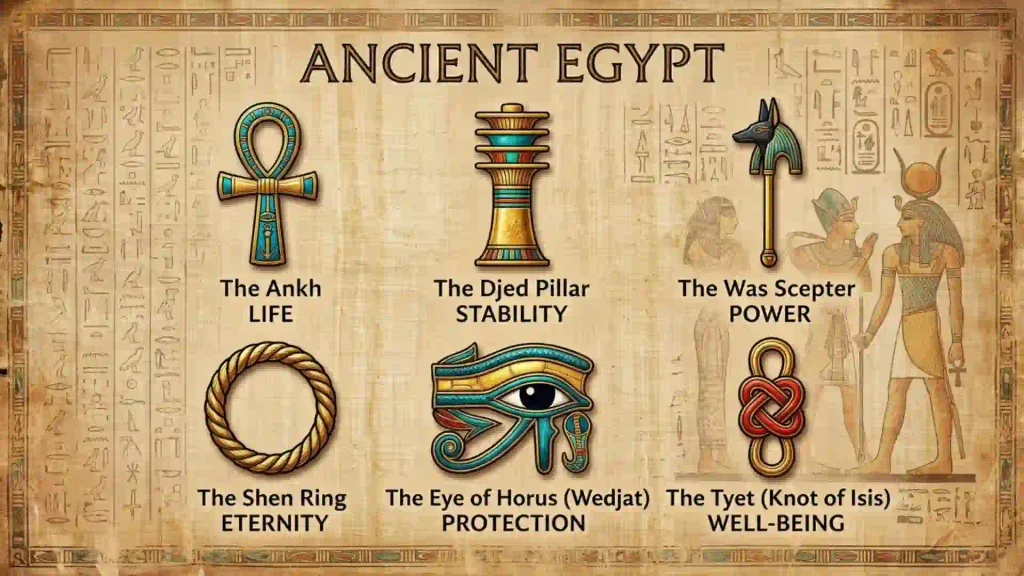
Ancient Egyptian craftspeople developed practical knowledge of metals, glass, pigments, cosmetics, fermentation, and medicine. Their writing systems included signs for materials and processes, although these were not modern chemical symbols.
Egypt later became closely associated with alchemical traditions. Alexandria, in particular, served as a meeting point for Egyptian, Greek, and other intellectual influences.
Ancient Greece
Greek philosophers tried to explain matter through basic elements such as earth, water, air, and fire. Aristotle later added a fifth heavenly substance often called aether.
These ideas were not chemistry in the modern scientific sense, but they influenced European and Middle Eastern thought for centuries.
Roman Culture
Roman culture connected metals with planets and gods. Iron was associated with Mars, copper with Venus, silver with the Moon, and gold with the Sun.
Some of these connections survived in alchemical diagrams, folklore, astrology, and artistic symbolism.
Eastern Traditions
Chinese traditions described change through the five phases of wood, fire, earth, metal, and water. These phases were used to interpret cycles in nature, medicine, society, and philosophy.
They should not be confused with chemical elements on the modern periodic table. Their purpose was philosophical and relational rather than atomic.
Indian thinkers also developed early theories of matter, including ideas about tiny particles. These traditions contributed to humanity’s long effort to understand what physical objects are made of.
Islamic Civilization
Scholars working in the medieval Islamic world preserved, criticized, and expanded knowledge from Greek, Egyptian, Persian, and Indian traditions.
Figures such as Jabir ibn Hayyan became associated with laboratory processes, including distillation, crystallization, and the study of substances. Although historical accounts of individual contributions can be complex, this scientific culture played a major role in the development of experimental chemical practice.
Indigenous Traditions
Indigenous communities around the world developed detailed knowledge of minerals, plant dyes, medicines, tanning, pottery, food preservation, and metalworking.
These systems were not usually expressed through modern chemical notation. However, they represented careful observation of material properties and practical chemical change.
Modern Interpretations
Today, chemistry symbols are internationally standardized. Organizations such as the International Union of Pure and Applied Chemistry help establish consistent names, terminology, and element symbols.
Modern notation values precision rather than mythological meaning. Still, historical associations remain visible in art, jewelry, tattoos, fiction, and popular culture.
Similar Symbols and Their Meanings
Chemistry symbols are sometimes confused with formulas, equations, alchemical signs, or hazard pictograms.
| Symbol Type | Example | Main Purpose |
| Element symbol | O | Identifies an element |
| Chemical formula | O₂ | Describes a substance |
| Chemical equation | 2H₂ + O₂ → 2H₂O | Shows a chemical reaction |
| Ion symbol | Mg²⁺ | Shows an atom or group with a charge |
| Isotope notation | ¹⁴C | Identifies a specific isotope |
| Alchemical symbol | Traditional gold or mercury sign | Represents substances in historical alchemy |
| Hazard pictogram | Flame image | Warns about chemical danger |
| Mathematical symbol | Δ | Shows change or heat in certain contexts |
A common misconception is that an element symbol always represents one free atom. Its meaning depends on context. The symbol O can refer to the element oxygen or an oxygen atom, while O₂ specifically represents molecular oxygen.
Chemistry Symbols in Mythology and Folklore
The modern periodic table is scientific, but many elements have names connected with mythology.
Thorium was named after Thor, the Norse god of thunder. Promethium refers to Prometheus, who stole fire for humanity in Greek mythology. Tantalum was named after Tantalus, while niobium refers to his daughter Niobe.
Titanium draws its name from the Titans of Greek mythology. Vanadium was named after Vanadis, another name associated with the Norse goddess Freyja.
Mercury has one of the strongest mythological links. The element was associated with the fast-moving planet Mercury and the Roman messenger god. Its liquid movement seemed mysterious to ancient observers.
These names show how scientists often used familiar cultural stories when naming unfamiliar discoveries.
Chemistry Symbols in Art, Literature, Movies, and Pop Culture
Chemistry symbols frequently appear in modern visual design because they look precise, intelligent, and mysterious.
Television programs and movies use periodic-table-style lettering in titles, posters, and opening sequences. Writers use chemical formulas to represent science, danger, transformation, medicine, or technological power.
In tattoos, people may choose symbols such as:
- C for carbon, the foundation of known organic life
- Fe for strength and iron
- Au for value, light, or achievement
- O for breath and life
- H₂O for adaptability and survival
Fashion brands and social media creators also use periodic table designs to spell words or create science-themed identities.
However, chemical symbols should be checked carefully before permanent use. Capitalization, subscripts, and element abbreviations can completely change the intended meaning.
Spiritual and Dream Meaning of Chemistry Symbols
Dreams involving chemistry symbols may reflect learning, problem-solving, experimentation, or personal change. Dream interpretation is subjective and should not be treated as a scientific diagnosis.
A periodic table in a dream may symbolize a desire to organize a complicated situation. A chemical reaction may represent emotional tension or rapid change. Mixing substances may reflect curiosity, creativity, or concern about uncertain consequences.
From a spiritual perspective, some people use chemistry as a metaphor for transformation. The idea is not that formulas possess supernatural power. Rather, the transformation of matter can inspire reflection on growth, balance, and renewal.
Positive and Negative Meanings of Chemistry Symbols
| Positive Meaning | Negative Meaning |
| Knowledge and discovery | Confusion or intellectual pressure |
| Transformation and growth | Unstable or unwanted change |
| Precision and order | Emotional coldness |
| Innovation and medicine | Pollution or harmful experimentation |
| International cooperation | Misuse of scientific knowledge |
| Curiosity and education | Fear of dangerous substances |
The same chemistry symbol can create different feelings depending on context. A flask may represent discovery in a classroom but danger near a hazardous chemical warning. Meaning develops from both the symbol and the situation surrounding it.
Why Humans Are Attracted to Chemistry Symbols
Chemistry symbols turn the invisible world into something we can see.
Atoms are too small to observe directly with ordinary human senses. Symbols give them names, identities, and relationships. This makes the hidden structure of matter feel understandable.
People are also attracted to compact codes. Learning that Fe means iron or that NaCl means salt creates a small moment of discovery. It feels like gaining access to a secret language.
Chemistry also tells a powerful human story. Everything we touch, breathe, eat, and build is made of elements. The calcium in bones, iron in blood, carbon in cells, and oxygen in the air all belong to the same chemical system.
In that sense, chemistry symbols do not merely describe a laboratory. They describe us.
Modern Uses of Chemistry Symbols
Chemistry symbols appear in nearly every scientific and industrial field.
Education and Research
Students use symbols to learn atomic structure, bonding, reactions, acids, bases, and organic chemistry. Researchers use standardized notation to report experiments and publish findings.
Medicine
Medical laboratories use chemical notation when measuring substances such as sodium, potassium, glucose, oxygen, and carbon dioxide. Pharmaceutical science also depends on molecular formulas and structural diagrams.
Engineering and Manufacturing
Engineers use chemistry symbols when selecting metals, creating polymers, refining fuels, developing batteries, and controlling industrial reactions.
Environmental Science
Scientists track carbon dioxide, methane, ozone, nitrates, heavy metals, and other substances when studying climate, water quality, soil, and air pollution.
Tattoos and Jewelry
Element symbols can represent identity, strength, relationships, or personal values. Couples may combine symbols, while science professionals sometimes wear molecular jewelry connected with their work.
Branding and Social Media
Periodic-table-inspired graphics are used in logos, educational accounts, science events, clothing, and online communities. Their clean appearance communicates intelligence, experimentation, and innovation.
Interesting Facts About Chemistry Symbols
- Every officially recognized chemical element has a unique symbol.
- Temporary systematic symbols may be used before a newly discovered element receives a permanent name.
- No current element uses the letter J as its official symbol.
- Some symbols come from Latin names, which explains why iron is Fe and gold is Au.
- The symbol W for tungsten comes from the older name wolfram.
- Chemical symbols are case-sensitive. CO and Co represent completely different things.
- A subscript changes the number of atoms, while a coefficient changes the number of entire molecules or formula units.
- Several elements are named after places, including polonium, francium, germanium, and californium.
- Some element names honor scientists, including curium, einsteinium, mendelevium, and oganesson.
- Element symbols allow a chemical equation to be understood across many spoken languages.
Frequently Asked Questions
What are the most common chemistry symbols?
Common symbols include H for hydrogen, O for oxygen, C for carbon, N for nitrogen, Na for sodium, Cl for chlorine, Fe for iron, and Ca for calcium.
Why do some chemical symbols have two letters?
Two-letter symbols help distinguish elements that begin with the same letter. The first letter is uppercase, while the second is lowercase, as in Ca for calcium and Cl for chlorine.
What is the difference between a chemical symbol and a chemical formula?
A chemical symbol represents one element, such as O for oxygen. A chemical formula represents a substance and shows its elemental composition, such as H₂O for water.
Who created modern chemistry symbols?
Jöns Jacob Berzelius helped establish the modern letter-based system of chemical symbols during the early nineteenth century.
Are alchemy symbols the same as chemistry symbols?
No. Alchemical symbols were historical signs connected with metals, planets, processes, and philosophical ideas. Modern chemistry symbols follow standardized scientific rules.
What do the small numbers in chemical formulas mean?
Small lower numbers, called subscripts, show how many atoms of an element are present. In H₂O, the 2 shows that each water molecule contains two hydrogen atoms.
Conclusion
Chemistry symbols form a precise language that connects ancient curiosity with modern science.
They reveal what matter contains, how substances react, and how invisible atoms shape everyday life.
Their history includes alchemy, mythology, language, experimentation, and international cooperation.
Once you understand these signs, the periodic table becomes more than a chart. It becomes a map of the material world and a reminder that every object, living cell, and human body shares the same elemental story.
 Sarah Thompson
 Michael Rivera