
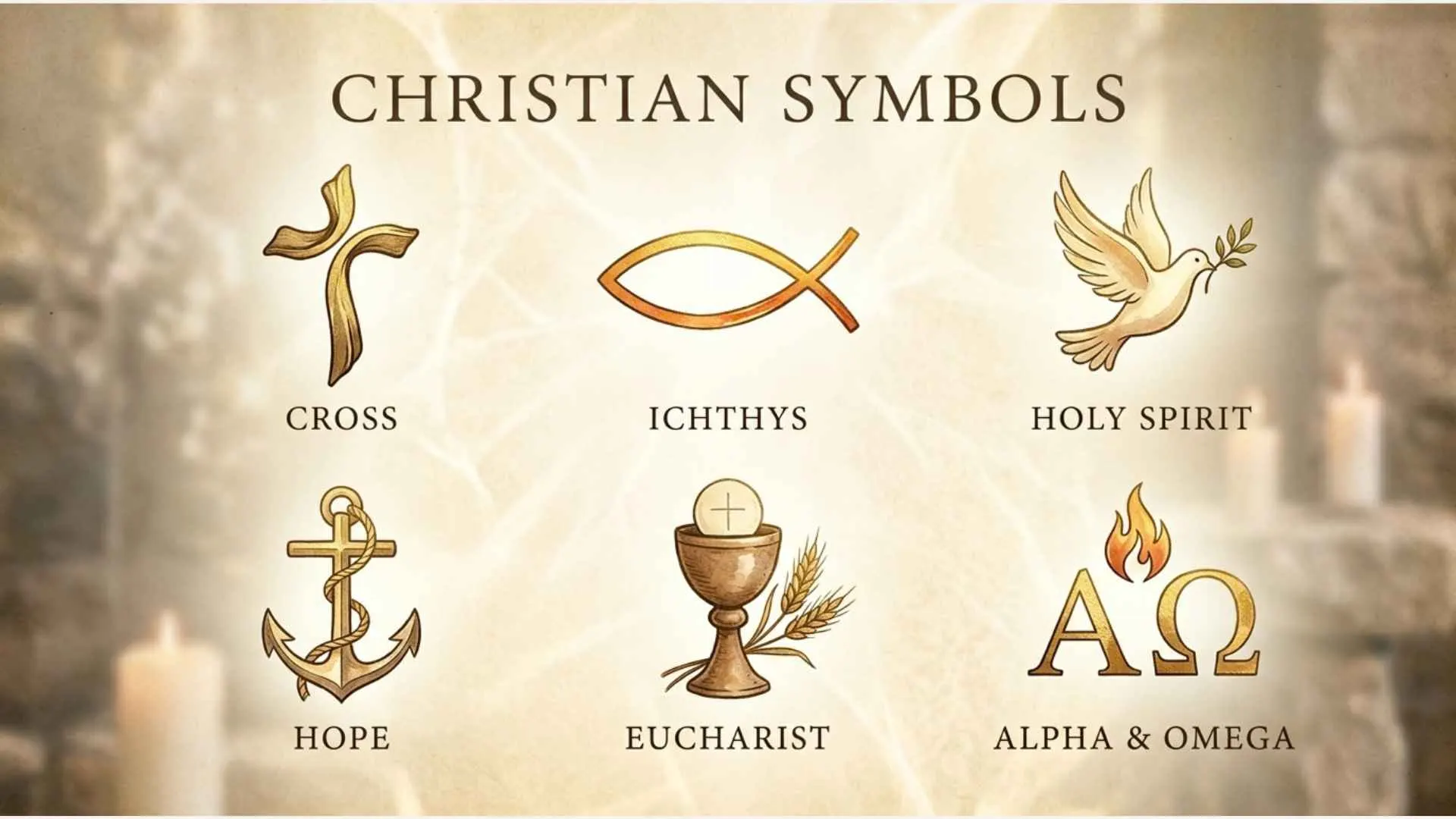
Christian symbols have been used for centuries to express faith, hope, love, sacrifice, salvation, and devotion. From the familiar cross and fish to the dove, lamb, anchor, and crown, these symbols can communicate important ideas about Christianity without using words. Many appear in churches, artwork, jewelry, architecture, religious texts, and Christian celebrations.
The meaning behind a Christian symbol often comes from the Bible, early Christian traditions, historical events, and religious art. Some symbols point directly to Jesus Christ and His teachings, while others represent important Christian beliefs such as resurrection, peace, eternal life, and the promise of salvation. Understanding these meanings can make Christian art and traditions easier to appreciate.
In this guide, we’ll explore Christian symbols and their meanings, including their history, biblical connections, spiritual significance, and common uses. Whether you’re studying Christian history, researching religious symbolism, choosing a meaningful symbol, or simply curious about the signs found in Christian traditions, this guide provides a clear starting point.
Quick Answer
Christian symbols are visual signs, objects, and images that represent important beliefs, teachings, and traditions of Christianity. They express ideas such as salvation, faith, resurrection, love, and the relationship between God and humanity. These symbols appear in churches, art, literature, ceremonies, and personal expressions of devotion worldwide.
Quick Facts About Christian Symbols
| Aspect | Information |
| Origin | Developed from early Christian teachings, biblical references, and ancient cultural traditions |
| Historical Significance | Helped early Christians express faith and identity, especially during periods of persecution |
| Main Meaning | Represents beliefs about Jesus Christ, God, salvation, and spiritual life |
| Spiritual Meaning | Symbolizes hope, divine connection, forgiveness, and transformation |
| Cultural Importance | Influenced architecture, art, traditions, festivals, and religious practices worldwide |
| Modern Usage | Found in jewelry, tattoos, decorations, literature, media, and personal faith expressions |
What Are Christian Symbols?
Christian symbols are meaningful images, objects, gestures, and signs used to communicate important ideas within Christianity. They help believers understand spiritual truths that can sometimes be difficult to express through words alone.
The roots of Christian symbolism can be traced back to the earliest followers of Jesus Christ. During the first centuries after Jesus’ death, Christians often faced persecution under the Roman Empire. Because openly displaying their faith could be dangerous, they used hidden symbols to identify themselves and communicate with other believers.
One famous example is the fish symbol, known as the Ichthys. Early Christians used this simple image as a secret sign of faith. The Greek word for fish, “Ichthys,” became an acronym for “Jesus Christ, Son of God, Savior.”
As Christianity spread throughout Europe, Asia, Africa, and other regions, symbols became an important part of churches, religious artwork, and worship practices. They appeared in cathedrals, paintings, manuscripts, and religious ceremonies.
Over time, Christian symbols evolved. Some symbols came directly from the Bible, while others developed through traditions, historical events, and cultural interpretations.
Deep Symbolic Meaning of Christian Symbols
Spiritual Level
On a spiritual level, Christian symbols represent the connection between humanity and God. They serve as reminders of faith, devotion, and the teachings of Jesus Christ.
The cross, for example, represents sacrifice and redemption. For Christians, it recalls the crucifixion of Jesus and the belief that His death brought forgiveness and salvation.
The dove represents the Holy Spirit and divine peace. It reminds believers of God’s presence, guidance, and spiritual renewal.
Symbols also help believers reflect on personal transformation. A person looking at a cross may remember the importance of forgiveness, compassion, and selfless love.
Psychological Level
Christian symbols have a strong psychological impact because humans naturally connect with images and patterns. The psychologist Carl Jung discussed how symbols can represent deep human experiences and shared ideas called archetypes.
A symbol like light often represents knowledge, hope, and goodness. Darkness may represent uncertainty or struggle. These meanings appear across many cultures because humans use visual language to understand emotions and life experiences.
Christian symbols create emotional connections because they are linked with personal memories, family traditions, worship experiences, and moments of comfort.
For many believers, seeing a cross, angel, or candle can create feelings of peace, safety, and spiritual connection.
Cultural Level
Christian symbols have shaped societies, traditions, and artistic expressions for centuries. They appear in churches, holidays, ceremonies, and public spaces.
Christmas symbols such as the star and nativity scene represent the birth of Jesus Christ. Easter symbols such as the empty tomb and lamb represent resurrection and new life.
These symbols are not only religious images. They have become important parts of global history, influencing architecture, music, painting, and literature.
Types and Variations of Christian Symbols
The Cross
Visual Description: Two intersecting lines, usually with one vertical line and one shorter horizontal line.
Meaning: The cross is the most recognized Christian symbol.
Symbolism: It represents the crucifixion of Jesus Christ, sacrifice, forgiveness, and salvation.
Cultural Connection: The cross appears in churches, jewelry, paintings, and religious ceremonies.
Where It Appears:
- Churches and cathedrals
- Christian artwork
- Necklaces and personal items
- Literature and films
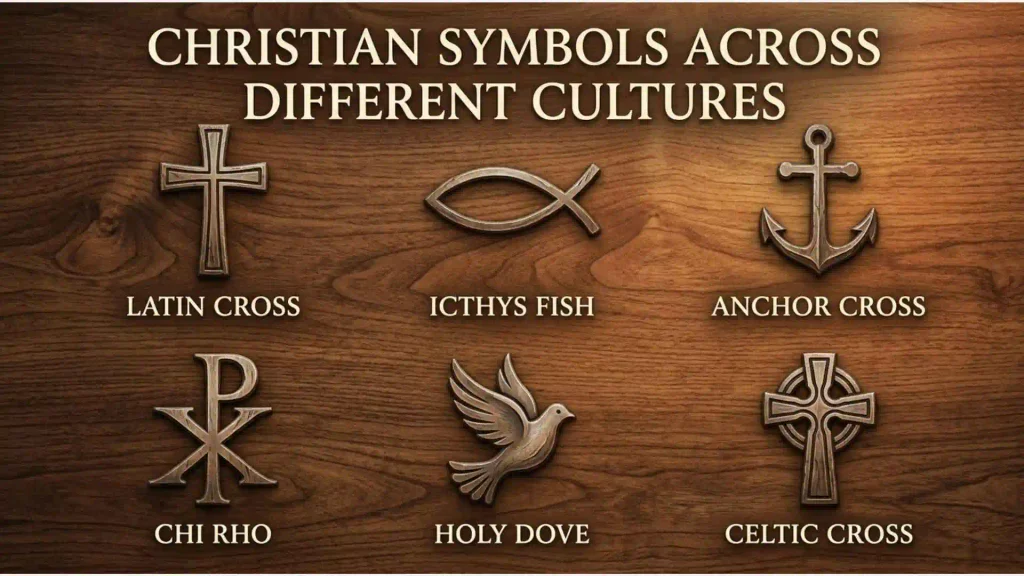
Different forms of the cross include the Latin cross, Celtic cross, and Orthodox cross, each carrying unique cultural meanings.
The Fish (Ichthys)
Visual Description: A simple outline of a fish.
Meaning: Represents Jesus Christ and Christian faith.
Symbolism: The fish became an early secret symbol among Christians.
Cultural Connection: It remains popular today as a sign of Christian identity.
Where It Appears:
- Car stickers
- Jewelry
- Christian merchandise
- Religious artwork
The Dove
Visual Description: A white bird, often shown with open wings.
Meaning: Represents the Holy Spirit.
Symbolism: The dove symbolizes peace, purity, hope, and divine guidance.
Cultural Connection: It is strongly connected with the baptism of Jesus, where the Holy Spirit appeared like a dove according to the New Testament.
Where It Appears:
- Baptism ceremonies
- Church decorations
- Religious paintings
The Lamb
Visual Description: A young sheep, sometimes carrying a banner.
Meaning: Represents Jesus Christ as the “Lamb of God.”
Symbolism: The lamb represents innocence, sacrifice, and redemption.
Cultural Connection: It connects Christianity with ancient Jewish sacrificial traditions.
Where It Appears:
- Easter celebrations
- Religious paintings
- Church artwork
The Alpha and Omega
Visual Description: Greek letters Alpha (Α) and Omega (Ω).
Meaning: Represents God as the beginning and the end.
Symbolism: It expresses the eternal nature of God.
Cultural Connection: These symbols are often found in Christian churches and religious artwork.
Where It Appears:
- Church decorations
- Cross designs
- Christian writings
The Anchor
Visual Description: A traditional ship anchor.
Meaning: Represents hope and stability.
Symbolism: Early Christians used the anchor as a hidden representation of faith and security in God.
Cultural Connection: It was especially common among early Christian communities.
Where It Appears:
- Ancient Christian inscriptions
- Jewelry
- Religious art
Christian Symbols Across Different Cultures
Ancient Egypt
Christianity arrived in Egypt during the first century, creating one of the oldest Christian communities in the world.
The Coptic Christian tradition developed unique artistic styles that combined Christian beliefs with Egyptian cultural influences.
The ankh, an ancient Egyptian symbol of life, is sometimes compared with Christian ideas of eternal life, although its original meaning came from earlier Egyptian religion.
Ancient Greece
Greek culture strongly influenced early Christianity. Many Christian ideas were expressed using Greek language and philosophy.
The Ichthys symbol comes from Greek words connected with Jesus Christ. Greek letters Alpha and Omega also became important Christian symbols.
Roman Culture
The Roman Empire played a major role in Christian history. Early Christians used symbols like the fish and anchor during periods of persecution.
After Emperor Constantine legalized Christianity in the fourth century, Christian symbols became more visible in public spaces, churches, and art.
Eastern Traditions
Eastern Christianity, including Orthodox Christianity, developed rich symbolic traditions.
Icons, gold backgrounds, candles, and detailed religious artwork became important ways to express spiritual truths.
The Orthodox cross is one example of a symbol with unique Eastern Christian meaning.
Indigenous Traditions
When Christianity spread to indigenous communities around the world, local cultures often blended Christian symbols with traditional artistic styles.
Native artists incorporated Christian themes into paintings, carvings, clothing, and ceremonies while preserving their cultural identity.
Modern Interpretations
Today, Christian symbols continue to appear in modern design, media, fashion, and personal expression.
Many people use these symbols to communicate faith, identity, hope, or personal values.
Similar Symbols and Their Meanings
| Symbol | Similar Meaning | Main Difference |
| Cross | Sacrifice and spiritual connection | Specifically connected to Jesus’ crucifixion |
| Dove | Peace and purity | Represents the Holy Spirit in Christianity |
| Light | Hope and goodness | Used broadly across many religions and cultures |
| Lamb | Innocence and sacrifice | Represents Jesus as the Lamb of God |
| Anchor | Hope and stability | Often linked with early Christian secret symbolism |
A common misconception is that every religious symbol has the same meaning across cultures. While symbols may share similar ideas, their meanings depend on historical and religious context.
Christian Symbols in Mythology and Folklore
Christian symbols appear in many legends, stories, and cultural traditions.
The story of the cross is central to Christian belief. According to tradition, Emperor Constantine saw a vision involving the cross before a major battle and later supported Christianity.
The dove appears in biblical stories, including Noah’s Ark, where a dove returning with an olive branch represented peace and a new beginning.
The lamb became connected with stories of sacrifice and redemption, reflecting both biblical traditions and older cultural practices.
These stories helped shape how people understand Christian symbols today.
Christian Symbols in Art, Literature, Movies and Pop Culture
Christian symbols have influenced some of the world’s greatest works of art.
Painters such as Leonardo da Vinci and Michelangelo used Christian imagery to express religious themes and human emotions.
In literature, symbols like light, crosses, and angels often represent hope, morality, struggle, and redemption.
Movies frequently use Christian symbolism to explore themes of sacrifice, forgiveness, and transformation.
Christian symbols also appear in:
- Tattoos
- Jewelry
- Fashion
- Home decorations
- Music
- Television
A cross necklace, for example, may represent personal faith, family tradition, or cultural identity.
Spiritual and Dream Meaning of Christian Symbols
Many people interpret Christian symbols in dreams as messages connected with faith, emotions, and personal growth.
Dreaming of a cross may represent spiritual reflection, responsibility, or a desire for guidance.
A dove in a dream may symbolize peace, healing, or emotional freedom.
Light may represent hope, understanding, or a new beginning.
However, dream meanings are personal. A symbol’s meaning often depends on a person’s experiences, beliefs, and emotions.
Positive and Negative Meanings of Christian Symbols
| Positive Meaning | Negative Meaning |
| Faith | Misinterpretation |
| Hope | Religious conflict |
| Love | Symbol misuse |
| Forgiveness | Judgment by others |
| Spiritual growth | Cultural misunderstanding |
| Protection | Extreme interpretations |
A symbol itself is not automatically positive or negative. Its meaning depends on how people understand and use it.
Why Humans Are Attracted to Christian Symbols
Humans naturally search for meaning. Symbols allow people to express complex emotions and beliefs through simple images.
Christian symbols connect people with history, family traditions, and personal experiences.
A person may wear a cross because it represents faith. Another may value it because it reminds them of a loved one or an important moment in life.
Symbols also create a sense of belonging. They connect individuals with larger communities and shared stories.
Modern Uses of Christian Symbols
Tattoos
Many people choose Christian symbols as tattoos to represent faith, personal struggles, healing, or spiritual journeys.
Jewelry
Cross necklaces, rings, and bracelets remain popular expressions of belief and identity.
Fashion
Christian imagery appears in clothing designs, especially among people who want to combine faith with personal style.
Branding
Some organizations use Christian symbols to communicate values such as compassion, charity, and service.
Social Media
People often use Christian symbols in profiles, posts, and digital artwork to express beliefs and encouragement.
Home Decor
Crosses, scripture artwork, and religious paintings are common decorations in many Christian homes.
Interesting Facts About Christian Symbols
- The fish symbol was used by early Christians as a secret sign of faith.
- The cross was not always the main Christian symbol. Early Christians often used the fish and anchor.
- Alpha and Omega come from the first and last letters of the Greek alphabet.
- The dove became strongly connected with the Holy Spirit through biblical descriptions.
- Christian symbols influenced Western art for more than a thousand years.
- The Celtic cross combines Christian meaning with Celtic artistic traditions.
- Many churches use colors and symbols to communicate different seasons of the Christian calendar.
Frequently Asked Questions
What is the most important Christian symbol?
The cross is the most recognized Christian symbol because it represents the crucifixion and resurrection of Jesus Christ.
What does the fish symbol mean in Christianity?
The fish symbol, known as Ichthys, represents Jesus Christ, Son of God, Savior, and was used by early Christians.
Why do Christians use symbols?
Christians use symbols to express faith, remember biblical teachings, and communicate spiritual ideas.
What does the dove symbolize in Christianity?
The dove represents the Holy Spirit, peace, purity, and divine guidance.
Are Christian symbols only used in churches?
No. Christian symbols are also used in homes, jewelry, art, literature, tattoos, and personal expressions of faith.
Conclusion
Christian symbols are more than simple images. They are powerful expressions of faith, history, culture, and human emotion. From the cross to the dove, each symbol carries stories that connect generations of believers. These symbols remind people of hope, sacrifice, love, and spiritual transformation. Their lasting influence shows the deep human desire to find meaning and connection.
 John Mercer
 Michael Rivera