
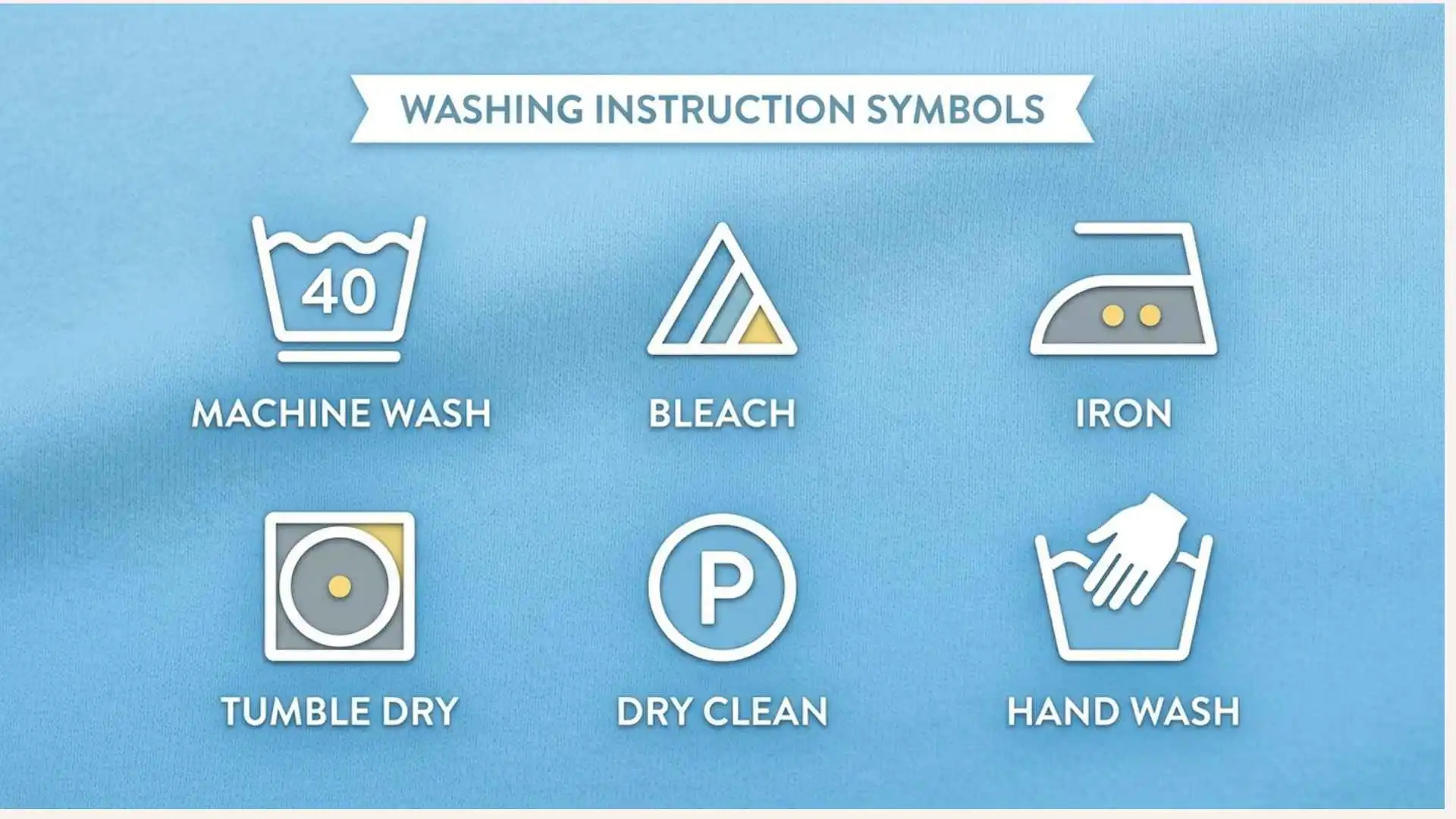
Washing instruction symbols can look confusing at first, but they provide simple instructions for keeping your clothes clean, fresh, and in good condition. Found on clothing tags and fabric care labels, these small symbols tell you how to wash, dry, bleach, iron, and dry-clean different fabrics safely.
Understanding laundry care symbols can help prevent common problems such as shrinking, fading, stretching, color bleeding, or damaging delicate materials. A washing tub, triangle, square, iron, or circle may each represent a different type of care instruction, while dots, lines, and crosses add more specific details.
In this complete guide, you’ll learn what the most common washing instruction symbols mean and how to read them correctly. From machine-wash and hand-wash symbols to tumble-drying, bleaching, ironing, and professional-cleaning symbols, you’ll have an easy reference for caring for your clothes the right way.
Quick Answer
Washing instruction symbols are standardized icons placed on clothing labels to explain how garments should be washed, dried, ironed, bleached, and professionally cleaned. They help people choose the correct laundry methods and prevent shrinking, fading, stretching, or fabric damage.
Quick Facts About Washing Instruction Symbols
| Aspect | Information |
| Origin | Developed from international textile care systems created during the 20th century |
| Historical Significance | Made clothing care easier as synthetic fabrics and global clothing production increased |
| Main Meaning | Provide instructions for washing, drying, ironing, and cleaning garments |
| Spiritual Meaning | Represent care, preservation, and respect for valuable belongings |
| Cultural Importance | Create a universal language that connects people across countries |
| Modern Usage | Found on clothing labels, bedding, towels, and textile products worldwide |
What Are Washing Instruction Symbols?
Definition of Washing Instruction Symbols
Washing instruction symbols are visual signs printed on clothing care labels that tell consumers how to properly clean and maintain their garments. Instead of using long written instructions in multiple languages, manufacturers use simple symbols that can be understood internationally.
A shirt made in Japan, sold in the United States, and worn in Europe can have the same laundry symbols because these icons communicate beyond language barriers.
Common washing instruction symbols include:
- Washing symbols showing how clothes should be cleaned with water
- Drying symbols explaining safe drying methods
- Ironing symbols showing heat limits
- Bleaching symbols explaining whether bleach is safe
- Dry cleaning symbols for professional cleaning methods
Origin and Historical Background
Before modern clothing labels existed, people relied on personal experience, family traditions, and fabric knowledge to care for clothes. This worked when most garments were made from natural materials like cotton, wool, and linen.
However, the rise of synthetic fabrics during the 20th century changed clothing care. Materials such as polyester, nylon, and blended fabrics required specific washing methods. A simple mistake could ruin an expensive garment.
To solve this problem, textile organizations developed standardized care labeling systems. The International Organization for Standardization (ISO) helped establish global textile care symbols, while organizations such as GINETEX in Europe promoted the use of care label systems.
Evolution Over Time
Washing instruction symbols have evolved alongside fashion and technology.
Early clothing labels often used written instructions only. As international trade expanded, symbols became more practical because they removed language barriers.
Today, these symbols appear on:
- Everyday clothing
- Luxury fashion items
- Sportswear
- Baby clothing
- Household textiles
- Outdoor equipment
Modern care symbols continue adapting as new fabrics and cleaning technologies develop.
Deep Symbolic Meaning of Washing Instruction Symbols
Although washing instruction symbols are practical tools, they also represent deeper ideas connected to human behavior and culture.
Spiritual Level
Symbolism of Care and Preservation
At a symbolic level, washing instruction symbols represent the human desire to protect and preserve what has value. Clothing is not only material. It often carries memories, identity, and emotional connections.
A wedding dress, a childhood sweater, or a family heirloom contains personal stories. Following care instructions becomes an act of respect toward those memories.
Inner Transformation
Cleaning has always held symbolic importance in many traditions. Across cultures, washing represents renewal, purification, and transformation.
The act of caring for clothing reflects a broader human idea: what we value deserves attention and maintenance.
Psychological Level
Human Connection With Order
Psychologists often study how humans create systems to reduce uncertainty. Washing instruction symbols provide clear guidance in situations where people may feel unsure.
A small icon removes confusion:
- Can this shirt go in the washing machine?
- Should this fabric be dried naturally?
- Is high heat dangerous?
These symbols create confidence and control.
Jungian Symbolism and Universal Communication
From a Jungian perspective, symbols are powerful because humans naturally understand visual patterns. Carl Jung suggested that certain symbols connect with shared human experiences.
Laundry symbols are not ancient archetypes like the sun or the tree, but they demonstrate the same psychological principle: humans use images to communicate meaning quickly.
Cultural Level
A Universal Language
Washing instruction symbols show how societies create shared communication systems. A person who cannot read another language can still understand many clothing care icons.
They represent:
- Cooperation between cultures
- Global manufacturing connections
- Shared human needs
A simple bucket, iron, or circle can communicate across borders.
Types and Variations of Washing Instruction Symbols
Washing Symbols
Tub Symbol
Visual Description: A container filled with water.
Meaning: Indicates washing instructions involving water.
Symbolism: Represents cleansing, renewal, and maintenance.
Cultural Connection: Water has traditionally represented purification in many societies.
Where It Appears: Clothing labels, towels, bedding, and household fabrics.
Common variations include:
- Numbers inside the tub showing maximum water temperature
- Hand inside the tub showing hand washing only
- Lines underneath showing gentle or delicate cycles
Drying Symbols
Square Drying Symbol
Visual Description: A square shape with drying-related marks.
Meaning: Explains how the garment should be dried.
Symbolism: Represents balance between natural elements and human technology.
Common variations include:
- Circle inside square for tumble drying
- Dots indicating heat levels
- Lines showing natural drying methods
Ironing Symbols
Iron Shape Symbol
Visual Description: A small iron icon.
Meaning: Shows whether ironing is allowed and the maximum heat setting.
Variations include:
- One dot: low heat
- Two dots: medium heat
- Three dots: high heat
- Crossed-out iron: do not iron
Bleaching Symbols
Triangle Symbol
Visual Description: A triangle shape.
Meaning: Indicates whether bleach can safely be used.
Variations include:
- Empty triangle: bleach allowed
- Triangle with lines: non-chlorine bleach only
- Crossed triangle: no bleach
Dry Cleaning Symbols
Circle Symbol
Visual Description: A circle shape.
Meaning: Indicates professional dry cleaning instructions.
Letters inside circles may tell cleaners which chemical methods are suitable.
Washing Instruction Symbols Across Different Cultures
Ancient Egypt
Ancient Egyptians placed great importance on cleanliness and clothing care. White linen garments were especially valued, and washing was connected with purity and social status.
Although they did not use modern laundry symbols, their respect for textile preservation reflects the same human desire behind today’s care labels.
Ancient Greece
Greek culture connected cleanliness with health and beauty. Clothing, especially wool and linen garments, required careful maintenance.
The modern idea of protecting fabrics follows a similar principle.
Roman Culture
Romans developed advanced washing practices through public laundries called fullonicae. Workers cleaned garments using specialized methods.
Their textile care traditions show that clothing maintenance has been important for thousands of years.
Eastern Traditions
Many Eastern cultures connect washing with purification and respect. Traditional textile care methods often involved careful hand washing, natural drying, and fabric preservation.
Modern washing symbols continue this philosophy through standardized guidance.
Indigenous Traditions
Many Indigenous cultures developed detailed knowledge about natural fibers, dyes, and materials. Caring for clothing and textiles was connected with survival, identity, and tradition.
Modern Interpretations
Today, washing instruction symbols represent global cooperation. They allow clothing manufacturers and consumers worldwide to communicate through one visual system.
Similar Symbols and Their Meanings
| Symbol Type | Similar Concept | Difference |
| Washing symbol | Water purification symbols | Focuses specifically on fabric care |
| Iron symbol | Heat symbols | Provides clothing heat limits |
| Circle symbol | Professional service symbols | Indicates dry cleaning requirements |
| Triangle symbol | Warning symbols | Specifically relates to bleach use |
A common misunderstanding is believing that all symbols mean the same worldwide. While many are standardized, some regional differences exist.
Washing Instruction Symbols in Mythology and Folklore
Water and cleaning symbols connect indirectly with ancient stories about renewal and transformation.
Many mythologies feature water as a powerful force:
- Ancient Greek myths often connected water with gods and transformation.
- Hindu traditions include sacred rivers associated with purification.
- Ancient Egyptian beliefs connected cleanliness with spiritual preparation.
Although laundry symbols are modern inventions, their meanings connect with older human ideas about care and renewal.
Washing Instruction Symbols in Art, Literature, Movies, and Pop Culture
Fashion Design
Fashion designers use care labels as part of the relationship between creator and consumer. A garment’s value depends not only on appearance but also on proper maintenance.
Movies and Television
Laundry and clothing care often appear in storytelling as symbols of everyday life, family traditions, and personal identity.
Tattoos and Modern Design
Some people use household symbols creatively in artwork because they represent simplicity, organization, and daily routines.
Branding
Textile brands use care communication to demonstrate quality and responsibility.
Spiritual and Dream Meaning of Washing Instruction Symbols

Dreams involving clothing or washing often relate to personal identity, change, and emotional renewal.
Possible interpretations include:
Positive Meanings
- Personal growth
- Fresh beginnings
- Self-care
- Emotional healing
Cautionary Meanings
- Fear of losing something valuable
- Feeling responsible for maintaining perfection
- Anxiety about mistakes
Dream interpretation is personal, but clothing often represents how people present themselves to the world.
Positive and Negative Meanings of Washing Instruction Symbols
| Positive Meaning | Negative Meaning |
| Protection | Restriction |
| Care | Confusion |
| Preservation | Fear of mistakes |
| Organization | Dependence on rules |
| Responsibility | Complexity |
A symbol itself is neutral. Its meaning depends on how people understand and use it.
Why Humans Are Attracted to Washing Instruction Symbols
Humans naturally search for patterns and meaning. Symbols simplify complex information and allow quick understanding.
Washing symbols attract people because they provide:
- Clear instructions
- A feeling of control
- Protection against mistakes
- Connection between people worldwide
They show how small images can carry significant information.
Modern Uses of Washing Instruction Symbols
Clothing and Fashion
Almost every modern garment includes care symbols to help customers maintain quality.
Home Decor
Curtains, blankets, rugs, and upholstery often include fabric care instructions.
Technology and Smart Labels
Some modern brands are exploring digital clothing labels and QR codes that provide expanded care information.
Sustainable Living
Proper garment care helps reduce waste by extending clothing lifespan.
Interesting Facts About Washing Instruction Symbols
- The same care symbols can often be understood across many countries without translation.
- A crossed-out symbol usually means the action can damage the fabric.
- The temperature number inside a washing symbol indicates the maximum safe washing temperature.
- Clothing care labels became increasingly important after synthetic fabrics became popular.
- The symbols help reduce textile waste by encouraging proper maintenance.
- Dry cleaning symbols are designed mainly for professional cleaners.
- Many people damage clothing because they ignore care labels.
- Modern care systems combine traditional textile knowledge with international standards.
Frequently Asked Questions
What are washing instruction symbols?
Washing instruction symbols are icons on clothing labels that explain how garments should be washed, dried, ironed, bleached, or professionally cleaned.
Why are washing instruction symbols important?
They help prevent fabric damage, protect clothing quality, and extend the life of garments.
What does a triangle symbol mean on clothing labels?
A triangle symbol relates to bleaching instructions. A crossed triangle means bleach should not be used.
What does a circle symbol mean on laundry labels?
A circle usually indicates professional dry cleaning instructions.
Can washing instruction symbols differ between countries?
Most symbols are internationally recognized, but some regional differences may exist.
How can I learn clothing care symbols quickly?
Start by remembering the five main categories: washing, drying, ironing, bleaching, and dry cleaning.
Conclusion
Washing instruction symbols are more than simple marks on clothing labels. They are a universal communication system built around care, preservation, and responsibility. These small icons connect modern technology with ancient human values of cleanliness and protection. Understanding them helps people save money, reduce waste, and respect the items that carry personal memories. A simple symbol can tell a powerful story about how humans care for what matters.
 Sarah Thompson
 John Mercer