
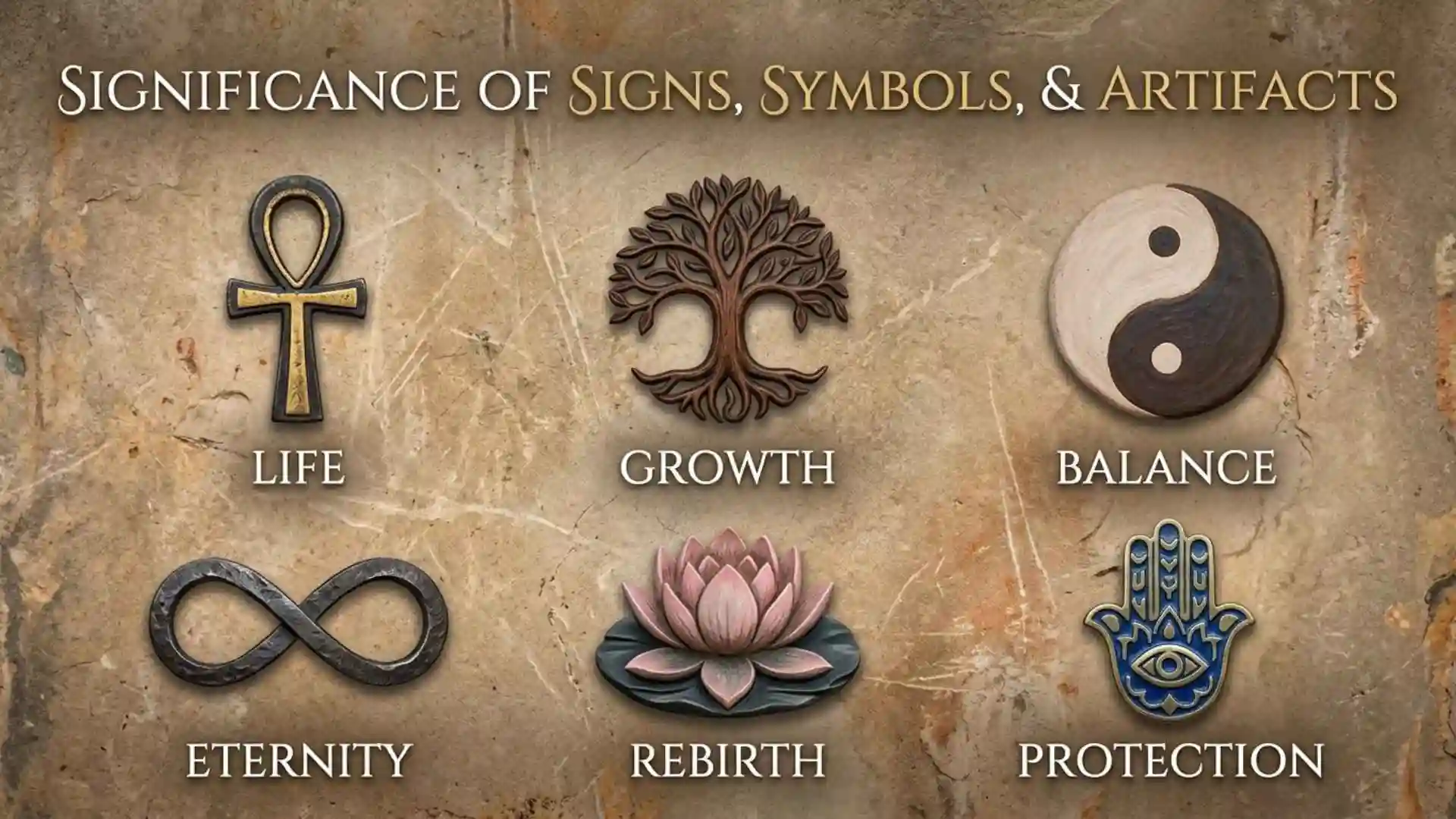
Signs, symbols, and artifacts are an important part of how people communicate, preserve history, and express ideas. A simple sign can give information, while a symbol can represent a deeper belief, emotion, identity, or cultural value. Artifacts, such as tools, clothing, artwork, jewelry, and religious objects, provide physical evidence of how people lived and what mattered to them.
The significance of signs, symbols, and artifacts can change depending on culture, religion, history, and social context. For example, a particular color, animal, object, or shape may represent something meaningful in one society but have a different meaning somewhere else. Understanding these differences helps us interpret traditions, artwork, historical objects, ceremonies, and everyday forms of communication more accurately.
Together, signs, symbols, and artifacts help connect the past with the present. They can tell stories about a community’s beliefs, values, experiences, and identity even when written records are limited. By exploring their meanings and historical context, we can better understand how humans have communicated ideas and preserved cultural knowledge across generations.
Quick Answer
Signs, symbols, and artifacts are visual or tangible representations that communicate meaning, convey cultural and spiritual messages, and preserve historical and social knowledge across generations.
Quick Facts About Signs, Symbols, and Artifacts
| Aspect | Information |
| Origin | Human societies have used symbols and artifacts since prehistoric times, from cave paintings to pottery. |
| Historical Significance | They record beliefs, events, and societal norms, often serving as evidence of early civilizations. |
| Main Meaning | Convey complex ideas, values, or messages beyond verbal communication. |
| Spiritual Meaning | Represent divine, mystical, or sacred concepts, aiding rituals and meditation. |
| Cultural Importance | Strengthen identity, tradition, and community cohesion through shared symbols. |
| Modern Usage | Found in art, media, branding, fashion, spiritual practices, and education. |
What Are Signs, Symbols, and Artifacts?
Definition
A sign is a visual cue that conveys a specific message or information, such as a stop sign. A symbol carries deeper, often abstract meanings, like a heart representing love. An artifact is a physical object created by humans that embodies cultural, historical, or spiritual significance, like ancient tools or religious relics.
Origin
The earliest signs date back to prehistoric times with cave paintings in Lascaux, France, and engraved stones in Africa. Symbols emerged as humans developed language, religion, and social structures. Artifacts, tangible representations of culture, began as utilitarian tools but evolved into objects carrying aesthetic, ceremonial, and societal meaning.
Historical Background
From ancient Egyptian hieroglyphs to Roman coins, signs, symbols, and artifacts were essential in documenting knowledge, communicating across generations, and asserting authority. They often reflected social hierarchies, spiritual beliefs, and political structures.
Evolution Over Time
Initially practical, these representations grew complex, incorporating abstract concepts, moral codes, and metaphysical ideas. They became tools for storytelling, identity expression, and preserving collective memory.
Importance
Signs, symbols, and artifacts provide insights into human cognition, creativity, and the evolution of culture. They reveal how societies interpret the world, manage social order, and seek meaning beyond the tangible.
Deep Symbolic Meaning
Spiritual Level
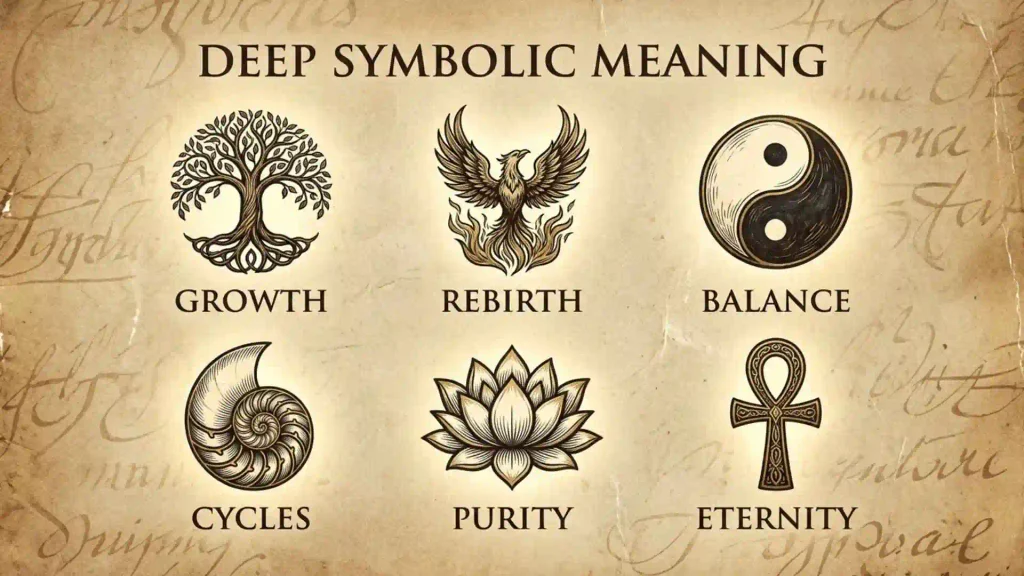
- Spiritual Symbolism: Many symbols, such as the lotus in Eastern traditions or the ankh in Egypt, represent spiritual enlightenment, rebirth, and life’s cyclical nature.
- Inner Transformation: Artifacts like ritual masks and sacred objects facilitate meditation, self-reflection, and personal growth.
- Soul and Consciousness Connections: Symbols act as bridges between the material and spiritual realms, helping humans explore consciousness and existential questions.
Psychological Level
- Human Emotions: Symbols evoke strong emotions, from comfort in familiar icons to awe in monumental artifacts.
- Archetypes: Carl Jung highlighted universal symbols—like the hero, shadow, or wise old man—that reflect shared psychological patterns.
- Emotional Attraction: Humans instinctively respond to symmetry, color, and patterns, making certain symbols enduring and memorable.
Cultural Level
- Social Significance: Symbols and artifacts communicate social norms, power structures, and communal values.
- Community Beliefs: Shared symbols reinforce cohesion, whether in flags, religious icons, or traditional motifs.
- Traditional Interpretations: From dreamcatchers to totems, artifacts often embody moral lessons, mythologies, and ethical guidance.
Types and Variations
| Name | Visual Description | Meaning | Symbolism | Cultural Connection | Where It Appears |
| Totem | Carved figure or animal | Clan identity | Protection, ancestry | Indigenous tribes | Rituals, carvings |
| Ankh | Cross with loop | Eternal life | Life and resurrection | Ancient Egypt | Art, tombs, jewelry |
| Mandala | Geometric circular design | Unity and balance | Cosmic order | Hinduism and Buddhism | Meditation, temples |
| Ouroboros | Snake eating its tail | Infinity | Cycles of life | Greek and Egyptian | Mythology, alchemy |
| Dreamcatcher | Web with beads | Protection | Filtering dreams | Native American | Home décor, spiritual practice |
Signs, Symbols, and Artifacts Across Different Cultures
Ancient Egypt
Symbols like the Eye of Horus represented protection and healing, while artifacts such as sarcophagi preserved social hierarchy and spiritual beliefs.
Ancient Greece
Greek amphorae and statues conveyed stories of gods and heroes, while symbols like the olive branch denoted peace.
Roman Culture
Roman coins, sculptures, and public monuments broadcast political power and historical events, embedding societal values.
Eastern Traditions
Mandala patterns, Yin-Yang symbols, and ritual artifacts express harmony, spirituality, and cosmic balance in Indian, Chinese, and Japanese cultures.
Indigenous Traditions
Totems, masks, and ceremonial tools connect communities with ancestors, nature, and spiritual dimensions.
Modern Interpretations
Contemporary art, branding, tattoos, and digital emojis carry symbolic meanings inherited or adapted from historical precedents.
Similar Symbols and Their Meanings
| Symbol | Similar Symbol | Difference | Misconception |
| Lotus | Water Lily | Lotus signifies purity in Hinduism; water lily is primarily botanical | Often confused in Western art |
| Ankh | Cross | Ankh represents life; cross is primarily Christian salvation | Confusion in modern tattoos |
| Ouroboros | Infinity symbol | Ouroboros implies cyclical renewal; infinity is abstract | Often simplified in graphics |
| Eye of Horus | Evil Eye | Protection vs. curse warding | Misinterpretation as negative symbol |
Signs, Symbols, and Artifacts in Mythology and Folklore
Stories about symbols like Thor’s hammer, the Phoenix, and Celtic knots illustrate power, rebirth, and fate. Folklore integrates these elements into cultural memory, shaping morality, values, and societal norms across generations.
Signs, Symbols, and Artifacts in Art, Literature, Movies, and Pop Culture
- Paintings: Symbolism of light, color, and form communicates hidden narratives, as seen in Renaissance works.
- Literature: Objects and symbols carry thematic weight; for example, the green light in The Great Gatsby signifies hope.
- Movies and TV: Iconic symbols like the Deathly Hallows or superhero emblems convey identity and values.
- Tattoos and Fashion: Modern interpretation of ancient symbols expresses personal beliefs and identity.
- Modern Design: Brands leverage symbols for instant recognition and emotional connection.
Spiritual and Dream Meaning
- Dream Symbolism: Artifacts in dreams can signify personal growth, transformation, or unresolved emotions.
- Meditation Experiences: Mandalas or sacred objects focus attention, enhancing mindfulness and insight.
- Spiritual Encounters: Encountering symbols in nature or rituals may signal guidance, protection, or awakening.
- Common Interpretations: Positive messages often involve healing and clarity, while cautionary messages warn of imbalance or neglect.
Positive and Negative Meanings
| Positive Meaning | Negative Meaning |
| Protection | Oppression |
| Life and Renewal | Mortality and Decay |
| Unity | Conformity |
| Wisdom | Misinterpretation |
| Transformation | Destruction |
Symbols can carry both light and shadow; context, culture, and perception shape their meaning.
Why Humans Are Attracted to Signs, Symbols, and Artifacts
Humans are pattern-seeking beings. Symbols satisfy cognitive curiosity, evoke emotion, preserve memory, and provide frameworks to interpret complex ideas. Shared symbols reinforce social bonds and create continuity across generations, linking the past to present identities.
Modern Uses of Signs, Symbols, and Artifacts
- Tattoos: Personal storytelling and identity expression.
- Jewelry and Fashion: Cultural homage and aesthetic appeal.
- Branding: Logos create recognition and emotional resonance.
- Social Media: Emojis and icons convey meaning quickly.
- Contemporary Spirituality: Objects and symbols facilitate meditation and rituals.
- Home Décor: Artifacts enhance cultural ambiance and personal connection.
Interesting Facts
- The Rosetta Stone unlocked understanding of Egyptian hieroglyphs.
- Mandalas are used in neuroscience studies to reduce stress and improve focus.
- Totems were legally recognized as clan symbols in certain Indigenous societies.
- Ancient coins often doubled as propaganda tools.
- Symbols like the Yin-Yang predate formal writing systems in Eastern cultures.
- Alchemical symbols influenced modern chemistry notation.
- Cave paintings may represent early symbolic communication for over 40,000 years.
- The Ouroboros appeared independently in Egyptian and Norse mythology.
- Ancient artifacts often served multifunctional roles—utility, ritual, and storytelling.
- Emojis are the digital evolution of universal human symbols.
Frequently Asked Questions
1. What is the difference between a sign and a symbol?
A sign conveys direct information, while a symbol carries deeper, often abstract meaning.
2. Why are artifacts important in understanding history?
Artifacts preserve tangible evidence of past cultures, beliefs, and daily life, offering insights into civilizations long gone.
3. Can symbols have different meanings in different cultures?
Yes, a symbol may represent protection in one culture and danger in another; context is crucial.
4. How do symbols influence human behavior?
Symbols shape emotions, reinforce social norms, and guide rituals, impacting perception and action.
5. Are modern emojis considered symbols?
Yes, emojis are digital symbols conveying ideas, emotions, and cultural references quickly and universally.
6. Can a single artifact represent both spiritual and psychological meaning?
Absolutely; many artifacts carry layered meanings that resonate across spiritual, emotional, and social levels.
Conclusion
Signs, symbols, and artifacts are more than objects; they are carriers of human experience, memory, and meaning. From ancient hieroglyphs to modern tattoos, they reveal our shared desires, fears, and aspirations. By exploring them, we connect with the past, understand the present, and find guidance for the future, reminding us that every mark, object, and emblem holds a story worth discovering.
 Sarah Thompson
 Michael Rivera