
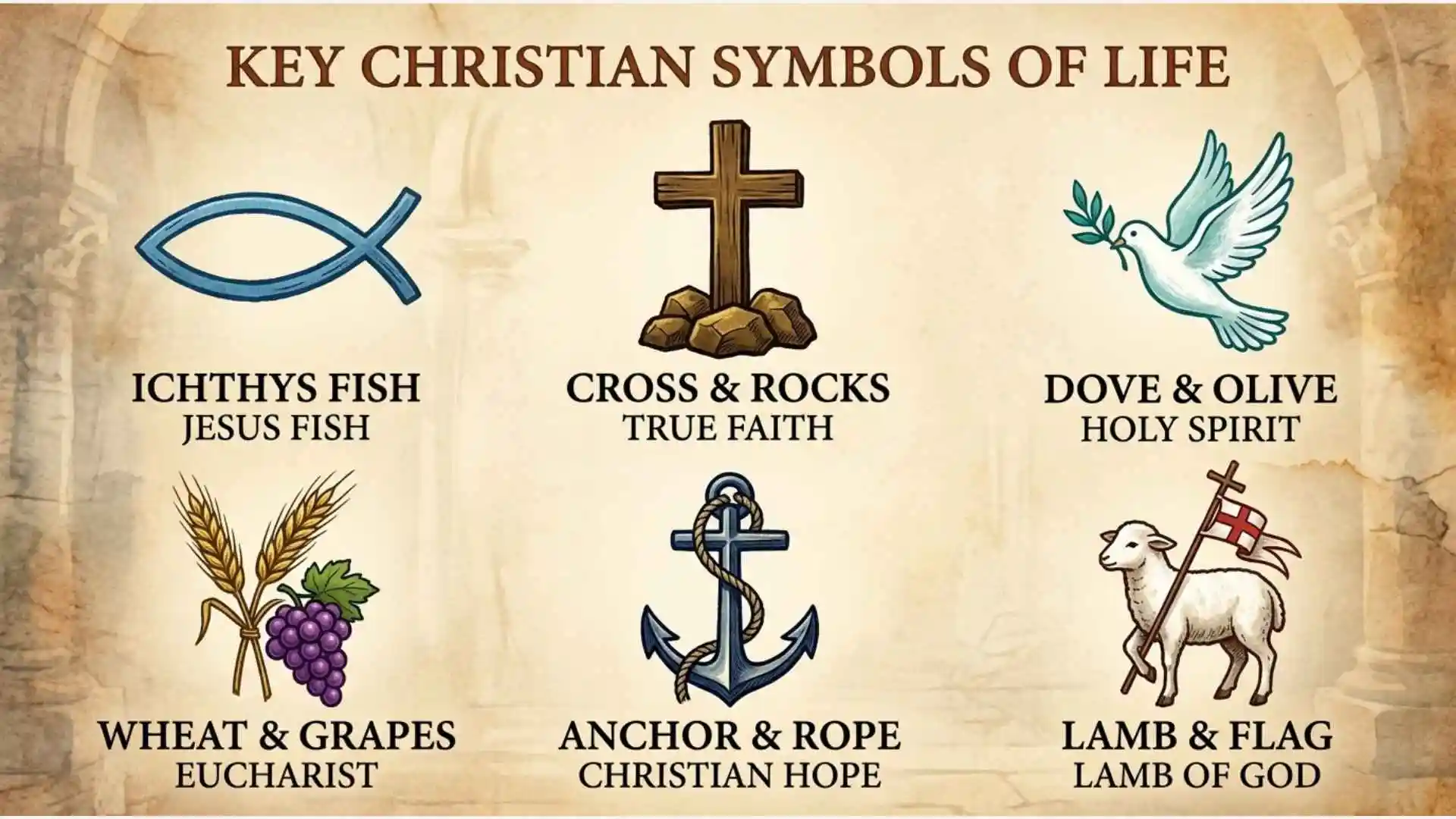
Christianity has a rich tradition of symbols that express faith, hope, sacrifice, love, and devotion. From the cross and fish to the dove, lamb, and crown, these sacred signs have been used by Christians for centuries to communicate important spiritual ideas. Many symbols also connect biblical teachings with the history and traditions of the Christian faith.
The meaning of a Christian symbol can go beyond its simple appearance. The cross, for example, represents the crucifixion and resurrection of Jesus Christ, while the dove is commonly associated with the Holy Spirit, peace, and purity. Other symbols, such as the anchor, ichthys, alpha and omega, and Good Shepherd imagery, carry meanings connected to Scripture, salvation, eternal life, and Christian identity.
In this guide to Christianity symbols, you’ll discover the history, biblical connections, and spiritual meanings behind some of the most recognizable sacred Christian signs. Whether you are studying Christian history, exploring biblical symbolism, or simply curious about the meaning behind these images, this guide provides a clear and easy-to-understand look at the symbols that have shaped Christian worship and culture.
Quick Answer
Christianity symbols are visual signs that represent important beliefs, teachings, and events within the Christian faith. They communicate ideas such as salvation, resurrection, peace, love, and eternal life. These symbols appear in churches, artwork, literature, jewelry, and personal expressions of faith around the world.
Quick Facts About Christianity Symbols
| Aspect | Information |
| Origin | Developed from early Christian teachings, biblical stories, and ancient cultural traditions |
| Historical Significance | Helped early Christians express faith and identity, especially during periods of persecution |
| Main Meaning | Represents Christian beliefs, values, and spiritual truths |
| Spiritual Meaning | Reflects connection with God, salvation, hope, and inner transformation |
| Cultural Importance | Influenced architecture, art, literature, traditions, and celebrations worldwide |
| Modern Usage | Found in churches, jewelry, tattoos, clothing, media, and personal devotion |
What Are Christianity Symbols?
Christianity symbols are images, objects, and signs that represent important aspects of Christian faith. They help believers understand complex spiritual ideas through simple visual forms. A symbol can communicate a message that words alone may not fully express.
The earliest Christian communities used symbols to share their beliefs and recognize one another. During the Roman Empire, when Christians sometimes faced persecution, symbols provided a discreet way to identify their faith.
One of the earliest examples is the fish symbol, known as the Ichthys. The Greek letters of the word represented the phrase “Jesus Christ, Son of God, Savior.” Early Christians used this symbol as a secret sign of belief.
As Christianity spread throughout Europe, Asia, Africa, and the Americas, new symbols developed. Churches, paintings, sculptures, and religious objects became filled with meaningful imagery. Each symbol carried stories about biblical events, spiritual lessons, and the relationship between humanity and God.
Today, Christianity symbols remain powerful reminders of faith. They appear in cathedrals, homes, artwork, clothing, and personal items used by millions of believers.
Deep Symbolic Meaning of Christianity Symbols
Spiritual Level
On a spiritual level, Christianity symbols represent the relationship between humans and God. They provide reminders of important teachings from the Bible and encourage believers to reflect on their faith.
The cross, for example, represents Jesus Christ’s sacrifice and resurrection. For Christians, it is not only a reminder of suffering but also a symbol of forgiveness, victory, and eternal hope.
The dove represents the Holy Spirit and divine peace. It reminds believers of guidance, purity, and spiritual renewal.
Many Christians use symbols during prayer and meditation because visual reminders can help focus the mind and strengthen spiritual connection.
Psychological Level
From a psychological perspective, symbols have a powerful effect on human emotions and memory. Swiss psychologist Carl Jung studied symbols as expressions of deep human experiences and shared unconscious patterns called archetypes.
Christian symbols often represent universal human themes:
- Hope during difficult times
- The desire for forgiveness
- The search for meaning
- The journey from suffering toward renewal
A person seeing a cross may immediately connect it with love, sacrifice, and comfort. These emotional associations create a strong personal relationship between the individual and the symbol.
Cultural Level
Christianity symbols have shaped societies for thousands of years. They influenced architecture, holidays, paintings, music, and traditions.
For example, the cross became one of the most recognizable symbols in world history. It appears in churches, monuments, national traditions, and works of art.
Symbols also help communities preserve shared memories. They connect generations by passing religious stories and values from parents to children.
Types and Variations of Christianity Symbols
The Cross
Visual Description: Two intersecting lines, usually one vertical and one horizontal.
Meaning: The cross represents the crucifixion and resurrection of Jesus Christ.
Symbolism: It represents sacrifice, salvation, forgiveness, and victory over death.
Cultural Connection: The cross is the central symbol of Christianity and appears in churches, artwork, jewelry, and memorials.
Where It Appears:
- Churches and altars
- Religious paintings
- Jewelry
- Tattoos
- Literature and films
Different forms include the Latin cross, Celtic cross, Orthodox cross, and crucifix.
The Fish Symbol (Ichthys)
Visual Description: A simple outline of a fish.
Meaning: Represents Jesus Christ and Christian identity.
Symbolism: It symbolizes faith, belonging, and the teachings of Jesus.
Cultural Connection: Early Christians used it as a recognition sign during times of persecution.
Where It Appears:
- Car decorations
- Jewelry
- Church materials
- Christian artwork
The Dove
Visual Description: A white bird often shown flying or carrying an olive branch.
Meaning: Represents the Holy Spirit, peace, and purity.
Symbolism: The dove connects with the biblical story of Jesus’ baptism, where the Holy Spirit descended like a dove.
Cultural Connection: It became a universal symbol of peace beyond Christianity as well.
Where It Appears:
- Baptism artwork
- Religious paintings
- Peace symbols
- Church decorations
The Lamb
Visual Description: A lamb, sometimes carrying a banner or cross.
Meaning: Represents Jesus as the “Lamb of God.”
Symbolism: It represents innocence, sacrifice, and redemption.
Cultural Connection: The lamb connects Christian beliefs with ancient Jewish sacrificial traditions.
Where It Appears:
- Biblical art
- Church designs
- Religious celebrations
Alpha and Omega
Visual Description: The Greek letters Alpha (Α) and Omega (Ω).
Meaning: Represents God as the beginning and the end.
Symbolism: It expresses the eternal nature of God.
Cultural Connection: These letters appear frequently in Christian architecture and religious artwork.
Christianity Symbols Across Different Cultures
Ancient Egypt
Although Christianity developed later than ancient Egyptian religion, early Egyptian Christians, known as Copts, incorporated local artistic traditions into Christian expression.
The Coptic cross became an important symbol among Egyptian Christians. It combined Christian meaning with regional artistic styles and represented faith, eternity, and life.
Ancient Greece
Greek culture strongly influenced early Christianity. The fish symbol comes from the Greek language, and many early Christian writings used Greek philosophical concepts to explain spiritual ideas.
Greek letters such as Alpha and Omega became important because they expressed ideas about God’s eternal existence.
Roman Culture
The Roman Empire played a major role in Christian history. The cross became deeply connected with Roman history because crucifixion was a Roman method of execution.
After Christianity became accepted within the empire, Christian symbols appeared widely in Roman architecture, mosaics, and public spaces.
Eastern Traditions
Eastern Christian communities developed unique symbolic traditions. The Orthodox Church uses icons, incense, colors, and artistic styles to communicate spiritual truths.
Icons are not simply decorations. They are viewed as windows that help believers reflect on sacred realities.
Indigenous Traditions
When Christianity spread to indigenous communities, local cultures often blended Christian symbols with traditional art forms.
Christian imagery appeared in regional crafts, clothing, storytelling, and ceremonies, creating unique expressions of faith.
Modern Interpretations
Today, Christianity symbols continue to evolve. People use them in personal ways through jewelry, tattoos, digital designs, and home decorations.
While their meanings remain rooted in tradition, individuals often connect them with personal experiences of hope, healing, and identity.
Similar Symbols and Their Meanings
| Symbol | Similar Meaning | Main Difference |
| Cross | Sacrifice and spiritual transformation | Specifically connected to Jesus Christ |
| Dove | Peace and purity | Represents the Holy Spirit in Christianity |
| Fish | Faith and identity | Connected with early Christian communities |
| Heart | Love and devotion | More general symbol of emotion |
| Circle | Eternity and completeness | Used across many religions and cultures |
A common misconception is that all religious symbols have the same meaning. While some ideas overlap, Christian symbols have specific connections to biblical teachings and historical events.
Christianity Symbols in Mythology and Folklore
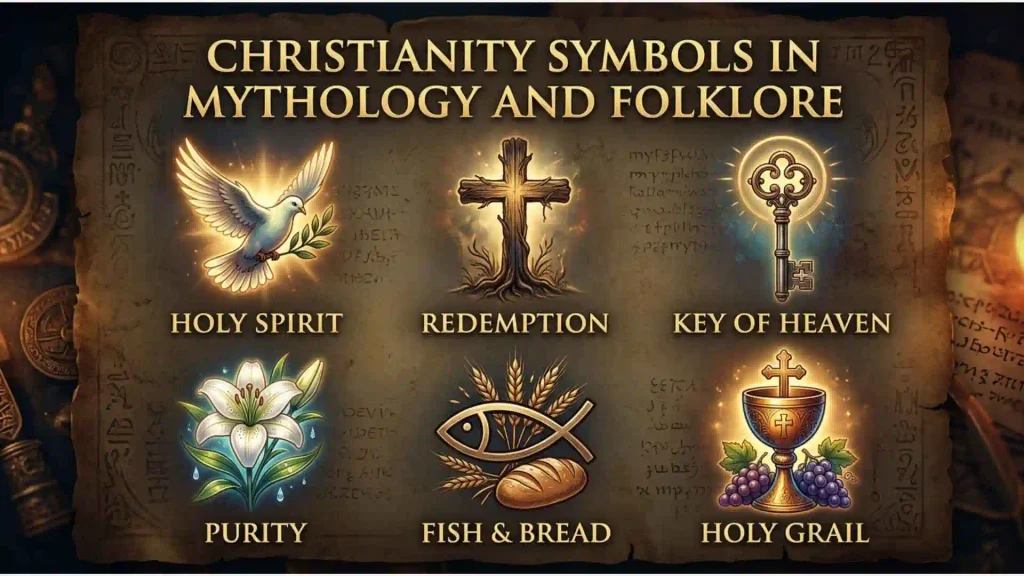
Christian symbols have influenced countless legends and stories throughout history.
The cross appears in many medieval tales as a sign of protection and divine power. Stories of saints often describe crosses, angels, and other sacred signs as symbols of courage and faith.
The dove became connected with stories of peace and divine messages. In Christian folklore, birds and animals often carried symbolic meanings linked to spiritual lessons.
These stories helped preserve religious values and made complex beliefs easier for communities to understand.
Christianity Symbols in Art, Literature, Movies, and Pop Culture
Christian symbols have played a major role in global art history.
Artists such as Michelangelo and Leonardo da Vinci used Christian imagery to communicate biblical stories and spiritual ideas. Paintings of the crucifixion, resurrection, and Virgin Mary remain among the most recognized artworks in history.
In literature, Christian symbolism appears in works such as Dante Alighieri’s Divine Comedy and many modern novels exploring morality, sacrifice, and redemption.
Movies and television often use Christian symbols to represent themes of good versus evil, hope, forgiveness, and transformation.
In modern culture, crosses and other symbols appear in:
- Tattoos expressing personal faith
- Jewelry representing devotion
- Fashion designs
- Home decorations
- Digital artwork
Spiritual and Dream Meaning of Christianity Symbols
Dreams involving Christianity symbols are often interpreted as reflections of personal beliefs, emotions, or spiritual questions.
Seeing a cross in a dream may represent:
- Hope during challenges
- A desire for guidance
- Personal sacrifice
- Spiritual growth
A dove may symbolize:
- Peace
- Emotional healing
- New beginnings
However, dream meanings are personal. A symbol’s meaning can change depending on someone’s experiences, culture, and beliefs.
Positive and Negative Meanings of Christianity Symbols
| Positive Meaning | Negative Meaning |
| Faith | Misinterpretation |
| Hope | Religious conflict |
| Love | Symbol misuse |
| Forgiveness | Judgment by others |
| Spiritual guidance | Cultural misunderstanding |
A symbol itself is not automatically positive or negative. Meaning depends on how people understand, use, and interpret it.
Why Humans Are Attracted to Christianity Symbols
Humans naturally connect with symbols because they transform invisible ideas into visible forms.
Faith involves concepts such as love, eternity, and spiritual connection. Symbols allow people to experience these ideas in a personal way.
Christianity symbols also create emotional connections. A small cross necklace may remind someone of family, prayer, or a difficult moment they overcame.
They preserve cultural memory and provide comfort during important life experiences such as birth, marriage, grief, and celebration.
Modern Uses of Christianity Symbols
Tattoos
Many people choose Christian tattoos to express faith, personal journeys, or important life experiences.
Jewelry
Cross necklaces, rings, and bracelets are popular expressions of devotion and personal identity.
Fashion
Christian symbols appear in clothing and accessories, sometimes as religious statements and sometimes as cultural designs.
Branding and Design
Some organizations use Christian imagery to communicate values such as compassion, service, and tradition.
Social Media
Digital platforms have introduced new ways for people to share Christian symbols through images, emojis, and artwork.
Home Decor
Many believers display crosses, biblical artwork, and religious decorations as reminders of faith and family values.
Interesting Facts About Christianity Symbols
- The fish symbol was used by early Christians before the cross became the main Christian symbol.
- The cross was originally associated with a Roman method of execution before becoming a symbol of hope.
- Alpha and Omega come from the first and last letters of the Greek alphabet.
- The dove became a Christian symbol because of its connection with Jesus’ baptism.
- The Celtic cross combines Christian symbolism with ancient Celtic artistic traditions.
- Christian symbols appear in some of the world’s most famous artworks and architectural structures.
- The cross is one of the most recognized symbols worldwide.
Frequently Asked Questions
What is the most important Christianity symbol?
The cross is considered the most important Christianity symbol because it represents Jesus Christ’s crucifixion, resurrection, salvation, and hope.
Why do Christians use symbols?
Christians use symbols to express beliefs, remember biblical teachings, strengthen faith, and communicate spiritual ideas visually.
What does the fish symbol mean in Christianity?
The fish symbol, called Ichthys, represents Jesus Christ and was used by early Christians as a sign of faith and identity.
What does the dove symbolize in Christianity?
The dove represents the Holy Spirit, peace, purity, and divine guidance.
Are Christian symbols only used in churches?
No. Christian symbols appear in homes, jewelry, artwork, clothing, tattoos, literature, and modern media.
Conclusion
Christianity symbols are more than simple images. They are powerful reminders of faith, history, culture, and human spirituality. From the cross to the dove, each symbol carries centuries of stories and emotional meaning. These sacred signs continue to connect people with ideas of hope, love, sacrifice, and divine connection. Their lasting influence shows how deeply symbols shape human understanding and spiritual expression.
 Sarah Thompson
 John Mercer