
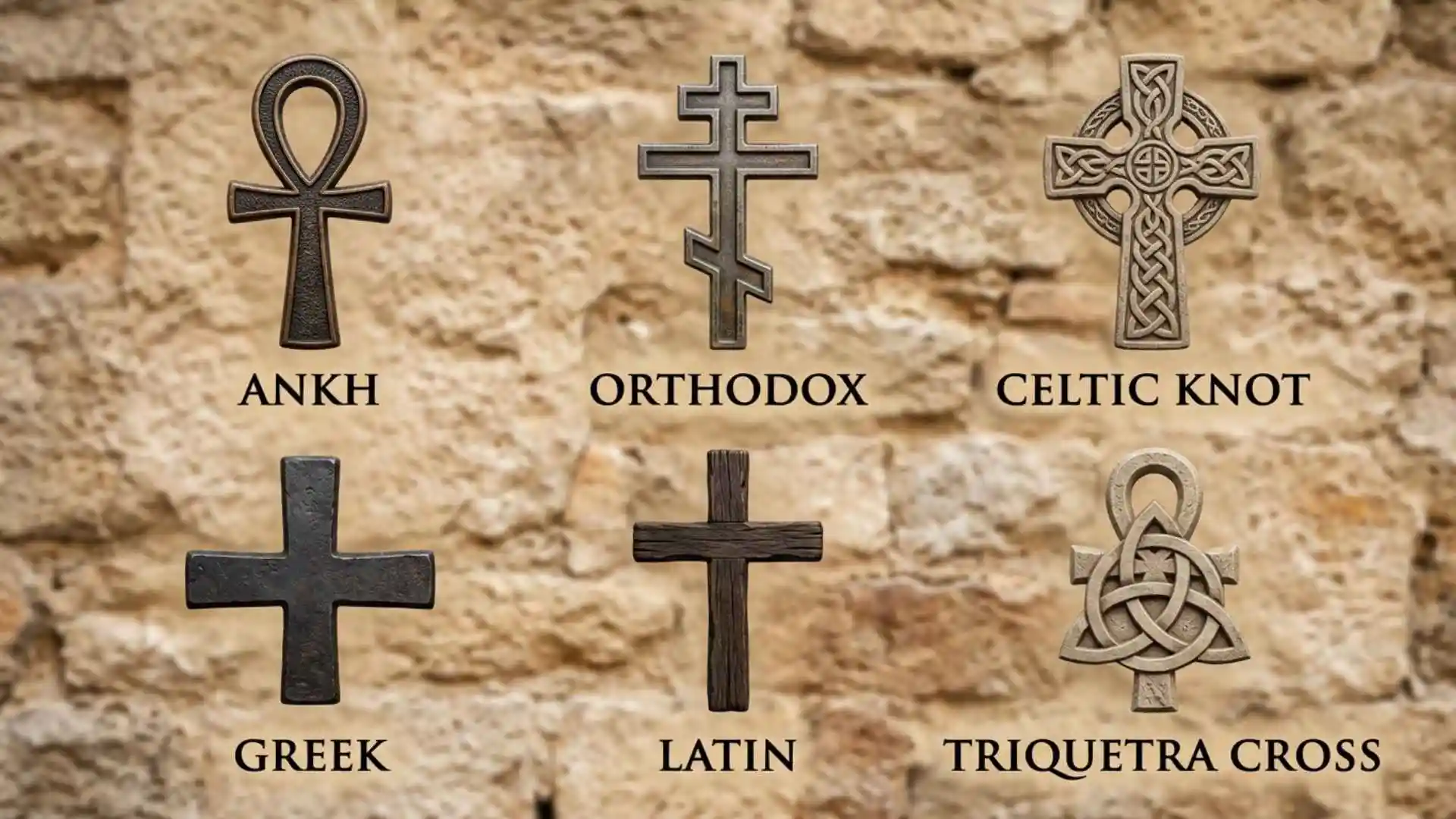
Cross symbols have been used for centuries to express faith, spirituality, sacrifice, protection, hope, and cultural identity. While the cross is strongly associated with Christianity, its shapes and meanings appear in many historical and cultural traditions. Different cross designs can carry very different messages depending on their origin, context, and use.
From the familiar Christian cross to the Celtic cross, Greek cross, Latin cross, and other ancient forms, each design has its own history and symbolism. Some represent religious devotion, while others have been connected with life, balance, eternity, protection, or transformation. Understanding these differences can help explain why cross symbols appear in religious art, architecture, jewelry, monuments, flags, and everyday designs.
In this guide, we will explore the history and meanings of cross symbols, including their spiritual significance and cultural symbolism. You will learn about common types of crosses, what they represent, how their meanings developed, and why these powerful symbols continue to hold significance in different parts of the world.
Quick Answer
Cross symbols are visual representations made by intersecting lines, traditionally associated with Christianity, spirituality, balance, protection, and sacrifice. While the Christian cross represents the crucifixion of Jesus Christ, different cultures have used cross-like designs to symbolize life, nature, harmony, direction, and cosmic connections.
Quick Facts About Cross Symbols
| Aspect | Information |
| Origin | Ancient civilizations used cross-like shapes before Christianity, including Egypt, Mesopotamia, and Europe |
| Historical Significance | Became globally recognized through Christianity and the story of Jesus Christ’s crucifixion |
| Main Meaning | Faith, sacrifice, balance, unity, protection, and transformation |
| Spiritual Meaning | Connection between earthly life and higher consciousness |
| Cultural Importance | Represents religion, identity, heritage, and personal beliefs |
| Modern Usage | Used in jewelry, tattoos, art, architecture, fashion, and personal expression |
What Are Cross Symbols?
Definition of Cross Symbols
A cross symbol is a shape created by two lines crossing each other, usually at a right angle. Although the design appears simple, its meanings are complex and vary across cultures, religions, and historical periods.
The most famous cross symbol is the Christian cross, which represents the crucifixion of Jesus Christ. For billions of Christians around the world, it symbolizes salvation, forgiveness, sacrifice, and the promise of eternal life.
However, cross symbols existed before Christianity. Ancient societies used similar shapes to represent ideas such as the sun, the four directions, fertility, life cycles, and the connection between heaven and earth.
Historical Background of Cross Symbols
The cross has one of the oldest symbolic forms in human civilization. Archaeologists have discovered cross-like designs in ancient pottery, carvings, and religious artifacts from different regions.
In Ancient Egypt, the ankh, often called the Egyptian cross, represented life and immortality. Ancient European cultures used variations of crosses to symbolize nature, seasons, and cosmic balance.
The meaning of the cross changed significantly after the Roman Empire. During the first centuries of Christianity, the cross became associated with the death and resurrection of Jesus Christ. Over time, it transformed from a symbol of punishment into one of hope and spiritual victory.
Evolution of Cross Symbols Over Time
As cultures developed, different versions of the cross appeared. Some represented religious beliefs, while others reflected cultural identity and philosophical ideas.
Today, cross symbols appear in churches, artwork, jewelry, tattoos, national flags, monuments, and digital communication. Their meanings depend heavily on context.
Deep Symbolic Meaning of Cross Symbols
Spiritual Level
Connection Between Earth and Heaven
One of the strongest interpretations of cross symbols is the connection between the physical and spiritual worlds.
The vertical line is often viewed as representing a connection between heaven and earth. The horizontal line can represent human existence, relationships, and life in the material world.
Together, these lines create a symbolic meeting point between divine energy and human experience.
Symbol of Sacrifice and Redemption
In Christianity, the cross represents the sacrifice of Jesus Christ. It reminds believers of compassion, forgiveness, and unconditional love.
The symbol teaches the idea that suffering can lead to transformation and that hope can emerge from difficult experiences.
Inner Transformation
Many spiritual traditions view the cross as a symbol of personal growth. The crossing point can represent a moment of change where a person chooses a new path or discovers deeper awareness.
Psychological Level
Jungian Symbolism and Human Archetypes
Psychologist Carl Jung studied symbols as expressions of the human unconscious. A cross can be understood as an archetypal image representing wholeness, balance, and the meeting of opposites.
The intersection of two lines reflects the human desire to find harmony between:
- Mind and body
- Logic and emotion
- Physical life and spiritual purpose
- Individual identity and community
Emotional Attraction to Cross Symbols
Humans are naturally drawn to symbols because they communicate complex ideas quickly. A cross can represent personal memories, family traditions, religious beliefs, or emotional experiences.
For many people, wearing a cross necklace is not simply decoration. It can represent comfort, protection, identity, or connection to something greater.
Cultural Level
Social Identity and Community
Cross symbols often create a sense of belonging. Religious communities use them to express shared values and traditions.
Church buildings, ceremonies, artwork, and cultural celebrations frequently include cross imagery because the symbol connects individuals with collective history.
Traditional Interpretations
Across cultures, crosses have represented ideas such as:
- Life and death
- Protection and guidance
- Balance and harmony
- Faith and devotion
- Renewal and rebirth
Types and Variations of Cross Symbols
Latin Cross
Visual Description
The Latin cross has a longer vertical line with a shorter horizontal line near the upper section.
Meaning
It is the most recognized Christian cross and represents the crucifixion of Jesus Christ.
Symbolism
It represents:
- Salvation
- Sacrifice
- Forgiveness
- Resurrection
Cultural Connection
The Latin cross appears in churches, cemeteries, religious artwork, and Christian jewelry worldwide.
Where It Appears
- Christianity
- Religious paintings
- Architecture
- Literature
- Tattoos
Greek Cross
Visual Description
The Greek cross has four equal arms of the same length.
Meaning
It represents balance, equality, and harmony.
Symbolism
The four equal sides are sometimes connected with the four directions:
- North
- South
- East
- West
Cultural Connection
The Greek cross appears in early Christian art and Byzantine traditions.
Where It Appears
- Ancient religious artwork
- Flags
- Architecture
- Decorative designs
Celtic Cross
Visual Description
The Celtic cross combines a traditional cross shape with a circular ring around the intersection.
Meaning
It represents spirituality, eternity, and the connection between life and nature.
Symbolism
The circle is often interpreted as representing:
- The sun
- Infinity
- The cycle of life
Cultural Connection
The Celtic cross is strongly associated with Irish and Scottish heritage.
Where It Appears
- Celtic monuments
- Jewelry
- Tattoos
- Historical sites
Ankh Cross
Visual Description
The ankh has a loop at the top with a vertical and horizontal structure beneath it.
Meaning
The ancient Egyptian ankh symbolizes life, immortality, and spiritual existence.
Symbolism
It represents the balance between masculine and feminine forces and the continuation of life.
Cultural Connection
Ancient Egyptian gods and pharaohs were often shown holding the ankh.
Where It Appears
- Egyptian art
- Archaeological discoveries
- Modern spirituality
St. Andrew’s Cross
Visual Description
This cross is shaped like an X.
Meaning
It represents humility and martyrdom.
Symbolism
According to Christian tradition, Saint Andrew was crucified on an X-shaped cross.
Cultural Connection
It is featured on the national flag of Scotland.
Where It Appears
- Flags
- Religious symbols
- Heraldry
Cross Symbols Across Different Cultures
Ancient Egypt
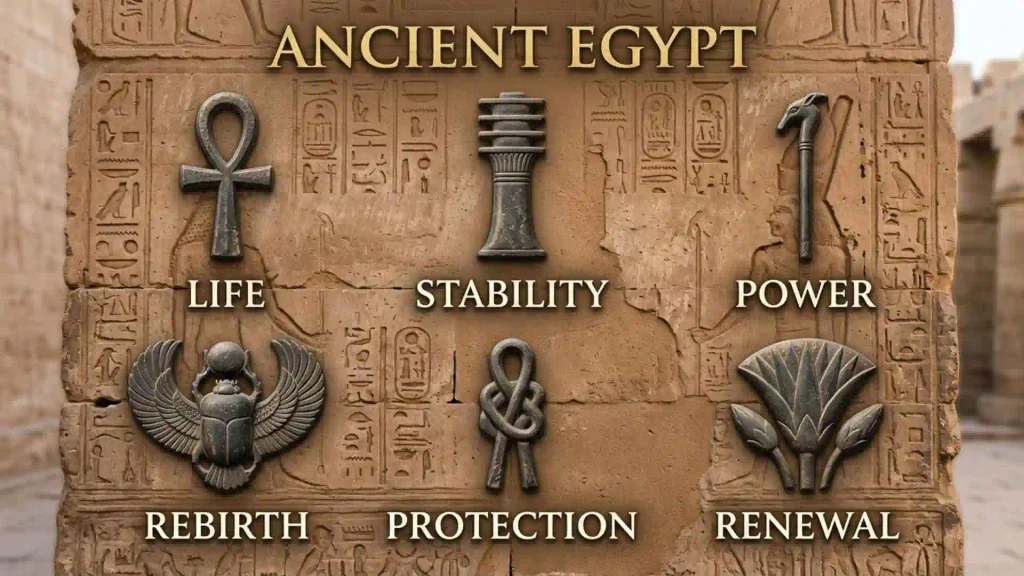
Ancient Egyptians used the ankh as a powerful symbol of life and eternity.
The gods were often depicted holding the ankh, showing their connection to divine life energy. Unlike the Christian cross, the ankh focused more on existence, immortality, and the continuation of life.
Ancient Greece
Greek culture used cross-like patterns in art and decoration. The Greek cross later became important in early Christianity and Byzantine traditions.
It represented order, balance, and the harmony of the universe.
Roman Culture
The Romans transformed the meaning of the cross through crucifixion. Originally, crucifixion was a punishment method designed to create fear.
After the rise of Christianity, the cross changed from a symbol of suffering into a symbol of faith and victory.
Eastern Traditions
In Eastern cultures, cross-like symbols appeared in different forms connected with balance, cosmic order, and spiritual harmony.
In some Buddhist and Hindu traditions, similar geometric designs represent universal balance and sacred directions.
Indigenous Traditions
Some Indigenous cultures used cross-like designs to represent the four directions, nature cycles, and connections between humans and the universe.
These symbols often reflected relationships between land, sky, seasons, and spiritual forces.
Modern Interpretations
Today, cross symbols can represent religion, heritage, personal beliefs, artistic expression, or cultural identity.
Their meaning depends on the person and the situation in which the symbol appears.
Similar Symbols and Their Meanings
| Symbol | Similarity | Difference |
| Ankh | Represents life and spirituality | Focuses on immortality rather than Christian salvation |
| Swastika (ancient symbol) | Represents cosmic balance in some ancient cultures | Modern meanings vary greatly due to misuse by Nazi Germany |
| Four Directions Cross | Represents balance and nature | Often connected with Indigenous traditions |
| Celtic Cross | Shares Christian meaning | Includes Celtic spiritual symbolism through the circle |
Cross Symbols in Mythology and Folklore
Cross symbols appear in many myths and traditional stories around the world.
In Egyptian mythology, the ankh was connected with gods such as Isis and Osiris. It represented the power of life and the continuation of existence beyond death.
Christian stories transformed the cross into a symbol connected with the life, death, and resurrection of Jesus Christ.
In European folklore, cross symbols were sometimes believed to provide protection against evil forces. People placed crosses in homes, wore them as jewelry, or carved them into objects for spiritual protection.
These traditions show humanity’s long relationship with symbols as sources of meaning and security.
Cross Symbols in Art, Literature, Movies and Pop Culture
Paintings and Religious Art
Artists throughout history have used the cross to express faith, suffering, hope, and redemption.
Famous religious paintings often show the cross as the central image connecting human pain with divine love.
Literature and Poetry
Writers use cross symbolism to explore themes such as:
- Sacrifice
- Moral struggles
- Personal transformation
- Faith during hardship
Movies and Television
Films often use cross imagery to communicate character beliefs, spiritual battles, or moments of emotional change.
The symbol can represent protection, conflict, redemption, or personal discovery.
Tattoos and Fashion
Cross tattoos remain popular because they allow people to express personal stories.
Common meanings include:
- Religious devotion
- Memory of loved ones
- Strength during challenges
- Personal transformation
Jewelry featuring cross symbols often carries emotional value beyond appearance.
Spiritual and Dream Meaning of Cross Symbols
Dream Symbolism
Seeing a cross in a dream may represent different ideas depending on the dreamer’s experiences.
Common interpretations include:
- Searching for guidance
- Facing a major decision
- Finding inner peace
- Seeking protection
- Experiencing personal growth
Meditation and Spiritual Experiences
During meditation, some people view cross imagery as a symbol of balance and connection.
It may represent bringing different parts of life together and finding harmony within oneself.
Positive and Cautionary Messages
A cross dream can suggest hope, but it may also represent responsibility, sacrifice, or emotional burdens.
The meaning depends on personal circumstances.
Positive and Negative Meanings of Cross Symbols
| Positive Meaning | Negative Meaning |
| Faith | Suffering |
| Hope | Burden |
| Protection | Conflict |
| Love | Judgment |
| Transformation | Sacrifice |
A symbol does not have one fixed meaning. Context, culture, and personal experience shape interpretation.
Why Humans Are Attracted to Cross Symbols
Humans have always used symbols to understand life’s biggest questions.
Cross symbols attract people because they combine simplicity with deep meaning. A small design can represent thousands of years of history, spiritual beliefs, and emotional experiences.
The human brain naturally searches for patterns and connections. Symbols help people organize complex ideas into images that are easy to remember.
Cross symbols also carry cultural memory. They connect generations, allowing people to feel linked with ancestors, traditions, and shared stories.
Modern Uses of Cross Symbols
Tattoos
Cross tattoos remain popular because they often represent personal beliefs, memories, or life-changing experiences.
Jewelry
Necklaces, rings, and bracelets featuring crosses are commonly worn as expressions of faith or identity.
Fashion
Designers use cross imagery in clothing and accessories because of its strong visual impact.
Branding and Design
Some organizations use cross-inspired shapes to communicate ideas such as care, healing, community, or protection.
Home Decor
Cross artwork is often displayed in homes as a reminder of spirituality, family values, or personal beliefs.
Interesting Facts About Cross Symbols
- The cross existed as a symbolic shape before Christianity.
- The Egyptian ankh is one of the oldest known cross-like symbols.
- The Latin cross became widely recognized after the spread of Christianity.
- Celtic crosses combine Christian symbolism with ancient Celtic traditions.
- Cross symbols appear in architecture across many centuries.
- The cross is one of the most recognized symbols worldwide.
- Different cultures created their own interpretations of cross-shaped designs.
- Cross symbolism appears in religion, art, psychology, and popular culture.
Frequently Asked Questions
What is the most famous cross symbol?
The Latin cross is the most famous cross symbol because it represents Christianity and the crucifixion of Jesus Christ.
What do cross symbols represent spiritually?
Cross symbols often represent faith, connection, transformation, sacrifice, protection, and spiritual growth.
Are cross symbols older than Christianity?
Yes. Cross-like designs existed in ancient cultures, including Ancient Egypt and other civilizations, before Christianity.
What does a cross tattoo symbolize?
A cross tattoo can represent religious faith, remembrance, strength, personal growth, or emotional experiences.
Why are cross symbols important in Christianity?
The cross represents the sacrifice of Jesus Christ, forgiveness, salvation, and the hope of resurrection.
Conclusion
Cross symbols are among humanity’s most powerful and meaningful designs. Their simple shape carries stories of faith, sacrifice, balance, protection, and transformation across thousands of years.
From ancient civilizations to modern personal expression, the cross continues to connect people with history, spirituality, and deeper questions about life.
A cross is more than two lines meeting together. It is a symbol of human belief, memory, and the endless search for meaning.
 Sarah Thompson
 John Mercer