
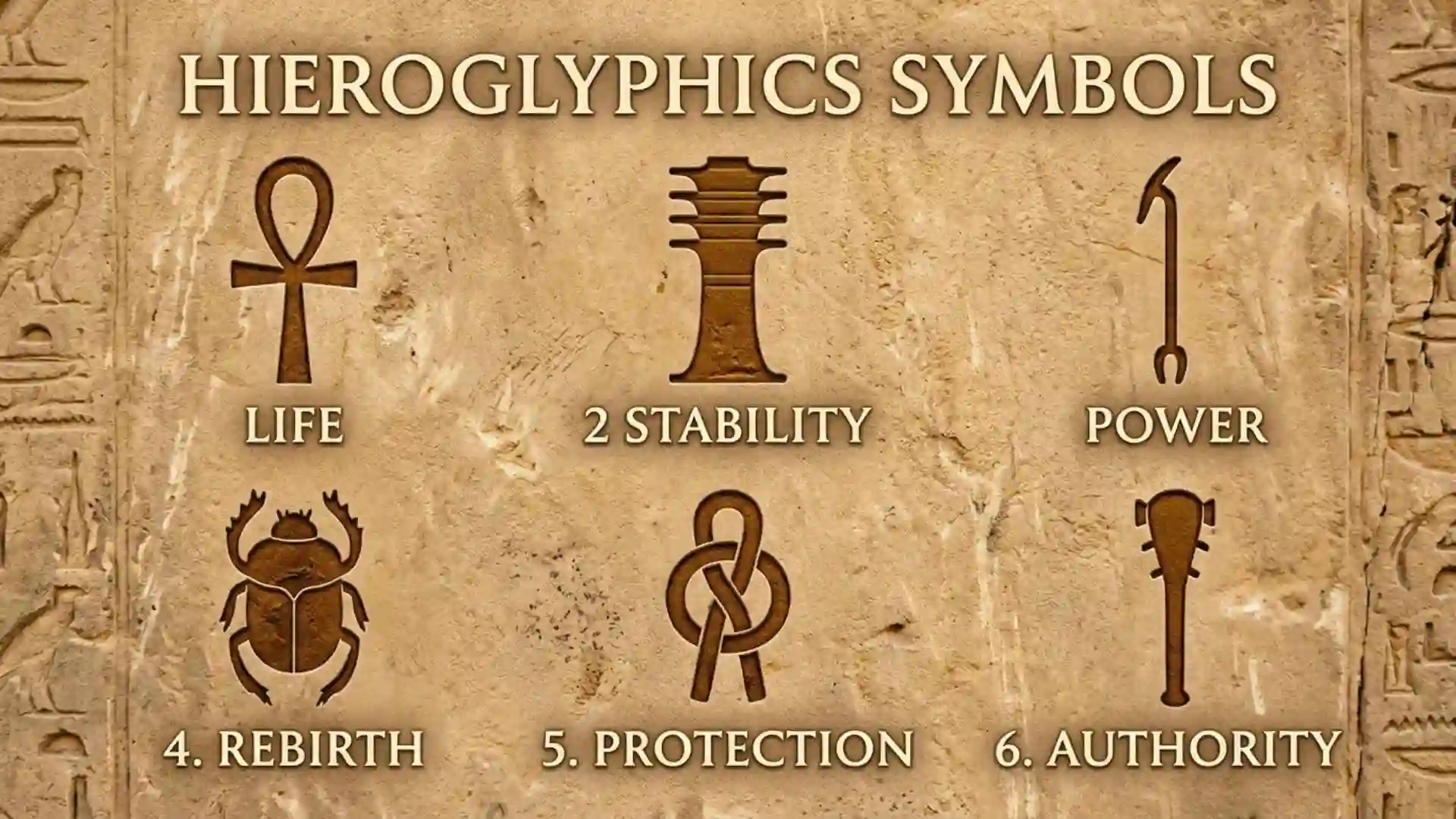
Hieroglyphics symbols are among the most fascinating signs left behind by ancient Egypt. These detailed images of people, animals, objects, and nature were more than simple drawings. They formed a writing system used to record names, stories, religious beliefs, royal achievements, prayers, and important events. Even today, these symbols give us a glimpse into how ancient Egyptians understood their world.
Each hieroglyph could carry a specific sound, word, idea, or symbolic meaning depending on how it was used. Some symbols were connected with life, protection, power, death, rebirth, and the gods, while others represented everyday objects or sounds. Famous signs such as the Ankh, Eye of Horus, scarab, lotus, and Djed pillar continue to attract interest because of their rich historical and spiritual associations.
In this guide, you’ll discover the meanings behind important Egyptian hieroglyphics symbols, how the ancient writing system worked, and why these signs were so important to Egyptian culture. You’ll also learn about their religious significance, hidden symbolism, and lasting influence on modern art, jewelry, tattoos, design, and popular culture.
Quick Answer
Hieroglyphics symbols are ancient Egyptian picture-based characters used for writing religious texts, royal records, names, and everyday messages. Each symbol represented sounds, objects, ideas, or spiritual concepts. They appeared on monuments, temples, tombs, and papyrus documents, preserving Egyptian history for thousands of years.
Quick Facts About Hieroglyphics Symbols
| Aspect | Information |
| Origin | Ancient Egypt around 3200 BCE |
| Historical Significance | One of the world’s earliest writing systems used by Egyptians |
| Main Meaning | Visual symbols representing sounds, objects, ideas, and concepts |
| Spiritual Meaning | Connection between humans, gods, nature, and the afterlife |
| Cultural Importance | Preserved Egyptian beliefs, history, mythology, and traditions |
| Modern Usage | Used in archaeology, art, tattoos, education, movies, and design |
What Are Hieroglyphics Symbols?
Hieroglyphics symbols are ancient Egyptian characters made from pictures of animals, objects, plants, human body parts, and abstract shapes. The word “hieroglyph” comes from Greek words meaning “sacred carving.” Ancient Egyptians called their writing system medu netjer, meaning “words of the gods.”
Unlike modern alphabets, hieroglyphics did not work with only letters. A single symbol could represent:
- A sound
- A complete word
- An idea
- A religious concept
- A symbolic meaning
For example, the image of an owl represented the sound “m,” while a sun disk represented the sun god Ra and the concept of light and creation.
Hieroglyphics developed during the Early Dynastic Period of Egypt around 3200 BCE. They were used for more than 3,000 years, making them one of the longest-lasting writing systems in human history.
Ancient Egyptians carved these symbols into temples, pyramids, statues, and tomb walls. They also wrote them on papyrus for religious texts, medical records, government documents, and personal letters.
The importance of hieroglyphics became clear when scholars discovered the Rosetta Stone in 1799. This ancient artifact contained the same text written in Greek, Demotic, and Egyptian hieroglyphics. Using the Greek translation, French scholar Jean-François Champollion successfully decoded the ancient writing system in 1822.
Deep Symbolic Meaning of Hieroglyphics Symbols
Spiritual Level
For ancient Egyptians, hieroglyphics symbols were not simply a method of communication. They were believed to contain spiritual power.
Egyptians viewed written words as living forces. A name written in hieroglyphics could preserve a person’s existence beyond death. This belief explains why royal names and prayers were carefully carved into tombs and temples.
Many symbols represented ideas connected with spirituality:
- The Ankh symbolized life and eternal existence.
- The Eye of Horus represented protection and healing.
- The Scarab represented rebirth and transformation.
- The Lotus flower symbolized creation and spiritual awakening.
These symbols reflected the Egyptian belief that life continued after death and that humans were connected to divine forces.
Psychological Level
From a psychological perspective, hieroglyphics symbols show how humans naturally use images to understand complex ideas.
The Swiss psychologist Carl Jung explored the idea of archetypes, universal symbols that appear across human cultures. Hieroglyphics connect with this concept because many symbols represent shared human experiences:
- The sun represents energy and hope.
- The eye represents awareness and knowledge.
- The serpent represents transformation and hidden power.
- The bird represents freedom and spiritual movement.
Humans are naturally attracted to symbols because they communicate emotions faster than words.
Cultural Level
Hieroglyphics symbols were deeply connected to Egyptian identity. They recorded:
- Pharaohs’ achievements
- Religious beliefs
- Military victories
- Stories of gods and heroes
- Daily life
These symbols allowed ancient Egyptians to communicate across generations. They became a bridge between the living and the ancestors.
Types and Variations of Hieroglyphics Symbols
1. Ankh Symbol
Visual Description: A cross-like symbol with a loop at the top.
Meaning: Life, immortality, and eternal existence.
Symbolism: The Ankh represented the gift of life from the gods. Egyptian deities were often shown holding it.
Cultural Connection: It appeared in temples, tombs, jewelry, and religious artwork.
Where It Appears:
- Ancient Egyptian temples
- Royal artwork
- Modern tattoos
- Spiritual jewelry
2. Eye of Horus
Visual Description: A stylized human eye with decorative markings.
Meaning: Protection, healing, wisdom, and restoration.
Symbolism: The symbol comes from the myth of Horus losing and restoring his eye during his battle with Set.
Cultural Connection: Egyptians believed it protected people from danger and evil forces.
Where It Appears:
- Amulets
- Tomb paintings
- Religious objects
- Modern spiritual designs
3. Scarab Beetle
Visual Description: A beetle-shaped symbol.
Meaning: Rebirth, creation, and transformation.
Symbolism: The scarab was linked with the sun god Khepri, who represented the rising sun.
Cultural Connection: Egyptians placed scarab amulets with the dead to support their journey into the afterlife.
Where It Appears:
- Jewelry
- Funerary objects
- Temple decorations
4. Lotus Flower
Visual Description: A blooming flower with long petals.
Meaning: Creation, purity, rebirth, and spiritual growth.
Symbolism: Egyptians believed the lotus represented the beginning of life because it rises from water.
Where It Appears:
- Temple columns
- Paintings
- Religious ceremonies
5. Djed Pillar
Visual Description: A vertical column with horizontal lines near the top.
Meaning: Stability, strength, and endurance.
Symbolism: Associated with Osiris, the god of the afterlife.
Where It Appears:
- Tomb decorations
- Religious ceremonies
- Protective amulets
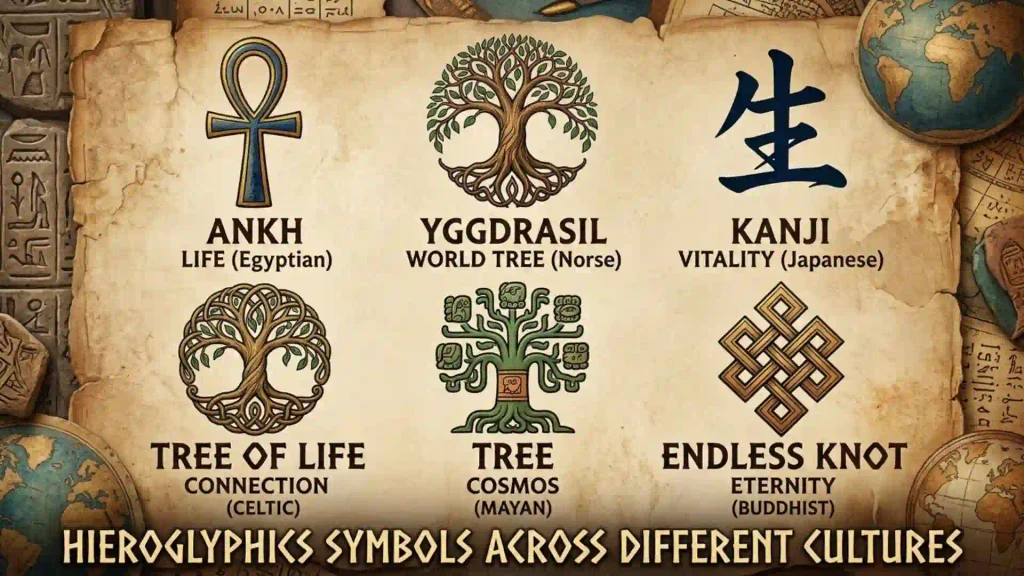
Hieroglyphics Symbols Across Different Cultures
Ancient Egypt
Ancient Egypt gave hieroglyphics their strongest meaning. Symbols were connected with gods, kings, nature, and the afterlife.
Pharaohs used hieroglyphics to demonstrate divine authority and preserve their achievements for eternity.
Ancient Greece
Greek writers studied Egyptian symbols and considered them mysterious sacred knowledge. Greek philosophers often connected Egyptian wisdom with ideas about the universe and existence.
The Greek influence also contributed to the later naming of Egyptian writing as “hieroglyphics.”
Roman Culture
Romans admired Egyptian culture after conquering Egypt in 30 BCE. Egyptian symbols appeared in Roman architecture, religious practices, and artwork.
Some Roman temples included Egyptian-inspired designs connected with mystery religions.
Eastern Traditions
Eastern cultures also developed symbolic writing systems, such as Chinese characters and Sanskrit symbols. Like Egyptian hieroglyphics, these systems connected visual forms with deeper meanings.
Many Eastern traditions viewed symbols as tools for meditation and spiritual understanding.
Indigenous Traditions
Many Indigenous cultures worldwide used symbolic drawings, carvings, and visual storytelling. Like hieroglyphics, these symbols preserved history, spiritual beliefs, and cultural identity.
Modern Interpretations
Today, hieroglyphics symbols appear in:
- Museums
- Films
- Tattoos
- Fashion
- Graphic design
- Spiritual communities
Modern audiences often view them as symbols of mystery, wisdom, and ancient knowledge.
Similar Symbols and Their Meanings
| Symbol | Culture | Meaning | Similarity |
| Ankh | Egypt | Life and immortality | Similar to symbols of eternal life |
| Cross | Christianity | Faith and salvation | Represents spiritual connection |
| Yin Yang | China | Balance and harmony | Represents universal forces |
| Tree of Life | Multiple cultures | Growth and connection | Represents existence and continuity |
| Eye Symbol | Many cultures | Protection and awareness | Represents knowledge and perception |
A common misconception is that every Egyptian symbol had only one meaning. In reality, meanings changed depending on context, location, and historical period.
Hieroglyphics Symbols in Mythology and Folklore
Egyptian mythology gave many hieroglyphics symbols their emotional power.
The story of Osiris, Isis, and Horus shaped many important symbols. Osiris represented death and rebirth, while Horus represented protection and kingship.
The Eye of Horus became powerful because of the myth that Horus restored his damaged eye, transforming it into a symbol of healing.
The scarab became meaningful because Egyptians connected the beetle’s behavior with the movement of the sun and the cycle of creation.
These myths transformed ordinary images into powerful spiritual symbols.
Hieroglyphics Symbols in Art, Literature, Movies, and Pop Culture
Hieroglyphics symbols continue to influence modern creativity.
Paintings and Museums
Ancient Egyptian artwork displays thousands of symbols that tell stories about religion, politics, and daily life.
Literature
Writers often use hieroglyphics as symbols of mystery, forgotten knowledge, and ancient civilizations.
Movies and Television
Films about ancient Egypt frequently include hieroglyphics to create an atmosphere of discovery and adventure.
Tattoos and Fashion
Many people choose Egyptian symbols as tattoos because they represent:
- Protection
- Strength
- Wisdom
- Transformation
- Personal growth
Modern Design
Designers use hieroglyphics-inspired patterns in logos, jewelry, clothing, and decorative art.
Spiritual and Dream Meaning of Hieroglyphics Symbols
Dreams involving hieroglyphics are often interpreted as messages about hidden knowledge or personal discovery.
Possible meanings include:
- Searching for deeper understanding
- Discovering forgotten emotions
- Connecting with history or ancestry
- Exploring spiritual growth
Seeing ancient writing in dreams may symbolize that something important is waiting to be understood.
In meditation and spiritual practices, hieroglyphics can represent the search for wisdom and inner transformation.
Positive and Negative Meanings of Hieroglyphics Symbols
| Positive Meaning | Negative Meaning |
| Wisdom | Hidden fears |
| Protection | Mystery and uncertainty |
| Spiritual growth | Misinterpretation |
| Connection with history | Obsession with the past |
| Transformation | Fear of change |
A symbol itself is not positive or negative. Its meaning depends on the person, culture, and situation where it appears.
Why Humans Are Attracted to Hieroglyphics Symbols
Humans are naturally drawn to symbols because symbols communicate ideas beyond ordinary language.
Hieroglyphics attract people because they combine:
- Visual beauty
- Mystery
- Ancient wisdom
- Emotional storytelling
- Human creativity
They remind us that ancient people experienced the same emotions we experience today: love, fear, hope, curiosity, and the desire to be remembered.
The fascination with hieroglyphics comes from their ability to connect modern humans with forgotten voices from thousands of years ago.
Modern Uses of Hieroglyphics Symbols
Tattoos
People use Egyptian symbols to represent personal beliefs, protection, transformation, and strength.
Jewelry
Ankh necklaces, scarab bracelets, and Eye of Horus pendants remain popular worldwide.
Fashion
Egyptian-inspired patterns appear in clothing, accessories, and luxury designs.
Branding
Some brands use ancient symbols to create feelings of mystery, tradition, and authenticity.
Social Media
Hieroglyphics-inspired images are often shared as symbols of curiosity, history, and ancient knowledge.
Home Decor
Egyptian artwork and symbols are used to create elegant and historical interior designs.
Interesting Facts About Hieroglyphics Symbols
- Ancient Egyptians used more than 700 different hieroglyphic signs.
- Hieroglyphics were usually written from right to left, left to right, or vertically.
- Animal symbols often represented sounds rather than only animals.
- The Rosetta Stone was the key to unlocking ancient Egyptian writing.
- Hieroglyphics were used for more than 3,000 years.
- Ancient Egyptians believed written names had spiritual importance.
- Many modern symbols still come from ancient Egyptian designs.
- Hieroglyphics were not completely forgotten but became difficult to understand until modern discoveries.
Frequently Asked Questions
What do hieroglyphics symbols mean?
Hieroglyphics symbols represent sounds, words, ideas, objects, and spiritual concepts from ancient Egyptian culture.
What is the most famous Egyptian symbol?
The Ankh, Eye of Horus, and scarab beetle are among the most famous Egyptian symbols.
Are hieroglyphics a language?
Hieroglyphics are a writing system used to write the ancient Egyptian language.
Why are hieroglyphics important?
They preserve thousands of years of Egyptian history, religion, culture, and human knowledge.
Can hieroglyphics symbols be used today?
Yes. They are commonly used in education, art, tattoos, jewelry, and cultural designs.
Conclusion
Hieroglyphics symbols are more than ancient drawings carved into stone. They are powerful expressions of human creativity, spirituality, and the desire to preserve meaning across generations. From Egyptian temples to modern tattoos, these symbols continue to inspire curiosity and connection. They remind us that every civilization leaves behind stories waiting to be discovered.
 Sarah Thompson
 Michael Rivera