
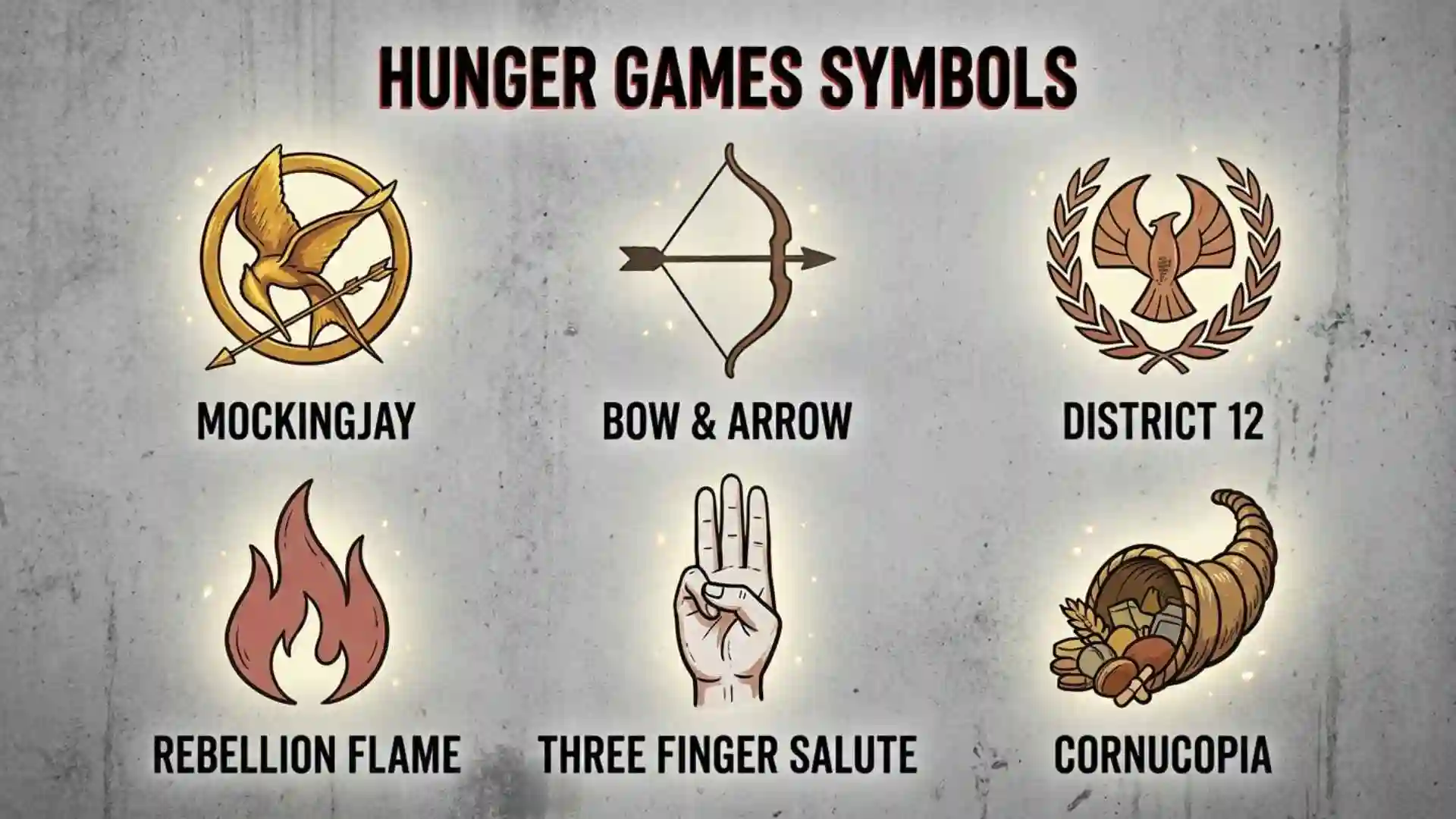
The Hunger Games series is filled with powerful symbols that reveal deeper messages about freedom, power, survival, and rebellion. From the famous Mockingjay symbol to the Capitol’s blazing fire imagery and President Snow’s white roses, each symbol represents more than what appears on the surface. These visual details help tell the story of Panem, where the Capitol controls the districts and ordinary people struggle against oppression.
Many Hunger Games symbols connect directly to the characters, their choices, and the growing resistance against the Capitol. The Mockingjay becomes a sign of hope and defiance, fire represents Katniss Everdeen’s fierce spirit and transformation, and white roses reflect President Snow’s power, manipulation, and disturbing connection to Katniss. Other symbols, including the three-finger salute, the arena, and the districts themselves, reveal the importance of unity, sacrifice, inequality, and courage.
Understanding Hunger Games symbols and their meanings makes the story even more fascinating. Whether you are a longtime fan of Suzanne Collins’s books or discovered the series through its movie adaptations, exploring these symbols can help you recognize hidden themes and character development. In this guide, we will explain the most important symbols, what they represent, and how they connect to the series’ central ideas of resistance, survival, justice, and hope.
Quick Answer
Hunger Games symbols are recurring objects, colors, creatures, actions, and images that represent larger ideas in the novels and films. The mockingjay symbolizes rebellion, fire represents transformation, bread suggests survival and compassion, and President Snow’s roses reflect beauty hiding corruption. Together, these symbols explore power, sacrifice, propaganda, identity, and hope.
Quick Facts About Hunger Games Symbols
| Aspect | Information |
| Origin | Suzanne Collins’s The Hunger Games trilogy, first published in 2008 |
| Historical Significance | Inspired partly by war, authoritarian rule, Roman entertainment, and public spectacle |
| Main Meaning | Resistance against oppression and the struggle to remain human |
| Spiritual Meaning | Rebirth, sacrifice, moral courage, inner transformation, and hope |
| Cultural Importance | Became widely recognized symbols of protest, youth resistance, and political awakening |
| Modern Usage | Tattoos, jewelry, fan art, fashion, protest imagery, social media, and popular culture |
What Are Hunger Games Symbols?
Hunger Games symbols are images and objects that communicate meanings beyond their literal role in the story. Suzanne Collins uses them to reveal how power works in Panem and how ordinary people respond to fear, hunger, violence, and injustice.
The story follows Katniss Everdeen, a teenager from District 12 who volunteers to enter the Hunger Games in place of her younger sister, Prim. The Capitol presents the Games as entertainment, but they are actually a yearly warning. Each district must remember that rebellion has consequences.
Many symbols in the series grow in meaning over time. The mockingjay begins as a small pin. Later, it becomes the face of a national revolution. Fire first describes Katniss’s costume, then becomes part of her public identity. Bread begins as food, but it also represents kindness, memory, political unity, and the basic right to live.
The symbolic system of Panem matters because the struggle is not only physical. It is also a battle over stories, images, and public belief. Whoever controls the meaning of a symbol can influence millions of people.
Deep Symbolic Meaning of Hunger Games Symbols
Spiritual Meaning
On a spiritual level, many Hunger Games symbols represent death followed by renewal. Katniss repeatedly loses safety, innocence, and certainty. Yet each painful stage forces her to develop a stronger moral identity.
Fire is closely connected to purification and rebirth. In many religious and mythological traditions, fire destroys what is old while preparing the way for something new. Katniss becomes “the girl on fire,” not because she is untouched by suffering, but because suffering changes her into a symbol others can follow.
The mockingjay also carries spiritual meaning. It is a living creature that was never supposed to exist. Its survival suggests that life can move beyond the plans of those who try to control it. In this sense, the bird represents the soul’s refusal to be fully captured.
Psychological Meaning
Psychologically, the symbols reflect trauma, identity, fear, and emotional resilience. Katniss does not freely choose to become a revolutionary icon. Others place meanings upon her, often without understanding her inner pain.
From a Jungian perspective, Katniss resembles the reluctant hero archetype. She enters danger to protect someone she loves, passes through symbolic death, and returns changed. The mockingjay becomes her public mask, while her private self struggles with grief, guilt, and mistrust.
President Snow’s roses work as psychological weapons. Their beauty is linked with threat, manipulation, and death. He understands that fear becomes stronger when it enters personal memory. A single rose can remind Katniss that he can reach her anywhere.
Cultural Meaning
At a cultural level, Hunger Games symbols show how communities create shared meaning. The three-finger salute begins as an intimate gesture of respect and farewell. As more people repeat it, the salute becomes a language of resistance.
This mirrors real human behavior. Communities often use songs, colors, hand signs, flags, and flowers to express unity. A symbol allows many people to communicate the same emotion without speaking. In Panem, silence itself can become political.
Major Types and Variations of Hunger Games Symbols
The Mockingjay
The mockingjay is a small bird created accidentally through the breeding of mockingbirds and jabberjays. Jabberjays were genetically engineered by the Capitol to record rebel conversations. When the rebels discovered their purpose, they fed them false information. The Capitol abandoned the birds, but they survived and produced mockingjays.
The bird symbolizes resistance, adaptation, and the failure of authoritarian control. It appears on Katniss’s pin, rebel propaganda, uniforms, tattoos, jewelry, and revolutionary imagery.
Its greatest meaning comes from its origin. The Capitol created the conditions for its existence but could not control the result. The mockingjay is therefore a living reminder that oppressive systems can create the forces that eventually challenge them.
Fire
Fire appears in Katniss’s costumes, public image, speeches, and emotional development. Visually, it is bright, dangerous, and impossible to ignore.
It symbolizes rebellion, transformation, rage, survival, and hope. Cinna uses artificial flames to make Katniss memorable during the tribute parade. Later, the phrase “girl on fire” becomes larger than fashion. It suggests that the desire for freedom is spreading from person to person.
Fire can give warmth, but it can also destroy. That double meaning reflects Katniss herself. She inspires people, yet the revolution built around her also causes suffering.
Bread
Bread represents survival, generosity, community, and human dignity. Peeta gives Katniss burned bread when she is starving, an act that helps save her life.
Different districts are associated with different kinds of bread, making it a symbol of regional identity. During the arena, District 11 sends bread to Katniss after Rue’s death. This gift is not merely food. It is a public act of gratitude and solidarity.
Bread has deep cultural and spiritual associations. In many traditions, it represents life, hospitality, shared labor, and divine provision. In the trilogy, it reminds readers that compassion can be revolutionary.
The Three-Finger Salute
The salute is performed by touching three middle fingers to the lips and extending them outward. In District 12, it expresses admiration, gratitude, love, and farewell.
After Katniss volunteers for Prim, the crowd gives her the salute. Later, it becomes a protest gesture across the districts.
The symbol shows how private grief can become public resistance. A respectful farewell develops into a challenge against the Capitol because people recognize their shared suffering.
White Roses
President Snow’s white roses symbolize control hidden beneath elegance. They are beautiful, carefully cultivated, and associated with wealth. However, their scent also hides the smell of blood from Snow’s mouth.
The roses represent deception, corruption, surveillance, and psychological domination. Snow uses them to frighten Katniss and remind her of his presence.
Traditionally, white roses may symbolize innocence, purity, or peace. Collins reverses those expectations. In Snow’s hands, purity becomes a disguise.
The Primrose
Prim is named after the primrose flower, which often symbolizes youth, new beginnings, protection, and fragile beauty. Prim represents the innocent life Katniss wants to protect.
Her name connects her with nature, healing, and gentleness. She cares for people and animals, trains as a healer, and maintains compassion in a brutal world.
The primrose becomes especially meaningful because the revolution begins with Katniss’s attempt to save her sister. Prim is not only a character. She is the emotional center of Katniss’s choices.
Rue’s Flowers
After Rue dies, Katniss covers her body with wildflowers. This act rejects the Capitol’s effort to turn death into entertainment.
Flowers symbolize dignity, mourning, innocence, and peaceful defiance. Katniss cannot save Rue, but she can control how Rue is remembered. She presents her as a beloved child rather than a fallen contestant.
The scene transforms grief into protest. Beauty becomes a form of resistance.
The Pearl
Peeta gives Katniss a pearl found in an oyster during the Quarter Quell. The pearl symbolizes emotional truth, memory, and the gentle part of Peeta that the Capitol cannot fully erase.
Pearls are formed when an irritant enters an oyster and is slowly covered with layers. Symbolically, beauty emerges from pain. This reflects the relationship between Katniss and Peeta, which develops under extreme suffering.
Hunger Games Symbols Across Different Cultures
Ancient Egypt
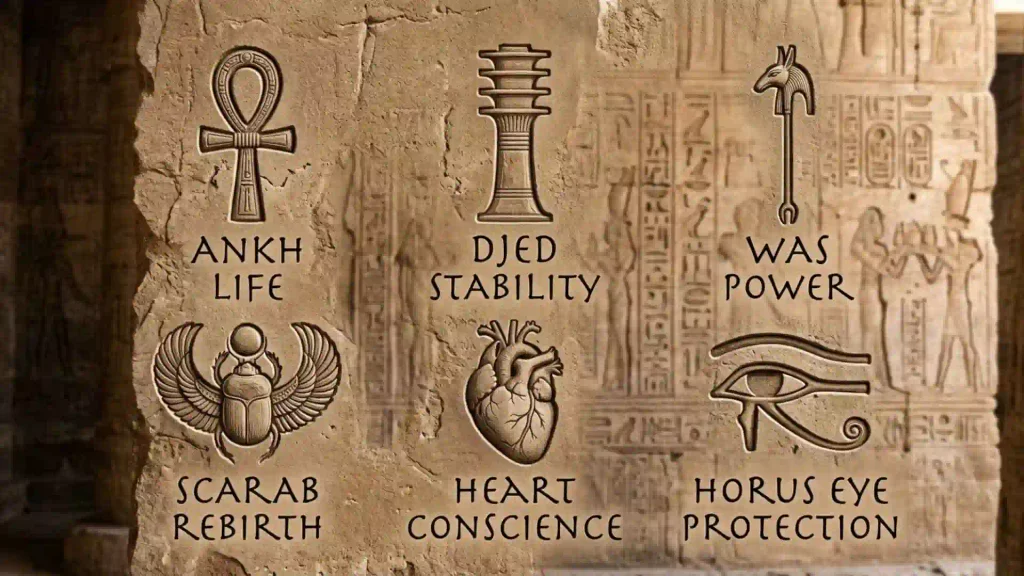
Ancient Egyptians used animals, flowers, colors, and sacred objects to express divine power and rebirth. Birds often represented the soul or movement between worlds. Like the mockingjay, Egyptian bird imagery could suggest freedom from earthly limits.
Ancient Greece
The Hunger Games reflect Greek myths in which young people are sacrificed to monsters or rulers. The story of Theseus and the Minotaur is especially relevant. Athens sends youths into a deadly labyrinth until Theseus challenges the system.
Katniss, like Theseus, enters an organized space of death and becomes a threat to the authority that created it.
Roman Culture
Panem’s political culture strongly recalls ancient Rome. The name Panem comes from the Latin phrase panem et circenses, meaning “bread and circuses.” Roman leaders used food and entertainment to distract citizens from political problems.
The arena, public ceremonies, stylized costumes, and violent spectacle echo Roman gladiatorial culture.
Eastern Traditions
In several Eastern traditions, fire symbolizes purification, wisdom, and spiritual change. Birds may symbolize liberation, harmony, or messages between worlds. These meanings connect with Katniss’s transformation and the mockingjay’s role as a carrier of forbidden songs.
Indigenous Traditions
Indigenous cultures are diverse and should not be reduced to one interpretation. Still, many traditions view animals, plants, songs, and natural cycles as carriers of memory and relationship. The mockingjay’s ability to repeat melodies reflects the idea that songs preserve collective experience.
Modern Interpretations
Modern readers often see the mockingjay as a symbol of resistance against inequality, propaganda, surveillance, and political abuse. The three-finger salute has also moved beyond fiction and appeared in real protest movements, showing how fictional symbols can gain new cultural lives.
Similar Symbols and Their Meanings
| Hunger Games Symbol | Related Symbol | Shared Meaning | Main Difference |
| Mockingjay | Phoenix | Rebirth and survival | The mockingjay represents accidental resistance, while the phoenix is reborn through fire |
| Fire | Torch | Hope and leadership | Fire can destroy, while a torch is usually controlled and guiding |
| Bread | Grain or wheat | Life and nourishment | Bread emphasizes human labor, sharing, and community |
| White rose | Mask | Hidden identity | The rose hides corruption beneath beauty |
| Three-finger salute | Raised fist | Unity and resistance | The salute also expresses grief, respect, and farewell |
| Rue’s flowers | Funeral wreath | Mourning and honor | Katniss uses flowers as an open rejection of dehumanization |
These symbols are sometimes misunderstood as simple decorative elements. In reality, their meanings depend on context. Fire is not always hopeful. Roses are not always loving. The mockingjay does not represent a perfect revolution. Each symbol holds tension between light and shadow.
Hunger Games Symbols in Mythology and Folklore
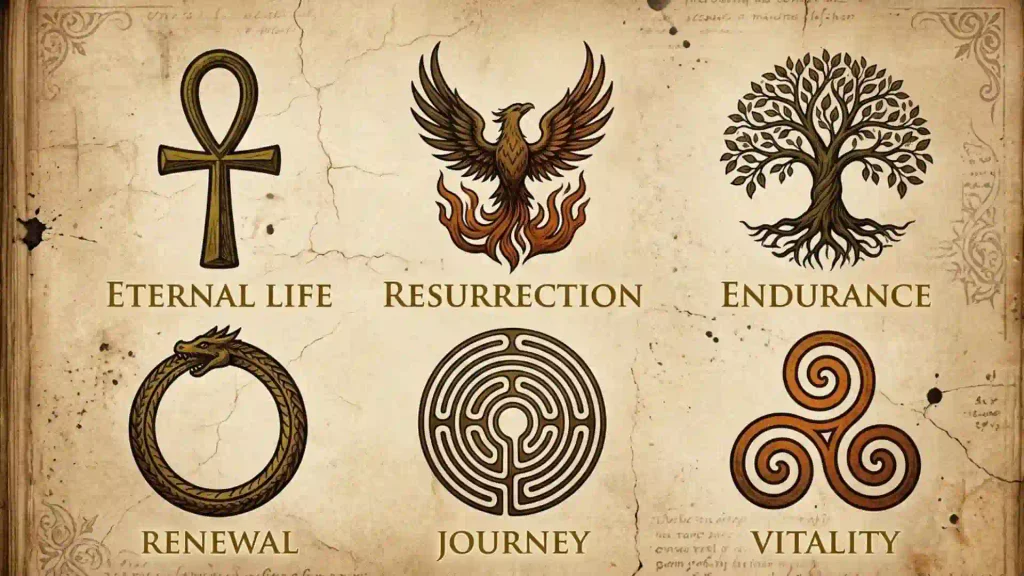
The mockingjay resembles mythological birds that carry messages, preserve memory, or return after destruction. It shares qualities with the phoenix, although it is not reborn from ashes. Instead, it survives through adaptation.
Katniss also resembles Artemis, the Greek goddess of the hunt. Both are associated with archery, wilderness, independence, and the protection of the young. However, Katniss is human and deeply vulnerable. Her courage comes from love rather than divine power.
The arena recalls the labyrinth. Tributes enter a controlled environment filled with traps, strange creatures, and hidden powers. Like mythic heroes, they must confront both external monsters and internal fear.
Hunger Games Symbols in Art, Literature, Movies, and Pop Culture
In literature, symbols help readers understand themes that characters cannot always explain directly. Katniss often struggles to describe her feelings, but objects such as the pearl, the rose, and the mockingjay reveal her inner world.
In the films, visual design makes these symbols even more powerful. Flames move across costumes. White roses appear in cold, controlled spaces. The mockingjay emblem changes across promotional posters, reflecting the growth of rebellion.
The symbols also appear in tattoos, necklaces, clothing, fan art, posters, and digital designs. Some people wear the mockingjay as a sign of courage or independence. Others connect it with loyalty, survival, or resistance to injustice.
Spiritual and Dream Meaning of Hunger Games Symbols
Dreaming of a mockingjay may suggest a desire to speak freely, recover one’s identity, or resist pressure. It can also represent a message that has been repeated but not fully understood.
Dreams of fire may point to anger, purification, creative energy, or major personal change. Gentle fire may suggest warmth and renewed purpose, while uncontrolled flames may signal fear or emotional overload.
Bread in dreams often represents security, basic needs, generosity, or the desire for stability. A white rose may symbolize peace, but within a Hunger Games context, it may also warn against attractive appearances that hide danger.
These meanings are symbolic rather than predictive. Personal emotions and life experiences should guide interpretation.
Positive and Negative Meanings of Hunger Games Symbols
| Positive Meaning | Negative Meaning |
| Hope | Manipulation |
| Courage | Violence |
| Unity | Mob pressure |
| Transformation | Destruction |
| Survival | Trauma |
| Remembrance | Grief |
| Freedom | Political exploitation |
| Love | Fear of loss |
| Sacrifice | Forced suffering |
| Rebellion | Revenge |
The same symbol can hold both meanings. Fire can warm a home or burn it down. A public icon can unite people, but leaders can also use that icon as propaganda. The trilogy repeatedly asks whether a just cause can remain moral when it begins using the tools of oppression.
Why Humans Are Attracted to Hunger Games Symbols
Humans naturally search for patterns and meaning. Symbols allow complicated emotions to become visible. A bird can represent freedom. A flower can hold grief. A hand gesture can unite strangers.
People are also drawn to symbols during uncertain times. They provide emotional structure and help communities feel less alone. The mockingjay gives the districts a shared identity before they have a shared victory.
On a personal level, readers may see themselves in Katniss’s struggle. Many people know what it feels like to carry expectations they never chose. The symbols make those feelings easier to recognize and remember.
Modern Uses of Hunger Games Symbols
Today, Hunger Games symbols appear in many forms:
- Tattoos: The mockingjay often represents survival, independence, or personal rebellion.
- Jewelry: Pins and pendants recreate Katniss’s famous emblem.
- Fashion: Fire patterns, arrows, roses, and district-inspired clothing remain popular.
- Branding: Promotional campaigns use the mockingjay to signal courage and revolution.
- Social media: Fans use symbols in profile images, edits, hashtags, and political discussions.
- Contemporary spirituality: Some interpret fire and birds as symbols of rebirth and inner freedom.
- Home decor: Posters, framed quotes, and symbolic artwork allow fans to express identity.
- Personal expression: The three-finger salute and mockingjay can communicate solidarity without words.
Interesting Facts About Hunger Games Symbols
- The mockingjay exists because the Capitol’s original spying project failed.
- Katniss’s mockingjay pin connects her personal identity with a wider history of rebellion.
- The word Panem comes from a Roman political phrase about controlling citizens through food and entertainment.
- Peeta’s name sounds similar to “pita,” a type of bread, which supports his symbolic connection with nourishment.
- Katniss is named after an edible arrow-shaped plant, linking survival, nature, and archery.
- President Snow’s roses cover the scent of blood, joining beauty with concealed violence.
- Rue means regret or sorrow, fitting the grief her death creates.
- Cinna turns clothing into political communication.
- The three-finger salute changes from a local tradition into a national protest.
- The pearl becomes a reminder that tenderness can survive even inside violence.
Frequently Asked Questions
What is the most important symbol in The Hunger Games?
The mockingjay is the most important symbol. It represents survival, rebellion, unintended consequences, and the Capitol’s inability to control everything it creates.
What does fire symbolize in The Hunger Games?
Fire symbolizes transformation, rebellion, anger, hope, and destruction. It makes Katniss visible, but it also shows the danger of revolutionary power.
What do President Snow’s roses symbolize?
Snow’s roses represent beauty hiding corruption. They also symbolize surveillance, psychological control, death, and his carefully maintained public image.
Why is bread symbolic in The Hunger Games?
Bread represents survival, kindness, shared humanity, and community. Peeta’s bread saves Katniss physically, while later gifts of bread express political solidarity.
What does the three-finger salute mean?
The three-finger salute expresses respect, gratitude, love, and farewell. It later becomes a silent gesture of unity and rebellion against the Capitol.
What do Rue’s flowers symbolize?
The flowers symbolize innocence, dignity, mourning, and peaceful resistance. Katniss uses them to show that Rue was a human being, not a piece of entertainment.
Conclusion
Hunger Games symbols reveal that revolutions are fought with more than weapons. They are also fought through memory, stories, images, songs, and gestures. The mockingjay, fire, bread, flowers, and roses each expose a different side of survival and power. Together, they remind us that even under oppression, human beings continue to create meaning, protect love, and imagine freedom.
 Sarah Thompson
 Michael Rivera